How Golf Clubs Can Increase Membership Numbers in 2026

If your club is looking to grow its membership in 2026, you might assume the answer lies in generating more enquiries. But what if the real bottleneck isn't at the top of your funnel, but right in the middle of it?
Success rarely comes from simply getting more leads. It comes from having the right systems in place to efficiently handle the ones you already have, ensuring a promising prospect does not go cold while waiting for a response.
Why Your Membership Problem Isn't What You Think
Many club managers we speak with are convinced that their biggest growth challenge is a lack of local interest or a marketing budget that is too small. Having partnered with clubs across the UK, we can tell you this is almost never the root of the problem. The appetite for golf is strong.
The real issue, the one that quietly saps thousands from your potential revenue, is almost always operational. It is all about what happens, or more often, what does not happen, the moment an enquiry lands.
Think about it. An enquiry pops into a general manager's inbox. But they are out on the course dealing with an issue, or deep in a committee meeting. Hours, maybe even a full day, can pass before anyone with the right information can send a proper reply.
The True Cost of a Slow Follow-Up
That delay is a deal-breaker. In the time it takes for you to get back to them, a highly motivated golfer has seen their initial excitement fade. Worse, they have probably already had a welcoming, prompt reply from a competing club down the road.
One missed opportunity might not seem like a catastrophe. But multiply that across dozens of enquiries every month, and the cumulative loss is staggering.
This is not a knock on club staff. We know they are stretched incredibly thin, juggling everything from day-to-day operations to member relations. The problem is the process itself, or the lack of one. Relying on spreadsheets, shared inboxes, and Post-it notes is simply no match for the speed and consistency needed to convert modern buyers.
The biggest leak in a club's membership pipeline is not a lack of interest. It is the gap between a prospect raising their hand and the first meaningful conversation you have with them.
When you are running on manual, you are flying blind. You have no clear view of your sales pipeline. How many enquiries did you actually get last month? How quickly were they followed up? What is your conversion rate from an initial enquiry to a tour of the facilities? Without a system, these crucial questions go unanswered.
To put this in perspective, let's compare the old way of doing things with a more methodical approach.
Manual Processes vs. A Structured Growth System
| Area of Focus | Traditional Manual Approach | Structured Growth System |
|---|---|---|
| Response Time | Hours or days; dependent on staff availability. | Instant automated response; human follow-up within minutes. |
| Lead Tracking | Scattered across emails, spreadsheets, and notes. Leads are easily lost. | All enquiries are captured and tracked in a central CRM. Nothing falls through the cracks. |
| Follow-Up | Inconsistent and ad-hoc. Relies on someone remembering. | Automated, multi-step nurture sequences via email and SMS. |
| Data & Reporting | No clear data on enquiry volume, conversion rates, or pipeline value. | Real-time dashboards showing all key metrics from lead to new member. |
| Prospective Member Experience | Feels slow, impersonal, and disorganised. | Feels professional, responsive, and personal. |
The difference is stark. One approach is based on hope and circumstance, while the other is engineered for predictable results.
A Growing and Engaged Market Awaits
The opportunity to capture this interest is undeniable. Recent data from England Golf, for example, showed club membership rising from 730,602 in 2024 to 750,071 in 2025. That is a healthy 2.66% year-on-year increase.
Even more telling is the rise of the independent golfer. There are now approximately 60,000 iGolfers, who make up over 7% of all players with a handicap in England. These are dedicated, engaged golfers, prime candidates for full club membership, but only if they are met with a professional and timely welcome. You can dive deeper into these trends on the England Golf website.
To genuinely move the needle on membership numbers in 2026, we need to reframe the entire problem. It is not about a shortage of leads; it is about the absence of a system to convert them. By diagnosing and fixing this internal process, any club can build a reliable engine for growth that turns existing interest into a consistent stream of new, loyal members.
Building Your Predictable Membership Sales Pipeline
If your club’s strategy for 2026 is still based on hoping for more enquiries, it is time for a fundamental shift. To see real, sustainable growth, you need to stop wishing for new members and start engineering the system that brings them in. This is about creating a predictable, repeatable process that turns an online click into a fully-fledged member, a core principle of our work here at GolfRep.
It all begins where your potential members spend their time: online. With smart, data-led advertising on platforms like Facebook, Instagram, and Google, you can pinpoint local golfers who fit your ideal member profile. But getting them to click is just the opening shot. What happens in the moments, hours, and days that follow is what truly counts.
Let us be honest, without a solid system, that promising new lead is incredibly fragile. All too often, it ends up buried in a general manager’s crowded inbox or lost in a forgotten spreadsheet. Its potential value evaporates with every hour that passes. This is precisely the problem a modern sales pipeline is designed to solve.
The Inner Workings of a Modern Pipeline
A predictable pipeline is not magic. It is built on two pillars: a central Customer Relationship Management (CRM) system and smart automation. Think of the CRM as your club’s command centre, a single, organised hub where every enquiry is logged, tracked, and managed. No more lost leads, no more missed opportunities.
Automation, then, acts as the engine. It is not there to replace the personal touch of your team. Quite the opposite. It is there to handle the initial legwork, ensuring your team’s valuable time is spent talking to the right people at the right moment.
This diagram shows how a structured system bridges the gap between a cold lead and an engaged new member.
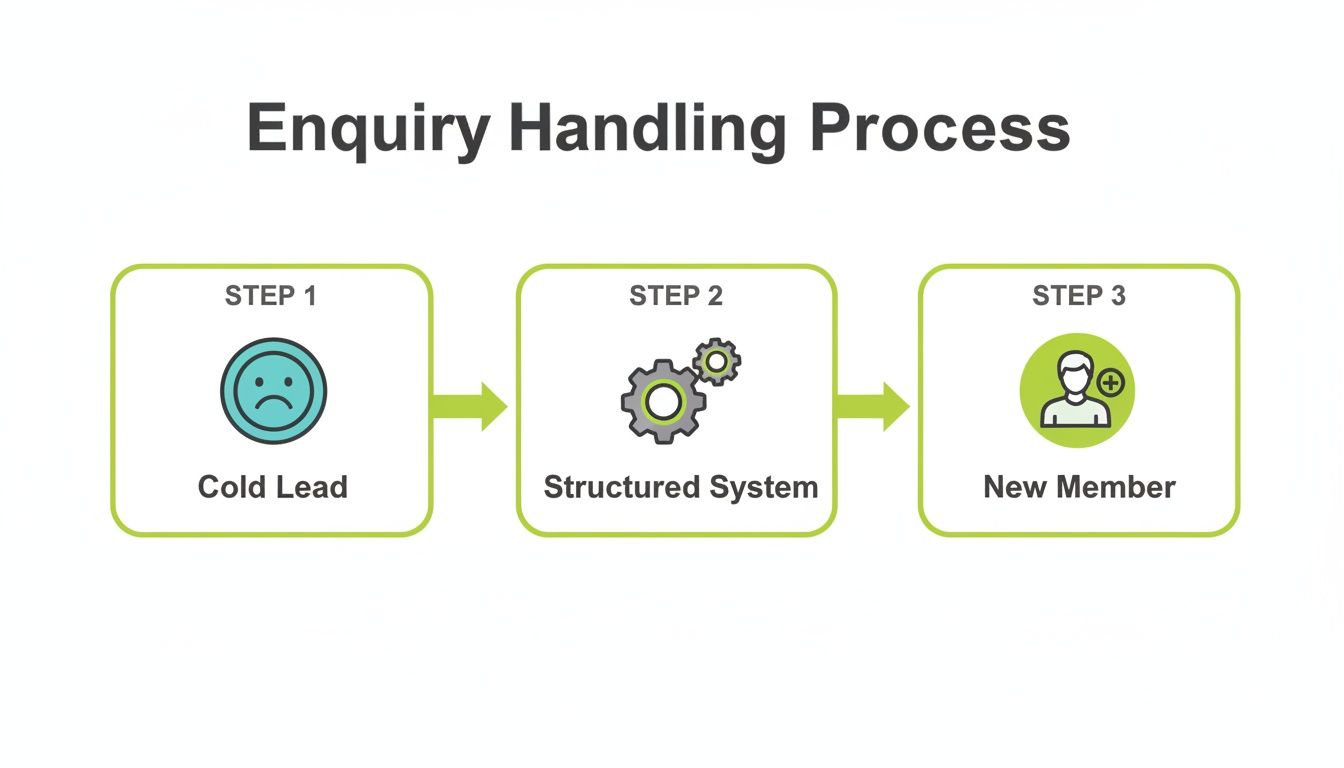
As you can see, the journey from a disconnected prospect to a committed member is clear and logical. The system itself is the critical link that prevents people from falling through the cracks. It is the difference between being reactive and being truly proactive about growth.
From a Late-Night Click to a Club Tour
Let’s put this into a real-world context. Imagine a local golfer browsing online at 10 PM on a Tuesday. They see your club's ad, their interest is piqued, and they fill out your form to get more information. Here is what happens next:
Immediate Engagement: The moment they hit ‘submit,’ our system springs into action. They instantly receive a professionally branded text message and an email. It is not a sales pitch; it is a simple, welcoming note that thanks them and asks a key qualifying question. Something like, "Thanks for your interest in Anytown Golf Club. To help us send the right details, are you looking for a 7-day or 5-day membership?" This provides instant gratification and starts the conversation.
Consistent Nurturing: Over the next few days, the prospect automatically receives a carefully crafted sequence of communications. This is not a blunt email blast. It is a thoughtful journey that might include a short video tour from the head professional, testimonials from current members, and clear details about the specific membership category they are interested in.
The Human Handoff: All this automation has one primary goal: to compel the prospect to book a call or a tour of the club. Once they take that step, the system immediately notifies your membership team. Now, your staff can have a meaningful conversation with a warm, educated lead who has already shown a genuine desire to join.
This entire process keeps your club at the forefront of their mind, building value and rapport long before your team even picks up the phone.
A predictable pipeline removes luck and staff availability from the equation. It systematically guides prospects from initial curiosity to genuine commitment, ensuring every single enquiry gets a prompt, professional, and personal experience.
This is what separates the clubs struggling with inconsistent growth from those enjoying a steady, reliable stream of new members. You move from a position of reacting to enquiries to proactively managing a pipeline of future revenue. We break this methodology down even further in our complete guide to building a modern golf club sales pipeline. By implementing these systems, you are creating a powerful asset that works for your club 24/7, turning your advertising spend into measurable, long-term success.
Designing Membership Offers That Convert in 2026

Having a slick system to manage enquiries is critical, but it can only sell what you have on offer. So, what exactly are you selling? If your club’s growth strategy for 2026 still hangs on a single, one-size-fits-all 7-day membership and reactive price hikes, you are not just behind the times, you are leaving serious money on the table.
Today's golfers simply do not fit into one neat box. Their lives, schedules, and budgets vary. Sticking to a rigid model alienates huge swathes of your potential market. It is time to move away from blanket increases that penalise loyal members and instead build a smarter, tiered membership structure that actually drives growth.
What this really means is creating a ladder of options. You need packages that meet prospects where they are right now, giving them a clear and appealing path towards a deeper commitment to your club.
Moving Beyond the Traditional Model
Let's be honest, talking about membership costs is never easy. Clubs have to cover their rising operational expenses, but simply bumping up fees for everyone is a risky game. In 2026, UK golf clubs are at a crossroads. While subscription costs have understandably risen, the data is telling. Lower handicap golfers (in the 10-20 range) tend to stick around, but the more casual player often walks away because a full membership just does not make sense for their playing habits.
Busy professionals and those with families cannot always get the peak tee times they need, which pushes them toward more flexible pay-and-play options. An insightful analysis on golf club memberships highlights this very trend, which savvy clubs can turn into a major opportunity.
This confirms what we see on the ground every day: a single, high-priced membership is a massive barrier. The answer is not to devalue your club; it is to diversify your offer. By introducing more flexible categories, you attract new types of golfers and, just as importantly, fill your tee sheet during those quiet off-peak times. That is a direct win for your bottom line.
Here are a few categories we have seen work wonders:
- Off-Peak or Twilight Membership: This is a perfect fit for members with flexible work schedules or those who enjoy a late afternoon round. It breathes life into the course on weekdays and afternoons, boosting course use and, crucially, food and beverage sales.
- Flexible Points-Based Membership: This one speaks directly to the time-poor golfer who cannot justify a full subscription. Members buy a bank of credits and use them as they play. It gives them control and a real sense of value for money.
- Pathway or Academy Membership: This is your ideal on-ramp for newcomers or those getting back into the game. Typically, it bundles a set number of rounds with group lessons, creating a welcoming, low-pressure environment. In our experience, well-run golf coaching courses are the secret sauce for a successful pathway programme.
The goal is not just to sell memberships; it is to sell the right membership to the right person. A tiered model creates multiple entry points, making your club more accessible and financially resilient.
The Financial Case for Strategic Tiers
Let us be clear: adopting a flexible membership structure is not about discounting. It is about smart revenue maximisation. We have seen firsthand how clubs that modernise their offerings can completely transform their financial health.
Take a club we worked with, Ravensworth Golf Club. They were struggling to attract a younger demographic who felt priced out. By introducing carefully designed flexible memberships, they opened the doors to a new wave of golfers who previously saw the club as out of reach.
The results were fantastic and rippled through the entire club:
- Increased Overall Membership: They added dozens of new members without stealing from their core 7-day base.
- Boosted Ancillary Revenue: These new faces quickly became regulars in the bar, restaurant, and pro shop, adding a significant new income stream.
- A Clear Upgrade Path: Best of all, a good portion of these flexible members, having fallen in love with the club, eventually upgraded to full membership.
Ravensworth turned its fortunes around by aligning its product with the modern golfer's lifestyle. For your club, rethinking your membership packages is not just a marketing exercise, it is one of the most fundamental business decisions you will make to grow your numbers in 2026 and beyond.
Turning Members into Lifelong Advocates: The Retention Game
Getting a new member to sign on the dotted line feels like crossing the finish line. But really, it is just the starting gun. The hard work you put into attracting new faces must be mirrored by an experience that makes them want to plant their roots and stay for years. True, sustainable growth is not about a revolving door of new members; it is built on a foundation of long-term loyalty.
After all, it is a simple truth of business that keeping a current member is far less expensive than recruiting a new one. A genuinely engaged membership base does not just reduce churn, it builds a community of advocates who become your most powerful marketing asset. In 2026, the clubs that truly prosper will be those who master the art of the member experience.
Stop Guessing, Start Listening
The first, and most critical, step to improving the member experience is to understand what your members actually want. All too often, club committees make decisions behind closed doors, assuming they have their finger on the pulse. This frequently leads to expensive, misguided projects that do little for member satisfaction, while small, everyday frustrations are left to fester.
The only way to avoid this trap is to create a solid system for gathering feedback. This is not a one-off task; it is an ongoing conversation.
- New Member Check-ins: Do not wait a year to ask how things are going. Touch base with new members after their first three months. You will get priceless insights into your onboarding process and discover any early issues before they become reasons to leave.
- Annual Satisfaction Surveys: A well-designed annual survey is your chance to benchmark satisfaction across every facet of the club, from the condition of the greens to the quality of the coffee. This data helps you spot trends and prioritise investment.
- Meaningful Exit Interviews: When a member does decide to leave, treat it as a crucial learning opportunity. The goal is not a last-ditch attempt to change their mind, but to gather candid feedback that could prevent the next person from leaving for the same reason.
This feedback is gold. It allows you to make decisions that show you are paying attention, whether that means a simple tweak to the online booking system or a major rethink of your capital spending plans.
More Than Just a Golf Course
Let's be honest: a golf club is so much more than just a place to play 18 holes. At its best, it is a social hub, a second home. The most successful and resilient clubs are the ones that actively cultivate a real sense of community.
This does not happen by magic. It requires a deliberate strategy to create opportunities for members to connect, socialise, and build friendships that extend beyond the fairway. Think about your events calendar. Does it cater for everyone? Family fun days, gin-tasting evenings, and themed supper clubs can transform the clubhouse into a destination, reinforcing the value of membership far beyond simple access to the tee sheet.
Your club’s culture is its most powerful retention tool. When members feel they are part of a community, their subscription becomes a badge of belonging, not just a transaction.
Retention is Your Best Financial Strategy
The critical importance of retention comes into sharp focus when you look at the financial pressures facing UK golf clubs today. With costs rising, the temptation to apply a broad-brush price increase is strong, but it is a risky move. For 2026, there is no question that retention is the smartest path to growth. The numbers prove it is far cheaper to keep your existing members happy than to find replacements, especially as resignation rates climb due to cost and inflexibility.
A blanket 36% price hike, as one club painfully discovered for its 2025 renewals, can be catastrophic. It is a sure-fire way to alienate loyal, long-standing members and price out the younger generation you need for the future. You can explore a better alternative to blanket golf membership price increases to see how a more nuanced approach can protect revenue without alienating your core.
By focusing on the experience and the value you provide, you build the kind of loyalty that makes members view their subscription as a worthwhile investment, not just another bill. That loyalty is your ultimate defence against churn and the only true foundation for a thriving club.
Measuring the Metrics That Actually Matter for Growth

There is an old saying in business: what gets measured gets managed. It is a bit of a cliché, but when it comes to golf club membership, it is absolutely true. Too many clubs are still flying blind, making decisions based on guesswork or, worse, on metrics that look good in a report but do nothing for the bottom line.
For years, we have seen committees presented with charts showing website visits, social media 'likes', and email open rates. These are vanity metrics. While they create a buzz of activity, they do not tell you how to actually increase your membership numbers in 2026. It is the marketing equivalent of a beautiful practice swing that results in a topped shot right off the first tee.
The real questions we need to be asking are far more direct. How much does it cost us to get a new enquiry? And how many of those enquiries ever become dues-paying members?
The KPIs That Build a Predictable Pipeline
A robust, modern growth strategy is built on a handful of Key Performance Indicators (KPIs). These are the numbers that connect your marketing budget directly to your membership revenue, giving you a brutally honest look at what is working and what is not.
With a properly structured system, these are the only metrics you should be obsessing over:
- Cost Per Enquiry (CPE): This is your total ad spend divided by the number of enquiries you receive. It tells you precisely how much you are paying for each person who raises their hand.
- Cost Per Qualified Lead (CPQL): Let's be honest, not all enquiries are good ones. This metric tracks the cost to get a lead who is genuinely a good fit for membership, filtering out the tyre-kickers.
- Enquiry-to-Visit Conversion Rate: What percentage of those qualified leads actually book and show up for a tour of the club? This is a direct reflection of how effective your follow-up process is.
- Visit-to-Member Conversion Rate: The moment of truth. This is the percentage of prospects who, after visiting your club, decide to join. It is the ultimate test of your in-person experience and sales conversation.
Trying to track all this manually is a nightmare. It means digging through spreadsheets, piecing together reports, and making educated guesses. It is slow, inefficient, and often inaccurate, which is why most clubs simply do not do it.
This is exactly where a central Customer Relationship Management (CRM) system becomes your most valuable asset.
Using a CRM to Provide Total Clarity
Think of a CRM as the command centre for your entire growth engine, not just a digital address book. It captures every single enquiry, no matter the source, and automatically tracks its journey through your sales pipeline.
By integrating your advertising platforms with a CRM, you get a single, transparent dashboard showing the entire member journey, from the first ad click to the final handshake. There is nowhere for wasted spend or missed opportunities to hide.
This level of clarity completely changes how you make decisions. For instance, you might see that a Facebook campaign has a brilliant Cost Per Enquiry but a terrible Enquiry-to-Visit Conversion Rate. You now know that ad is attracting the wrong crowd, so you can pause it and shift that budget to a channel delivering high-quality, convertible leads.
This data-led approach lets you make constant, small improvements that add up. You can A/B test ad creative, fine-tune your automated follow-up messages, and tweak your tour process, all while measuring the direct impact on your most important numbers. It takes the guesswork and emotion out of the equation and replaces it with cold, hard data.
This process is fundamental to calculating a genuine return on investment, a topic we dive into when looking at the real ROI of golf club marketing. In the end, this is how you turn your membership pipeline from an unpredictable trickle into a powerful, reliable engine for growth.
Answering Your Toughest Membership Growth Questions
Even with a perfect plan laid out, we find that club managers and committee members always have a few practical questions. It is only natural. Drawing from our experience working directly with clubs across the UK, here are the frank answers to the questions that come up time and time again.
Our Club Is Run by Volunteers with Limited Time. Is This System Too Complex?
This is probably the question we hear most, especially from committee-run clubs where everyone’s time is stretched thin. It's a fair concern, but the truth is, a properly designed growth system does the exact opposite of adding complexity, it is designed specifically to reduce the administrative headache.
Think of all the repetitive, time-consuming tasks that fall through the cracks. Manually logging enquiries, figuring out who to call back, trying to remember what was discussed last week... a smart system handles all of that for you, instantly and without fail.
Our job as a growth partner is to take on all the technical heavy lifting: the setup, the implementation, and the day-to-day management. This frees up your volunteers to focus on what they do best and what matters most, having real conversations with genuinely interested people and showing them around your fantastic club. It gives them their time back.
We’re Worried About the Cost. Is This System Worth the Investment?
This one gets right to the point. The key here is to shift your thinking from ‘cost’ to ‘investment’. Spending a few hundred pounds on a one-off print advert or boosting a random social media post is a cost, you spend the money and simply hope for the best, with no real way to measure if it worked.
An investment in a structured growth system is entirely different. It is about creating predictable, measurable revenue. Because every pound is tracked from the ad click all the way to a new member's first subscription payment, you can calculate a precise Return on Investment (ROI).
The clubs we partner with know almost to the pound what it costs to acquire a new member. This figure is consistently a tiny fraction of the first year's membership fee, which makes the financial case crystal clear. The real question is not "Can we afford this system?" but rather, "How much potential revenue are we losing every month from enquiries that get a slow reply, or worse, no follow-up at all?"
Will Automation Make Our Club Feel Impersonal and Corporate?
It’s a valid worry, but when done right, automation actually enhances the personal touch, it does not replace it.
Picture this: a prospective member sends an enquiry through your website at 10 PM on a Sunday. Without a system, they get silence until Monday morning, if they are lucky. With a system, they immediately receive a polite, professional text message or email. It confirms you have received their enquiry, thanks them for their interest, and lets them know when to expect a personal call. Which one feels more impressive?
The whole point of the initial automation is to start a conversation and be helpful. The automated messages are carefully designed to guide that person towards a genuine, one-to-one interaction, like a phone call with the club manager or a personal tour of the course. It is about using technology to be consistently professional from the very first minute, building trust and ensuring your staff are talking to warm, engaged people who are already impressed.
We Already Get a Good Number of Enquiries. Why Do We Need This?
This might be the most important question of all, because it gets to the heart of a huge, often invisible, problem for many successful clubs. Having a steady flow of enquiries is fantastic, but it can mask an enormous amount of missed opportunity.
If you do not have a system, you are operating with critical blind spots.
- How many enquiries wait more than 24 hours for a response? (We know from data this dramatically cuts your chances of conversion.)
- How many prospects are followed up with just once before being forgotten?
- Of the people who tour the club but do not join on the day, what percentage are ever contacted again?
A structured system is built to plug these expensive leaks. It guarantees every single enquiry is handled instantly, nurtured professionally, and followed up with until a decision is made. For a club that already generates interest, this is not about adding a few members here and there. It is about unlocking a significant and predictable uplift in your conversion rate, turning that existing interest into a powerful engine for growth.
At GolfRep, we specialise in building these predictable growth systems for clubs across the UK. If you're ready to stop guessing and start building a reliable pipeline of new members, we should talk.
Book a no-obligation discovery call with our team today and let's explore how we can help your club achieve its growth targets for 2026 and beyond. Visit us at https://www.golfrep.co.
Ready to tap into our proven growth system?