Golf Club Sponsorship Packages: What UK Clubs Charge
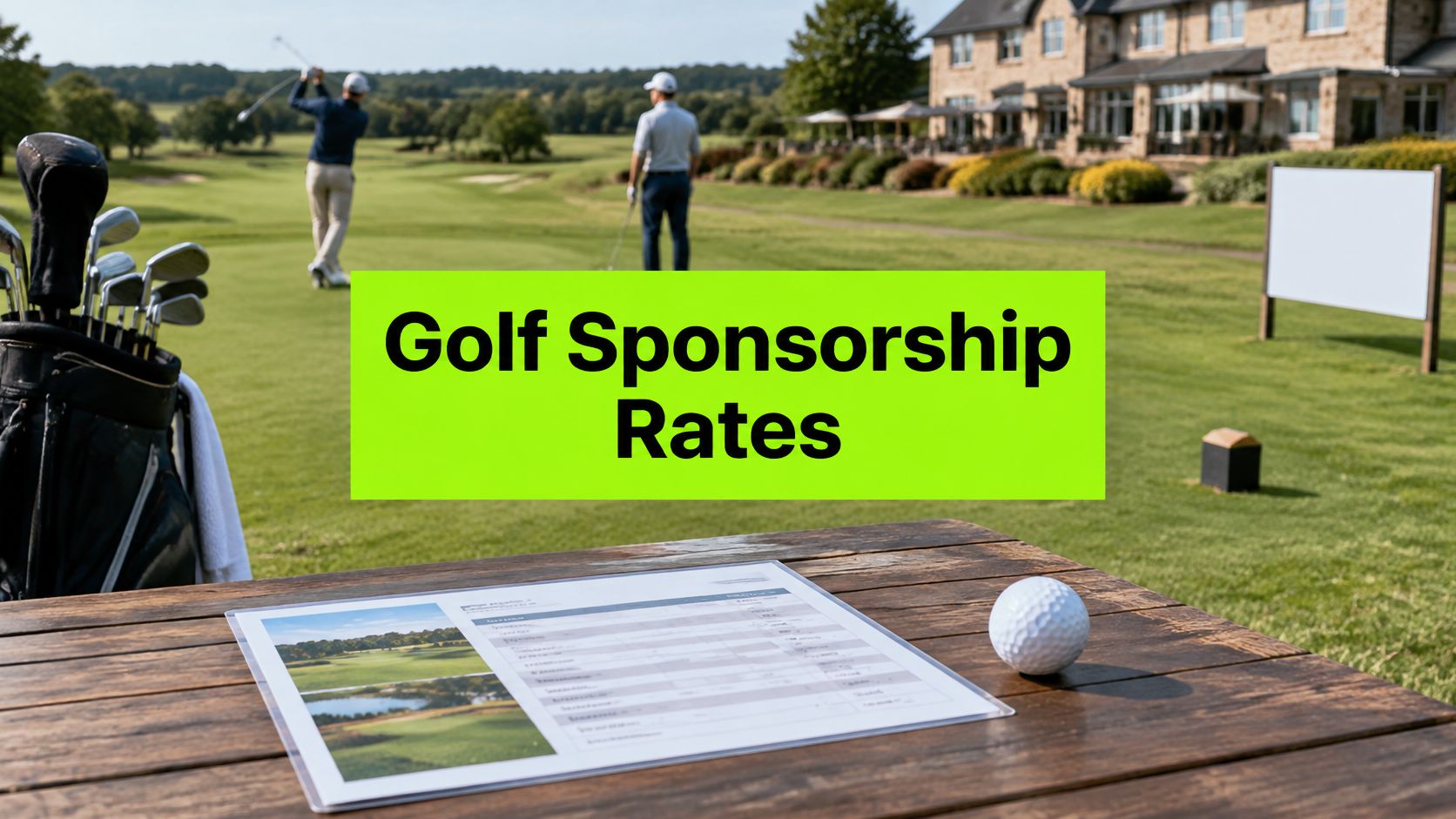
Your committee is reviewing the sponsorship board beside the first tee. Someone thinks the club should charge more, someone else knows a local business that might take it, and nobody is quite sure what the current sponsor receives beyond the sign.
That's the commercial problem to solve before printing a new rate card. At GolfRep, our view is that golf club sponsorship packages should be priced bundles of visibility, access and accountable delivery, not a collection of advertising spaces with an arbitrary fee attached. A club needs to know what it can sell, what it costs to deliver and what evidence will make a responsible local business renew.
Published Sponsorship Prices at UK Golf Clubs
What do other clubs charge? It's usually the committee's first question, but the useful comparison is price against rights and benefits, rather than price alone.
Published UK golf club sponsorship price ranges
| Club | Published price range | What the range covers |
|---|---|---|
| Driffield Golf Club | £325 to £1,975 + VAT | Entry tee sign and clubhouse-TV advertising; top tier adds unlimited golf for two named people, four four-ball vouchers and scorecard sponsorship |
| Buckingham Golf Club (2024) | £1,000 to £2,000 + VAT | Tee sponsorship board, website exposure, digital-noticeboard visibility and social-media mentions in each tier |
| Downfield Golf Club (2024) | £1,250 to £4,995 | Silver to Premier tiers combining tee sponsorship, company cardholders, corporate golf days and annual playing rounds |
| Blyth Golf Club | £500 to £1,995 + VAT | Hole partnership at £500, limited to 18 partners; practice-area sponsorship at £1,500; corporate golf with named membership at £1,995 |
| Exeter Golf and Country Club | From £1,500 + VAT | Limited three-year hole package with prominent tee sign, business link on website, one annual four-ball and sponsors' launch event |
| Dunham Forest Golf & Country Club (2025) | £1,260 + VAT | Twelve-month hole sponsorship with tee-marker artwork, eight rounds, two buggies per four-ball and clubhouse use |
| Darlington Golf Club | £299 to £499 starting prices | Driving-range sponsorship from £299, hole sponsorship from £399, external three-metre by one-metre banner from £499 |
| St Catherine's Golf Society (2026) | £75 to £5,000 | Hole sponsorship with banner at £75; hole-plus-banner and meal-table leaflets at £150; Gold at £2,500; Platinum headline at £5,000 across seven events |
Read the inclusions before comparing the fee
These published examples include schedules from 2024 to 2026, not a single contemporaneous market survey. Many prices exclude VAT, and an event banner isn't equivalent to an annual course partnership.
At the accessible end, a business buys a defined placement. That's straightforward to explain and relatively easy for the club to fulfil, provided artwork, installation and replacement responsibilities are clear.
Buckingham's structure demonstrates how a package can combine a tee board with website and digital exposure throughout its tiers. The commercial question then becomes what distinguishes the higher tier, rather than whether every sponsor gets a logo online.
Downfield's corporate structure illustrates a different proposition: the sponsor also buys opportunities to play and host people. Those benefits deserve proper costing because they use tee-sheet capacity and staff time.
Pricing discipline: Use another club's rate as a reference point, not as permission to copy its price.
Your club may have a stronger local business community but less visitor traffic, or excellent corporate access but limited premium signage. These rows are rate-card reference points, not a market average. The fee you can defend depends on your audience, the scarcity of the rights and whether businesses nearby value them.
What Sponsors Buy and How to Prove It
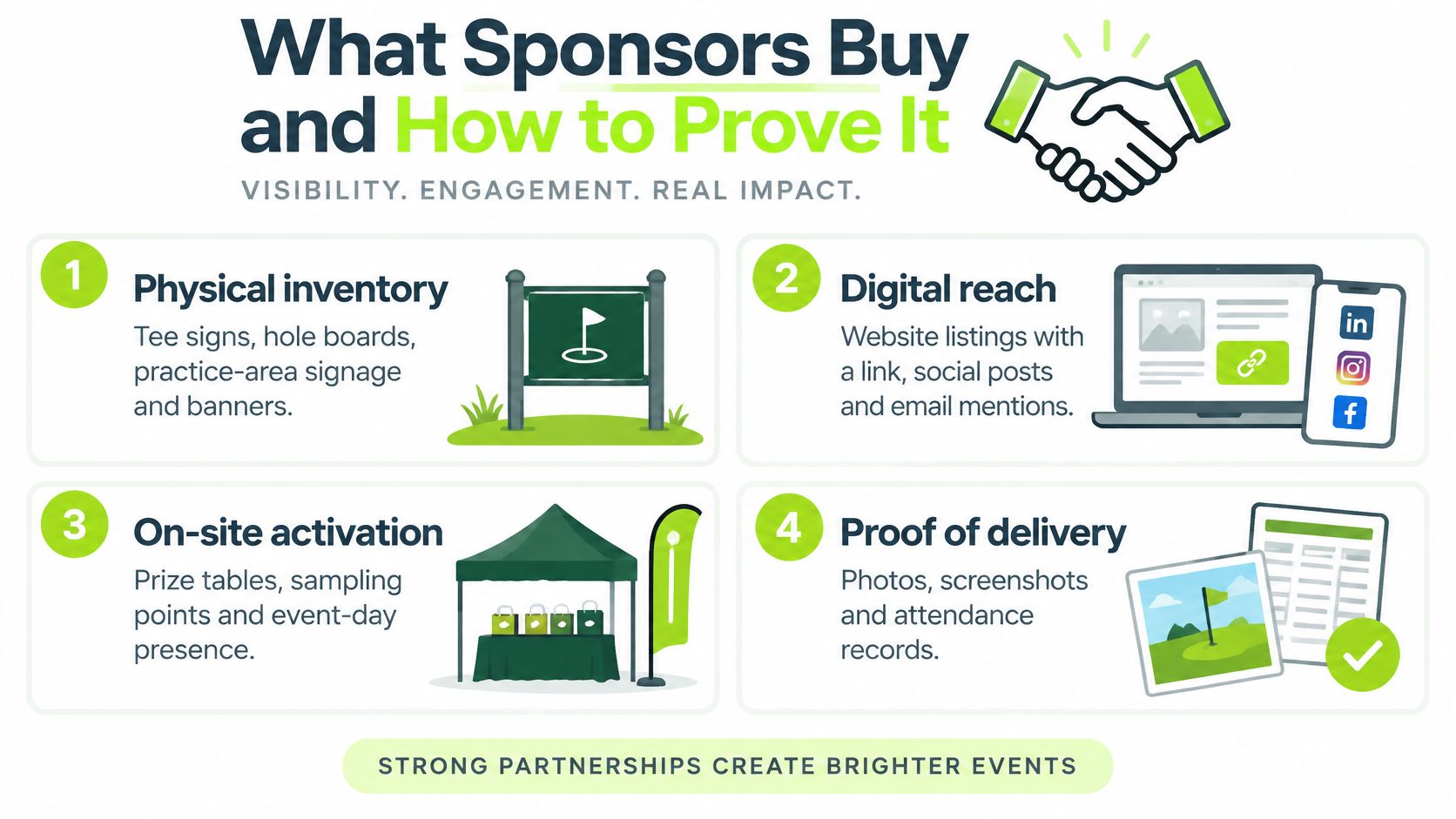
Break a sponsorship proposal into components the buyer can recognise:
- Physical inventory: Tee signs, hole boards, practice-area signage and banners.
- Digital reach: Linked website listings, social posts and agreed email mentions.
- Hospitality and access: Playing rounds, four-ball vouchers, buggies and meeting space.
- Event rights: Competition naming, scorecard sponsorship and agreed on-site activation.
The distinction matters because each component serves a different business objective. A builder's merchant might value repeated local recognition, while an accountancy practice may care more about entertaining existing clients.
A package needs a commercial purpose
Dunham Forest Golf & Country Club's published 2025 package priced twelve-month hole sponsorship at £1,260 plus VAT, including tee-marker artwork, a linked website listing, eight complimentary rounds, two buggies for each four-ball, clubhouse use and social-media promotion. Its stated audience included members, regular visitors and more than 5,000 corporate and charity golf guests.
That's a bundled proposition, not a sign rental. However, an audience statement isn't proof that everyone noticed the sponsor, and complimentary golf isn't valuable to a business that never redeems it.
Before signing, ask the sponsor to choose its primary objective: recognition, customer response, client hospitality or business relationships. Then agree what the club can measure and what the sponsor must report itself.
Sponsor measures and how the club captures them
| Measure | What it tells the sponsor | How the club captures it |
|---|---|---|
| QR code scans | Interest in the sponsor's offer from the tee sign or noticeboard | Unique QR code printed for each sponsor |
| Website referrals | Visits to the sponsor's listing and onward clicks | Dedicated landing page and tracked outbound link per sponsor |
| Promotion code redemptions | Response to a club-specific offer | Unique discount or booking code per sponsor |
| Voucher redemptions | Use of hospitality benefits such as four-ball vouchers | Voucher register reviewed each quarter |
| Enquiries received | Direct contact generated by the sponsorship | Sponsor-specific email address or phone line, with agreed logging in the club's CRM |
| Booked visits | Golfers who moved from interest to play | Booking-system tag linked to the sponsor's code |
Separate delivery from outcomes
Proof of delivery includes dated sign photographs, screenshots of published posts and confirmation that promised hospitality was available. Commercial outcomes include enquiries, hosted guests and attributable bookings.
Don't combine these into a single inflated impression total. A QR scan isn't a sale, and a website click doesn't establish that a golfer became a customer.
Send a quarterly summary showing contracted benefits, delivered benefits, response measures and outstanding actions. For commercial enquiries handled by the sponsor, agree an aggregate reporting process without requesting unnecessary customer details.
Our guide to measuring marketing effectiveness provides a useful basis for separating activity from results. The same discipline applies here: report what you know, label what you estimate and don't promise revenue you can't attribute.
What Sets Package Prices and Contract Length
Exclusivity, location, prominence and named-member benefits are distinct reasons to charge more. A sponsor paying for category exclusivity buys protection from competing brands, while a sponsor buying a practice-area position pays for a particular setting and pattern of exposure.
Blyth Golf Club's sponsorship opportunities illustrate the distinction: its standard hole partnership is £500 plus VAT, limited to 18 partners, while practice-area sponsorship is £1,500 plus VAT and its £1,995 plus VAT corporate-golf package includes a named full membership and competition eligibility.
Don't treat those benefits as interchangeable upgrades. Named membership has playing and administration implications; premium signage occupies scarce physical inventory; category exclusivity restricts whom the club can sell to next.
Make longer commitments comparable
A multi-year agreement can justify a lower annual rate because the club gains committed income and avoids repeatedly selling the same asset. The discount must still leave enough income to maintain signage and fulfil benefits.
The published term structures at Bangor Golf Club and Wilton Golf Club show the annual comparison below.
Annual rate by contract length
| Club and package | One-year rate | Two-year rate | Three-year rate |
|---|---|---|---|
| Bangor Golf Club, holes 1 or 10 | £600 a year, excluding VAT | £500 a year, excluding VAT | £400 a year, excluding VAT |
| Bangor Golf Club, other holes | £400 a year, excluding VAT | £300 a year, excluding VAT | £250 a year, excluding VAT |
| Wilton Golf Club, Red Flag | £350 + VAT | £630 + VAT total, £315 a year | Not published in the cited schedule |
| Wilton Golf Club, Yellow Flag | £425 + VAT | £765 + VAT total, £382.50 a year | Not published in the cited schedule |
| Wilton Golf Club, White Flag | £475 + VAT | £855 + VAT total, £427.50 a year | Not published in the cited schedule |
Wilton's Red Flag structure therefore gives a £70 saving across the two-year commitment. Make that saving explicit in a proposal rather than expecting a sponsor to calculate it.
Model available income, not just the headline fee
Using the Blyth inventory and rate above as a capacity calculation, 18 partners at £500 would produce £9,000 before VAT and any term discount. That's theoretical full occupancy, not a statement of the club's actual sponsorship revenue.
Your committee should distinguish available inventory, contracted revenue, delivery cost and renewal performance. Deduct artwork, installation, servicing and the opportunity cost of hospitality before deciding a package is profitable.
Offer a longer-term discount only when the club can confidently deliver the contracted benefits throughout the agreement.
Reserve premium holes and membership rights for clearly differentiated tiers. Otherwise, a generous entry package can leave the club with little meaningful reason for a sponsor to upgrade.
Packaging Access for Non-Member Golfers
England Golf's 2025 figures, reported by Golf Business News, show 72,921 iGolf users, up more than 34% year on year, while iPlay registrations rose from 5,738 to 12,562. The same report records 11.83 million World Handicap System scores submitted in England, up 16% year on year.
These aren't your club's audience figures. They do, however, give a clear reason not to build sponsorship solely around existing members.
Sell a relevant activity, not a database
A measurable participation programme can be a stronger proposition than another tee sign, particularly when the sponsor wants a specific local audience. Start with an activity the club already delivers well, then attach appropriate sponsorship rights.
- Independent golfers: Offer recognition within a visitor series or independent-golfer event. Measure attributed bookings and repeat attendance, distinguishing people from rounds.
- Beginners: A programme sponsor could receive an approved welcome-email mention with a tracked offer. Report trial-round bookings and attendance rather than email sends alone.
- Juniors: Package support around coaching equipment or a development programme, with communication directed appropriately through parents or guardians. Report programme participation without identifying children.
- Women: Sponsor a relevant coaching series or playing event, developed around participants' interests rather than assumptions about purchasing behaviour. Track registrations, attendance and return visits.
- Hotel guests: Where accommodation forms part of the business, connect an approved sponsor offer to the golf-break experience. Measure code use and associated golf bookings.
- Existing members: Build an optional sponsor-supported business event or member benefit. Report uptake and volunteered introductions, not a claim that every member engaged.
Keep access permission-based
Audience access means agreed opportunities to engage, not unrestricted access to personal information. Use anonymised, aggregated reporting by default, check the lawful basis for communications and obtain appropriate consent before sharing contact details.
A club should never sell its member database as an automatic package inclusion. Nor should it describe anonymised reporting as permission for a sponsor to contact participants independently.
Our perspective on golf for business is useful when matching corporate relationships to actual golfing activity. Give sponsors a clear booking trail and an honest explanation of participation, and they'll have a more concrete basis for deciding whether to renew.
Brand Safety and Contract Terms to Put in Writing
A sponsor's fee covers visibility and access. It does not buy the club's judgement. The committee should decide which categories and businesses fit the club before staff agree wording, produce artwork or accept payment. A local estate agent, building firm or financial adviser may be a strong fit. A payday lender or unlicensed gambling operator is a different decision.
The Advertising Standards Authority's sponsorship guidance distinguishes sponsorship arrangements themselves, which may sit outside parts of the CAP Code, from advertising referring to sponsorship, which can fall within its remit. Website material, social posts, posters and press advertising still need accurate, non-misleading claims. Club approval should cover the sponsor's use of the club name as well as the artwork on the tee.

Give the committee a usable approval checklist
Regulated categories need more proof. Gambling operators must show licensing and source-of-funds checks before a sponsorship is considered. Alcohol, financial services and health claims deserve similar care. A sponsor in a regulated category should expect to provide evidence, not just a logo file.
Junior safeguarding deserves equal attention wherever sponsorship appears around junior activity. Junior membership has grown strongly in recent years, which reinforces the need to consider who will encounter sponsor material around junior activity. Apply the same standard to coaching, events, changing areas and photography. If an activation puts sponsor material in front of children, the club needs a written reason to approve it.
Put these provisions into the agreement, with legal review where appropriate:
- Sponsor screening criteria: Record the contracting business, its trading activity and the checks needed for its category. Refuse businesses that cannot satisfy the club's suitability requirements.
- Approval rights: Require club approval of wording, artwork and subsequent changes before publication. State that payment doesn't override these rights.
- Category exclusivity limits: Define the protected category and where protection applies. An estate agency partnership shouldn't accidentally exclude every property-related business.
- Claims substantiation: Require the sponsor to support promotional claims and notify the club when an offer changes or expires.
- Termination and removal: Address non-payment, unlawful content, material reputational concerns and failure to supply approved assets. Specify how removal and any refund dispute will be handled.
- Junior safeguarding: Define prohibited placements and activities around junior events, including sampling, photography and direct contact.
- Approved asset library: Keep authorised logos, copy and artwork in a shared folder, with an identifiable version and approval record.
Name the person who can say no
Appoint a named approver and a deputy before the first sponsor signs. The professional shop, office and committee should all know where an unusual request goes.
Governance is part of the offer: A responsible local brand should be able to trust the club's standards as well as its audience.
Good controls protect both parties from an outdated claim, an inappropriate placement or a competing sponsor appearing where exclusivity was promised. That discipline also makes the package easier to sell to a responsible local brand.
How to Build a Package Your Committee Can Approve
The committee needs a rate card it can authorise and an operating plan staff can deliver. Prepare both together, so an attractive proposal doesn't create obligations that the golf team, office or clubhouse cannot support.
Turn inventory into an approved offer
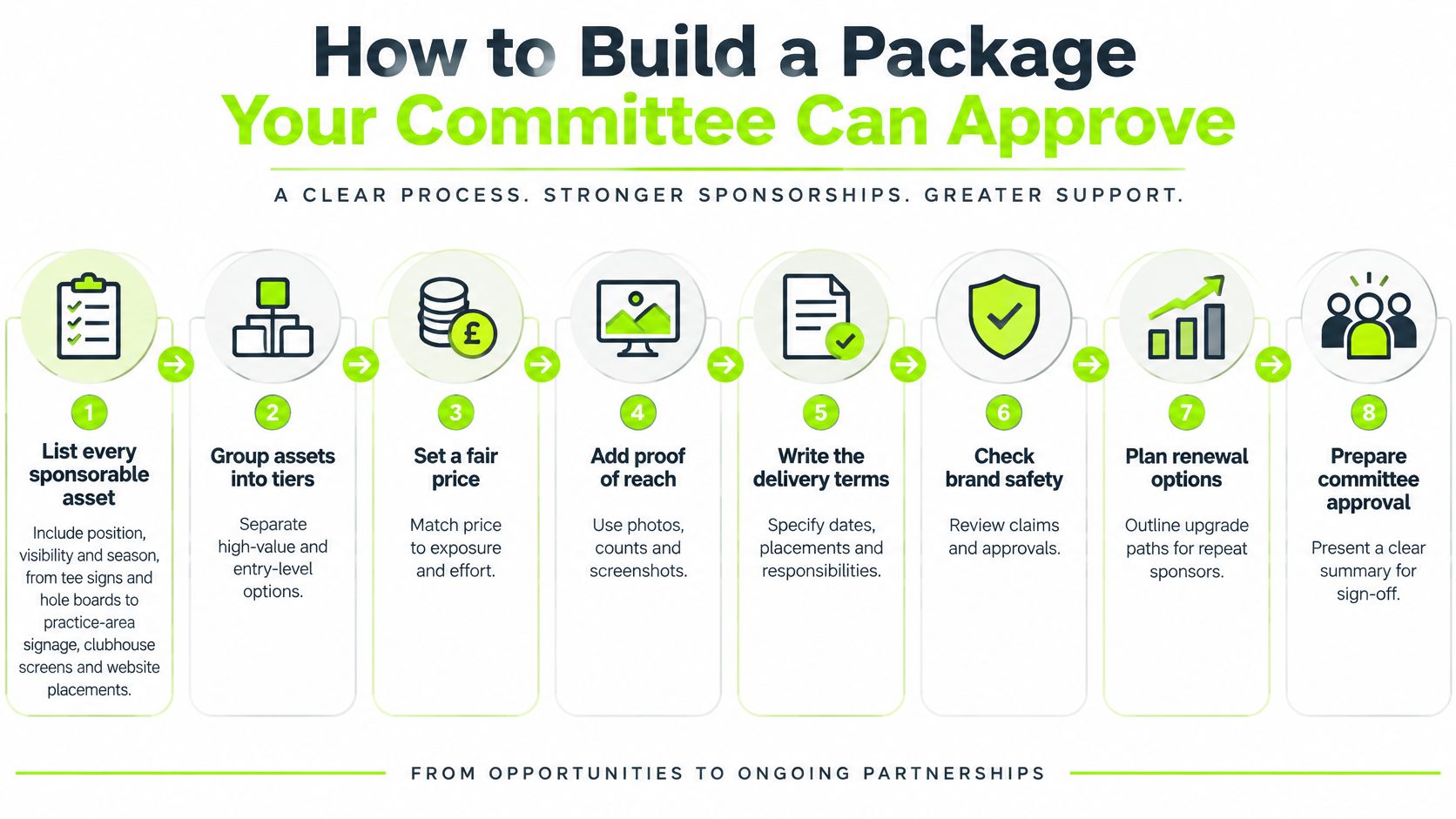
List every sponsorable asset. Record position, visibility, available season and any restrictions for tee signs, hole boards, practice areas, clubhouse screens and website placements. Check who already controls each right before offering it.
Name the asset and its starting price. Specify dimensions and production responsibilities, as Darlington Golf Club does with its external three-metre by one-metre banner from £499. A named placement is easier to assess than an undefined promise of course exposure.
Separate visibility from added-value benefits. Show design support, playing vouchers, hospitality and event rights as identifiable inclusions. Cost these internally, even when the sponsor sees a bundled fee.
Build three distinct tiers. Give each a commercial purpose, such as local visibility, client hospitality or a broader partnership. Set an exclusivity limit that the club can enforce.
Specify the commitment incentive. If offering a term discount, show the total contract price, annual equivalent and saving in pounds. Include renewal dates and any price-review mechanism rather than leaving future charges open to interpretation.
Assign reporting before launch. Set up each sponsor's QR code, promotional code and tracked link, then allocate responsibility for the quarterly summary. Test the customer journey on a phone before printing signs.
Apply screening and approval rules. Confirm the decision-maker, approved artwork and placement restrictions before signature. Keep an agreement and delivery checklist together in the club's own records.
Review the first season commercially. Compare enquiries, voucher use, delivery effort and renewals against the package's intended purpose. Ask sponsors which benefits they used and which they would remove.
A clear committee marketing approval process helps prevent informal promises from becoming uncosted package additions. Present the committee with decisions to approve, not a long list of promotional possibilities.
A hypothetical inventory calculation
Say an 18-hole club sells 12 hole partnerships at £500 plus VAT, producing £6,000, and two practice-area sponsorships at £1,500 plus VAT, producing £3,000. In this hypothetical example, contracted base inventory generates £9,000 a year before VAT and term discounts, not profit.
The committee should confirm demand for the practice-area slots before adding a premium fourth tier. It should also check that the same playing benefits haven't been promised across overlapping packages.
If a tier doesn't sell in two consecutive seasons, change its content before automatically reducing its price.
That's a management decision rule, not an industry benchmark. Diagnose whether buyers dislike the location, the benefits, the commitment or the proposition itself, then change the relevant element.
Pitching Your Package to Local Businesses
Start with an approved single-page proposal: the three tiers, asset prices with VAT clearly shown, commitment discounts, reporting arrangements and screening rule. Staff should be able to explain the offer without seeking permission for every conversation.
Build the prospect list by category before filling it with names. Builders' merchants, accountants, car dealers, physiotherapists, estate agents and independent hotels are useful starting points, but relevance matters more than the category label.
Match the proposal to the buyer
Prioritise businesses whose customers already play at the club or spend time nearby. For a broader perspective on finding complementary partners, the business development insights from EmailScout offer a useful resource alongside your local business knowledge.
Each approach should contain:
- Audience fit: A plain summary of whom the club reaches, using the club's own records.
- Recommended package: The tier that suits the business's objective, rather than the most expensive option.
- Evidence example: A sample tracked offer and the report the sponsor would receive.
- Decision date: A reasonable date tied to installation or event planning, not artificial urgency.
Keep the sales record useful
As a practical working cadence, follow up once after two weeks, then move on unless the prospect asks for further discussion. Record enquiries, decisions, reasons for declining and renewal dates in the club's own system.
That gives the committee something useful to assess: which categories show interest, which packages sell and where the offer needs adjusting. GolfRep's first conversation is an open, strategic discussion about the club's setup, goals and challenges, not a sales pitch.
This month, write down the three tiers, the reporting method and the person who approves sponsor wording. Bring that single-page rate card to the committee before the first local conversation.
We provide the system, strategy and partnership to help golf clubs improve acquisition, conversion, retention and revenue growth. If you'd like to connect sponsorship sales to a clearer commercial process, visit GolfRep to discuss your current setup and what a workable growth system could look like.
Ready to tap into our proven growth system?