A Guide to Golf Society Lead Generation

It's a common story we hear from golf clubs. The enquiries for society days are coming in, but the number of confirmed bookings just isn't matching up. So what is going wrong?
Many clubs believe the answer is to chase even more leads, often by slashing prices or casting a wider marketing net. The practical reality is that this usually just pours more water into a leaky bucket. The real problem isn't a lack of interest; it’s a broken internal process for handling the interest you already have. The main challenge is not generating enquiries, but handling, responding to, and converting them effectively.
Why Your Golf Society Lead Generation Is Failing
The breakdown in most society sales funnels happens after the organiser clicks 'submit'. The challenge isn’t attracting enquiries; it's the operational bottleneck created by manual processes, slow response times, and a complete lack of visibility into your sales pipeline.
The Hidden Costs of a Manual Process
When a society organiser sends an enquiry, they are at their peak level of interest. They are ready to book. But a slow, disorganised response gives them plenty of time to get a quote from the club down the road.
Every hour you delay significantly lowers your chance of converting that lead.
Think about the all-too-common manual approach:
- An enquiry lands in a general inbox, often unchecked for hours.
- A staff member has to hunt through a paper diary or a messy spreadsheet to check for availability.
- A reply is finally cobbled together and sent, sometimes a full day after the organiser reached out.
- If the organiser doesn't reply, the lead is often forgotten, with no structured follow-up in place.
This process is riddled with friction. It doesn't just cost you a single booking; it damages your club’s reputation for professionalism and leaves a huge amount of revenue on the table.
The core issue for most golf clubs is not lead generation but lead management. Success comes from building a predictable pipeline with systems that ensure every opportunity is captured, tracked, and converted efficiently.
Let’s look at how these two approaches stack up. The difference between a manual, reactive workflow and a modern, system-driven one is stark.
Manual VS System-Driven Lead Management
| Metric | Manual Approach (The Common Method) | System-Driven Approach (The GolfRep Method) |
|---|---|---|
| Response Time | Hours or even days. Dependent on staff availability. | Instant automated acknowledgement. First human reply within 1-2 hours. |
| Lead Tracking | Spreadsheets, email inboxes, or paper notes. Prone to errors and omissions. | Centralised in a CRM system. Complete visibility of every lead's status. |
| Follow-Up | Inconsistent and often forgotten. Relies on individual memory. | Automated and scheduled follow-up sequences. No lead is ever left behind. |
| Data & Reporting | Guesswork. No clear data on conversion rates or pipeline value. | Real-time dashboards showing conversion rates, response times, and revenue forecasts. |
| Organiser Experience | Slow, frustrating, and unprofessional. | Seamless, professional, and impressive from the very first interaction. |
As the table shows, a system-driven approach isn't just a minor improvement; it fundamentally changes your club's ability to turn interest into income.
Shifting from 'More Leads' to 'Better Systems'
Truly effective society booking growth requires a fundamental shift in mindset. Stop chasing more enquiries and start implementing a structured system for handling the ones you get.
This means obsessing over enquiry response time, demanding complete lead visibility, and establishing watertight conversion tracking. A system-driven strategy uses smart automation and a robust Customer Relationship Management (CRM) platform to make this happen.
From the moment an organiser shows interest, they are guided through a seamless, professional process that maximises your chance of winning their business.
This playbook will not waste your time with generic marketing theory. Instead, we are giving you a practical, step-by-step guide to building a predictable revenue pipeline for your society bookings. We will show you exactly how to move from a chaotic, manual workflow to a proactive, system-driven strategy that ensures no opportunity is ever missed.
Attracting High-Value Society Organisers
Once you have a solid, system-driven process in place, you can stop being reactive and start confidently hunting for the right kind of society enquiries. Just casting a wide net and hoping for the best is a sure way to bury your staff in low-quality leads that go nowhere. The aim isn't just to fill the diary; it's to fill it profitably.
Let's be honest, the person organising a corporate golf day or a large charity event has a completely different set of priorities than someone booking a casual four-ball. They are not just shopping for the cheapest green fee. They are looking for a smooth, professional experience from their first enquiry right through to the prize-giving. Your marketing has to show them you understand that.
Go Beyond the Usual Social Media Posts
Too many clubs think society marketing begins and ends with the occasional pretty picture of the 18th green on Facebook. While that has its place, it is not a strategy for reaching the decision-makers who book high-value events. You need to get smarter about where these organisers spend their time and what messages will actually grab their attention.
This means your content needs to do more than just show off your course. It should anticipate and answer the questions every organiser has in their head:
- Can we build our own package? Or are we stuck with your rigid Gold, Silver, and Bronze options?
- How do you handle the logistics? We will need nearest-the-pin markers, a prize table, and specific dining arrangements. Can you manage that?
- What is your real availability? Can you actually accommodate a large group on a Friday in June?
Tackling these points upfront shows you are a professional outfit that understands what goes into running a successful golf day. It automatically filters your enquiries and positions your club as a partner, not just a venue. We've put together a more in-depth guide on effective golf club society marketing strategies that dives deeper into this.
Use Data to Your Advantage
One of the most powerful ways to get in front of society organisers is through data-led advertising. Think targeted campaigns on platforms where they are professionally active, like LinkedIn, or highly specific Google Ads.
Instead of a generic ad for "society golf," you can get incredibly specific. Target users by job titles like "Office Manager," "PA to CEO," or "Events Coordinator." Or, capture people actively searching for "corporate golf day venues near [your town]."
Crucially, that advert must click through to a dedicated landing page, not your club’s homepage. This page needs to instantly reinforce the ad's message, lay out your society packages clearly, show off testimonials from other happy organisers, and have a simple, impossible-to-miss enquiry form.
The goal here is to attract qualified traffic. When your messaging is all about seamless event execution and creating a memorable experience, you naturally weed out the price-shoppers and attract the organisers who value quality.
This focused approach is more important than ever. Golf in the UK is booming, and clubs need to be strategic to capture their share of this high-value business. Attracting top-tier society business is not about shouting the loudest. It's about showing you have listened to what organisers truly need and have the systems in place to deliver an event that makes them look good. That is the secret to smart, sustainable growth.
Building Your High-Converting Booking System
Getting a society organiser’s attention is one thing; turning their passing interest into a confirmed, paid-up booking is another game entirely. This is where so many clubs drop the ball. They spend good money on marketing, only to funnel perfectly good leads to a generic homepage or a clunky, outdated enquiry form. You can almost feel the organiser's initial excitement fizzle out.
A high-converting system isn’t about flashy design. It is about making the entire journey from their first click to their final decision as simple, transparent, and compelling as possible. It all starts by creating a dedicated digital "front door" that speaks directly to their needs.
This process map shows exactly how targeted ads and optimised content should work in harmony to bring qualified organisers right to you.
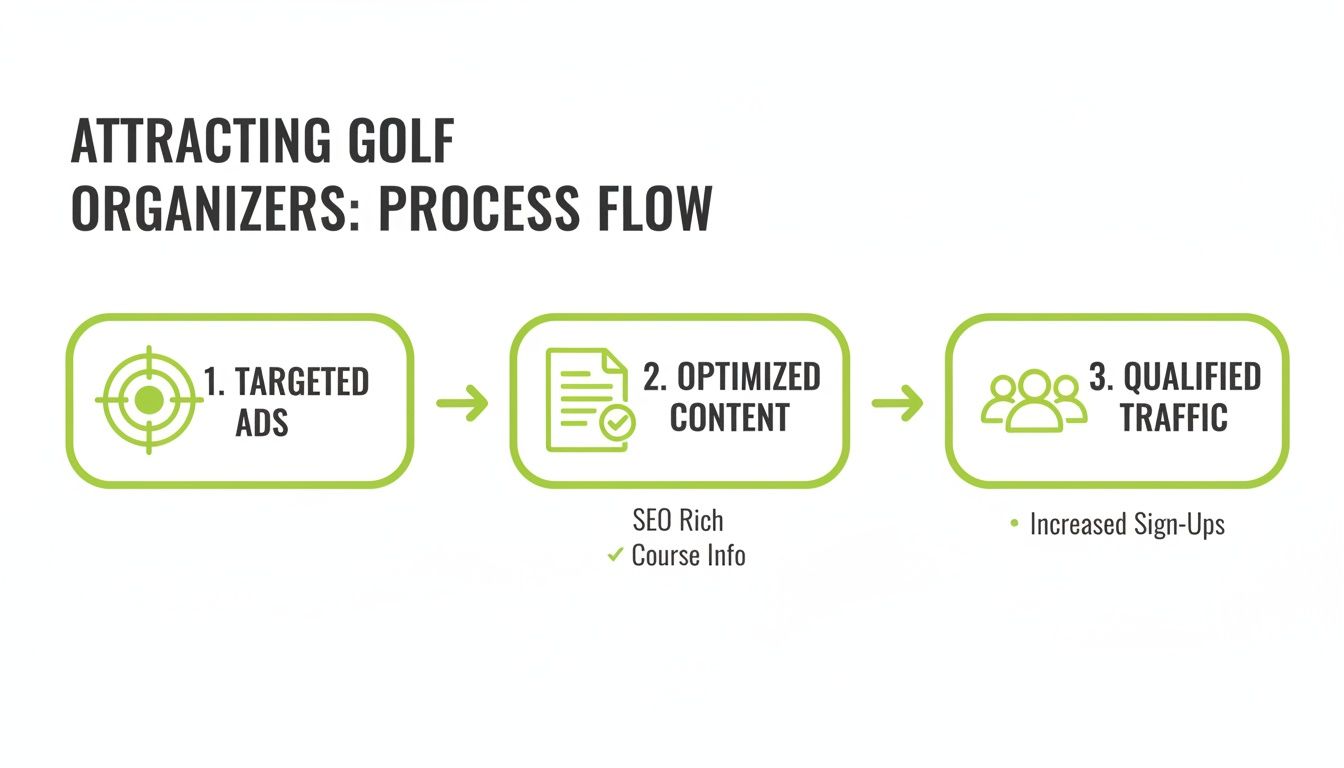
As you can see, a winning strategy begins with precision targeting, not just casting a wide net. This brings better quality traffic from the get-go. But once they land on your site, the system you have built is what determines whether they book with you or click away to a competitor.
Create Dedicated Society Landing Pages
Think about your main club website. It has a lot of jobs to do: member news, visitor green fees, clubhouse menus, you name it. A society organiser, however, comes with a very specific mission. Sending them to your homepage forces them to become a detective, hunting for the information they need. It is a frustrating experience that usually ends with them giving up.
The solution is a dedicated society landing page. This is a single, focused webpage with one clear goal: to persuade the organiser to get in touch.
An effective landing page has to nail these elements:
- Clear, Compelling Packages: Do not be vague. Lay out your society packages with transparent pricing and exactly what is included. It is also smart to mention that you can customise packages; flexibility is a huge selling point.
- A Simple Enquiry Form: Only ask for the absolute essentials at this stage: name, email, phone, ideal date, and estimated player numbers. A long, complicated form is a guaranteed conversion killer.
- Powerful Social Proof: Showcase testimonials and logos from past corporate or society clients. This is a shortcut to building trust and credibility.
- A Clear Call-to-Action (CTA): Use big, obvious buttons with direct language like "Enquire Now" or "Get a Custom Quote." Leave them in no doubt about what to do next.
This focused approach strips away all the noise and guides the organiser smoothly towards making an enquiry, dramatically improving your lead generation results.
The Psychology of an Irresistible Offer
To attract high-value groups, you have to think beyond a simple discount. While a small price cut might catch someone's eye, real value is about enhancing the entire experience of their event.
Your best bet is to build offers that make the organiser's job easier and their day more memorable. These kinds of incentives show you understand their challenges and are a true partner in making their event a success.
The most effective offers provide tangible value that elevates the entire golf day. This positions your club as a premium partner, not just another course competing on price.
For instance, instead of a basic 10% discount, why not offer something more creative?
- A dedicated event coordinator to handle all the logistics on the day.
- Complimentary custom merchandise, like branded ball markers or pitchforks for their group.
- A free 'beat the pro' competition on one of your signature par-3s.
- A complimentary drinks reception for any group booking over a certain size.
These kinds of extras add perceived value that far outweighs their actual cost, showing you are committed to delivering something truly special.
Implement 24/7 Automated Qualification
The moment an organiser hits 'submit' on your enquiry form is golden. Their interest is at its absolute peak, but that peak doesn't last long. Manual follow-up processes, where enquiries sit in an inbox for hours or even days, are the single biggest reason potential bookings go cold.
This is where an automated qualification flow, powered by a proper golf CRM system, becomes your secret weapon. An automated system can work for you around the clock to:
- Instantly Engage: It sends an immediate, personalised email and SMS to the organiser. This acknowledges their enquiry instantly and tells them what to expect next.
- Gather Key Details: It can then ask a few simple, automated questions to qualify the lead further. Think: "Are you considering a shotgun start?" or "Will you require a private dining area for your meal?"
- Alert Your Team: The system notifies the right staff member that a new, qualified lead has arrived, armed with all the information needed to have a productive conversation.
This level of automation guarantees 100% lead visibility and stops your staff from wasting time chasing down cold enquiries. Instead, they can invest their energy in valuable conversations with organisers who are already warmed up and pre-qualified. This is how you build a predictable pipeline for growth. To see how this works in practice, you can learn about the benefits of a golf CRM system in our detailed guide.
Turning Enquiries into Bookings with Automated Follow-Up
Let's be honest, this is where most clubs drop the ball. You can have the best marketing in the world and a brilliant website, but if your follow-up is slow and patchy, you are haemorrhaging potential revenue. That crucial window between a society organiser sending an enquiry and receiving your response is the weakest link in your entire sales process.
Winning the business comes down to two things: speed and value. A quick reply shows you are professional and you respect the organiser's time. Following that up with genuinely helpful information keeps your club at the forefront of their mind and builds a relationship that is not just about the price. This is exactly where a smart, automated system, powered by a good CRM, becomes your unfair advantage.
Why Speed Is Non-Negotiable
The second an organiser hits 'send' on an enquiry form, the clock is ticking. They are not just waiting for you; they are actively shopping around and contacting your competitors. The first club that gets back to them with a polished, helpful response sets the standard everyone else has to beat.
Relying on someone to check an inbox and manually reply, which can take hours or even a day, just doesn't cut it anymore. An automated system, on the other hand, can make contact instantly.
Imagine this: within seconds of an enquiry, the organiser receives an automated email and an SMS. It is a simple touch that confirms you have received their request, thanks them for their interest, and tells them what to expect next. Instantly, you have taken them from a state of uncertainty to feeling confident they are dealing with a professional outfit.
This first touchpoint isn’t meant to replace a personal conversation; it is designed to perfect it. It buys your team precious time to put together a thoughtful quote while making sure the organiser feels looked after and stays engaged with your brand. This is a fundamental part of effective lead nurturing, a topic we explore in depth in our guide to lead nurturing best practices.
Building a Nurture Sequence That Actually Adds Value
Once that instant acknowledgement is sent, the real work begins. The aim is to stay on the organiser’s radar without nagging them or just chasing them for a decision. A well-thought-out nurture sequence accomplishes this by providing real value and answering their questions before they even have to ask.
Here is a practical example of what this looks like, triggered automatically after an enquiry:
- Day 1 (Instant): The automated email and SMS acknowledgement goes out.
- Day 2: Send an email with a short video tour of the course and clubhouse, pointing out things society organisers love, like your private dining areas or dedicated registration desk.
- Day 4: Share a PDF of your society menus or a link to a blog post like "5 Tips for a Flawless Corporate Golf Day."
- Day 7: An automated check-in email asks if they have any questions and reminds them you are ready to build a bespoke package for their event.
With this approach, you position your club as a helpful partner, not just another venue after a booking. Every communication builds trust and shows you truly understand what it takes to run a great golf day.
A Tale of Two Clubs
Let’s look at two very different scenarios. Club A is still using a paper diary and a general email inbox. An enquiry lands at 6 PM. The organiser hears nothing back. The next morning, a busy staff member finally sees the email, spends 20 minutes cross-referencing the diary, and sends a basic reply with a price list. By this point, the organiser has already had a detailed phone call with a competitor.
Now, consider Club B, which uses an integrated CRM. The same enquiry arrives at 6 PM. Instantly, the organiser gets a branded email and a text message thanking them and confirming a personal follow-up is coming the next morning. The CRM has already logged the lead and created a task for the sales manager. When the manager comes in, all the details are right there, allowing them to make a confident, well-informed call.
The difference is not small; it is everything. Club B looks more professional, works far more efficiently, and has a massively higher chance of converting that enquiry. Their process for golf society lead generation is a predictable system, not a game of luck. In today's market, that system is more critical than ever. The clubs that can systematically turn interest into confirmed bookings will be the ones that thrive.
Measuring and Optimising for Predictable Growth
If you want to build a reliable pipeline of golf society bookings, you have to stop guessing and start measuring. Just getting a steady stream of enquiries is not the real goal. The aim is to build a system where you know your numbers so well that you can forecast revenue, spot problems before they escalate, and make smart decisions based on hard data.
Without this, you are flying blind. You might feel busy handling enquiries, but you have no real idea which of your efforts are actually turning into profitable bookings. A good CRM system acts as your flight deck, giving you a clear view of the entire journey, from the first ad click right through to the final, confirmed booking.
The Numbers That Actually Matter
Forget about vanity metrics like website clicks or social media likes. They do not pay the bills. Instead, you need to laser-focus on the numbers that directly impact your revenue and tell the true story of your sales performance.
Here are the key performance indicators (KPIs) you should have on your dashboard:
- Enquiry Response Time: How long does it take your team to make that first, crucial contact with a new lead? Getting this under an hour is one of the single biggest factors in whether you win the business or not.
- Enquiry-to-Booking Conversion Rate: This is the big one. What percentage of your total enquiries become paid-up, confirmed bookings? This is the ultimate health check for your entire sales process.
- Lead Source Performance: Pinpoint exactly where your best leads come from. Is it Google Ads, a specific social media campaign, or your website's contact form? You need to know which channels deliver enquiries that actually convert.
- Average Revenue Per Society: This helps you understand the real value of each booking. It allows you to double down on attracting the most profitable groups, not just the most numerous ones.
Do not think of this as creating more admin. Think of it as gaining the clarity you need to make smarter, more profitable decisions. When you know your numbers, you can stop guessing and start building a predictable revenue machine.
By keeping a close eye on these KPIs, your CRM becomes a powerful diagnostic tool. If your conversion rate suddenly drops, it might be due to slow follow-up, a pricing issue, or a broken link in your email sequence. Without the data, you would never know where to look.
Turning Data into Smarter Decisions
Collecting the data is just the starting point. The real magic happens when you analyse it to find opportunities to improve. A well-configured CRM dashboard makes this easy, visually laying out your sales pipeline and flagging the areas that need your attention.
For instance, your data might show that enquiries from a specific Google Ads campaign are converting at a rate 30% higher than those from your Facebook efforts. That is a crystal-clear signal to shift your marketing budget to where it is working hardest.
Or perhaps you notice that your team’s response time slows down over the weekend, causing a nosedive in conversion rates for any leads coming in on a Saturday. That is not a personnel problem; it is an operational one. The data gives you the business case to adjust staff rotas or implement better automation to make sure no weekend lead ever goes cold.
Building a System for the Long Haul
This data-driven mindset changes everything. You move away from the frantic, reactive cycle of just "getting more leads" and start building a robust, predictable system for growing revenue. Every decision, from marketing spend to staff scheduling, becomes strategic and backed by evidence.
This is not about complicated marketing theory. It is about simple, practical improvements. By consistently measuring, analysing, and optimising, you create a powerful feedback loop that fuels continuous growth. You will quickly see which society packages are the most popular, which follow-up emails get the best response, and which members of your team excel at closing deals.
Ultimately, your objective is to build a reliable engine for society revenue that does not depend on any single person's heroic efforts. It is a system that guarantees long-term, measurable success, turning your club into a truly sophisticated business operation.
Your Questions on Society Lead Generation Answered
Moving to a proper system for managing golf society leads is a big change. It means stepping away from the familiar, such as the diary, the spreadsheets, and the frantic email searches, and trusting a more organised, data-driven approach. It is only natural for club managers, secretaries, and committees to have a few questions before making that leap.
We hear the same questions time and again from clubs looking to build a reliable pipeline of society bookings. Let's tackle them head-on with some straight-talking, practical answers based on our experience of what actually works.
How Much Does a System Like This Cost to Set Up?
This is always the first question, and rightly so. While the costs can vary, the most important shift is to see this as an investment, not an expense. A well-built system isn't a cost centre; it's a revenue engine designed to pay for itself many times over by capturing and converting leads you are almost certainly losing right now.
The initial investment typically breaks down into three areas:
- CRM Software: This is your subscription to a Customer Relationship Management platform. Costs will depend on the system's capabilities and how many of your staff need access.
- Setup and Integration: This is the one-off work to get everything running. It involves customising the CRM, building the automated workflows, creating high-converting landing pages, and connecting it all to your website. Getting this done by an expert is crucial for a smooth start.
- Advertising Spend: This is your budget for channels like Google Ads or paid social media to get in front of society organisers. The great thing is, you control this budget completely and can scale it up once the returns start coming in.
The real metric to focus on is not the upfront cost, but the return on investment. A properly executed system will dramatically increase your enquiry-to-booking conversion rate. The revenue from just one or two extra society bookings can often cover the system's cost for the entire year.
How Much Time and Training Will My Staff Need?
This is another common worry, the potential disruption for your team. But here is the good news: a modern system is designed to make your staff's lives easier, not harder. The whole point is to automate the repetitive, time-consuming tasks so your team can focus on what they do best: talking to people and securing bookings.
Honestly, the learning curve is much gentler than most clubs think. A good setup simplifies everything, giving your staff a clear dashboard where they can see every lead, its current status, and exactly what needs to happen next.
Training usually covers a few key things:
- Understanding the Pipeline: We teach staff how to visually track a lead from the first phone call or email right through to a confirmed booking.
- Managing Communications: They will learn to use pre-built email templates and log calls within the system, creating a perfect history of every interaction with a client.
- Reading the Numbers: A quick look at key reports, like conversion rates and follow-up times, shows the team the direct impact of their work.
Most staff take to it very quickly because the benefits are immediate. No more digging through old emails, no more messy spreadsheets, and no more debates about who was meant to call that organiser back. It just brings clarity and a bit of healthy accountability to the process.
Can This Integrate With Our Existing Software?
Yes, in almost all cases. Modern CRM platforms are designed to be flexible and connect with the other software clubs rely on, whether it's your tee-sheet provider, accounting package, or email marketing tool.
The goal isn't to rip out and replace your existing tools. It is about creating a central "brain" for your sales and marketing that communicates with your other systems. This ensures data flows seamlessly between them, cuts down on manual data entry, and gives you a single, clear picture of your entire society business, from the first click on an ad to the final payment.
At GolfRep, we do not just find leads; we build the entire system that turns those leads into predictable revenue. We blend data-driven advertising with expert CRM implementation and automated follow-up to give your club a complete, end-to-end growth solution.
If you are ready to stop guessing and start building a reliable pipeline for your society bookings, let's have a chat. Learn more about how we help clubs grow at https://www.golfrep.co.
Ready to tap into our proven growth system?