Boost Golf Club Revenue Growth in 2026

Most advice on golf club revenue growth starts in the wrong place. It tells clubs to buy more attention, run more campaigns, post more content, and push harder on lead generation.
That sounds sensible until you look at what happens inside most clubs after an enquiry arrives.
At GolfRep, we see the same pattern repeatedly. The inbox fills up. A prospect asks about membership, a society day, or an event. Nobody owns the reply. Follow-up depends on who is on shift. A warm lead goes cold while the club debates how to grow. The issue usually isn't demand. It's the absence of a reliable process to turn interest into revenue.
Why Your Club's Growth Problem Isn't What You Think
The most common assumption in club growth is simple. More revenue requires more enquiries.
In practice, that assumption often masks the underlying problem. Overall membership growth in the UK golf sector is up nearly 10 percentage points year-on-year in 2025, which points to healthy demand for golf memberships. But clubs that are still struggling often aren't suffering from a visibility issue. They're suffering from a handling issue, where enquiries sit in inboxes and follow-up depends on staffing rather than a system, as reported by Golfshake's review of golf club membership in 2025.
That distinction matters.
If your club already generates interest, spending more on marketing without fixing conversion is like topping up a leaking bucket. You may feel busy. You may even see more leads coming in. But the actual business result stays inconsistent because the process after the enquiry is weak.
The real bottleneck sits after the click
Most clubs don't lose revenue because nobody knows they exist. They lose revenue because no one can answer basic questions quickly, book the visit confidently, and keep the prospect moving.
A membership enquiry is not revenue. A tour is not revenue. Even a trial round is not revenue until somebody follows through and closes the next step.
Practical rule: If your team can't say who replied, when they replied, what happened next, and whether the prospect visited, you don't have a lead generation problem. You have a pipeline problem.
This is why manual effort rarely fixes the issue for long. Staff work hard. Managers chase. Committee members want updates. But if the process lives in memory, email chains, and handwritten notes, results stay uneven.
Predictability comes from structure
Golf club revenue growth becomes more reliable when clubs treat enquiry handling as an operational system rather than an admin task.
That means:
- Central visibility: every lead sits in one place, not across inboxes and notebooks
- Clear ownership: one person or one workflow moves the enquiry forward
- Defined stages: new enquiry, contacted, booked visit, attended, decision pending, joined
- Measured follow-up: the club knows what happens after first contact
This approach also changes the internal conversation. Instead of asking, "How do we get more leads?" the better question becomes, "How many of the right leads are we already failing to convert?"
That's where the biggest revenue gap usually sits.
Establishing Your Baseline with the Right KPIs
You can't improve a process you can't see. Most clubs track top-line outcomes like membership totals, visitor revenue, or monthly sales. Those matter, but they don't explain where revenue is won or lost.
The first job is to establish a baseline for the pipeline itself.
Start with speed, not volume
Across more than 50 UK golf clubs, the average response time to a membership enquiry was 30 hours in 2025, and faster response times consistently correlated with significantly higher conversion rates, according to The Revenue Club review cited by GolfRep. If your club is slower than that, you're already behind the benchmark.
Response time is one of the clearest operational KPIs because it exposes whether your front-end process works under normal conditions. A club might feel responsive internally and still be slow from the prospect's point of view.
Track these first:
- Lead-to-response time: how long it takes for a new enquiry to receive a meaningful reply
- Lead-to-visit rate: how many enquiries become booked tours, calls, or trial rounds
- Visit-to-member rate: how many visits convert into sign-ups
- Follow-up completion rate: whether each lead received the next planned contact
- Source-to-member yield: which channels produce actual members, not just form fills
Build a dashboard your team will actually use
Keep the dashboard simple. If it takes half a day to update, no one will trust it and no one will maintain it.
A useful weekly view might look like this:
| KPI | What it tells you | Warning sign |
|---|---|---|
| Response time | Whether the club replies quickly enough | Leads waiting without ownership |
| Booked visits | Whether first contact creates momentum | Plenty of replies, few tours |
| Visit attendance | Whether prospects are engaged | High no-show rates |
| Sign-ups | Whether the sales conversation is working | Visits happen, joins don't |
| Revenue by source | Whether spend and effort are justified | Busy channels with weak outcomes |
A second layer is value, not just conversion. If your team wants a clearer commercial lens, it helps to understand customer lifetime value so acquisition decisions aren't judged only on the first payment. Some membership categories produce more durable revenue than others.
Good reporting doesn't need to be sophisticated. It needs to be consistent enough to show where leads stop moving.
For clubs that want a clearer framework for interpreting the numbers, GolfRep's guide to marketing analytics for golf clubs is a useful starting point. The point isn't to create more admin. It's to make weak spots visible before they become revenue problems.
Avoid vanity metrics
Website traffic, social reach, and campaign clicks can all be helpful indicators. They are not growth on their own.
A club with fewer enquiries and a disciplined conversion process will often outperform a club with heavier traffic and no follow-up discipline. Baseline KPIs should tell you whether your sales process is healthy, not whether your team looks busy.
Growing Revenue Beyond Membership Dues
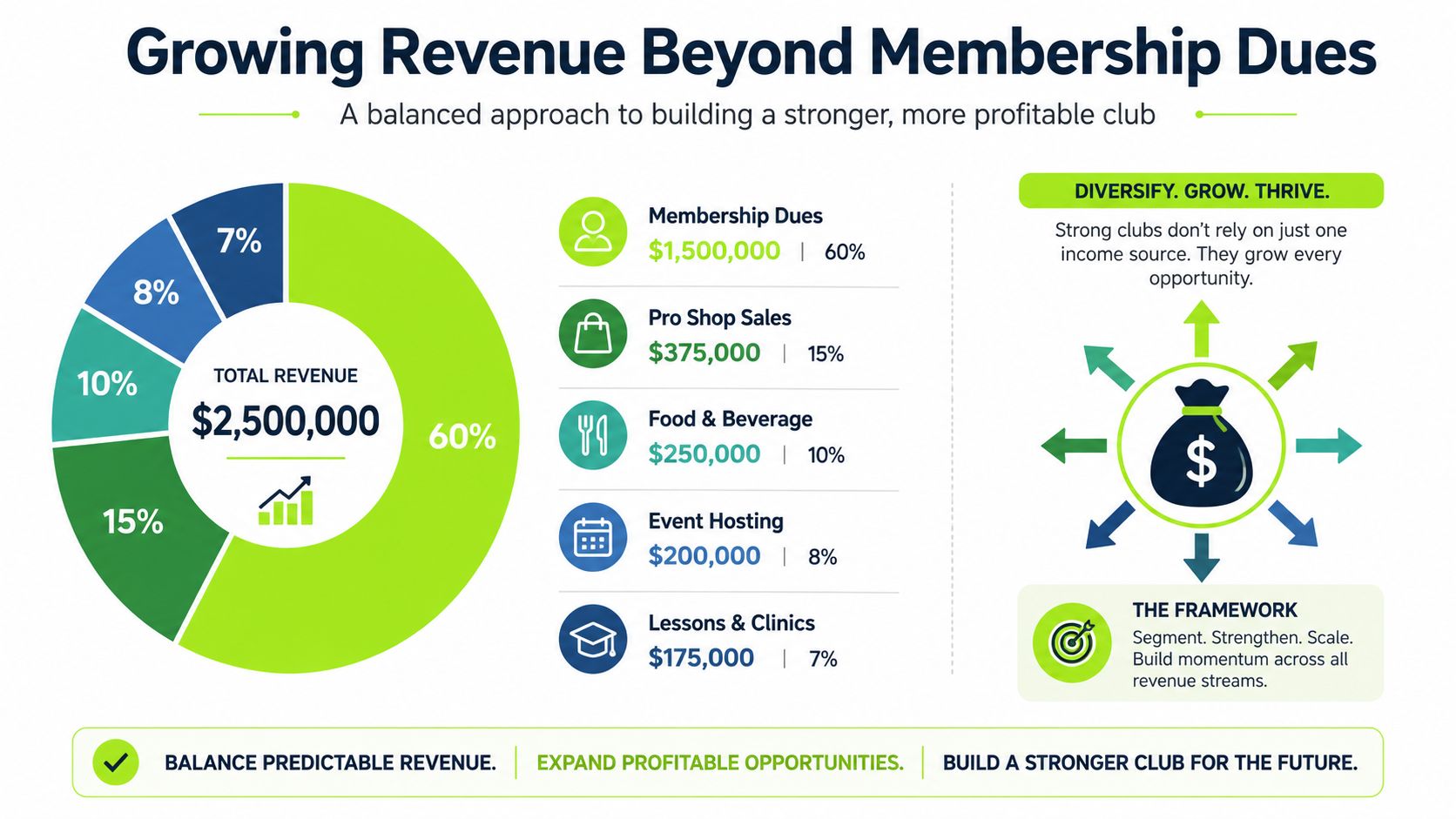
The clubs with the strongest revenue position don't rely on one stream. They build a model where membership provides stability and every visitor, guest, and non-member has a clear path to spend more across the club.
That doesn't mean chasing every possible idea. It means treating each income stream as part of one connected system.
Membership gives you the base
Membership income is usually the most predictable part of the business. It supports staffing, planning, and long-term investment. But clubs often make the mistake of treating members as a finished sale rather than an ongoing relationship.
A member who pays subscriptions can still spend in the bar, bring guests, attend events, book functions, and recommend new joiners. Revenue growth improves when the club sees membership as the beginning of commercial value, not the end of the process.
Hospitality is often underused
In the UK, 81% of members' clubs generated annual bar revenue exceeding £150,000 in 2024, the highest level since the Hillier Hopkins survey began. The same report notes that clubhouse hospitality can account for over 20% of total club income in top-performing UK facilities, according to the Hillier Hopkins Golf Clubs Report 2024-25.
That should change how clubs think about growth.
Too many clubs still treat food and beverage as secondary. The stronger operators treat it as a conversion tool, a retention tool, and a profit centre. The practical question isn't whether your bar matters. It's whether the club is actively driving people into it.
Where clubs usually miss the opportunity
- Visitor journeys end too early: guests finish their round and leave because nobody gave them a reason to stay
- Event space isn't promoted consistently: function rooms exist, but messaging is weak on-site and online
- Member guest spend is left to chance: there is no deliberate offer, package, or prompt
- Teams operate separately: golf, bar, and events are managed in silos rather than as one revenue engine
A club doesn't increase non-dues revenue by hoping people spend more. Staff need prompts, offers, timing, and visibility.
Build offers around behaviour
A practical revenue model connects activity to likely spend.
For example:
- Casual golfers: pair booking confirmations with clear clubhouse messaging and post-round offers
- Societies: package golf with food, prize tables, or private spaces so the spend isn't limited to the tee sheet
- Members: create regular reasons to use the club beyond the course
- Local businesses: position the venue as a meeting and event space, not only as a golf destination
The most resilient clubs don't choose between membership growth and visitor revenue. They connect them. A visitor can become a member. A member can become an event host. An event guest can become a repeat customer.
Clubs looking at visitor revenue specifically can also review practical ideas in GolfRep's article on how golf clubs can generate more revenue from visitors.
The Predictable Growth System From Enquiry to Member
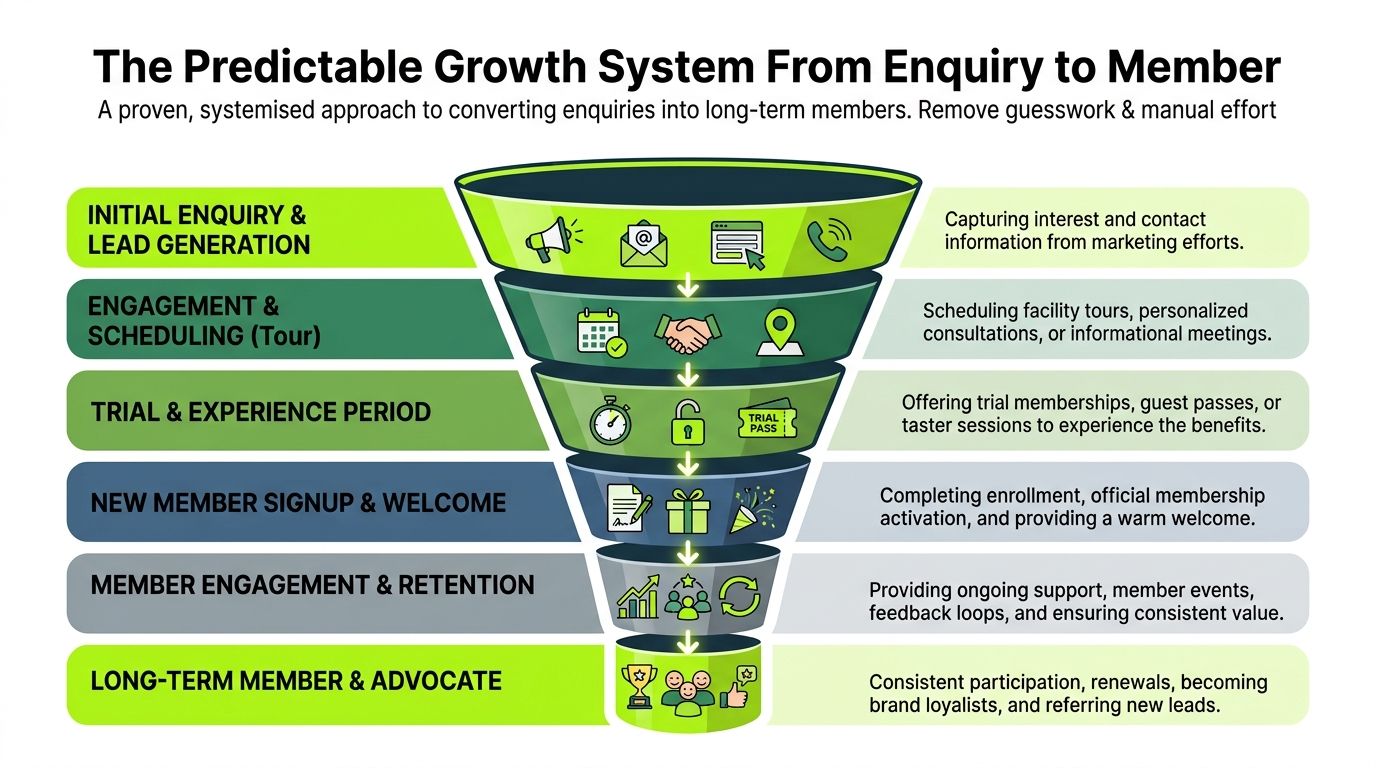
Most clubs don't need a more complicated sales process. They need one that consistently runs every day, regardless of who is on reception, who is off sick, or how busy the office gets.
A reliable growth system has four working parts. Miss one of them and the whole pipeline slows down.
Capture every enquiry in one place
If leads arrive through forms, phone calls, walk-ins, Facebook messages, and email, they need to land in one visible system.
Many clubs experience a loss of control. A prospect may enquire twice through different channels and still feel ignored because nobody can see the full history. Centralised capture fixes that. It gives the team one record, one timeline, and one owner.
Across clubs using HubSpot as a solutions partner, clubs receive an average of 500+ membership enquiries annually, yet the average response time remains 30 hours despite that volume, according to The Revenue Club's 2025 review. High enquiry volume doesn't create revenue if handling is weak.
What central capture should include
- Source tracking: where the lead came from
- Contact history: every email, call, and note in one place
- Status visibility: whether the enquiry is new, active, booked, or stalled
- Assigned ownership: one person responsible for the next action
Qualify quickly and automatically
Not every lead is ready to join today, but every lead should receive a prompt, professional response.
That doesn't require aggressive automation. It requires useful automation. A first reply can acknowledge the enquiry, answer immediate questions, and invite the next step without waiting for staff to become available.
The purpose of qualification is not to filter people out. It is to understand intent early. Are they asking about full membership, a flexible category, a tour, a visitor package, or a corporate option? The faster the club understands that, the easier it is to respond properly.
If your first reply is delayed, generic, or dependent on one staff member, the prospect experiences uncertainty before they experience the club.
Nurture leads without relying on memory
Most membership decisions aren't made after one email. Prospects compare clubs, discuss costs at home, look at location, and decide whether they can see themselves fitting in.
Manual follow-up usually breaks down. Teams mean to chase. Then the week gets busy.
A structured nurture sequence keeps the conversation moving. That might include a reminder to book a visit, a follow-up after a tour, answers to common objections, or a gentle reactivation message for people who went quiet.
A working nurture process should do three things well:
- Match the stage so the message fits where the prospect is
- Create a next step instead of sending vague check-ins
- Log activity so the club knows what has and hasn't happened
For clubs that want a practical example of this setup, GolfRep's guide to golf club enquiry conversion shows how structured follow-up can be mapped from first contact to sign-up. GolfRep is one option clubs use for this through centralised CRM, automated responses, and tracked nurture workflows.
Convert and onboard properly
Signing a member is not the end of the funnel. It is the moment where retention begins.
A poor onboarding process creates buyer's remorse. A good one reinforces the decision fast. New members should know what happens next, who they need to meet, how to book, what events are coming up, and how to become part of the club rather than just a payer of fees.
A simple operating model
| Stage | What the club must do | Common failure |
|---|---|---|
| Capture | Record every lead centrally | Enquiries split across channels |
| Qualify | Respond fast and identify intent | Delayed, generic replies |
| Nurture | Follow up consistently | Staff rely on memory |
| Convert and onboard | Make joining and settling in easy | Sale made, then momentum drops |
Predictable golf club revenue growth comes not from heroic effort, but from a process that keeps working on ordinary Tuesdays.
Optimising Pricing and Membership Packages
Discounting feels like action. It fills a short-term gap, creates urgency, and gives the committee something visible to approve.
It also creates problems that are harder to reverse.
When a club drops price too quickly, it trains prospects to wait, weakens perceived value, and puts pressure on retention later. People who join because the deal was cheap often judge the club through the same lens. They become price-sensitive from day one.
Price around fit, not just access
A stronger approach is to shape packages around how different golfers want to use the club.
Some prospects want full access and a traditional club environment. Others want flexibility because work, family, or travel makes full membership harder to justify. Corporate buyers care about hospitality, client use, and convenience. Younger players may respond better to a pathway into the club than a hard all-or-nothing choice.
That doesn't mean creating endless categories. It means offering a clean structure with clear value.
Useful package principles
- Protect the core: full membership should remain the flagship offer, not the fallback
- Add options with purpose: flexible categories should open the door without undermining premium value
- Bundle benefits clearly: social access, guest privileges, event access, and practice use all shape perceived value
- Keep admin manageable: if the package structure confuses staff, it will confuse prospects
Clubs rarely have a pricing problem in isolation. More often, they have a value communication problem.
Stop making price do all the selling
When a prospect asks, "How much is it?", many clubs answer too narrowly. They quote the fee and wait.
A better conversation explains what membership includes in lived terms. Not vague prestige. Real experience. Ease of booking, belonging, competitions, clubhouse use, guest opportunities, and community.
That matters even more when the club introduces new formats such as flexible memberships or corporate packages. The package must solve a real need and be easy for staff to explain. If a prospect needs a committee meeting to understand the offer, it isn't ready.
A practical test is whether your team can explain each package in one confident sentence.
Use tools carefully, not mechanically
Clubs exploring tools to optimize pricing strategies can learn from how other local businesses structure value and demand. The principle is useful. The application in golf needs judgement.
Golf isn't a commodity purchase. Your pricing has to reflect member culture, playing rights, demand pressure, and the experience attached to the badge. Packaging works when it increases relevance without making the club feel transactional.
A sensible pricing review usually asks three questions:
| Question | Why it matters |
|---|---|
| Which packages attract the right members? | Revenue quality matters as much as volume |
| Which offers are hard to explain or sell? | Complexity slows conversion |
| Which categories support long-term retention? | A cheap join isn't a good result if the member leaves quickly |
Value-based packaging is slower than a panic discount. It is also far more durable.
How to Measure and Refine Your Growth Engine
Once the pipeline is visible and the process is running, the next discipline is refinement. At this stage, clubs move from reacting to individual enquiries toward managing a repeatable commercial system.
The key is to review the funnel by stage, not just by outcome.
A club might say membership sales are soft. That statement is too broad to help. The useful question is narrower. Are leads not getting replies, not booking visits, not attending visits, or not converting after they attend? Each bottleneck points to a different fix.
Use benchmarks carefully
A useful benchmark can sharpen decision-making, but only if it is interpreted properly.
PlayMoreGolf achieved a 56% total conversion rate and a 27% in-month conversion rate in March 2025, generating 932 new members from 1,662 leads, according to Golf Business Technology's report on PlayMoreGolf's March results. That doesn't mean every private club should expect identical numbers. It does show what becomes possible when lead generation is paired with structured follow-up.
The lesson isn't to copy another operator's model blindly. The lesson is that conversion performance can be materially better than many clubs assume.
Review the funnel in sequence
Look at the journey in order.
- Enquiry to first reply: if this stage is weak, improve speed and ownership
- First reply to booked visit: if prospects go quiet here, your response may lack clarity or a strong next step
- Booked visit to attendance: if no-shows are common, reminders and confirmation messaging usually need work
- Visit to sign-up: if attendance is healthy but joins are low, the sales conversation or package fit may be off
This kind of review stops clubs making the wrong fix. More advertising won't solve a weak post-visit close. Better brochures won't solve missed first responses.
Small changes matter most at the narrowest point of the funnel. Fix the stage where prospects stall, not the stage that feels easiest to discuss.
Create a testing habit
Refinement doesn't need to become complicated. Start with controlled changes.
You might test:
- Reply style: short direct response versus more detailed welcome message
- Call to action: book a tour versus book a call first
- Visit follow-up: same-day follow-up versus next-day follow-up
- Message timing: weekday morning versus evening contact for working prospects
Track the outcome long enough to spot a pattern. Then keep what works and remove what doesn't.
For clubs trying to build a clearer link between campaign activity and commercial results, resources on linking marketing to revenue with AI can be useful as a broader reference point. The core principle still applies in golf. Measurement only matters when it improves the next decision.
Protect the feedback loop
The strongest clubs don't wait for year-end to review performance. They create a regular rhythm.
A monthly pipeline review should answer:
| Question | What it reveals |
|---|---|
| Where are leads stalling? | The current bottleneck |
| Which source produces joiners, not just enquiries? | Better budget allocation |
| Which package converts best? | Offer-market fit |
| Which staff process creates delay? | Operational friction |
That feedback loop is what turns activity into golf club revenue growth. Without it, teams stay busy and still struggle to explain results.
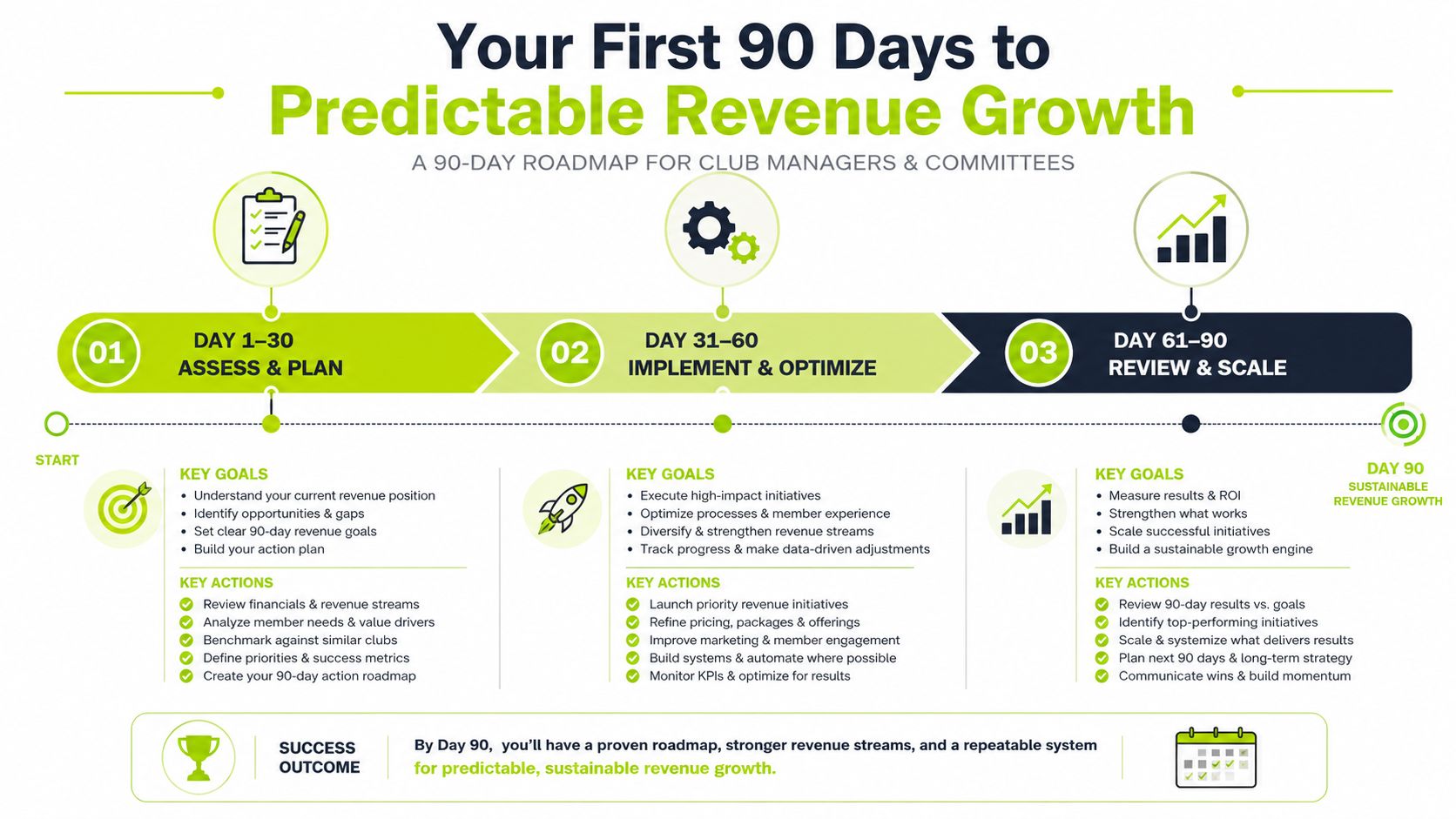
Your First 90 Days to Predictable Revenue Growth
Most clubs don't need a complete commercial overhaul. They need a disciplined start.
The first 90 days should focus on visibility, response, and follow-up. Keep it practical. Build something your team can run consistently before you add complexity.
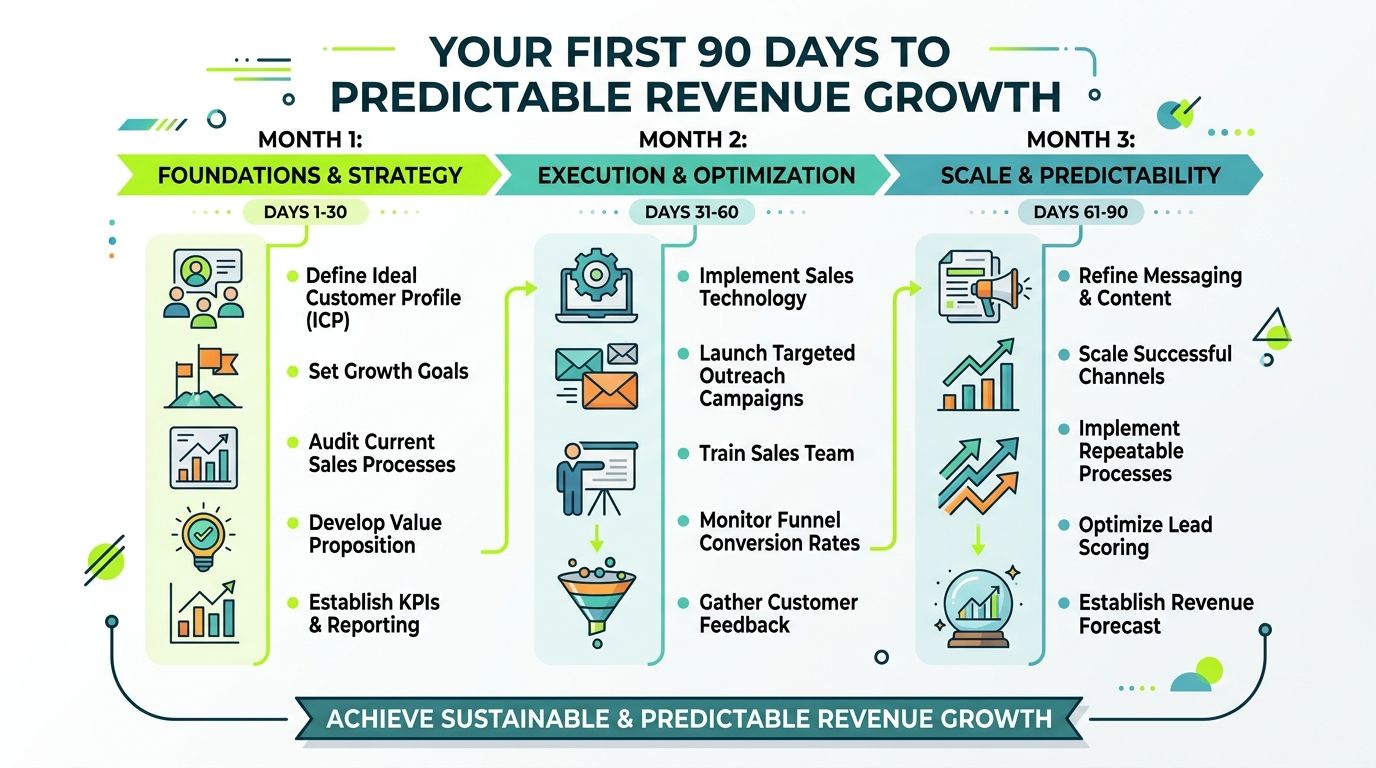
Days 1 to 30 assess and organise
Begin by mapping how enquiries currently arrive and who handles them. Most clubs discover quickly that the process itself is more fragmented than anyone thought.
Create one central place to log every new lead. Then define a small set of pipeline stages that everyone understands. Keep the labels plain and operational.
Month one checklist
- Audit every enquiry route: website forms, email inboxes, calls, social messages, and walk-ins
- Set your baseline: log response time, booked visits, and sign-ups
- Assign ownership: every lead needs a named next action
- Write core replies: prepare response templates for membership, events, and society interest
The main outcome in this phase is clarity. You should be able to see where leads come from, where they sit, and what happens next.
Days 31 to 60 implement and tighten
Once the basics are visible, remove avoidable delay. Faster acknowledgement and clearer follow-up usually produce improvement before any major marketing change does.
This is the right time to introduce simple automation, structured reminders, and a defined visit-booking process. Don't overengineer it. Build a sequence your current staff can maintain.
Priorities for month two
- Automate first acknowledgement: every prospect should receive a prompt, useful reply
- Standardise the next step: invite a tour, call, or trial round clearly
- Schedule follow-up tasks: stop relying on memory
- Confirm visits properly: reduce drop-off between booking and attendance
The first win isn't sophistication. It's consistency.
Days 61 to 90 review and improve
By this stage, the club should have enough activity to see where the process still leaks. Review the funnel, not just the total joins.
If plenty of people enquire but few book visits, improve the first response. If visits happen but sign-ups lag, review the sales conversation, package fit, and post-visit follow-up. Focus on one blockage at a time.
Month three review points
- Identify the weakest stage: response, booking, attendance, or close
- Compare lead sources qualitatively: which ones create serious conversations
- Refine messaging: strengthen the emails and calls around the weak stage
- Improve onboarding: make new members feel settled quickly
A good 90-day plan doesn't solve everything. It gives the club a working growth engine that can now be measured, trusted, and improved.
If your club is generating interest but still struggling to turn enquiries into members and revenue, GolfRep helps clubs build a more predictable process through lead tracking, CRM-enabled follow-up, and structured conversion systems that fit how golf clubs operate.
Ready to tap into our proven growth system?