Golf Club Advertising Agency: The 2026 Hiring Guide

Most advice about hiring a golf club advertising agency starts in the wrong place. It starts with ads, creative, reach, and campaign ideas. That sounds sensible, but it misses the operational problem that holds most clubs back.
For many clubs, the issue isn't a lack of enquiries. It's what happens after an enquiry arrives.
A prospect fills in a membership form, downloads a brochure, clicks on a Facebook advert, or asks about a trial round. Then the lead sits in an inbox, gets forwarded between staff, or waits for someone to respond after a busy weekend. By the time the club replies, interest has cooled and the opportunity has gone. That's not an advertising problem. It's a systems problem.
A good golf club advertising agency should help you generate attention. A useful growth partner should also help you see every lead, respond properly, and track whether that lead ever becomes a visit, a booking, or a member.
The Real Problem with Golf Club Marketing
The common belief is simple. If the membership pipeline feels thin, the club needs more traffic.
In practice, many clubs already lose value from the traffic and enquiries they have. Most golf advertising agencies focus on traffic generation, but almost none address the backend problem of converting enquiries. One cited industry reference states that without automated follow-up, golf club lead conversion rates typically drop 60 to 70% within 48 hours according to Long Drive Agency's discussion of golf marketing gaps. Whether your club is committee-led, owner-managed, or part of a larger operation, that basic failure is expensive.

The leaky bucket most clubs don't see
The easiest way to picture it is as a leaky bucket.
Advertising pours water in. Slow response times, poor lead visibility, and manual follow-up let it pour out again.
If your club can't answer basic questions such as these, the bucket is leaking:
- Lead visibility: Where do membership enquiries land, and who owns them?
- Response process: What happens in the first hour, the first day, and the first week?
- Conversion tracking: Can you link ad spend to visits, tours, applications, and signed memberships?
- Follow-up discipline: Does every prospect receive consistent communication, or only the ones a staff member remembers?
Practical rule: If a club can't see every enquiry in one place, it can't manage growth with confidence.
This matters outside pure membership sales too. Clubs that run opens, visitor campaigns, and local event activity face the same issue. If you're reviewing event-led revenue as part of your wider strategy, this guide to profitable multi-course events is a useful example of how structured operations often matter more than promotion alone.
What a manager should measure instead
A new club manager shouldn't judge marketing health by ad impressions or how polished the campaign artwork looks.
Judge it by operational evidence:
- How quickly enquiries are acknowledged
- Whether every lead is visible to the team
- How many prospects book a visit
- How many visits become real sales conversations
A flashy campaign can still fail if the club handles follow-up like an afterthought.
That is why the hiring decision shouldn't be framed as "Which golf club advertising agency can get us more leads?" The better question is "Which partner can build a reliable pipeline from first click to signed member?"
Defining Goals Beyond Just More Members
"More members" is too vague to brief an agency properly.
A club needs a target shape, not just a target size. Otherwise the agency will optimise for volume, while the club needs the right mix of members, the right revenue profile, and the right operational load on the team.
Start with the member you actually want
A full membership push and a lifestyle membership push are not the same job. Neither is a campaign for younger joiners, women returners, relocators, corporate users, or trial-based conversions from visitors.
Write down the basics before you speak to anyone:
- Membership category priority: Which categories matter most this year?
- Commercial outcome: Do you need cash flow now, better retention, or stronger long-term yield?
- Catchment reality: Who is realistically willing to travel to your club?
- Sales capacity: How many visits, calls, and tours can your team handle each week?
An agency that doesn't ask these questions usually defaults to broad targeting and generic messaging.
Set goals at three levels
Clubs make better decisions when they separate outcomes into stages.
| Goal level | What to define | Why it matters |
|---|---|---|
| Business | Revenue, member mix, occupancy by category | Keeps marketing tied to club priorities |
| Pipeline | Enquiries, booked visits, tour attendance | Shows whether follow-up is working |
| Operational | Response ownership, reporting cadence, CRM use | Prevents leads from disappearing |
This structure stops the conversation becoming too abstract. It also makes committee reporting easier because the club can explain not just what was spent, but what process is producing results.
If a brief only says "we want more members", don't expect a precise proposal back.
Private clubs and multi-site groups need different answers
A single private members' club often needs consistency. That means a steady pipeline, clear lead ownership, and communication that protects the club's positioning.
A resort group or hotel operator usually needs something else. Reporting becomes the sticking point. Multi-site operators face fragmented reporting, which makes it difficult to benchmark performance or allocate central budget efficiently. One verified reference notes that a 10-property hotel group could reduce marketing administration by 40 to 60% through unified systems, yet many agencies still manage each site separately according to NGF's marketing services overview.
That trade-off matters when you're building a brief. A local club may prioritise conversion process at one site. A group operator may need central visibility across all sites before it can even judge performance properly.
Questions worth settling internally first
Before you invite proposals, get agreement on these points:
- Decision timeframe: Are you trying to fill an immediate gap or build a year-round pipeline?
- Offer strategy: Will you sell on prestige, trial access, flexibility, or community?
- Internal owner: Who approves campaigns, and who owns follow-up once leads arrive?
- Data readiness: Can your club currently track where enquiries come from?
If those answers are fuzzy, agencies will fill the gaps with assumptions. That usually leads to disappointing campaigns and awkward review meetings later.
Must-Have Capabilities of a Modern Growth Partner
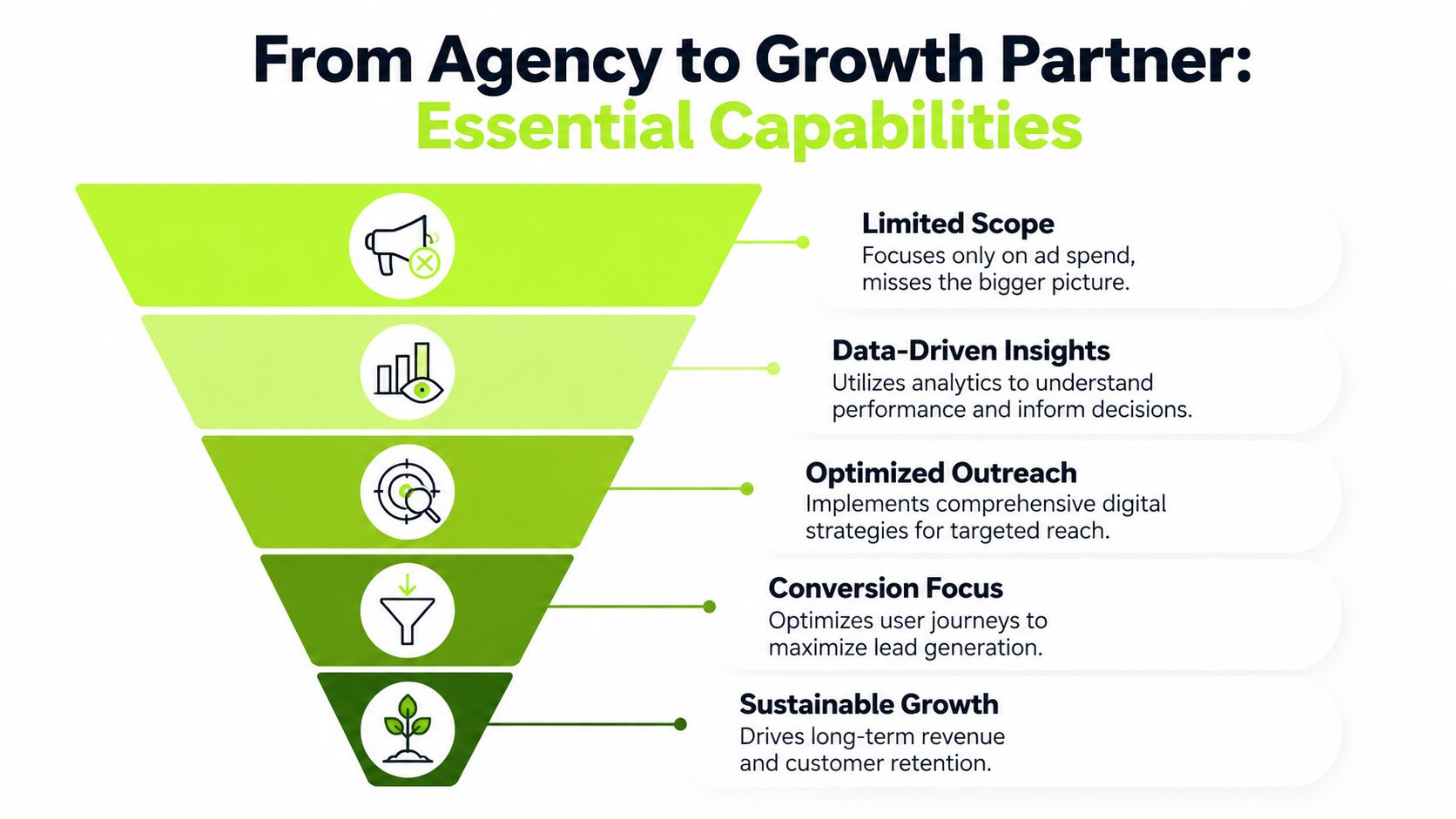
A traditional agency buys attention. A modern partner should manage the path from attention to conversion.
That difference matters more in golf than in many other sectors because clubs often have lean internal teams, seasonal pressure, committee oversight, and uneven sales follow-up. If the agency's work stops at generating clicks, the club still has the hardest part left to solve.
Data-led targeting beats generic media buying
The first requirement is targeting discipline.
Golf marketing often underperforms because campaigns are built around broad phrases and loose audience settings. The better approach is tighter intent, tighter geography, and tighter message matching. Verified industry data notes that agencies using CRM exports inside Google Ads and Meta audiences report 1.8 to 2.5 times higher cost-per-qualified-lead ratios, while better sequencing from search into CRM-enabled nurture raises the 30-day visit-rate-to-enquiry from around 8 to 10% to 20 to 25% in UK club environments according to Keiser University's golf marketing strategies article.
The wording of that data isn't the important bit for a manager. The practical lesson is. A prospect who already knows your club, visited your site, or started a form should not be treated the same as a cold audience.
For a more detailed look at how paid channels should be structured in golf, GolfRep's article on golf club paid advertising is worth reading alongside any agency proposal you receive.
CRM integration is not optional
Many clubs still treat CRM as a nice add-on. It isn't.
If enquiries live across email inboxes, paper notes, contact forms, and spreadsheets, nobody has a dependable picture of pipeline health. You don't know who was contacted, who booked a visit, who went cold, or which campaign produced revenue.
A capable partner should be able to answer practical questions such as:
- How will new enquiries enter the CRM automatically
- How will staff see lead status at a glance
- How will membership, visitor, and event leads be separated
- How will the club report on source, stage, and outcome
Without this, every campaign review turns into guesswork.
The real handover isn't from advert to website. It's from enquiry to follow-up.
Automation closes the gap staff can't cover manually
Most clubs don't ignore leads on purpose. They get busy.
Reception is dealing with visitors. The pro shop is stretched. The secretary is handling committee matters. Membership follow-up slips because it depends on memory and spare time.
Automation matters. Not robotic spam, but sensible sequencing. Immediate acknowledgement, a useful follow-up, a prompt to book a visit, and internal reminders when a lead has gone untouched.
A golf club advertising agency that can't talk confidently about automated nurture is only solving half the problem.
What this looks like in practice
The strongest setups usually combine three layers:
- Front-end acquisition: Search, Meta, retargeting, and landing pages aimed at the right local prospect
- Middle-layer tracking: CRM capture, source attribution, lead status, and staff visibility
- Back-end nurture: Email, SMS, reminders, and booked-visit workflows
GolfRep is one example of a provider built around that model, combining advertising with CRM-enabled follow-up and automation for golf clubs. The important point isn't the brand name. It's the operating model.
If a provider only shows you ad metrics, they are showing you the top of the funnel and asking you to trust the rest.
How to Interview and Vet Potential Agencies
An agency pitch can sound convincing in the first meeting. Most know how to talk about creative, audience reach, and campaign management. The interview gets useful when you move the conversation into process, evidence, and accountability.
Ask questions that force specificity. If the answers stay broad, you probably don't have a partner with the right operational depth.
Questions that expose real capability
Start with conversion, not ad channels.
Use questions like these in the first call:
- Lead handling: What happens after a prospect submits a form on a Friday evening?
- System integration: How will you connect campaigns to our existing CRM or membership database?
- Sales visibility: Can we see where each lead sits in the pipeline without asking your team?
- Reporting: Will you report on enquiries only, or on visits, applications, and closed memberships too?
- Nurture: What automated follow-up do you recommend when a lead doesn't reply straight away?
- Ownership: Who is responsible for improving conversion rates after the lead arrives?
A weak golf club advertising agency answers with channel language only. A stronger one talks about operational workflow as readily as media buying.
Ask for the exact path from click to club visit. If they can't map it clearly, they probably can't manage it clearly.
Benchmarks and proof to ask for
Results in golf marketing usually take sustained management, not a quick burst of ads. Verified data from Lightspeed shows that golf courses with active digital marketing management for 90 to 180 days saw a 142% increase in website sessions and a 4.3% increase in total sales, while longer engagement reached 5.9% sales growth according to Lightspeed's golf digital marketing analysis.
That gives you a sensible framing device. You are not asking an agency for miracles in a fortnight. You are asking for a managed process with visible movement over time.
If you're part of a resort, hotel, or leisure group, it can also help to compare how adjacent sectors handle central reporting and guest acquisition. This overview of a digital marketing agency for hotels is useful because hospitality buyers often evaluate agencies on system integration and revenue visibility, not just campaign aesthetics.
RFP essentials checklist
If you're sending a formal brief, make it hard for agencies to hide behind generic language.
| Component | Why It Matters | Example Question to Ask |
|---|---|---|
| Business objective | Aligns marketing with club priorities | What commercial outcome are you optimising for? |
| Ideal member profile | Prevents low-fit lead volume | Who exactly are you targeting in our catchment? |
| Current lead process | Reveals operational gaps early | How would you improve our current enquiry handling? |
| CRM and database setup | Determines whether tracking is possible | How will your campaigns integrate with our systems? |
| Reporting model | Avoids vanity metrics | What will the monthly report show beyond clicks and reach? |
| Response workflow | Protects lead quality | What should happen in the first 24 hours after an enquiry? |
| Team responsibilities | Stops confusion after launch | What does your team own, and what must our staff own? |
| Timeline assumptions | Sets realistic expectations | What should we expect in the first 30, 60, and 90 days? |
| Multi-site requirements | Crucial for groups and operators | How would you report across several locations centrally? |
| Exit and handover | Reduces dependency risk | If the contract ends, what data and assets remain with us? |
What to request before choosing
Before you sign anything, ask each finalist for:
- A sample report that includes conversion stages, not just traffic
- A clear onboarding plan with responsibilities on both sides
- An explanation of tracking in plain English
- A view on your current bottleneck based on the information you've given them
The strongest agency interview often feels less like a sales pitch and more like a diagnostic session.
Understanding Pricing Contracts and Red Flags
Price matters, but pricing structure matters more.
A cheap retainer that produces unmanaged leads can cost far more than a higher monthly fee tied to proper tracking and follow-up. Clubs often compare proposals line by line without checking what is included operationally.

Common pricing models and the trade-offs
A few models appear regularly.
- Fixed monthly retainer: Predictable and easy to budget, but only good value if reporting, optimisation, and lead handling support are included.
- Setup plus management fee: Often sensible when CRM, tracking, landing pages, and automation need building before campaigns can run properly.
- Performance-based pricing: Attractive in theory, but risky if "performance" only means raw enquiries and not qualified sales outcomes.
- Media-spend percentage: Common in advertising, yet it can misalign incentives if the agency earns more by increasing spend regardless of conversion quality.
A credible provider should be able to explain what the club is paying for in operational terms. Not just ads, but process.
Contract terms that deserve a close look
Check the basics carefully:
- Length of term: Is the commitment long enough to build a system, but not so long that you're trapped?
- Ownership of assets: Who owns landing pages, campaign data, CRM workflows, and creative?
- Reporting obligations: What exactly will be shown each month?
- Exit terms: How much notice is required, and what happens to your data on departure?
If you need help judging whether proposed fees tie back to measurable outcomes, this article on the real ROI of golf club marketing gives a useful commercial lens.
Red flags that should slow you down
Some warning signs appear again and again:
- Vanity-first reporting: The proposal talks about impressions, reach, and clicks, but says little about visits, booked meetings, or memberships.
- No answer on lead conversion: They can describe ad platforms in detail, but not what happens after a form submission.
- Unclear audience logic: The targeting sounds broad because the agency hasn't thought hard about who your club wants.
- Asset dependence: They build everything inside their systems and make portability difficult.
- Price without context: They quote a fee quickly but can't justify how it maps to workload or expected process.
Verified information from Golf Club Media's brand advertising overview also matters here. UK golf club advertising gives brands access to high-net-worth audiences in structured environments with extended dwell time and measurable campaign conditions. That means golf media can justify premium investment in the right context. A competent agency should be able to explain that value clearly, not reduce every conversation to cost per click.
Warning sign: If the agency treats golf like any other local service category, expect generic execution and generic results.
Onboarding for a Successful Growth Partnership
The actual assessment starts after the contract is signed.
A poor onboarding process usually reveals the same weakness that caused the problem in the first place. Too much emphasis on campaign launch, not enough on system design. Clubs then go live fast but still can't see, route, or convert enquiries properly.
What good onboarding should include
The first phase should create operational clarity.
That usually means:
- A working session on goals and sales process
- Audit of current lead sources and handoff points
- CRM setup or clean-up
- Tracking for forms, calls, booked visits, and key actions
- Basic nurture sequences for uncontacted or undecided leads
- A reporting view the club can understand
These aren't extras. They are the infrastructure.
The first 90 days should build confidence
The most useful early wins are often invisible to the outside world. Better lead routing. Faster acknowledgement. Fewer missed handovers. Cleaner source tracking. Staff knowing what to do next.
That foundation is what makes later advertising spend more efficient. Without it, the club keeps paying to refill the same leaky bucket.
A practical resource here is GolfRep's overview of golf club automation, which shows how follow-up systems can support clubs that don't have time for fully manual lead management.
Good onboarding gives the club two things quickly. Control, and visibility.
What the relationship should feel like
By this stage, your agency should no longer feel like an outsourced ad buyer.
It should feel like a partner helping the club answer straightforward business questions. Which campaigns create visits. Which messages attract the right prospects. Where leads stall. Whether staff follow-up is keeping pace. Whether one site outperforms another for reasons the group can act on.
That is the standard club managers should hold.
The right golf club advertising agency isn't just there to make the phone ring. It should help build a predictable, inspectable growth engine that the club can trust month after month.
If your club wants to assess whether the problem is traffic, follow-up, or both, GolfRep is one option to explore. The focus is on building a measurable pipeline through advertising, CRM visibility, and structured nurture so clubs can see what happens from first enquiry to signed member.
Ready to tap into our proven growth system?