Golf Club Not Growing? Unlock Predictable Growth 2026

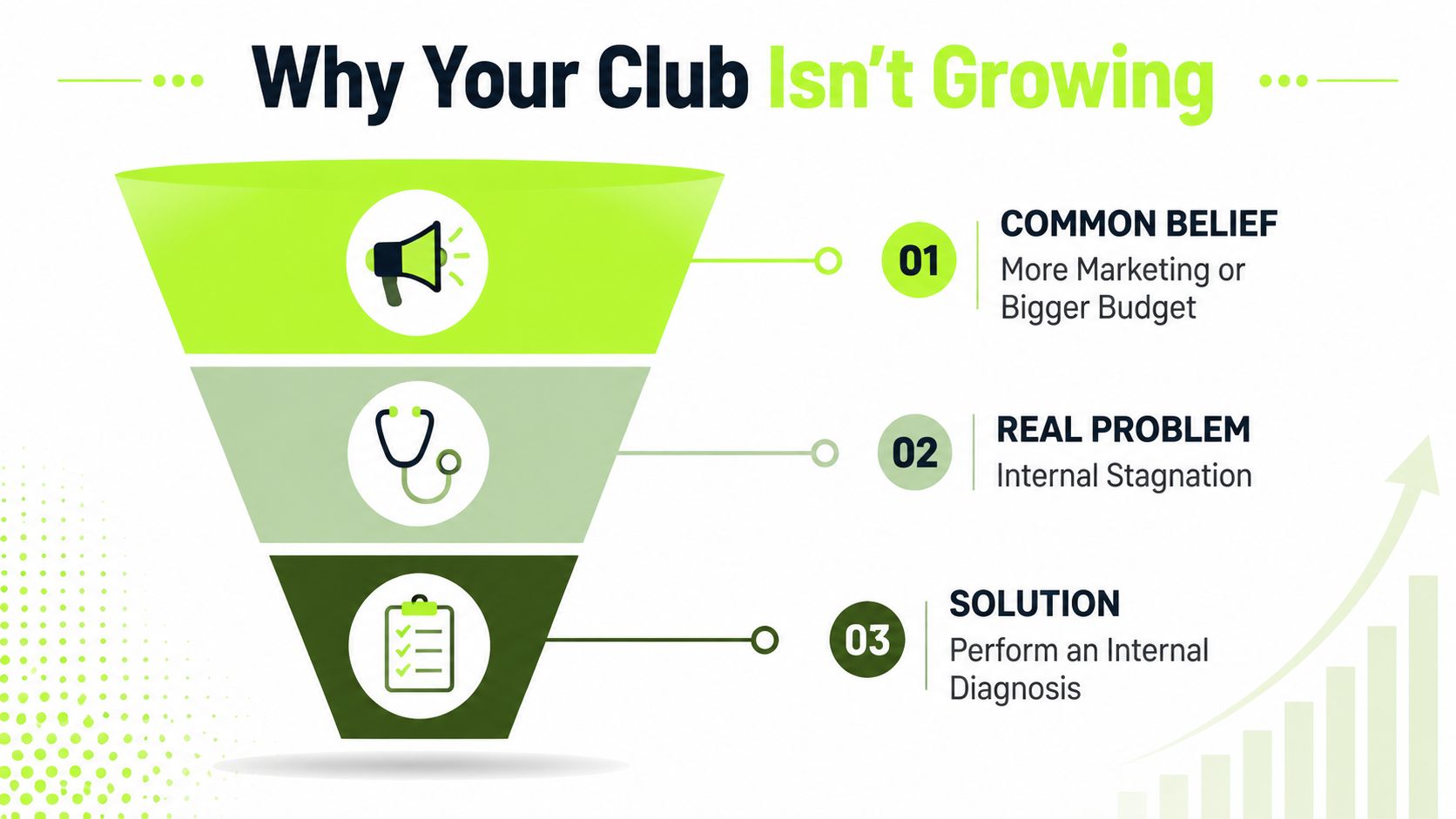
Most advice for a golf club not growing starts in the wrong place. It tells you to spend more on ads, post more on social media, or run another membership promotion. That can help, but it often treats the symptom and misses the bottleneck.
In practice, stagnant growth usually comes from a club system that leaks interest at every stage. Enquiries sit in inboxes. Follow-up depends on who happens to be on shift. Trial visitors arrive without context. Committee discussions focus on “more leads” when the actual problem is converting the interest already there.
That's the shift worth making. Stop asking only, “How do we get more attention?” Start asking, “What happens to every enquiry after it arrives?”
Diagnosing Stagnation Why Your Club Isn't Growing
If your golf club isn't growing, don't assume demand has dried up. In Great Britain, 4.2 million adults played golf at least once in the previous 12 months, according to The R&A's 2023 participation survey. That matters because a flat membership line often points to a conversion problem, not a market problem.
A lot of clubs can still attract interest. They just don't track it properly. An enquiry comes through the website, a message lands on Facebook, someone phones reception, a visitor asks about joining after a round. Each one sits in a different place, handled by a different person, with no consistent next step.
Start with a growth audit
The first job is diagnosis, not promotion. I'd look at four simple points before touching budget or creative:
- Enquiry volume: How many genuine membership enquiries arrive each month from all sources combined?
- Response handling: Who replies, how quickly, and is that response consistent?
- Visit conversion: How many enquiries turn into a tour, trial round, or meeting?
- Membership conversion: How many of those visits become members?
Most clubs know one of these numbers at best. Some know none of them. That's why committee conversations drift into opinion. One person thinks the website is the issue. Another blames pricing. Someone else wants a summer offer. Without a basic audit, everyone is guessing.
Practical rule: If you can't see the full journey from first enquiry to paid membership, you can't diagnose why the club is flat.
The real bottleneck is usually internal
A golf club not growing often looks like a marketing issue from the outside. From the inside, it's usually an operations and process issue. Leads are invisible. Follow-up is manual. Staff are busy with daily duties. Good prospects cool off while the club decides who should contact them.
That's why passive awareness rarely fixes the problem. Golfers already exist in your catchment area. Interest already exists. The club just isn't set up to capture, organise, and convert that interest reliably.
A useful way to frame it is this:
| Area | Healthy club behaviour | Stagnant club behaviour |
|---|---|---|
| Lead capture | Every enquiry goes into one system | Enquiries sit across email, paper notes, DMs and memory |
| Response | Clear ownership and prompt follow-up | Delayed replies or no reply at all |
| Sales process | Visits and tours are structured | Visits happen ad hoc with no set journey |
| Reporting | Committee sees conversion stages | Committee sees only total member count |
The hard truth is that a club can have a decent reputation, a strong course, and genuine local demand, and still underperform because the system between interest and membership isn't organised.
What to measure before you “do more marketing”
You don't need a complicated dashboard to start. You need a working scoreboard. Track:
- How many membership enquiries came in
- How many received a same-day response
- How many booked a visit
- How many joined
- How many dropped out without any follow-up
That last number is often the revealing one.
If you want a fuller breakdown of why this happens so often, GolfRep has written about why most golf clubs struggle to attract new members. The headline problem usually isn't visibility alone. It's what happens after visibility creates interest.
Fixing the Leaky Bucket Systems for Enquiry Conversion
Once you've identified the leak, don't try to solve it with more manual effort. That rarely lasts. Clubs are busy environments, and membership sales often sit alongside reception, admin, events, and member service. When conversion depends on people “remembering to follow up,” leads will slip.
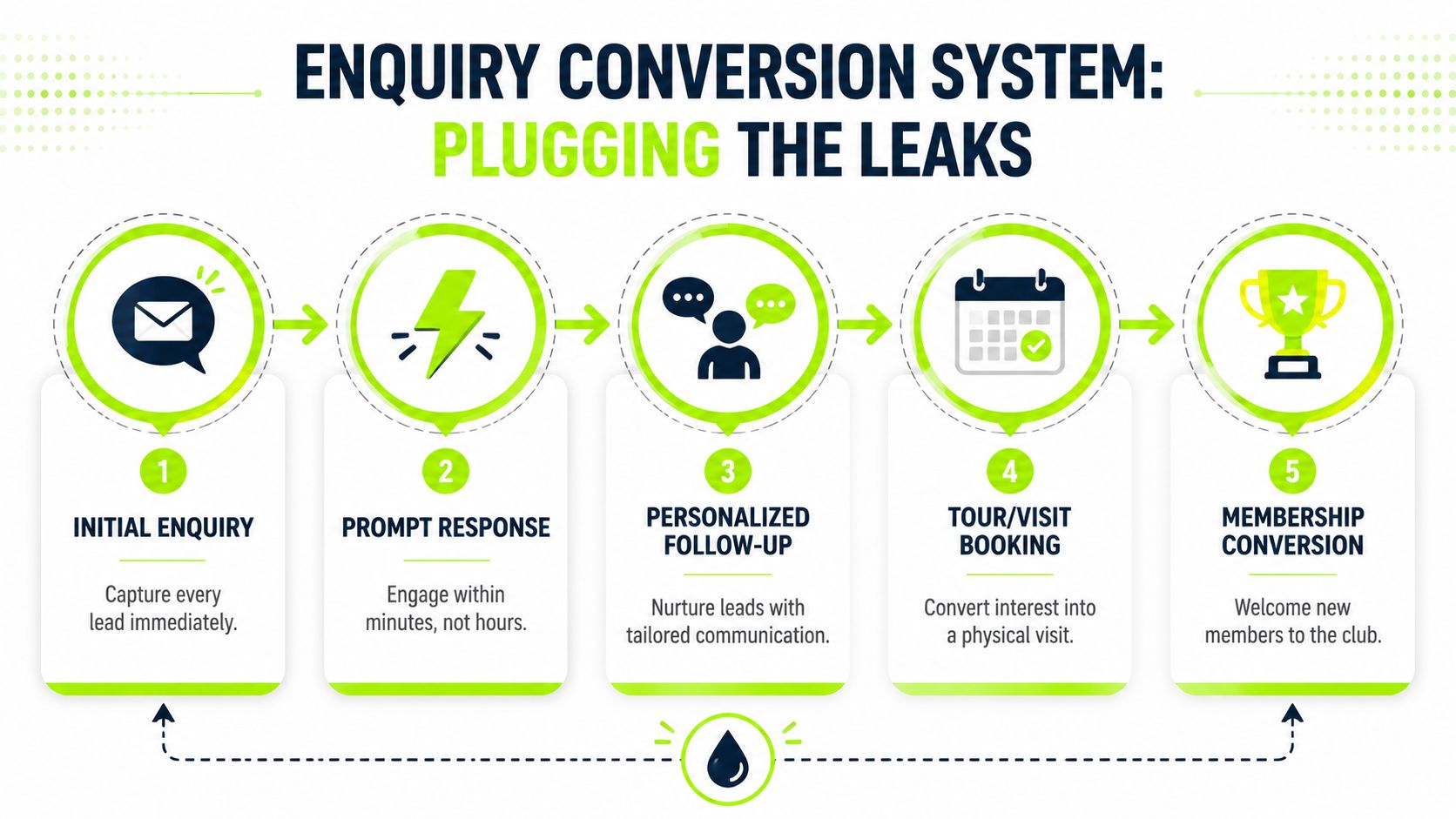
The better approach is a system. Not an abstract strategy. A practical workflow that captures every enquiry, assigns ownership, triggers follow-up, and shows what stage each prospect is in.
What a proper enquiry system looks like
A club that converts well usually has these pieces in place:
- One central CRM: Website forms, phone enquiries, social leads, and walk-ins all end up in the same place.
- Immediate acknowledgement: The golfer gets a prompt reply confirming the club has received the enquiry.
- Structured follow-up: The prospect doesn't rely on one staff member remembering to send the next message.
- Stage visibility: Everyone involved can see whether the lead is new, contacted, booked, visited, or lost.
- Reporting: Management can see which channels produce real members, not just raw enquiries.
Clubs often overcomplicate things. They think a CRM means a complex software project. It doesn't. It means one source of truth.
Response speed matters because interest decays fast
When someone enquires about joining, they're usually comparing options, checking affordability, or acting on a moment of motivation. If they don't hear back promptly, they don't sit patiently waiting. They move on, forget, or enquire elsewhere.
That doesn't mean every reply must be written by hand within minutes. It means the system must respond straight away, while the team handles the personal follow-up properly. An automated acknowledgement, a booked call slot, a tour invitation, or a short qualification form can do that job well.
Fast response isn't about looking slick. It's about preventing avoidable drop-off while interest is still active.
Build the journey, not just the first reply
Many clubs answer the first enquiry and then stop. That's not a conversion process. That's a reaction.
A better sequence looks more like this:
Capture the enquiry
The source doesn't matter. Website, Facebook, Instagram, phone call, referral. It all goes into one pipeline.
Acknowledge instantly
The golfer gets confirmation, a named point of contact, and a clear next step.
Qualify sensibly
Find out what type of membership they want, when they're looking to join, and whether they're local, returning to golf, or moving clubs.
Book a visit
Don't let the conversation drift. Give a specific call to action.
Follow up after the visit
Clubs lose good prospects when great conversations happen on site, then nobody contacts the visitor again for days.
Track the outcome
Joined, delayed, lost, not suitable. Every lead needs an outcome.
- Shared inbox chaos: Everyone can reply, so no one owns the lead.
- Paper note follow-up: Reception writes down a name, then the trail goes cold.
- One-message selling: A single email gets sent, then the club waits.
- No stage definitions: Staff use different meanings for “interested” and “warm.”
- Committee-led chasing: Strategic decisions get delayed because nobody sees live pipeline data.
Who fits the club best now
Not in theory. In reality. Which type of member tends to stay, engage, and pay happily?What problem does the club solve for them
Convenience, community, better course access, improved playing standard, a return to golf, or a more welcoming environment?What would make them choose you over another local option
Not “because we have a lovely course.” Every club says that. What is distinct and believable?- what membership option suits them
- how the club works week to week
- what kind of playing access they can expect
- how they'll settle in if they join
- what happens next if they want to proceed
It removes confusion
The prospect can quickly see which option fits.It protects value
The club doesn't need to rush into discounting.It supports retention
Members start on a package they can use, rather than one they later resent paying for.- A proper welcome sequence: Not just a payment receipt. A simple, human onboarding journey.
- Named contact: Someone the new member can ask without feeling awkward.
- Early integration: Introductions to groups, roll-ups, or club activities that suit their profile.
- Expectation setting: Clear communication on tee booking, competitions, clubhouse routines, and etiquette.
- Audit every enquiry source: Website, phone, social, referrals, visitor traffic.
- Create one lead pipeline: Even a simple CRM is better than scattered inboxes.
- Assign ownership: Every enquiry needs a responsible person, not a vague team duty.
- Standardise first response: Build templates, booking links, and next-step messages.
- Track core numbers: Enquiries, response handling, visits booked, memberships sold.
- Refining membership packages: Remove friction and clarify fit.
- Improving onboarding: Help new members settle in faster.
- Training staff around the pipeline: Keep the system consistent even when people change.
- Reviewing capacity regularly: Growth must match service delivery.
- Doubling down on proven channels: Keep the sources that produce quality members.
That process can be managed with many tools. One option is GolfRep, which combines lead generation, CRM tracking, and automated follow-up built around golf club membership pipelines. The important point isn't the brand. It's that the club stops relying on scattered inboxes and memory.
What doesn't work
Some habits look busy but produce weak results:
If this sounds familiar, you're not alone. It's common enough that we've written specifically about how most golf clubs lose 30% of enquiries without realising.
A club doesn't need more chaos at the top of the funnel. It needs fewer leaks in the middle.
Attracting the Right Golfers Not Just More Traffic
Once your conversion process is under control, marketing becomes more useful. Before that, extra traffic often just feeds a broken system.
The next mistake clubs make is targeting everyone. Broad reach sounds positive, but poor-fit enquiries create workload without improving member quality. If your club is attracting golfers who don't suit the pricing, location, culture, or playing offer, you'll stay busy and still feel like the golf club isn't growing.

Define who you actually want
A useful filter is to ask three simple questions:
This changes the tone of your advertising. Instead of generic “Join now” messaging, your campaigns can speak directly to golfers who are likely to value your proposition.
Better targeting beats more noise
A club doesn't need huge reach. It needs relevant reach. That usually means local targeting, golfer-specific interests, sensible exclusions, and messaging matched to intent.
For example, the message to a lapsed golfer returning after time away should look different from the message to a regular nomad golfer who currently pays green fees across multiple venues. The same offer won't resonate with both.
A lot of managers also confuse awareness work with direct response. Both matter, but they do different jobs. If you're trying to increase brand visibility, that can support future demand. It doesn't replace a proper lead capture and follow-up system.
The right campaign doesn't just generate clicks. It attracts golfers who can picture themselves belonging at your club.
Sell value, not discounting
Discount-led campaigns often bring the wrong type of urgency. They train prospects to compare price first and club fit second. That can create churn later, friction at enquiry stage, and pressure on your team to justify the normal rate.
A stronger approach is to market the membership experience clearly:
| Messaging angle | Weak version | Stronger version |
|---|---|---|
| Course | “Beautiful course” | Clear explanation of playing access, upkeep and experience |
| Community | “Friendly club” | Show how new members are welcomed and integrated |
| Value | “Affordable packages” | Explain what members actually get and why it suits their lifestyle |
| Fit | “All golfers welcome” | Speak directly to the type of golfer you serve best |
If you want the top of funnel to improve without lowering standards, focus your campaigns on fit, clarity, and intent. GolfRep has also covered this in more detail in its guide to golf club lead generation.
Turning Enquiries into Members and Members into Advocates
A signed membership form is not the finish line. If your onboarding is weak, your service is stretched, or your course standards slip, the club can win the sale and still lose the member.
This matters more than many committees realise. UK golf facilities face shortages of qualified staff, and course maintenance leaders rank lack of skilled labour as a top challenge, as noted in USGA reporting on the biggest challenges facing golf course maintenance. For a club chasing growth, that means operational capacity has to sit alongside marketing in the same conversation.
Convert tours properly
A tour shouldn't be a casual walk around with a few friendly comments. It needs structure.
The prospect should leave knowing:
Too many clubs rely on charm here. Charm helps, but clarity closes. If the visitor enjoys the atmosphere but still doesn't understand the package, fees, process, or fit, the club has created warmth without momentum.
Package for real buying behaviour
The old default of only pushing traditional categories can limit conversion. Golfers don't all buy for the same reasons. Some want regular competitive play. Others want flexibility, practice access, or a way back into the game without feeling locked in too quickly.
That doesn't mean creating endless options. It means building membership choices around actual behaviour and explaining each one well.
A sensible package structure usually does three things:
A club grows sustainably when the membership offer matches the golfer's real life, not when the golfer is forced into the nearest traditional box.
Retention begins on day one
The clubs that grow well don't just acquire members. They absorb them properly.
That means planning the first few weeks after sign-up. New members need introductions, practical guidance, clear booking knowledge, and visible ways to get involved. If they join and then feel anonymous, your acquisition work becomes expensive in effort even if the marketing looked efficient.
Here are the retention points I'd prioritise first:
A lot of clubs lose momentum because they think growth means filling membership categories. It doesn't. Growth means keeping promises at scale. If your staff, service model, and course presentation can't support the intake, the club will feel the strain quickly.
Your Action Plan for Predictable Growth
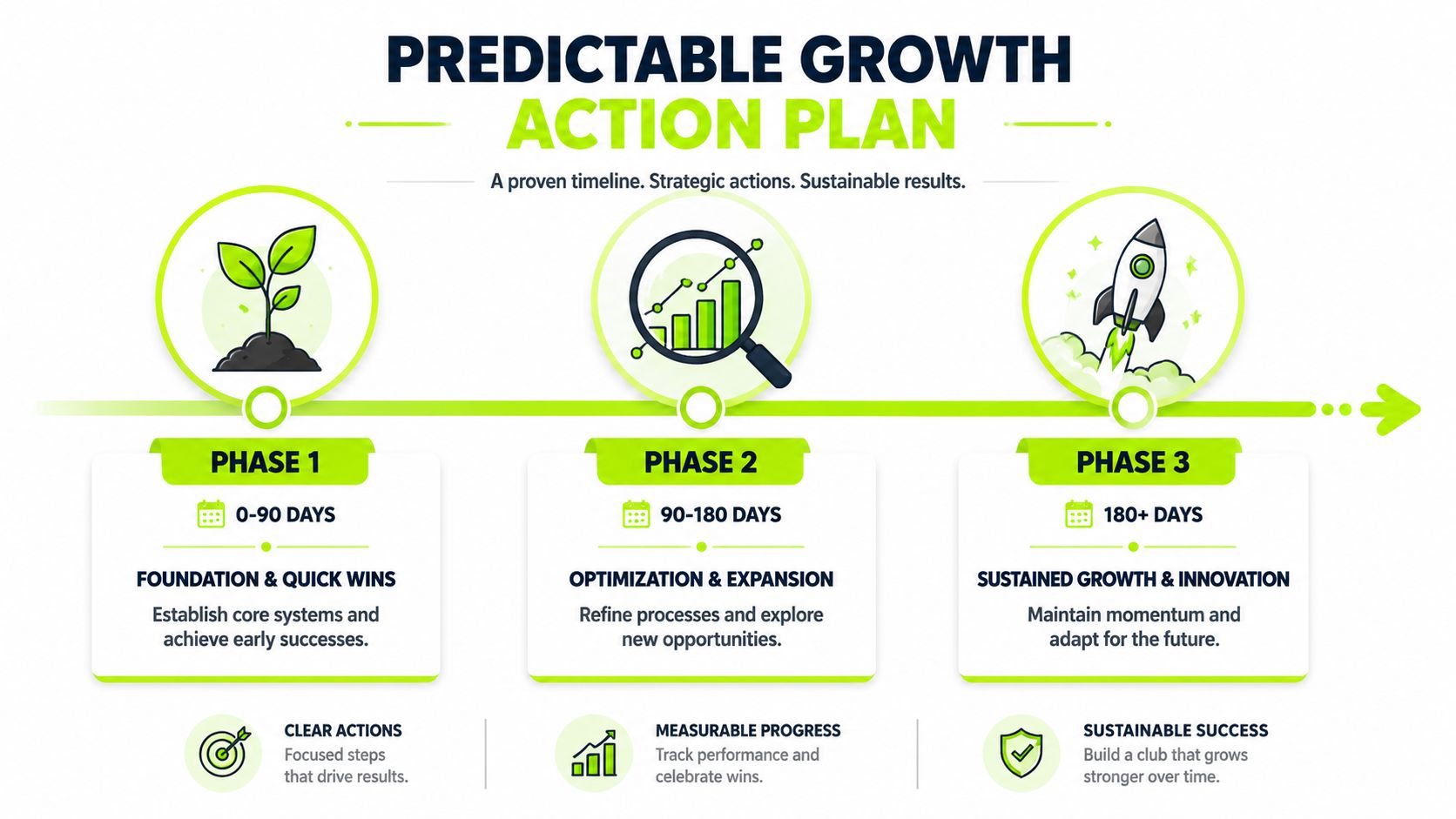
Most clubs don't need a dramatic turnaround plan. They need a sequence. The mistake is trying to fix marketing, sales, admin, and retention all at once. That spreads effort too thin and usually ends with another half-finished system.
A better route is phased progress, with each stage building on the last.
First 90 days
The first phase is about visibility and control. You need to know what is happening before you can improve it.
Focus on these actions:
At this stage, don't obsess over volume. Fix handling first.
Days 90 to 180
Once the basics are stable, start improving conversion quality. At this stage, you tighten the process and start feeding it better-fit demand.
I'd use this period to review where prospects stall. Is it before the visit, after the visit, or at package selection? Are staff handling tours consistently? Are follow-up messages happening on time? Are leads from one source stronger than another?
A short working table helps committees stay focused:
| Priority | What to review | What good looks like |
|---|---|---|
| Response | Speed and consistency | Every lead gets acknowledged and progressed |
| Tours | Booking rate and attendance | Visits are scheduled promptly and run to a set format |
| Follow-up | Post-visit communication | No warm prospect goes cold through silence |
| Campaigns | Lead quality by source | Better-fit enquiries, not just more form fills |
Key checkpoint: If the team still can't see where leads are being lost, don't increase ad spend yet.
Beyond 180 days
Predictability starts to emerge. By now, the club should know what kind of golfer converts well, which messages resonate, and where the sales process still needs work.
The next layer usually includes:
The objective isn't endless expansion. It's a club that knows how to attract, convert, and retain members without relying on luck, one-off promotions, or heroic staff effort.
If you're dealing with a golf club not growing, that sequence matters. Clubs that skip to “promotion” before they fix visibility, ownership, and follow-up often stay stuck in the same cycle. Busy, hopeful, and inconsistent.
Beyond Growth Building a Sustainable Club
Sustainable growth comes from infrastructure, not bursts of activity. A club becomes more resilient when enquiries are visible, follow-up is organised, staff know what happens next, and new members experience a club that can deliver on what was promised.
That's the answer to a golf club not growing. Not louder marketing on its own. Not cheaper offers. Not another committee debate about awareness. The answer is a reliable system that connects demand, conversion, operations, and retention.
Clubs that build that system stop relying on chance. They make better decisions because they can see what's working, where prospects are being lost, and whether the club can support further growth without damaging the member experience.
If your club wants a clearer view of where growth is stalling, GolfRep helps golf clubs build structured membership pipelines with lead tracking, follow-up automation, and conversion systems that fit how clubs operate.
Ready to tap into our proven growth system?