Master Facebook Giveaway Rules: UK Golf Clubs 2026

A lot of golf clubs have run the same Facebook giveaway.
It’s usually a decent prize. A free fourball. Sunday lunch for two. A lesson with the pro. The post gets plenty of attention, the comments roll in, members say it’s “doing well”, and for a few days it feels productive.
Then nothing much happens.
The tee sheet doesn’t change. Membership enquiries don’t meaningfully improve. Nobody can clearly say who entered, who looked like a serious prospect, who was followed up, or whether the campaign produced anything beyond a short burst of activity.
That’s the gap most articles miss when they talk about facebook giveaway rules. The rules matter, and getting them wrong creates avoidable risk. But the bigger issue for golf clubs is that a giveaway often gets treated as a social media task, not as part of a membership pipeline.
Why Your 'Win a Fourball' Giveaway Is Not Building Your Club
A golf club runs a Facebook giveaway for a free fourball on Monday. By Friday, the post has drawn plenty of comments, a healthy number of shares, and the usual messages from members saying it has "done really well". Two weeks later, there are no extra membership tours booked, no usable prospect list, and no clear record of who entered with any genuine interest in joining.
That result is common because the campaign was built for visibility, not for conversion.
A Facebook giveaway can create attention quickly. Attention on its own does not help a club forecast memberships, fill academy programmes, or track which local prospects should be invited in for a tour. If entry happens entirely inside the post, the club usually ends up with noise rather than lead data.
That distinction matters. Many clubs do not have an awareness problem. They have a follow-up problem, a data problem, and a process problem. Interest appears, then disappears into comments, inboxes, spreadsheets, and whoever on the team happens to be available that day.
The failure is in the system design
A giveaway only becomes commercially useful when it feeds a process the club can work.
That means three things need to be in place from the start:
- Lead capture: collect permission-based contact details, not just Facebook interactions
- Lead visibility: record who entered, what they were interested in, and whether they live locally or fit your target member profile
- Follow-up: assign a next action, whether that is a tour invitation, a guest round, a beginner offer, or a membership conversation
If the only output is post engagement and a winner announcement, the club has not created an asset. It has created a brief spike in activity on rented ground.
I have seen clubs give away rounds to hundreds of people who were never realistic prospects. Existing members tag friends from outside the area. Competition accounts join in because the prize is free. Staff then spend time sorting through names that will never turn into visits, lessons, society bookings, or memberships. The giveaway feels busy, but it does not move the pipeline.
There is also a risk trade-off. A quick post is easier to publish, but the less structure you put in at the start, the more likely you are to run into problems later. Unclear eligibility, vague winner selection, and weak handling of entrant data create avoidable issues for a club that is trying to protect its reputation locally.
What a productive giveaway looks like
A productive giveaway starts with a club objective, not a vanity metric.
For a UK golf club, that usually means using the offer to identify local people who are likely to buy something after the campaign. That could be a flexible membership, a beginner package, a lesson series, or a visitor round that leads to a membership discussion.
Once that is the goal, the structure changes:
- The prize filters for the right type of entrant instead of attracting everyone
- The entry route captures details the club can use lawfully and practically
- The selection process protects the club if the result is ever questioned
- The follow-up plan turns entrants into booked visits and sales conversations
A "win a fourball" giveaway can still work. It just needs to be treated as the front end of a measurable membership campaign, not as a standalone social post. That is the difference between a promotion that gets attention and one that helps the club grow predictably.
The Three Pillars of a Compliant Facebook Giveaway
Most clubs think of compliance as one box to tick. It isn’t. A giveaway sits across platform rules, UK promotion law, and your own handling of entrant data.
That’s why clubs get caught out. They read a quick checklist, copy a generic post, and assume they’re covered.
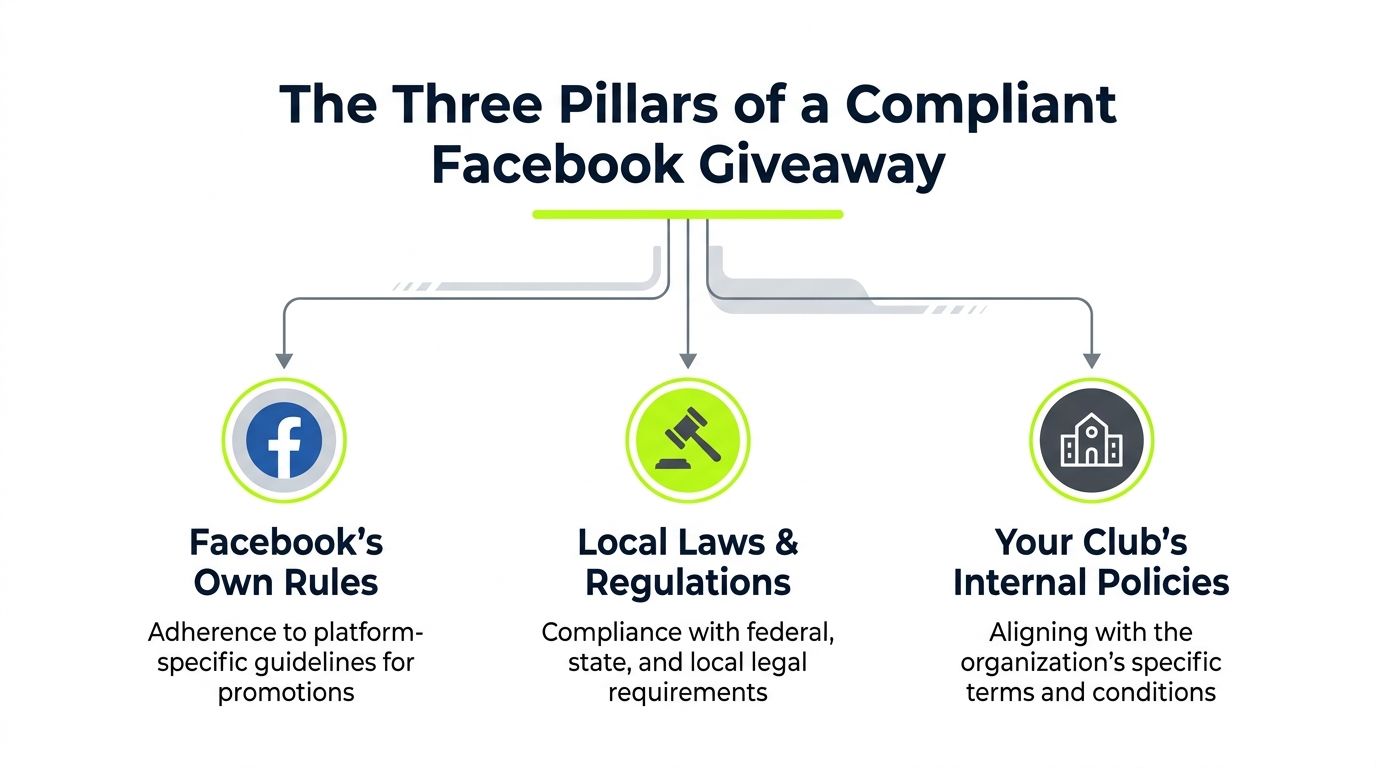
Facebook’s own rules
Facebook has its own promotion requirements, and these apply before you even get into UK law.
Promotions must be run from appropriate places on the platform, such as a Page, Group, or Event, not a personal profile. You also need clear rules covering eligibility, entry method, timing, and how the winner will be selected. Facebook also expects a disclaimer making clear that the promotion isn’t sponsored, endorsed, administered by, or associated with Facebook.
A lot of clubs fall down on entry mechanics. Older habits still linger, especially “like, share and tag to enter” posts. But that approach creates problems quickly. Facebook’s rules have long moved clubs away from building entry mechanics around native sharing or tagging requirements.
UK law and advertising standards
The second pillar is UK regulation.
Your giveaway has to operate as a lawful promotion. In practice, that means clubs need to pay attention to the Gambling Act 2005 distinction around free draws and to the CAP Code standards enforced by the ASA. The point isn’t to become a lawyer. The point is to avoid running something that looks casual on Facebook but fails basic promotional standards when challenged.
For club managers, the practical checks are straightforward:
- Eligibility must be clear: If it’s for UK residents aged 18+, say so.
- The prize must be described accurately: A fourball, lesson, lunch, or trial experience should be stated plainly.
- The timing must be unambiguous: Opening date, closing date, and how late entries are handled.
- Winner handling must be fair: Random draw means random draw. If there’s judging, explain the criteria.
- No purchase requirement for a free draw: If entry depends on payment, you’re in different territory.
Clubs usually don’t get into trouble because the prize was exciting. They get into trouble because the wording was vague, the process was unclear, or the promotion looked misleading after the fact.
Your club’s internal policies and data handling
The third pillar is the one many giveaway guides barely touch. Your club’s own data handling.
The moment you collect names, email addresses, or any information that can identify an entrant, you’re not just running a promotion. You’re handling personal data. That means your internal process matters as much as your Facebook caption.
A compliant giveaway needs to answer practical questions:
| Pillar | What it governs | What clubs need to control |
|---|---|---|
| Platform rules | Facebook promotion requirements | Post format, disclaimer, allowed entry methods |
| Local regulation | UK promotion and advertising law | Eligibility, fairness, prize wording, no misleading claims |
| Internal policy | Data capture and follow-up process | Consent, privacy notice, storage, CRM handover |
Why this matters operationally
Compliance isn’t only about avoiding complaints. It shapes whether your giveaway can be used as a serious lead source.
If your post is compliant but your staff store entrant details in scattered spreadsheets, forward emails manually, and follow up inconsistently, you still have a weak process. If your legal wording is fine but nobody can prove how the winner was chosen, that also creates risk.
A strong giveaway system is built on all three pillars at once. The post has to be compliant, the promotion has to be lawful, and the club has to handle enquiries like an organised business rather than a social feed.
Designing Your Giveaway Entry and Selection Mechanics
At this stage, most Facebook giveaways go off course.
The club wants reach, so someone suggests the usual formula. Like the page. Share the post. Tag three friends. Comment “done”. It feels simple, and it looks like it will spread. In practice, it’s exactly where compliance and tracking start to break down.
The key issue is that what people can do on Facebook is not the same as what you can reliably use as an auditable entry method.
What works and what doesn’t
Facebook giveaway mechanics need to be built around actions you can manage properly.
According to EasyPromos’ explanation of Facebook competition rules, Facebook’s API only allows third-party giveaway tools to access username, comment text, and timestamp from engagement-based entries. It cannot access data on who shared a post or tagged a friend, which means those actions can’t be used as required or trackable entry conditions in an automated, compliant giveaway.
That changes the practical setup for clubs.
What usually works best:
- Comment-based entry: Ask a relevant question in the comments.
- Like-based entry: Lower friction, but less useful for qualification.
- Landing-page entry from Facebook traffic: Better for lead capture and follow-up.
What doesn’t work well as a required mechanism:
- Mandatory shares: Hard to track properly through official tools.
- Mandatory tagging for winner selection: The data isn’t available in a reliable, auditable way.
- “Do all three” mechanics: They create confusion and are difficult to enforce fairly.
The best entry question is a qualifying question
For golf clubs, the smartest comment prompt isn’t random banter. It should reveal intent.
Instead of “Tag who you’d bring”, ask something that tells you why the entrant is relevant to the club. For example:
- Interest-led: What do you enjoy most about your golf at this time of year?
- Visit-led: Have you played the course before, or would this be your first visit?
- Lifestyle-led: What matters most to you in a club, course quality, social side, or flexibility?
These prompts do two jobs. They create an easy entry route, and they give your team useful context. You start to see who looks local, who shows true interest, and who may be worth moving into a fuller lead capture flow.
Operational note: The more your entry mechanic depends on manual checking, the more likely your team will abandon consistency once comments start piling up.
Choosing a winner fairly
Clubs often underestimate how important winner selection is.
A fair process protects reputation. If members or entrants think the result was vague, selective, or poorly handled, the goodwill from the campaign disappears. You need a method that can be explained clearly and repeated consistently.
A sound selection process usually includes:
- A published closing time
- A fixed rule for eligible entries
- A random draw or stated judging method
- A clear record of the selection
- A defined process for contacting the winner and handling non-response
If the giveaway uses comments, export or record the eligible entries before the draw. If it uses a landing page, make sure the list is complete and deduplicated before selecting a winner.
Manual versus systematic entry handling
There’s a trade-off here.
A pure Facebook comment giveaway is easier for people to join. But it’s weaker for lead handling. A landing-page entry introduces a little more friction, but it gives the club real data, proper consent language, and a better handover into follow-up.
That’s why the strongest club campaigns often split the process:
- The Facebook post creates attention.
- The entry page captures the actual lead.
- The CRM or lead log tracks what happens next.
If you keep everything inside comments, you may get noise. If you move entrants into a structured process, you’re much closer to a usable membership funnel.
Essential Legal Copy and Disclaimers for Your Post
A club posts “Win a Fourball,” gets strong reach, and assumes the hard part is done. Then the winner asks for the terms, a non-member questions the eligibility rule, and the marketing team wants to add every entrant into a membership sequence. If the post copy, entry form, and privacy wording do not line up, the giveaway creates admin and risk instead of a clean lead source.
Good legal copy does three jobs at once. It protects the club, sets entrant expectations, and supports the follow-up process you plan to run. For a UK golf club, that matters because the giveaway is not just a social post. It is the front end of a membership pipeline.
The minimum copy your Facebook post should include
Keep the post itself clear and readable. People should understand the offer in seconds, but the post still needs the points that stop confusion later.
Include:
- Prize description: State exactly what the winner receives.
- Eligibility: Set out who can enter, such as UK residents aged 18+.
- Entry method: Explain the valid route to enter.
- Closing date and time: Be precise.
- Winner selection method: Say whether the draw is random or judged.
- Facebook disclaimer: Make clear Facebook is not running the promotion.
- Terms access: Link to the full promotion terms.
A simple Facebook disclaimer can read:
This promotion is in no way sponsored, endorsed, administered by, or associated with Facebook. By entering, you acknowledge that your information is being provided to [Club Name], not to Facebook.
Put that in a clearly visible place. Do not bury it inside promotional copy.
What belongs in your full terms and conditions
The post gives the short version. The full terms carry the operational detail your team may need to rely on later.
For many clubs, the practical setup is a dedicated promotion page supported by a standing club terms and conditions page for promotions and website use. The key point is that each giveaway still needs campaign-specific wording. A generic website terms page will not cover the exact prize, dates, exclusions, and contact process unless you add them.
Your giveaway terms should cover:
| Compliance Area | Requirement | Action Check |
|---|---|---|
| Eligibility | State age, residency, and any exclusions | Confirm who can and cannot enter |
| Prize details | Describe the prize accurately | Check wording matches the actual offer |
| Entry method | Explain the valid route to enter | Remove unclear or conflicting instructions |
| Promotion dates | Include opening and closing details | Verify the post and terms match |
| Winner selection | State how the winner is chosen | Keep a record of the process |
| Winner contact | Explain how and when the winner will be notified | Assign responsibility internally |
| Data use | Explain what data is collected and why | Link to privacy wording at the entry point |
In this regard, clubs often cut corners. The risk is not only legal. Poor terms also make staff handover harder, especially if reception, marketing, and management each handle part of the promotion.
GDPR is usually the weak point
Generic giveaway advice often stops at platform rules. For UK golf clubs, the bigger issue is what happens to entrant data after the draw.
KickoffLabs’ guide to giveaway compliance highlights that UK GDPR requirements are a common gap in standard giveaway advice. If your club collects names, emails, phone numbers, or membership interest through the promotion, the entry point needs clear privacy wording and a clear consent choice for any later marketing. This is not a theoretical risk. KickoffLabs points to a 2025 ICO enforcement action involving poor giveaway data handling, which is exactly the kind of avoidable mistake clubs should steer clear of.
That has a direct commercial implication. If someone enters to win a fourball, that does not automatically give the club permission to send ongoing membership campaigns unless you have asked for that properly.
Your entry form should spell out:
- What information you collect
- Why you collect it
- Whether marketing follow-up is optional or included
- How someone can opt out
- Where the full privacy notice can be read
A privacy notice that works in practice
Clubs do not need legal theatre. They need wording that a real person can read and understand before submitting the form.
A workable version might say:
We’ll use your details to administer this giveaway and contact the winner. If you choose to receive club updates, we’ll also send information about membership, events, and visitor offers. You can unsubscribe at any time.
That copy does a practical job. It separates giveaway administration from optional marketing and gives your team a cleaner consent record if the entrant later becomes part of a membership enquiry workflow.
Keep the wording aligned with the process
The post, the form, and the internal handling process must match.
If the Facebook post says the winner will be contacted by direct message, do not switch to phone calls without saying so. If the form says entrants are only being contacted about the giveaway, do not drop them into a wider email sequence. If the club wants to use the campaign to identify prospective members, ask for that permission clearly at the point of entry.
This is the trade-off. Tighter wording can reduce the size of the marketing list. It usually improves the quality and defensibility of the leads you keep. For a club that wants a predictable membership pipeline, that is the better outcome.
Turning Giveaway Entrants into Members The GolfRep System
A club runs a "Win a Fourball" giveaway, gets strong engagement, and then nothing useful happens next. The winner is chosen, the post gets likes, and the team is left with a list of entrants that never becomes visits, tours, or membership conversations.
That is the gap.
Giveaways help clubs get attention. They only help grow membership when the campaign is built to collect usable data, route it into the right system, and trigger follow-up while the interest is still fresh.
The post should drive to a proper entry page
If membership growth is the objective, the post should do one job. It should send the right people to a dedicated entry page.
That structure gives the club control over the next step:
- Facebook post or ad
- Dedicated landing page
- Form submission
- CRM entry
- Automated and human follow-up
A proper landing page lets the club explain the prize clearly, ask qualifying questions, record consent properly, and pass each entrant straight into a visible pipeline. Facebook comments cannot do that. A downloaded list of names from a rushed admin process cannot do it either.
The trade-off is simple. A tighter form usually reduces total entries. It also improves lead quality, follow-up speed, and reporting. For a UK golf club trying to build a predictable membership pipeline, that is usually the better deal.
Why clubs lose leads after a successful giveaway
The failure point is usually not the giveaway itself. It is what happens in the 24 to 72 hours after someone enters.
A campaign can generate plenty of interest, but clubs still lose the opportunity if nobody owns the next action. One staff member exports the entries. Another plans to call them later. A few people get an email. The rest sit untouched until the campaign has gone cold.
That creates two problems at once. Prospective members do not hear back while intent is highest, and the club learns nothing useful about which campaigns produce revenue.
A giveaway becomes commercially useful when the club can answer practical questions quickly:
- Who entered from this campaign?
- Who gave permission for further contact?
- Who lives within the club's catchment area?
- Who is interested in flexible, beginner, or full membership?
- Who has already been contacted?
- Who booked a visit, replied, or asked for prices?
- Who later joined?
If those answers are buried across inboxes, spreadsheets, and Facebook notifications, the club does not have a pipeline. It has admin.
Automation makes the process repeatable
Good follow-up is not about sending more messages. It is about sending the right next message to the right entrant, with clear timing and ownership.
A connected system can send an immediate confirmation email, notify the relevant staff member, tag the source campaign, and place the entrant into the correct follow-up path based on the form response. Someone interested in a social membership trial should not receive the same sequence as a low handicap player asking about competition access.
That is why clubs need a documented golf club follow-up system, not just a giveaway post and a hope that the team will remember to chase people later. Speed matters. Visibility matters. So does knowing which staff member owns the next conversation.
Best practice: Treat the giveaway entry as the first conversion point. Membership interest is built in the follow-up, not proved by the initial click.
What the nurture should actually do
The follow-up should move the entrant toward a realistic next step.
For a golf club, that usually means one of these:
- A confirmation email with the winner announcement date
- An invitation to visit the club
- A note about a beginner pathway or flexible membership option
- An open day, trial session, or academy invitation
- A prompt to book a coffee, tour, or membership conversation
The message should match the original reason they entered. Someone who entered to win a lesson may respond well to coaching, beginner offers, or a low-pressure visit. Sending a hard membership pitch immediately can reduce response rates and waste a warm lead.
Experienced clubs separate volume from intent. The giveaway gets the hand-raise. The nurture sequence qualifies whether that person is entering a competition or showing signs of becoming a member.
Track movement, not just volume
Many clubs can tell you a giveaway performed well because the post reached people and generated entries. Fewer can show how many entrants became enquiries, visits, or joins.
That is the metric shift that matters.
Useful reporting should track progress through the pipeline:
| Stage | What to measure qualitatively |
|---|---|
| Entry | Which source brought the entrant in |
| Qualification | Whether the entrant fits the club's location and offer |
| Follow-up | Whether the entrant received a timely and relevant response |
| Engagement | Whether they opened, clicked, replied, or booked |
| Conversion | Whether they became an enquiry, a visit, or a member |
When that structure is in place, a Facebook giveaway stops being a one-off promotion. It becomes a repeatable acquisition channel that feeds the club's CRM, gives the team clear next actions, and makes membership growth easier to measure and improve.
Amplifying Your Giveaway with Paid Promotions
A club posts a "win a fourball" giveaway on Wednesday, adds budget on Thursday, and expects entries by the weekend. Then the ad stalls in review, the copy lacks the right disclosures, and the campaign misses the booking window it was meant to support.
That is the main difference between an organic giveaway and a paid one. Paid promotion gives the club more control over reach, but it also brings stricter scrutiny and less tolerance for vague setup.
Paid ads face review before they go live
Platform-specific guidance from The Social Media Law Firm on giveaway rules for paid Facebook and Instagram ads states that paid giveaway ads go through pre-delivery review. The firm also notes that key disclosures should appear in the ad copy itself, not be left to a separate page, and that advertisers should allow time for review before launch.
For a golf club, that affects planning as much as compliance.
If the giveaway supports an open day, a membership push, or a quiet midweek period, late approval can break the campaign before a single lead arrives. The practical fix is simple. Build the ad early, include the necessary terms in the creative or primary text, and leave enough time for approval before the promotion matters commercially.
What the ad needs to say clearly
A paid giveaway ad has to stand on its own. The landing page can carry the full terms, but the ad still needs enough detail for both reviewers and entrants to understand the offer.
In practice, that usually means including:
- Who can enter: for example, UK residents aged 18+ if that applies
- Whether payment is required: if no purchase is necessary, say so plainly
- What the prize is: such as a fourball, lesson, or visitor package
- Where full terms can be found: as a supporting route, not a substitute for clear ad copy
This is not just about getting the ad approved. It also improves lead quality. Clear copy filters out people who click because the post looked vague or overly broad.
Paid reach works best when the targeting matches the membership goal
The main benefit of paid promotion is precision.
Instead of hoping the post spreads through existing followers, the club can put the offer in front of local golfers inside its catchment, exclude areas that are too far away, and test different audiences against the same giveaway. That matters if the primary objective is membership growth rather than short-term engagement. Clubs that want a clearer model for this can review how golf clubs can add 50-100 members using paid advertising.
There is a trade-off. Paid campaigns take more discipline up front. The club needs tighter copy, a cleaner handoff to the entry page, and a plan for what happens after the lead comes in.
Organic posts are still useful for engaging current followers. Paid promotion is stronger when the club wants a steady flow of new local prospects who are not already in its audience.
Judge paid giveaways like acquisition campaigns
Once budget is involved, likes and comments stop being the useful scorecard.
The better questions are operational. Did the ad reach the right local audience? Did enough people complete the entry form? Did the team follow up quickly? Did any entrants move into a visit, trial, or membership conversation?
That is where paid giveaways either pay back or waste spend. A boosted competition can buy attention. A properly built campaign can produce qualified leads that enter the club's pipeline with source tracking, consent, and a next step already mapped.
Conclusion Beyond Likes to Lasting Growth
A Facebook giveaway is easy to launch and easy to misjudge.
If the club measures success by comments, it will usually overestimate the value of the campaign. If it treats the giveaway as the front end of a structured lead process, the same activity can become far more useful.
The foundation is compliance. Facebook’s promotion rules, UK advertising standards, lawful prize draw mechanics, and proper data handling all need to be in place before anything goes live.
After that, the actual work starts.
A worthwhile giveaway should move people off the platform, capture permission-based data, place every entrant into a visible system, and trigger follow-up that the club can manage. That’s how a simple promotion becomes part of a predictable membership pipeline.
For golf clubs, the problem usually isn’t that interest can’t be generated. It’s that interest is often handled manually, inconsistently, and too slowly. The clubs that grow steadily aren’t the ones running the flashiest competitions. They’re the ones with a process that turns attention into action.
If your club wants to build a more predictable way to turn social campaigns, paid traffic, and website enquiries into real membership conversations, GolfRep helps golf clubs put the right systems behind the lead flow so opportunities are visible, followed up properly, and tracked through to revenue.
Ready to tap into our proven growth system?