Golf Club Membership Decline: Data-Backed Solutions
Most advice on golf club membership decline is lazy. It tells clubs to run another promotion, shave a bit off the joining fee, or blame the economy and move on.
That misses the core issue.
Golf isn't short of interest. Your club is usually short of process. Enquiries arrive, then sit in inboxes. Prospects ask for information, then hear nothing useful back. Someone says they'll follow up, but nobody owns it. By the time the club responds properly, the golfer has moved on, postponed the decision, or chosen the easier option.
Committees often treat membership decline as a demand problem. In practice, it's usually a conversion problem first and a product problem second. If your club still handles membership sales with email chains, paper notes, and whoever happens to be free that day, you don't have a marketing problem. You have an operational leak.
That's the uncomfortable truth. It's also good news, because operational leaks can be fixed.
Reframing the Golf Club Membership Decline
“Membership decline” is a bad frame for this discussion because it encourages passivity. Committees hear the phrase and start talking like victims of a market trend instead of owners of a commercial process.
That mindset creates bad decisions.
It pushes clubs toward familiar but ineffective fixes: another offer, another discount, another round of hand-wringing about whether golfers still want to join. Meanwhile, genuine buying intent keeps appearing through website forms, phone calls, trial rounds, guest visits, and clubhouse conversations. The question is simpler. What happens to that interest once it reaches your club?
For many clubs, the answer is uncomfortable. Interest enters the building, then disappears into admin.
A prospect asks about membership categories and gets a generic PDF. Someone requests a tour and waits days for a reply. A visitor has a good experience on the course, but nobody follows up. None of that shows up in committee discussions as a process failure. It gets mislabelled as weak demand.
That is how clubs misdiagnose the problem.
The conversation should start with throughput, not theory
If you want a useful view of membership performance, stop debating the market in abstract terms and inspect the path from enquiry to join. Measure response times. Count booked visits. Track follow-up attempts. Review how many prospects stall after first contact. These are operating metrics, and they tell you far more than broad claims about decline.
A club with steady enquiry volume and poor follow-up discipline does not have a market problem. It has an execution problem.
Here is the practical test:
- Can you see every live membership enquiry in one place?
- Can you say who owns each next step?
- Can you measure how many enquiries become visits, and how many visits become members?
- Can you spot where prospects drop out before they decide?
If the answer is no, the committee is arguing from anecdotes.
Membership loss usually starts in the handoff
Traditional clubs often rely on goodwill and memory to handle sales. Reception takes one message. The manager handles another. A volunteer committee member promises to call someone back. The professional gives a strong tour, but nobody records what the prospect cared about or when to follow up.
That setup produces avoidable leakage.
| Process type | What the prospect experiences |
|---|---|
| Ad hoc handling | Slow replies, repeated questions, unclear next steps, inconsistent follow-up |
| Managed pipeline | Fast response, clear ownership, scheduled follow-up, visible progress toward a decision |
The clubs that hold membership together treat acquisition as an operational discipline. They do not wait for heroic individual effort to save the month. They build a repeatable system and inspect it regularly.
Committees should change the question they ask. Stop asking whether demand exists in theory. Ask where your club is failing to convert interest that already exists. That is the point where membership decline becomes manageable, because process can be fixed.
The True Causes of Modern Membership Decline
The biggest mistake clubs make is treating today's market like it's the same one they served ten years ago. It isn't.
The UK golf market has shifted away from the old assumption that every serious golfer wants a full annual membership, paid upfront, at one club. Golf Monthly's analysis of iGolf, OpenPlay, and flexible membership trends makes that plain. England Golf's iGolf and Scottish Golf's OpenPlay let non-members get official handicaps without joining a traditional club, and clubs have increasingly responded with flexible, credit-based memberships for golfers who don't play often enough to justify a full package.
Your club isn't just competing with the club down the road
That structural shift changes the competitive set.
You're no longer only competing with a nearby members' club that has a nicer bar or lower subscription. You're competing with low-commitment participation models that feel simpler, cheaper, and easier to pause. If your only offer is a full-fat annual membership with a rigid payment expectation, you're asking modern golfers to take on more commitment than they want.
That doesn't mean traditional membership is dead. It means the product ladder has to reflect real behaviour.
Here's where many clubs get it wrong:
- They defend the old package: full membership becomes the only “proper” option.
- They confuse rigidity with prestige: as if flexibility somehow cheapens the club.
- They wait too long to adapt: by the time they change, the prospect has built habits elsewhere.
Clubs that refuse to segment their membership offer usually end up segmenting the market by accident. They keep only the golfers who can absorb the cost and commitment.
Internal friction makes external pressure worse
External competition is real, but many clubs make the problem worse themselves.
The pattern is familiar:
| External pressure | Internal mistake |
|---|---|
| Flexible alternatives | One-size-fits-all membership |
| Price sensitivity | Poor explanation of value and options |
| Casual participation | No transition pathway into fuller commitment |
| More consumer choice | Slow, fragmented follow-up |
The club committee often debates fees first. That's rarely the only issue. A golfer who enquires may not need a discount. They may need a clear route from occasional play to structured membership. If the club can't present that route, it loses them before price becomes the primary objection.
The membership offer also matters after the first yes. If someone joins the wrong category, doesn't get onboarded properly, or never feels integrated into club life, they become a future resignation.
So yes, golf club membership decline has market causes. But the practical causes are easier to influence: inflexible product design, weak onboarding, and a sales process that assumes the prospect will do the work.
The Hidden Bottleneck in Your Membership Pipeline
Golf clubs talk about demand because it is more comfortable than talking about process. Demand is not the main problem in most cases. Conversion discipline is.
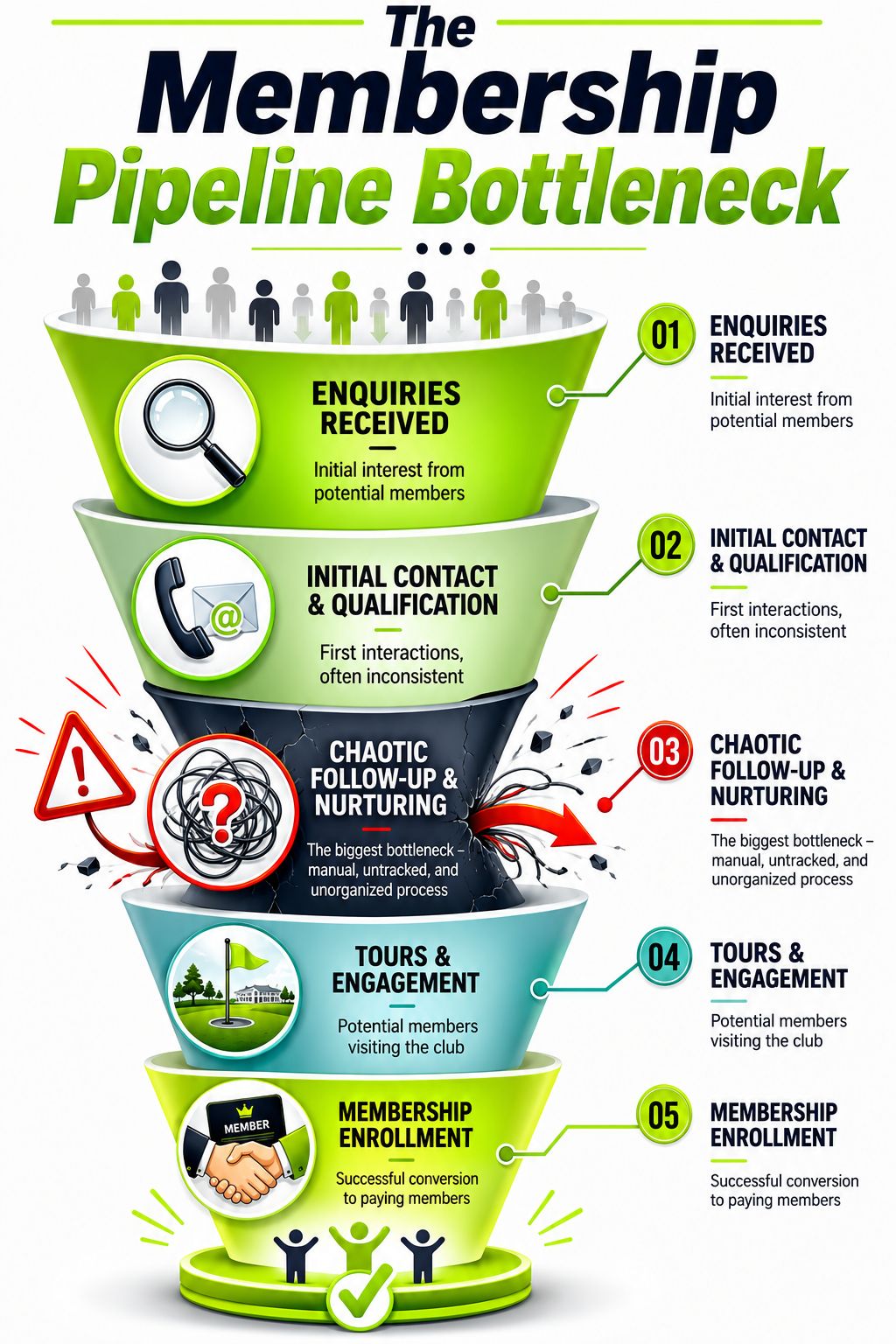
A prospect who fills in a membership form, emails about categories, or calls to ask about joining is not casually browsing. That person is showing buying intent. Yet clubs still treat these enquiries like admin tasks. They sit in an inbox. Reception passes on a message. A committee member replies when they get time. By then, the prospect has already looked elsewhere.
The break usually happens after the enquiry arrives.
Three failures come up again and again:
- Slow response: the club waits too long, and urgency disappears.
- Weak response: the prospect gets a brochure or a price list, but no clear next step.
- One-and-done follow-up: if the golfer does not reply to the first message, the club stops chasing.
That is not a traffic problem. It is a sales management problem.
Most clubs cannot see the leak
Ask the committee a few basic questions and the room often goes quiet.
How many membership enquiries came in last month? Which source produced them? How many booked a visit? How many went cold after first contact? Who owns follow-up today?
If those answers are unclear, the club is guessing. Guessing leads to the wrong fix. It pushes committees back toward more ads, more social posts, more open days, and more spend at the top of the funnel, even though the actual loss is happening in the handoff and follow-up. We broke that pattern down in more detail in our article on how most golf clubs lose 30% of enquiries without realising.
Speed matters. Structure matters more.
A fast reply without a process behind it still fails if nobody books the visit, sets the next contact date, records objections, or takes ownership of the lead.
The real issue is operational slack
As noted earlier, golfer interest has not disappeared. What disappears is momentum inside the club.
Enquiries are spread across email inboxes, paper notes, WhatsApp messages, and conversations at the front desk. Tours happen, but nobody defines the next action. Prospects ask good questions, but the club never qualifies timing, budget, or playing habits properly. Staff assume silence means no interest, when it often means the prospect got distracted or had an unanswered concern.
This is ordinary sales work. Clubs often avoid calling it that. They should stop.
A healthy membership pipeline needs five visible controls:
- Capture every enquiry in one shared system.
- Respond quickly with a specific next step.
- Qualify the prospect so the club recommends the right route in.
- Follow up on a schedule until there is a decision.
- Track outcomes by source, stage, and staff owner.
If one of those controls is missing, conversion falls and nobody can explain why. If several are missing, membership decline becomes self-inflicted.
Clubs that want a clearer operating model should study any practical sales process, not just golf marketing examples. This practical sales growth guide is useful because it focuses on response speed, qualification, and follow-up systems rather than wishful thinking about lead volume.
The committee does not need more noise at the top of the funnel. It needs a pipeline that turns existing interest into booked visits, joined members, and fewer missed chances.
Building a Predictable Member Acquisition System
Acquisition shouldn't mean “run some ads and hope”. It should mean building a repeatable path from local interest to booked visit.
That starts with accepting a blunt fact. Advertising on its own won't fix a broken process. If your enquiry handling is weak, paid traffic just pours more prospects into the same leak.
Build the system before you scale the traffic
A sensible acquisition setup has four connected parts.
First, attract the right people. That usually means local golfers with clear membership intent, not broad awareness campaigns aimed at everyone who's ever shown an interest in sport.
Second, give them a focused conversion point. Don't dump them onto a generic website page packed with committee language and outdated PDFs. Send them to a page that answers the practical questions and asks for the next action.
Third, route every enquiry into a central CRM. That's where clubs stop thinking of a CRM as a dusty database and start using it as an operating system for sales activity.
Fourth, trigger immediate and scheduled follow-up. If the club still relies on someone remembering to call later, the process isn't built.
A straightforward operating model looks like this:
| Stage | What the club should do |
|---|---|
| Traffic | Target local golfers with membership intent |
| Landing page | Present clear categories, value, and next step |
| CRM capture | Store every enquiry with source and status |
| Automation | Send immediate acknowledgement and alert staff |
| Sales follow-up | Book tours, answer objections, keep momentum |
What committees should insist on
A committee doesn't need to become technical, but it does need to become disciplined. Ask for these basics:
- Single source of truth: all enquiries must sit in one system, not scattered across inboxes.
- Defined response ownership: one person or role owns the first response and next action.
- Follow-up sequence: every prospect gets a structured path, even if they don't reply straight away.
- Conversion tracking: the club must know what turns an enquiry into a tour and a tour into a member.
That's the difference between sporadic marketing and predictable acquisition.
For clubs reviewing options, our guide to golf club member acquisition systems outlines what that setup should include. If you want a broader view of how automated conversations can support qualification and follow-up, this practical sales growth guide is also useful background reading.
Good acquisition systems don't replace people. They make sure people act on the right lead at the right time.
GolfRep works in this space by combining lead generation, automation, and CRM-led nurture so clubs can see what happens from first enquiry through to sign-up. That's the standard clubs should expect from any serious growth setup, whether they build it internally or use external support.
Engineering a Modern Member Retention Engine
Retention is where clubs either protect margin or erode it.
Too many committees still treat retention as an annual admin exercise. Renewal letters go out. A few people resign. The club shrugs and says that's normal churn. It isn't good enough, especially when warning signs are already visible.
A Golfshake survey in 2025 found that 71% of golfers still see membership as good value, but 19% were undecided about renewing and 4% said they would not renew. The same reporting also noted that the share of members paying less than £1,000 annually fell from 47% in 2024 to 41% in 2025, pointing to real pricing pressure in the lower end of the market, according to Golfshake's 2025 membership survey findings.
The undecided group is where retention is won or lost
Most clubs focus on the people who have already resigned. That's too late.
The smarter focus is the undecided member. This group doesn't always complain loudly. They merely drift. They play less, engage less, stop entering competitions, ignore club emails, and then decline to renew when the notice arrives.
A modern retention engine watches for those signals early.
- Usage patterns: Has the member stopped booking?
- Engagement behaviour: Have they gone quiet on events and competitions?
- Category fit: Are they paying for a level of golf they no longer use?
- Renewal sentiment: Have they shown uncertainty in conversation or email?
Once you spot that pattern, the club can intervene with something relevant rather than generic.
Retention needs segmentation, not blanket messaging
Not every at-risk member needs the same answer.
Some need a conversation about value. Others need a different category. Some are frustrated by access. Others are embarrassed that they're not playing enough and assume resignation is the only sensible move.
That's why a proper system matters. It lets the club segment members and act accordingly:
| Member type | Better retention response |
|---|---|
| Playing less often | Offer a step-down or transitional package |
| Price-sensitive | Reframe options before they resign completely |
| Quiet but still engaged | Prompt personal contact and club integration |
| Lapsed activity | Trigger a reactivation sequence |
A useful retention structure includes behaviour-based prompts, clear downgrade paths, and regular review of who looks vulnerable before renewal season arrives. Clubs that want to re-engage inactive members can take cues from this approach to golf club reactivation campaigns.
Retention isn't a survey once a year. It's a running system for spotting when a member's behaviour no longer matches their subscription.
If affordability pressure is pushing golfers out of lower-priced tiers, then clubs must stop pretending there are only two outcomes: full membership or goodbye. A modern club gives members a ladder to move down, pause, or re-engage without disappearing from the ecosystem.
Your Action Plan to Stabilise and Grow Membership
Most committees don't need another strategy document. They need an honest audit.
Start with your current reality, not the story the club tells itself. If you want to stabilise membership, test the process the way a prospect experiences it and measure what happens.
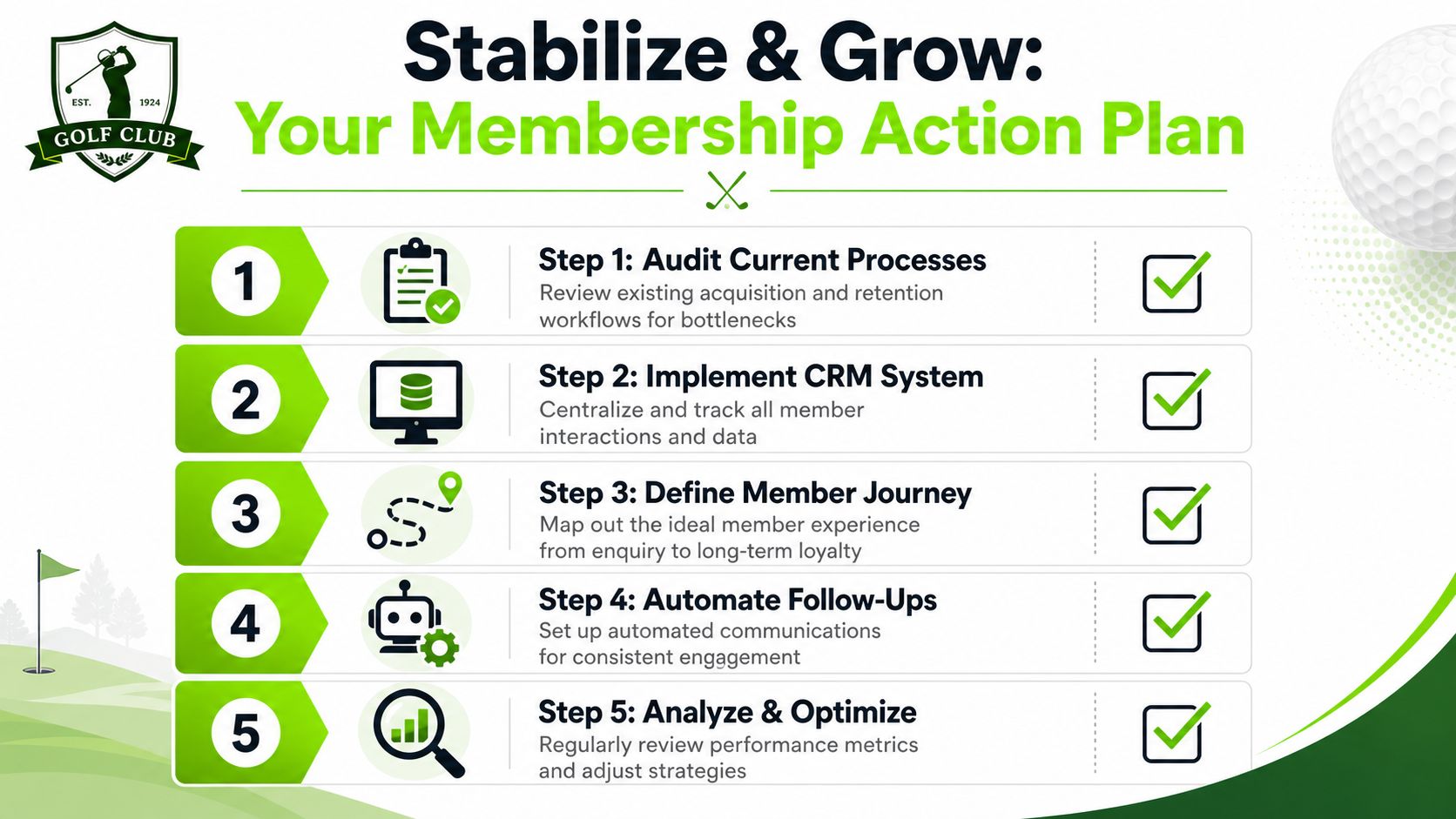
Five actions that expose the real problem
Mystery shop your own enquiry process
Submit a membership enquiry through your website. Send an email. Make a phone call. Then wait and record what happens. You'll quickly learn whether the club responds clearly, quickly, and with a real next step.Audit the data you already have
Don't settle for “we get quite a few enquiries”. Count them. Then work out how many became visits and how many became members. If you can't produce those figures, your club is operating blind.Map the follow-up journey
Write down each stage from enquiry to join. Who responds first? When is the second contact made? What happens if the prospect goes quiet? Committees are often shocked by how much of this process is undefined.Review your membership ladder
Check whether your categories reflect how people play. If the only credible route is full annual membership, you're forcing too many golfers into a yes-or-no decision they aren't ready to make.Assign ownership and cadence
Someone must own the pipeline. Not vaguely. Specifically. And they need a rhythm for review, follow-up, and reporting so the club can improve decisions instead of repeating assumptions.
What better looks like
When clubs tighten the process, the results show up in calmer operations as much as in sales. Enquiries stop disappearing. Staff know who is waiting for contact. Committee discussions get sharper because they're based on pipeline evidence, not anecdotes.
That's the pattern behind the strongest club turnarounds. It isn't magic. It's structure. A club like Bidston Golf Club didn't need vague optimism. It needed a managed system that turned demand into recurring membership revenue. Other clubs, including Addington Palace, show the same principle. Consistency beats chaos.
If your club wants growth, stop asking for better luck. Ask for a process that can be repeated, measured, and improved.
Golf club membership decline feels overwhelming when it's discussed as a market trend. It becomes manageable when you treat it as a pipeline problem, a product fit problem, and a retention discipline problem. Those are all solvable.
If your club wants a clearer view of where membership is leaking, GolfRep helps clubs build structured pipelines that connect enquiry generation, follow-up, CRM tracking, and retention into one practical system.
Ready to tap into our proven growth system?