Golf Club Membership Campaign: Your 2026 Growth Strategy
You can still hear the same sentence in clubs up and down the country, the enquiries are coming in, but the joiners aren't. A committee sees the form fills, the pro shop takes the calls, the secretary is busy, and the lead slips away before anyone has properly owned it. That gap is where a Golf club membership campaign succeeds or fails.
At GolfRep, we treat membership growth as a handling problem first and a traffic problem second. The clubs that grow consistently are rarely the ones that shout the loudest, they're the ones that respond quickly, track every enquiry, and move people through a clear process. Even outside golf, practical growth guidance for small businesses often comes back to the same point, strong systems beat scattered effort, and that's why resources such as proven growth tips for e-commerce owners are worth reading with a club operator's mindset.
Introduction to a Winning Membership Campaign
The hardest part of a membership drive is not getting interest. It is what happens after someone raises their hand. If a prospective member waits too long, gets passed between people, or never gets a clear next step, the enquiry cools quickly and the club loses the chance to build momentum.
A modern Golf club membership campaign has to run on process, not hope. England Golf reported affiliated club membership in England rose to 737,021, up by 89,797 players and 13.9% year on year from 647,224, with membership up by 100,000 since March 2020, which shows how structured campaigns can move a whole sector when clubs work through a proper acquisition system rather than relying on passive interest (England Golf membership rise).
A lot of clubs already know this instinctively. The issue is that they still run campaign activity as if the marketing job ends when the form is submitted.
Practical rule: if nobody can say who owns the lead, how fast it is answered, and what happens in the first week, the campaign is already leaking value.
That is the mindset behind GolfRep's Growth System. It combines acquisition, fast response, and CRM-led follow-up so clubs can see where interest is coming from, what gets booked, and what joins. For clubs that want a useful benchmark from another commercial setting, structured campaigns elsewhere also reward disciplined follow-up rather than raw spend, which is the same lesson this sector keeps relearning in golf. If you want a clearer way to shape those follow-up routes, market segmentation for clubs helps separate enquiry types before staff start chasing them.
Practical systems matter because enquiry handling has to be built into the campaign from the start. The clubs that convert better do not generate more names, they reduce delay, assign ownership, and make the next action obvious for the person who asked. That same discipline is why resources such as proven growth tips for e-commerce owners still read well for club operators, because the trade-off is familiar, more interest only helps if the response process is ready to catch it.
Defining Audience Segments and Messaging
A club does not need one message for every golfer in the catchment area. It needs a few clear audience segments, each with a reason to act and a message that matches it. Families care about value and convenience, beginners want reassurance, and regular players want a club that feels active, competitive, and worth the fee.
The common mistake is to write one broad pitch and hope it lands with everyone. It rarely does. Stronger campaigns start by mapping local demand against what the club can serve, then matching the message to the likely motivation. If the offer is aimed at the wrong golfer, even a good campaign wastes response time and staff effort.
For example, a member-get-member referral hook works best when current members already enjoy the club and can explain it in plain language. A family offer should feel easy to understand, without extra conditions buried in the detail. A performance-led pitch for stronger players should emphasise playing culture, competition, and the standard of golf rather than talking vaguely about community.
Clubs that handle enquiries well usually make this segmentation work before the first reply goes out. That is the practical lesson behind market segmentation for golf clubs. It helps separate enquiry types so staff know which message, offer, and follow-up path each golfer should receive.
A useful benchmark from England Golf's membership rise is not the headline itself, but the signal behind it. Clubs respond better when the route to joining is clear and the message feels relevant to the golfer reading it. That does not mean every club needs a discount. It means every club needs a reason for the right golfer to answer, then a follow-up process that keeps that interest moving.
A simple message test
- Families: lead with value, access, and how easy it is to get the whole household involved.
- Beginners: lead with welcome, guidance, and low-pressure first steps.
- Regular players: lead with status, competition, and playing opportunity.
- Members' referrals: lead with trust, familiarity, and a clear reward for introducing someone who will fit in.
A good way to test this is to write two versions of the same core offer, one for value-driven golfers and one for regular players. Send each into a different response route and watch which type creates faster replies, better bookings, and more joins. Clubs that do this well spend less time chasing low-fit enquiries and more time speaking to golfers who are ready to act.
Selecting Channels and Orchestrating Outreach
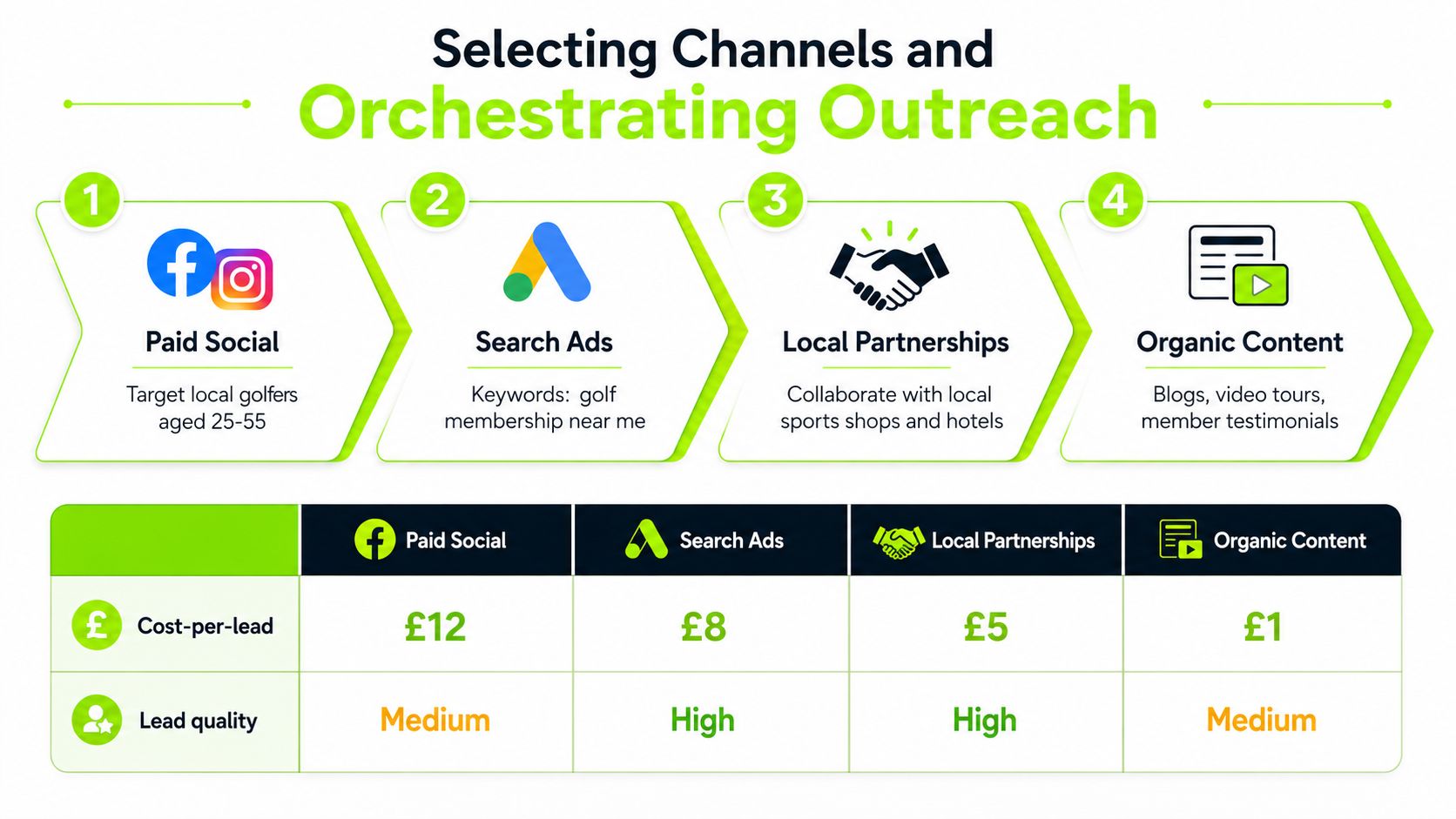
The right channel mix depends on two things, how quickly a club can follow up, and how well the audience matches the offer. Paid social can create reach, search can catch people already looking, local partnerships can add trust, and organic content can support all three with proof.
A UK case study shows why mix matters. One campaign spent £1,275 and generated 316,741 impressions among 93,742 local golfers, produced 644 leads at £1.97 per lead, and won 16 deals with £8,919 in return and 700% ROAS. A second phase spent £1,884 and generated 410 leads, 274 deals won, and £58,921 in return, delivering 3,127% ROAS (campaign case study). The point isn't that every club will see the same numbers, it's that outcome can vary sharply depending on targeting and follow-up quality.
For a £2,000 spend, I'd usually start with a balanced test rather than putting everything into one channel. A practical split is to protect enough budget for one strong paid channel, reserve a smaller amount for a second channel, and leave room for the content or partnership touchpoints that improve trust after the first click. If one channel produces enquiries that the club cannot answer quickly, that channel becomes expensive very fast.
Channel rule: spend should follow response capacity. If your team can't handle the leads quickly, more budget won't fix the problem.
GolfRep's automated nurture approach, which is discussed in automated follow-up for golf clubs, fits this channel logic because the job is not just to capture attention. It's to move the enquiry into a visible pipeline where the next step is already defined. That's the difference between campaign activity and a campaign that can scale.
Setting Up CRM and Automation for Fast Response
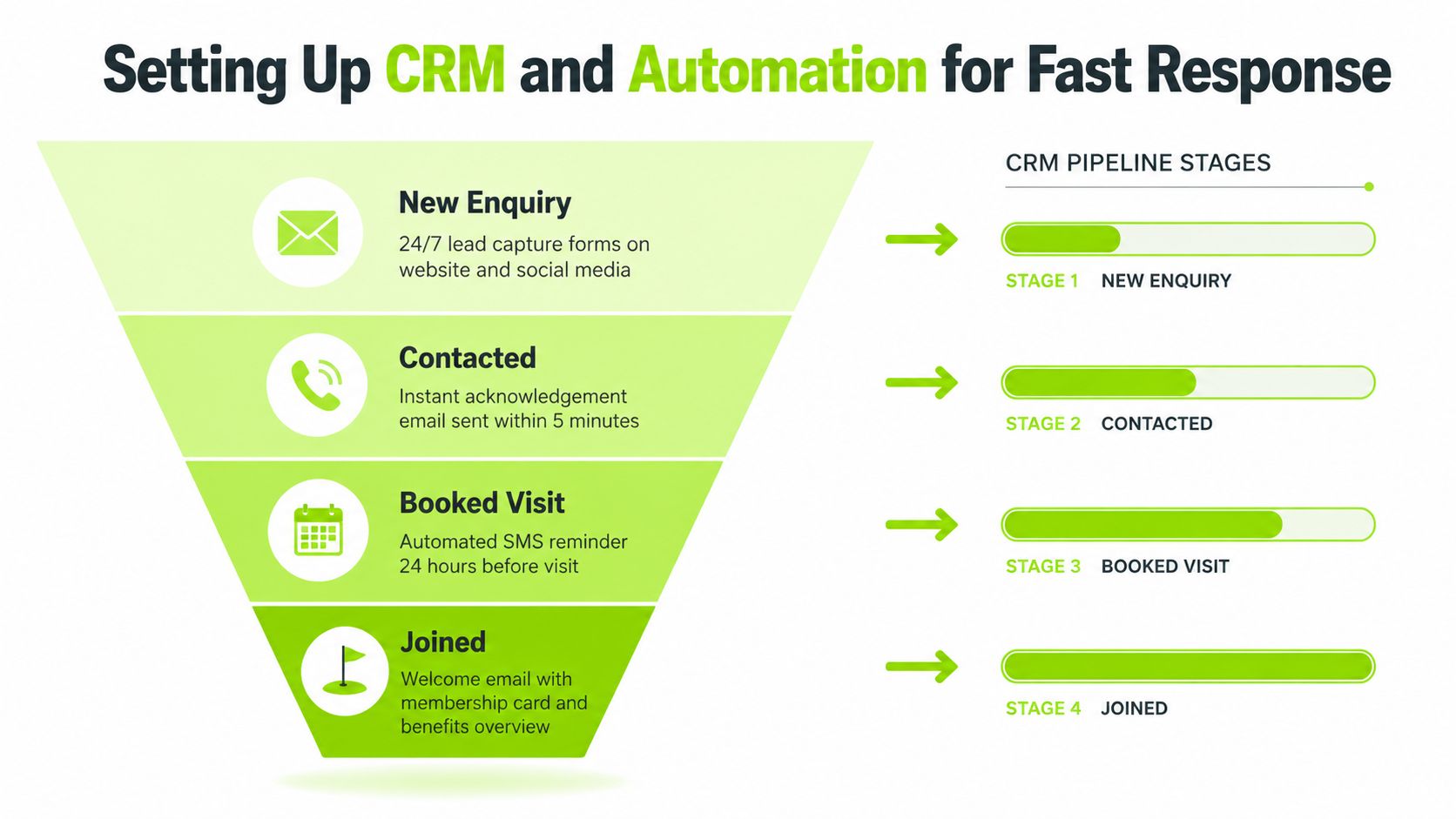
A CRM only works when it gives the club a clear view of response. The pipeline should stay simple, with new enquiry, contacted, booked visit, visited, pending decision, joined, and lost as the core stages. If the team cannot see where each lead sits, follow-up gets assumed rather than confirmed, and good prospects drift away.
The speed of that first response matters. A UK-focused analysis reports an average membership-enquiry response time of 47 hours 32 minutes, and says leads contacted within one hour are 5x more likely to convert than those left for 24 hours (response-time analysis). That is not a minor service issue. It separates a warm enquiry from a missed join.
Automation closes the first gap. A web form should trigger an immediate acknowledgement, then a useful follow-up within a few hours, not the next working day. That first reply needs to answer the obvious questions, thank the prospect, and invite them to visit or speak with the right person. After that, the sequence should continue until the enquiry books in, or exits cleanly with no loose end.
Ownership rules matter just as much. GolfRep's campaign guidance says the first seven days after an enquiry should be treated as a defined handling process, with clear ownership, acknowledgement, follow-up, and a route to a visit (GolfRep campaign process). One person or role needs to own the next step, even if several staff members help with calls, emails, or tour bookings.
What the CRM should show at a glance
- Source of enquiry: paid social, search, referral, open day, or website.
- Current stage: so nobody has to guess.
- Last action taken: call, email, SMS, or visit invite.
- Next action due: with a visible reminder.
- Owner: one named person, not a group.
- Outcome: joined, deferred, lost, or still active.
If a lead has no owner, follow-up becomes guesswork.
The useful setup question is simple. Can the system show who needs to act next, and can it prove that every enquiry received a proper first seven days of handling? Without that visibility, the club has a list rather than a pipeline.
GolfRep's automated follow-up approach fits this logic because it keeps the response process moving after the first enquiry lands. The club still has to make the calls, book the visits, and handle objections well, but the CRM stops good leads from sitting untouched.
Planning Offers Timelines Budgets and KPIs
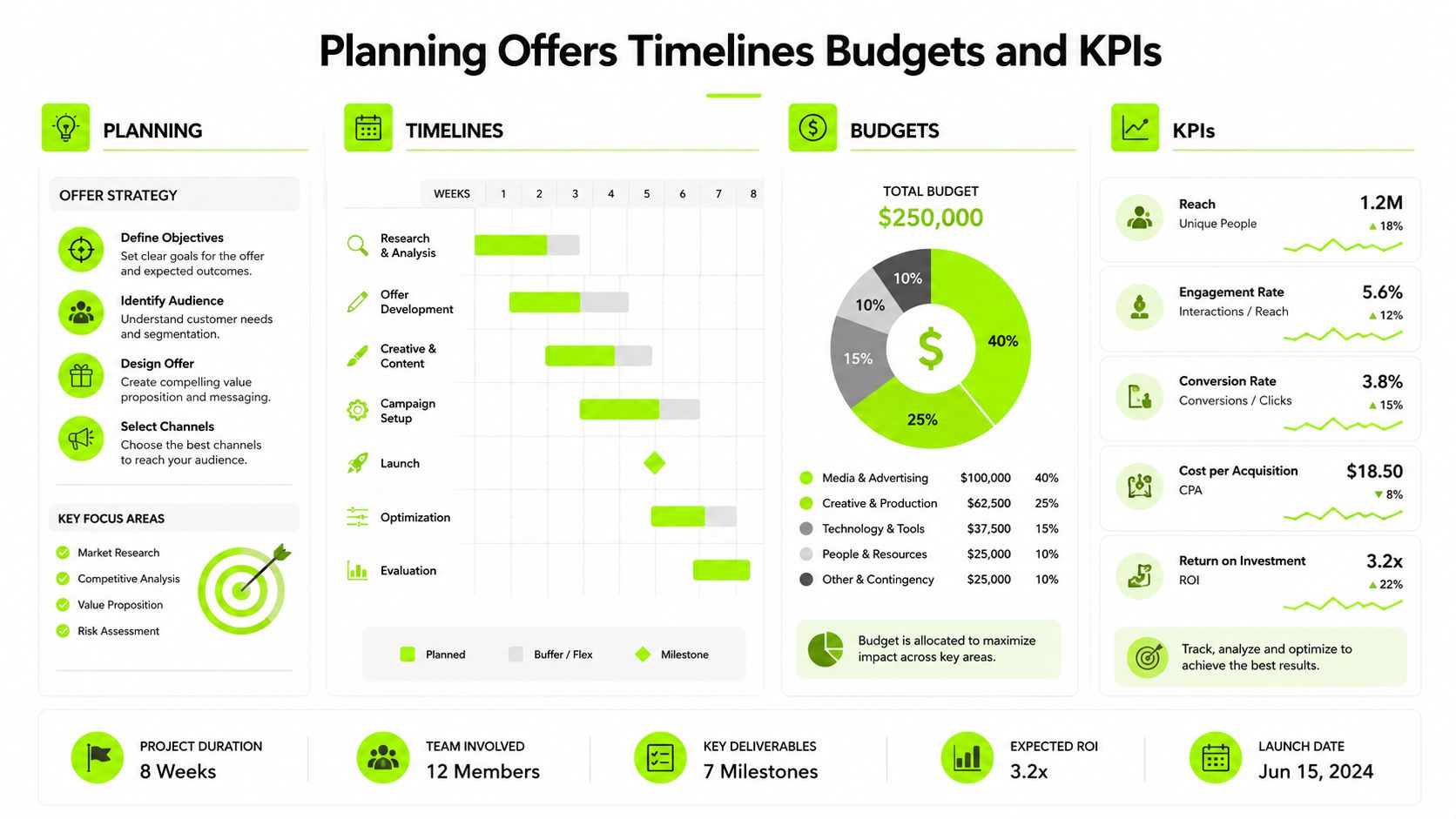
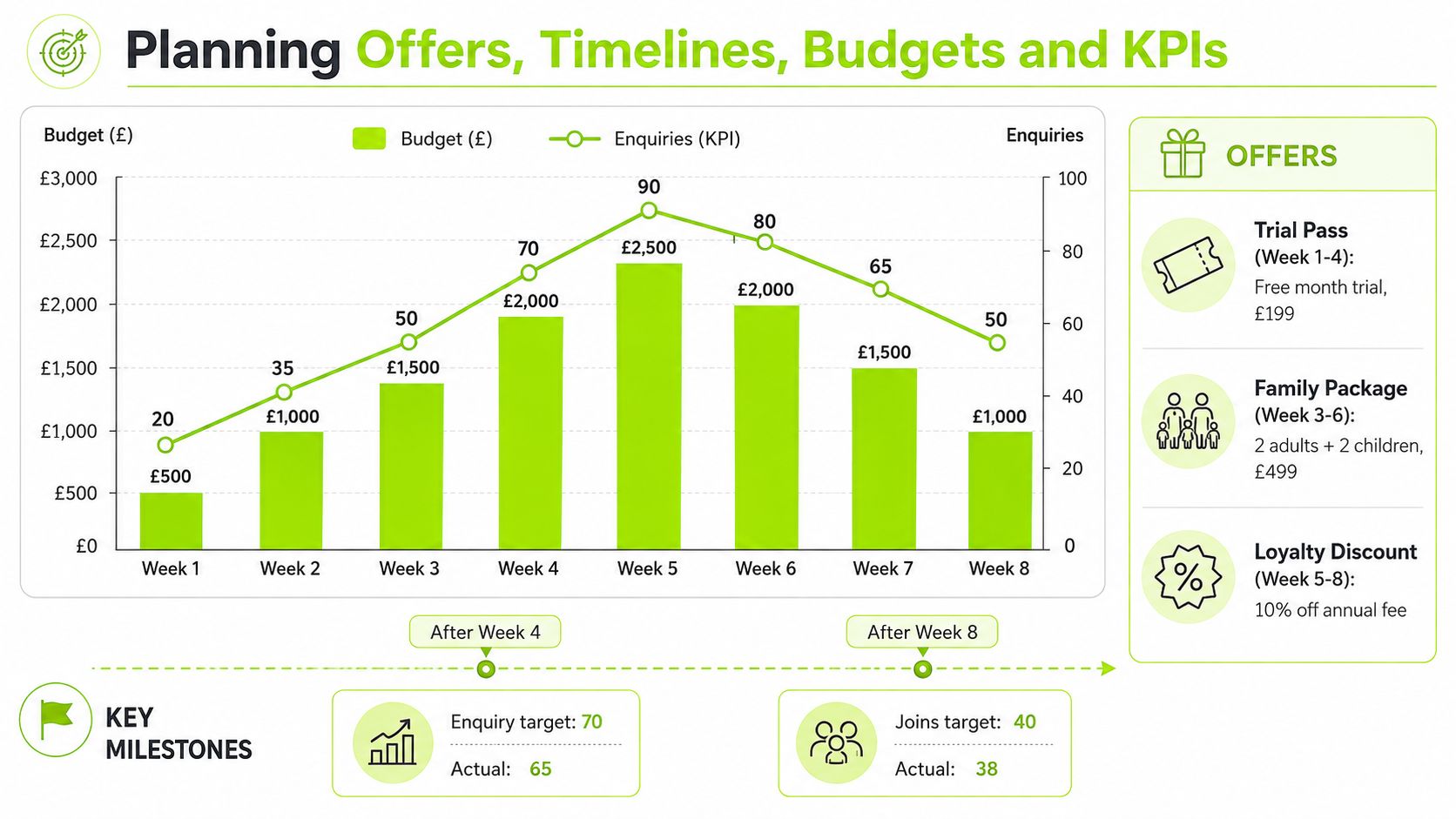
An eight-week campaign works best when the offer changes with the level of interest. Early weeks suit a trial pass, the middle of the campaign can support a family package, and the later stage can lean on a loyalty discount or a deadline-based prompt. The offer should support the timing, not overpower the club's identity.
The broader structure should follow a stage-gated funnel. GolfRep's guidance recommends a pre-launch data audit, immediate acknowledgement, substantive follow-up within hours, a visit invitation, three-day follow-up, and a final check-in, with reporting that tracks enquiry counts through to new member cost (eight-week campaign structure). That matters because a campaign without milestones turns into an argument about “how it feels” instead of what it's producing.
A good planning sheet doesn't need to be complicated. It needs to show budget by week, enquiry targets, visits, applications, joins, and cost per new member. If the club reviews that sheet weekly, it can spot where leads are stalling before the whole campaign drifts.
A useful reporting rhythm
| Metric | What it tells the club |
|---|---|
| Enquiries | Whether the offer is creating interest |
| Open day attendance | Whether the follow-up is working |
| Applications | Whether the visit converted intent |
| New members | Whether the campaign is producing joins |
| Cost per new member | Whether the spend still makes sense |
The biggest trade-off is between pace and polish. Clubs that wait until every creative asset is perfect usually miss the moment. Clubs that launch with a clear offer, a defined time frame, and a proper reporting rhythm can improve while the campaign is live.
Proactive Tips and Common Pitfalls
The most common failure is ambiguous ownership. One person assumes another person has replied, the lead stays unanswered, and the club loses the chance to move the conversation toward a visit. Another failure is manual follow-up that depends on memory, because memory falls apart when the phone rings and the bar gets busy.
The practical fix is to treat the first enquiry response as an operational handoff, not a loose admin task. GolfRep's approach is to define the first seven days after an enquiry as a managed process with named ownership, quick acknowledgement, follow-up, and clear next steps. That works for committee-run clubs that need simple rules, and it also holds up in larger clubs where several people touch the same lead.
A short checklist keeps standards consistent.
- Day 0: acknowledge the enquiry quickly and route it to the right person.
- Day 1: send the first proper response and invite the visitor in.
- Day 2: check whether the prospect opened or replied, then follow up.
- Day 3: restate the visit option and deal with any friction points.
- Day 4: return the lead to the owner if no response has arrived.
- Day 5: send one useful nudge, not a generic chase.
- Day 7: close the loop, record the outcome, and keep the status visible.
Poor alignment between teams causes a second set of problems. If the pro shop, office, and membership contact do not share the same handover process, leads fall between departments and the prospect gets mixed signals. A short weekly review with the person handling enquiries, the pro, and the membership lead usually exposes the weak points quickly, before the next wave of interest arrives.
Good clubs also track what happens after the first reply. If the enquiry is warm but the visit never gets booked, the issue is usually not the offer, it is response time, ownership, or the lack of a clear next step. That is why the follow-up process needs to be visible in the CRM, not just understood by the people doing the work.
For a practical example of how enquiry handling and campaign discipline affect membership growth, see this GolfRep case study on sales gains.
The clubs that improve fastest are the ones that remove friction between enquiry and visit.
Real-World Case Studies and Next Steps
GolfRep's case work shows what happens when clubs stop treating membership as a one-off promotion and start treating it as an operational system. Bidston Golf Club rebuilt momentum and moved to more than double membership with six-figure recurring revenue, while Addington Palace kept pipeline growth steady through better follow-up discipline. Downes Crediton shows the same pattern at launch, where speed and structure matter just as much as the message. For a closer look at how that kind of campaign thinking gets applied in practice, see the client growth case study.
The lessons are consistent. First, test creative iteratively rather than waiting for a perfect launch. Second, audit the funnel while the campaign is live, because small delays in response or booking can flatten the outcome. Third, debrief properly once the campaign ends, so the next round starts with better assumptions and cleaner reporting.
If a club wants better membership growth in 2026, the first move isn't another generic promotion. It's a data audit, a mapped CRM pipeline, and an automated sequence that gets every enquiry into a visible next step. After that, the club can decide where to spend, what to test, and how to improve the join rate with far less guesswork.
If your club wants a more reliable way to turn enquiries into members, GolfRep can help build the campaign structure, follow-up system, and CRM workflow around it. Visit GolfRep to discuss a membership campaign that's built for response speed, visibility, and measurable conversion.
Ready to tap into our proven growth system?