Golf Club Marketing Strategy: How to Turn More Enquiries into Members

A successful golf club marketing strategy is not just about getting more people to enquire; it is about building a robust system to convert the enquiries you already receive. We have seen countless clubs fixate on lead generation, but the real challenge, and the biggest opportunity, lies in what happens next. The bottleneck for most is not a lack of interest, but the absence of a structured process to handle, respond to, and convert those prospective members.
The Real Bottleneck in Golf Club Growth

For years, the go-to marketing play for golf clubs has been to simply cast a wide net. You spend money on advertising, post on social media, and run local promotions, all with the goal of making the phone ring or filling an inbox. But this approach misses a crucial truth: generating an enquiry is only the first, and frankly, the easiest part of the puzzle.
The real stumbling block for growth at most UK golf clubs is what happens after someone shows interest. Without a robust system in place, a huge portion of this hard-won interest simply evaporates.
Common Points of Failure
Take a moment and think about your current process. When a prospective member fills out a form on your website at 9 PM on a Tuesday, what actually happens? For many clubs, that lead simply lands in an inbox, waiting for a busy manager to find a spare moment to reply the next day, or even the day after.
That delay is a significant problem. In the time it takes you to respond, the prospect's initial excitement has already started to fade. They have probably researched other clubs and may have already had a prompt, professional call back from one of your competitors. This is where a simple "marketing" mindset falls short and a proper "growth system" becomes essential.
From our experience, the most common failure points are:
- Slow Enquiry Response Time: Prospects who are left waiting for hours, let alone days, are significantly less likely to convert. Speed is your biggest competitive advantage here.
- Poor Lead Visibility: Enquiries get lost. They are scattered across different email inboxes, scribbled on notepads, or buried in spreadsheets with no central, clear view of your sales pipeline.
- Inconsistent Follow-Up: Relying on manual follow-up is a recipe for missed opportunities. Staff get busy, things get forgotten, and high-value prospects fall through the cracks. It is not their fault; it is the lack of a system.
Shifting from Marketing to Growth Systems
A truly effective strategy confronts this conversion problem head-on. It is about moving beyond just drumming up interest and instead building a predictable pipeline for turning that interest into new members.
The core issue is not a lack of potential members; it is the lack of a reliable system to guide them from their first show of interest to their first round as a member. Fixing this is the single biggest opportunity for growth.
This requires a fundamental shift in thinking. Instead of just "doing marketing," the most successful clubs build an integrated system. This means combining targeted lead generation with structured, automated follow-up, typically powered by a Customer Relationship Management (CRM) tool. When you understand why golf club leads don't convert, you quickly realise the problem is rarely the quality of the lead, but the process that follows.
GolfRep helps clubs build these predictable pipelines. A proper growth system ensures every single enquiry gets an immediate, professional response, day or night. It gives you complete lead visibility, tracks every interaction, and automates the follow-up process. This frees up your staff to do what they do best: building relationships and speaking to qualified prospects. This is how you build a predictable, scalable engine for membership growth.
Defining Your Growth Goals and Ideal Member
Any successful marketing plan starts with a simple, yet critical, question: what are we trying to achieve, and who are we trying to reach? It is a common mistake for golf clubs to jump straight into advertising without this clarity. The result is often a scattered, inefficient effort that burns through the budget without delivering real results. "We need more members" is not a strategy; it is a wish.
A truly data-led approach demands specific, measurable targets. Before you spend a penny, you need to know your numbers. How many new full members will it take to hit your financial goals? What is your target for flexible, junior, or corporate memberships? Each of these is not just a membership category; it is a distinct revenue stream that needs its own focused plan.
Breaking down a big, overarching goal into smaller, targeted segments is where intelligent marketing begins. For instance, a campaign to attract 20 new female members will look completely different from one aiming for 30 new juniors. The messaging, the imagery, and even the channels you use will change. This precision is the first step toward building a predictable pipeline for growth.
Building Your Ideal Member Profile
Once you know your goals, the next step is to get crystal clear on who you are talking to. The best way to do this is not by guesswork. It is by digging into your existing membership data to build an Ideal Member Profile.
Take a look at your most engaged, loyal, and profitable members right now. What do they have in common?
- Demographics: What is their typical age, gender, and postcode? Are they young professionals, families, or active retirees?
- Behaviour: How often do they play a round? Are they big spenders in the pro shop or clubhouse? Do they regularly enter competitions and attend social events?
- Motivation: Why did they choose your club? Was it the championship course, the vibrant social scene, the state-of-the-art practice facilities, or simply the convenient location?
Answering these questions gives you a detailed blueprint of your perfect member. This profile becomes your marketing North Star. Every advert, social media post, and email campaign should be crafted to attract people just like them, because they are the ones most likely to join and, just as importantly, stay for the long haul.
Capitalising on Current Market Trends
This targeted approach has never been more vital, especially given the shifts happening in golf right now. Recent industry data shows a fascinating demographic renaissance in UK golf clubs. We are seeing a significant rise in junior and female golfers where clubs have put focused strategies in place.
In fact, the latest surveys show that club perceptions of junior membership growth have rocketed to over 51%: a huge leap of more than 10 percentage points in a single year. The sentiment around female membership growth is also climbing fast. You can dig into the complete dataset by reading the report on the current health of golf club membership in 2025 on Golfshake.com.
This data confirms what experienced growth partners already know: casting a wide, generic net is a waste of time and money. The real opportunity lies in identifying these growing segments and creating propositions that genuinely speak to what they want.
By combining specific growth goals with a data-driven Ideal Member Profile, your club can finally move on from hopeful, scattergun marketing. You will be building a precise, efficient system designed to attract prospects who are a perfect fit for your community. This ensures your pipeline is filled with high-quality leads, not just high volume, and that is the foundation of any modern strategy that delivers predictable results.
Mapping Your Member Acquisition Funnel
You have done the foundational work. You know who you want to attract and what your membership goals look like. Now for the crucial part: mapping out the exact journey someone takes from being a total stranger to a proud, paying member of your club. This is not just a marketing exercise; it is the operational blueprint for a modern member acquisition system.
The process kicks off by attracting the right people. Forget generic "come play our golf course" messages. We are talking about targeted digital ads and genuinely useful content that speaks directly to the Ideal Member Profiles you have already built. The whole idea is to get your club in front of high-value prospects at the precise moment they are weighing up their options.
But getting them to your website is only the first hurdle. The real work, and where most clubs unfortunately drop the ball, happens in the middle of the funnel.
The Critical Mid-Funnel Stage
This is where casual interest turns into a tangible lead. It boils down to two actions: capturing a prospect’s details and then qualifying them instantly. We have seen countless clubs get the first part right with a decent website form, only to let that enquiry gather dust in a general manager's inbox for hours, or even days.
This is where the entire system falls apart.
In today's market, speed is non-negotiable. A lead you do not respond to within minutes is a lead going cold. Your prospect is actively researching, and you can bet a competitor with a faster, automated system will get to them first.
An effective golf club marketing strategy uses automation to solve this problem. As soon as a prospect fills out a form, a 24/7 automated system should kick in. It qualifies the lead based on their answers and immediately sends a professional acknowledgement. This simple step ensures no enquiry is ever missed, whether it comes in at 2 PM on a Tuesday or 2 AM on a Sunday, and frees up your team from being chained to their emails.
This diagram shows how we start by focusing our efforts to attract the right people from the outset.
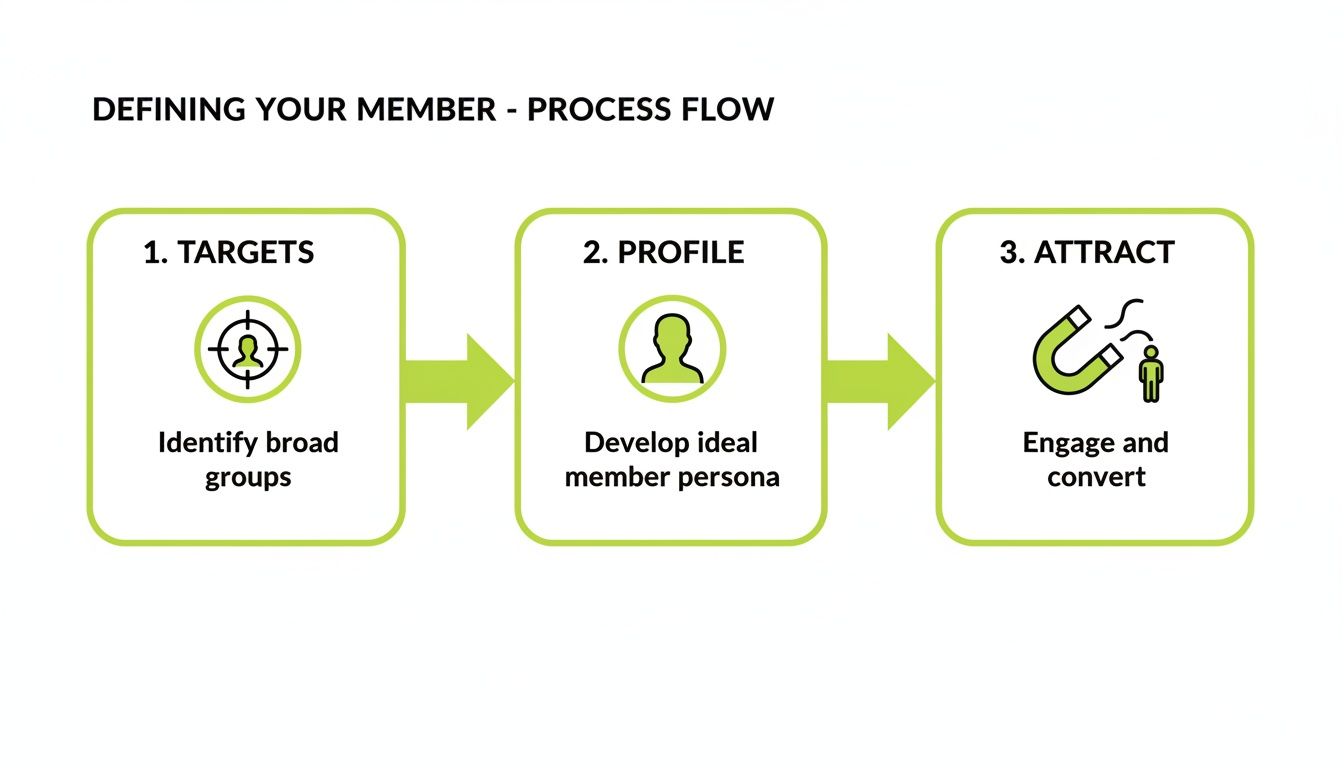
Moving from broad targets to specific profiles and attraction tactics is a deliberate process. It is all about making sure every penny of your marketing spend is working as hard as possible.
Designing Automated Nurture Flows
So, you have captured and qualified a lead. What now? Going straight for the hard sell is a common mistake and often just puts people off. The real goal is to nurture that initial spark of interest, building trust and showing them the unique value of your club over time. This is where automated communication flows, managed within a Customer Relationship Management (CRM) system, come into play.
A nurture flow is simply a pre-built sequence of timely, relevant emails and messages. Their one job is to guide a prospect towards taking the next logical step: booking a tour of the club.
The beauty of this is that the sequences can be tailored to what the person initially enquired about. For instance:
- 7-Day Membership Enquiry: The follow-up emails could feature member testimonials about the great social scene, a video tour of the course, and details on upcoming competitions.
- Junior Golf Enquiry: This sequence could showcase your coaching team's credentials, celebrate recent academy successes, and highlight family-friendly events on the club calendar.
- Flexible Points-Based Enquiry: Here, you might focus on the simplicity of the booking system, the value offered by the points model, and the opportunities to join in with midweek roll-ups.
Each message is carefully crafted to answer a potential question, overcome a common objection, or shine a light on a key benefit. It is a patient, professional way to stay top-of-mind without being pushy.
From Manual Guesswork to a Predictable Process
Ultimately, mapping your funnel this way transforms your membership growth from disjointed, manual guesswork into a predictable, data-driven process. Every single interaction, from the first click on an ad to the final membership signup, must be tracked. This gives your club’s leadership a completely transparent view of what is working and what is not.
You can see exactly which marketing channels are delivering the best leads, how many prospects are in each stage of the funnel, and what your conversion rates are at every step of the journey. This data is pure gold. It allows you to stop wasting money on tactics that do not deliver and double down on the ones that do.
A structured system like this replaces hope with certainty. It turns a sporadic trickle of enquiries into a predictable pipeline of new members, which is the very heart of an effective, modern golf club marketing strategy.
Building Your Growth Engine with the Right Systems
A perfectly mapped-out strategy is a great start, but it is the engine you build underneath that truly drives growth. A modern golf club marketing plan relies on a smart mix of lead generation channels and, critically, the technology that ties it all together. This is the turning point where you stop juggling fragmented, manual tasks and start operating an efficient machine built to convert interest into membership.
Choosing where to find your next member means going where they are. In our experience, a blended approach always delivers the best results.
- Paid Digital Advertising: Platforms like Facebook, Instagram, and Google Ads are brilliant for putting your club directly in front of your ideal demographic with pinpoint accuracy. You can target by age, postcode, and even specific interests that signal a potential golfer.
- Organic SEO: When someone in your area searches "golf membership near me," you need to be at the top of that list. Optimising your website for local search is a long-term play, but it consistently attracts people who are actively looking to join a club.
- Local Partnerships: Do not underestimate the power of your local community. Collaborating with estate agents, premium car dealerships, or corporate wellness programmes can open up fantastic new streams of high-quality leads.
But here is the thing: generating all these enquiries is a waste of time and money if you have no system to manage them. The real, sustainable growth comes from the infrastructure you build behind the scenes. GolfRep combines lead generation with structured follow-up and CRM systems to build these predictable pipelines for clubs.
Old vs New Approach to Golf Club Marketing
As you can see, the difference is not just about efficiency; it is about creating a predictable and measurable path to growth.
The CRM: Your Central Hub for Growth
The single most important piece of technology in your arsenal is a Customer Relationship Management (CRM) system. Think of it as the brain of your entire member acquisition process. It is the central hub where every single enquiry lives, ensuring no potential member is ever misplaced or forgotten.
When an enquiry lands, whether from your website, a social media ad, or a partner referral, it should flow directly into the CRM. This one simple step stops leads from getting lost in a busy inbox or scribbled on a notepad. Each prospect gets their own profile, and every interaction is logged automatically. Suddenly, you have complete lead visibility.
A CRM transforms your membership pipeline from an invisible, disorganised mess into a clear, manageable, and measurable asset. You can see exactly who is in your funnel, where they came from, and what needs to happen next.
This level of organisation is the bedrock of a predictable growth model. It replaces guesswork with data, empowering your team to spend their time building relationships rather than chasing down scattered information. Operating without a CRM today is like trying to manage club operations using pen and paper.
Unleashing Automation for 24/7 Speed and Efficiency
The second crucial component is automation. This is what gives your club superhuman speed and consistency, allowing you to qualify and respond to leads 24/7. In a competitive market, manual follow-up is just too slow and prone to human error.
By implementing smart automation, you can build a system that sends a professional, personalised response to every new prospect within minutes of their enquiry. That immediate engagement is so important for making a strong first impression while their interest is at its peak. Automation can ask initial qualifying questions, tag leads based on their interests (e.g., 7-day vs. 5-day membership), and start warming them up with relevant content. If you are curious about the specifics, you can learn more about how golf club marketing automation creates a serious competitive edge.
The result? It frees up your staff's valuable time. Instead of spending hours sending the same acknowledgement emails over and over, they can focus on what they do best: making personal calls to qualified leads and showing off your brilliant facilities on a club tour.
By combining targeted advertising, a central CRM, and intelligent automation, you create a powerful and integrated 'Growth System'. This is the machinery that turns your marketing strategy into a consistent, reliable source of new members.
Getting Your Pricing and Membership Packages Right
You can build the most sophisticated marketing system in the world, but if your membership packages do not hit the mark, your enquiries will go nowhere. Getting your pricing right is a huge part of this, and in the current climate, it is a particularly delicate conversation. With operational costs going up, many clubs are forced to raise their fees. Just slapping a higher price on your membership without explaining why is a recipe for disaster, risking the alienation of both potential new members and your loyal existing ones.
Your marketing has to be intrinsically linked to your pricing. The entire goal is to build a powerful case for why your club is worth every penny. You need to confidently own your price point by showcasing the incredible value you offer, from the pristine condition of the course to the welcoming community that makes your club special.
This is not just a hunch; the data backs it up. Recent research shows that a massive 87% of UK golf clubs have increased their fees to cover rising operational costs and investments in their facilities. You can dig into the specifics in this report on the rising costs of golf club membership from Orchard Funding. It is a balancing act. While clubs must stay profitable, sudden price hikes without clear communication are a fast track to losing members.
Think Beyond the Traditional 7-Day Membership
The old "one-size-fits-all" 7-day membership model just does not cut it anymore. A modern, effective strategy means offering a variety of membership categories that cater to the different ways people live and play golf today. This flexibility is absolutely vital for growth. It ensures you have a compelling offer for the time-poor young professional, the weekday retiree, and everyone in between.
Take a look at your current offerings. Could you introduce a wider range of options?
- Flexible/Points-Based Memberships: These are a game-changer for golfers who cannot commit to playing every week but still want that sense of belonging. It is a lower-risk entry point that often acts as a fantastic pathway to full membership down the line.
- Intermediate Categories: Do not let your junior members fall off a cliff when they turn 18. Creating tiered pricing for the 19-35 age bracket is one of the single most effective ways to retain your younger talent.
- Corporate Packages: Put together some attractive packages for local businesses. A mix of tee times, meeting room access, and clubhouse perks can be a great tool for client entertainment or employee benefits.
- Academy or Pathway Memberships: Why not create a dedicated programme for beginners? Combine lessons with off-peak course access and social events to properly integrate new golfers into the life of the club.
Each of these needs to be carefully priced and clearly defined, of course. But once you have them, you have given your marketing team a whole arsenal of specific products to promote. They can now target your Ideal Member Profiles with packages that speak directly to their lifestyle, playing habits, and budget.
Sell the Value, Justify the Price
Once you have got a strong suite of membership options, communicating their value becomes much easier. Your marketing content, from your website to your emails, should constantly reinforce what makes your club the obvious choice. Remember, it is not just about the 18 holes; it is about the entire experience.
Every piece of marketing you create should answer the prospect's unspoken question: "What am I actually getting for my money?" Your answer needs to be a compelling mix of tangible perks and intangible community benefits.
This means showing off everything you are proud of. Feature testimonials from happy members in your email campaigns. Create a short video tour of your top-notch practice facilities. Post photos from your buzzing social events.
When a prospect sees the whole picture, including the quality of the greens, the camaraderie in the bar, and the vibrant social calendar, the annual fee stops being a cost. It becomes an investment in a lifestyle they cannot wait to join. That is how you justify your pricing and build a thriving, loyal membership for years to come.
Measuring Success and Optimising for Growth

A robust marketing strategy is never a "set and forget" affair. It is a dynamic system that demands constant attention. You have to measure, analyse, and continuously refine it. To do this properly, you need to look past vanity metrics.
Sure, things like clicks, impressions, and website visits might look good on a report, but they do not pay the bills. The real measure of success comes from data that directly impacts your club’s financial health. After all, the whole point of building this growth system is to gain clarity on what is working, what is not, and where your biggest opportunities are hiding. That only happens when you track the right Key Performance Indicators (KPIs).
Key Metrics That Actually Matter
For any golf club, sustainable growth really boils down to a handful of core numbers. These are the metrics that tell the true story of your pipeline's health and efficiency. A well-configured CRM is indispensable here, giving you a live, transparent view of these figures at all times.
You need to be laser-focused on tracking:
- Cost Per Qualified Lead: How much are you actually spending to generate an enquiry from someone who fits your ideal member profile and is genuinely interested? This tells you exactly how efficient your ad spend is.
- Enquiry-to-Visit Rate: Of all the qualified leads that come in, what percentage book and show up for a tour of the club? This is a crucial test of your follow-up process and initial engagement.
- Visit-to-Member Conversion Rate: What percentage of prospects who tour the facilities go on to become paying members? This metric is a direct reflection of your sales process and the appeal of your club's offer.
Monitoring these figures helps you pinpoint the exact bottlenecks in your member acquisition funnel, allowing you to take decisive action where it is needed most.
Tracking vanity metrics is like judging a round of golf by how many swings you took. It is far more important to measure how many shots landed on the green and how many putts you sank. Your marketing KPIs should work the same way.
The Feedback Loop for Continuous Optimisation
This data creates the feedback loop you need for intelligent decision-making. For example, if your Cost Per Qualified Lead is low but your Visit-to-Member Conversion Rate is also poor, it strongly suggests the problem lies with your sales process or the membership proposition itself, not your marketing. On the other hand, a high cost per lead might mean your ad targeting is off.
This data-driven approach is what allows you to continuously optimise your efforts. You can test different ad creatives, refine your email nurture sequences, and adjust follow-up scripts based on what the numbers are telling you. This is how you build a truly predictable model for membership growth. You can learn more about how these numbers translate into tangible value in our guide to the real ROI of golf club marketing.
Of course, acquisition is only half the battle. You also have to track retention by keeping a close eye on new joiners versus leavers. Recent industry data reinforces just how important this is. The latest Hillier Hopkins survey revealed that while UK clubs are seeing healthy growth, member churn remains a persistent challenge.
The proportion of clubs with over 600 members rose to 59% in 2024, and the average club welcomed 75 new joiners. However, they also lost an average of 63 members, highlighting the ongoing need for both strong acquisition and effective retention strategies. You can dive into the full findings in the Hillier Hopkins Golf Clubs Report 2024-25.
Ultimately, measurement turns your strategy from a hopeful punt into a scientific process, allowing you to systematically refine your campaigns and build a system that delivers consistent, reliable growth.
Answering Your Top Questions
Switching from old-school methods to a structured, data-led marketing strategy is a big step, so it is completely normal to have questions. Let's tackle some of the most common ones we hear from club managers and committee members.
What is a Realistic Timeline to See Results?
You will feel the immediate benefits of better organisation and faster lead responses within the first month. That is the quick win. However, building a predictable pipeline of new members is a longer game.
Most clubs start seeing a noticeable uptick in qualified leads and booked tours within the first 90 days. But the real magic happens between 6 and 12 months in. By then, your system has gathered enough data, and your nurture campaigns have had time to work on those prospects who were not ready to join straight away. This is all about sustainable, long-term growth, not a quick fix.
How Much Should We Really Be Budgeting for a CRM and Automation?
This is an investment, not an expense. While the cost can vary, it is far more affordable than many committees assume. The crucial thing to remember is that a good system should pay for itself through new membership revenue and a massive boost in staff efficiency.
Think about it like this: if the system helps you sign up just one or two extra full members a year, it has likely already covered its annual cost. The real, hidden expense is sticking with a manual process where high-value leads slip through the cracks every single day.
The most expensive system is the one you do not have. Lost leads, missed opportunities, and inefficient use of staff time have a far greater hidden cost than a monthly software subscription.
How Do I Get the Committee On Board with This?
Getting the committee’s buy-in is everything. The trick is to frame the conversation around results and predictability, not marketing jargon. You need to shift the focus from "spending money on advertising" to "investing in a system that secures the club's financial future."
Use the practical insights from this guide to build a solid business case. Concentrate on three key areas:
- Total Lead Visibility: Show them how a CRM gets rid of all the guesswork. For the first time, they will have a completely transparent view of the entire membership pipeline, from first enquiry to final handshake.
- A System, Not Just People: Explain that this is not about replacing staff, but empowering them. The system automates all the repetitive, time-consuming tasks, freeing up your team to focus on what they do best: personal follow-ups and delivering brilliant club tours.
- A Measurable Return: This is the clincher. Stress that every pound spent will be tracked and accounted for. You will be able to walk into a board meeting and prove the value of your marketing with hard data, not just anecdotes.
By presenting a clear, logical plan for predictable growth, you can confidently address their concerns and build the support you need to push forward.
At GolfRep, we build these predictable growth systems for clubs across the UK, combining lead generation with the structured follow-up and CRM integration needed to turn enquiries into members. If you're ready to build a reliable pipeline for membership growth, get in touch with us today.
Ready to tap into our proven growth system?