Golf Club Marketing Plan That Actually Converts Enquiries

The most popular golf club marketing advice starts in the wrong place. It tells clubs to publish more social content, increase paid advertising and create another membership offer. Those activities can create attention, but attention alone doesn't fill a membership pipeline.
A practical golf club marketing plan starts with a harder question: what happens after a prospect submits an enquiry? If the answer involves a shared inbox, an unclear owner and a reply whenever somebody has time, the club may not need more leads yet. It needs a reliable way to see, qualify and follow up every opportunity.
At GolfRep, we work from that operational reality. Lead generation matters, but predictable growth comes from connecting advertising, enquiry handling, CRM visibility and structured nurture into one process.
Why Most Golf Club Marketing Plans Overlook the Core Problem
A recent sector review found that numerous clubs conflate low enquiry volume with a demand problem. That assumption directs committees towards visible activity, such as Facebook posts or Google Ads, while leaving ownership, response times and follow-up unexamined. A stronger golf club marketing plan starts by testing whether the club is losing opportunities it has already generated.
England Golf recorded 10,213,894 score submissions in 2024, more than 10.2 million, an increase of 811,712 on the previous year and 8.63% year on year (England Golf score submission reporting). The same reporting recorded a 17.89% rise in nine-hole scores, with 142,043 more submitted. That points to interest in flexible formats as well as traditional rounds, although interest does not guarantee membership enquiries will convert.
A prospect can find a club, complete a form and receive no useful response until the following day. Another enquiry may be answered quickly but never logged, leaving the club unable to link it to a campaign, referral or open day.
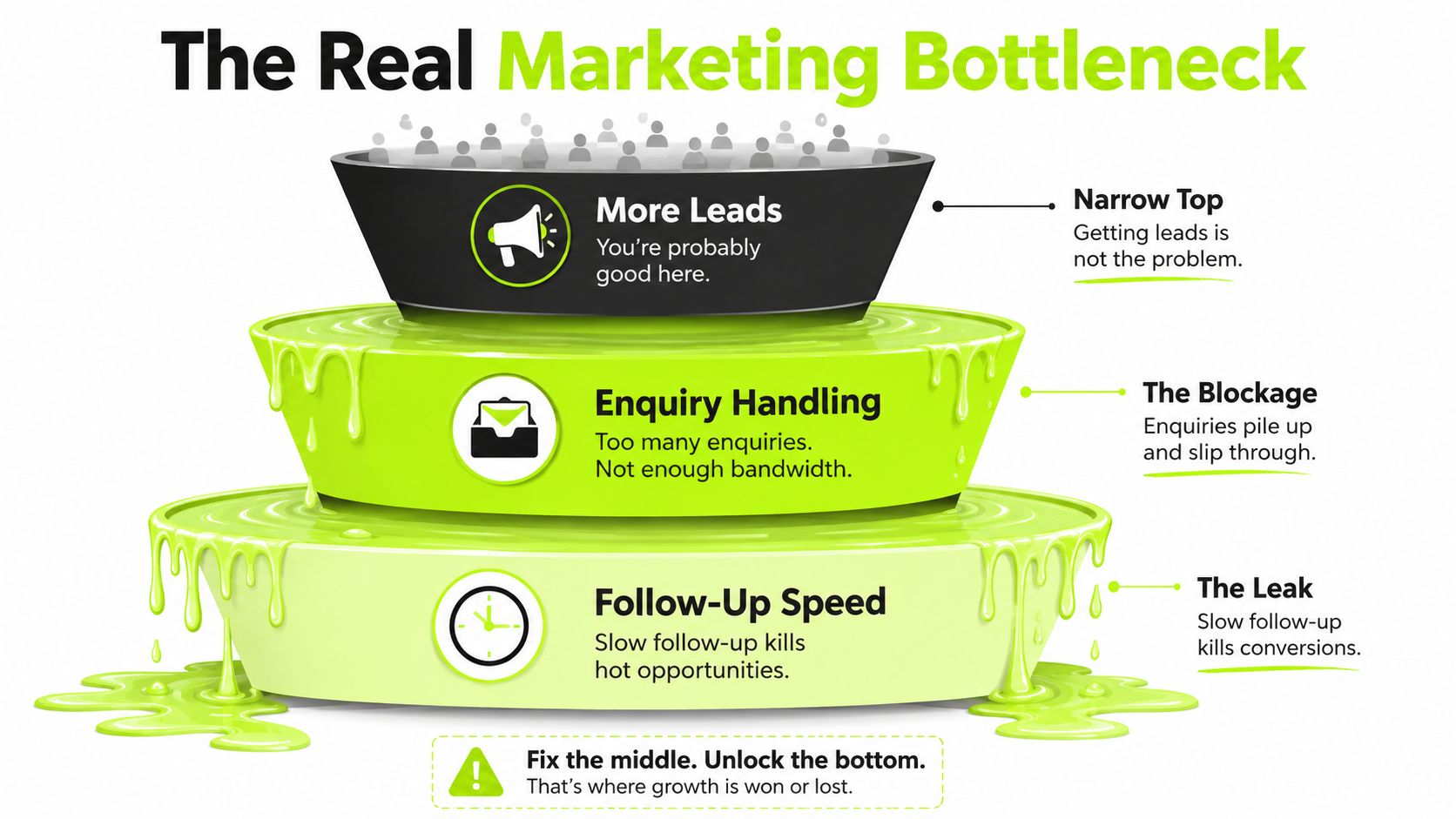
Find the leak before increasing spend
Audit four operating points before adding budget:
- Response ownership: Identify who receives every membership, lesson, society and hospitality enquiry.
- Lead visibility: Record source, segment, status, next action and outcome in one shared system.
- Qualification: Separate a casual information request from someone ready to book a visit.
- Follow-up discipline: Set a defined next step rather than relying on memory or personal inboxes.
UK lead-response benchmarks show why speed and consistency affect conversion. One cited benchmark reports that enquiries followed up within five minutes have conversion rates 98% higher, while leads become 10 times less likely to respond after that point (UK enquiry response benchmark). Another UK study found only about 10% of firms replied within five minutes, while more than 46% replied within an hour (UK lead response study).
A campaign that sends traffic into an unmanaged process increases waste. Review the causes of lost enquiries in why most golf club marketing fails, then fix the inbox, handover and reporting before scaling activity.
Practical rule: Do not ask for more enquiries until existing enquiries receive a prompt, relevant response and a recorded next action.
Running a Proper Situational Analysis Before You Spend
Marketing spend should follow evidence from the club's operating reality. Before approving a campaign, the committee needs a clear view of membership strength, reachable audiences, competitor activity and the points where prospective members stop responding.
Start with the membership base. Hillier Hopkins reported that 59% of members' clubs surveyed had more than 600 playing members in 2024, compared with 56% in 2023, and that clubs averaged 75 joiners during the year (Hillier Hopkins Golf Clubs Report 2023-24). Only 24% reported more leavers than joiners. Recruitment and retention therefore belong in the same commercial review. A campaign that replaces avoidable churn can produce a different return from one aimed only at new demand.
Pull the last 12 months of enquiries and trace each record from initial contact to outcome:
- Enquiry received
- First contact attempted
- Conversation completed
- Visit or tour booked
- Visit attended
- Offer made
- Membership joined or lost
Add the original source, audience category, response time and known reason for loss. Review the gaps as well as the totals. If the club cannot show which source generated a visit or where an enquiry stalled, channel comparisons are estimates, not performance reporting.
Compare use with actual contribution
The latest Hillier Hopkins report records the channels clubs use, but activity alone does not show commercial value (Hillier Hopkins Golf Clubs Report 2024-25). Compare each route by qualified enquiries, attended visits, joined memberships and cost per join. A referral may require little media spend but still consume staff time. Paid search can produce volume while poor enquiry handling lowers its final conversion.
Use this table as a working template. Leave unknown fields blank rather than manufacturing a result.
| Channel | Current Use | Enquiries / Month | Conversion % | Cost per Join | Effectiveness Rating |
|---|---|---|---|---|---|
| Member referrals | Record current activity | Measure | Measure | Calculate | Compare |
| Social media | Record current activity | Measure | Measure | Calculate | Compare |
| Paid search | Record current activity | Measure | Measure | Calculate | Compare |
| Email nurture | Record current activity | Measure | Measure | Calculate | Compare |
| Partnerships | Record current activity | Measure | Measure | Calculate | Compare |
Review competitors within the club's practical catchment. Check their joining routes, pricing presentation, visitor experience, Google Business Profile, search visibility, reviews and social proof. Ask members and recent joiners why they chose the club, what nearly stopped them and which information they needed before enquiring. Use this guide to identify market opportunities to structure the comparison.
The output should identify the bottleneck that limits conversion. If traffic is adequate but visits are not booked, improve the enquiry journey before increasing media spend.
Defining Segments, Personas and the Offers That Will Land
A time-poor professional in their 40s who plays once a month rarely converts from a generic “join today” page. The first screen must explain the flexible-access route, what it includes and how to arrange a visit. If that information is buried, more traffic will not solve the enquiry problem.
Use membership evidence to decide which propositions deserve testing. England Golf's 2025 figures reported junior membership rising from 46,028 to 61,483, while total club membership reached 750,071 (Golfshake membership reporting). The opportunity is not to attract more prospects. It is to give each audience a route that staff can explain, record and follow up consistently.
Build personas that change the campaign
Base personas on enquiry records, visit feedback and lost-lead reasons, rather than assumptions:
- Time-poor professionals: Adults aged 30 to 50 may value flexible access, short-format play and simple booking. State when the membership works, then route enquiries to someone who can confirm availability and next steps.
- Women returning to golf: Lead with welcoming introductions, playing partners, coaching support and clear first-visit information. The follow-up should answer practical concerns instead of treating this audience as a token addition to a general campaign.
- Families and juniors: Show the path from beginner coaching to regular junior participation and, where appropriate, family involvement. Parents need clear information about supervision, timings, progression and who will respond.
- Local businesses: Corporate buyers may want hospitality, society days, team experiences or client entertainment rather than individual membership. Give them a named contact and a separate enquiry route so commercial leads do not enter a slow membership queue.
- Lapsed members: Ask what changed, including circumstances, access needs and playing preferences. A discount can support the conversation, but it should not replace a reason to return or a recorded follow-up plan.
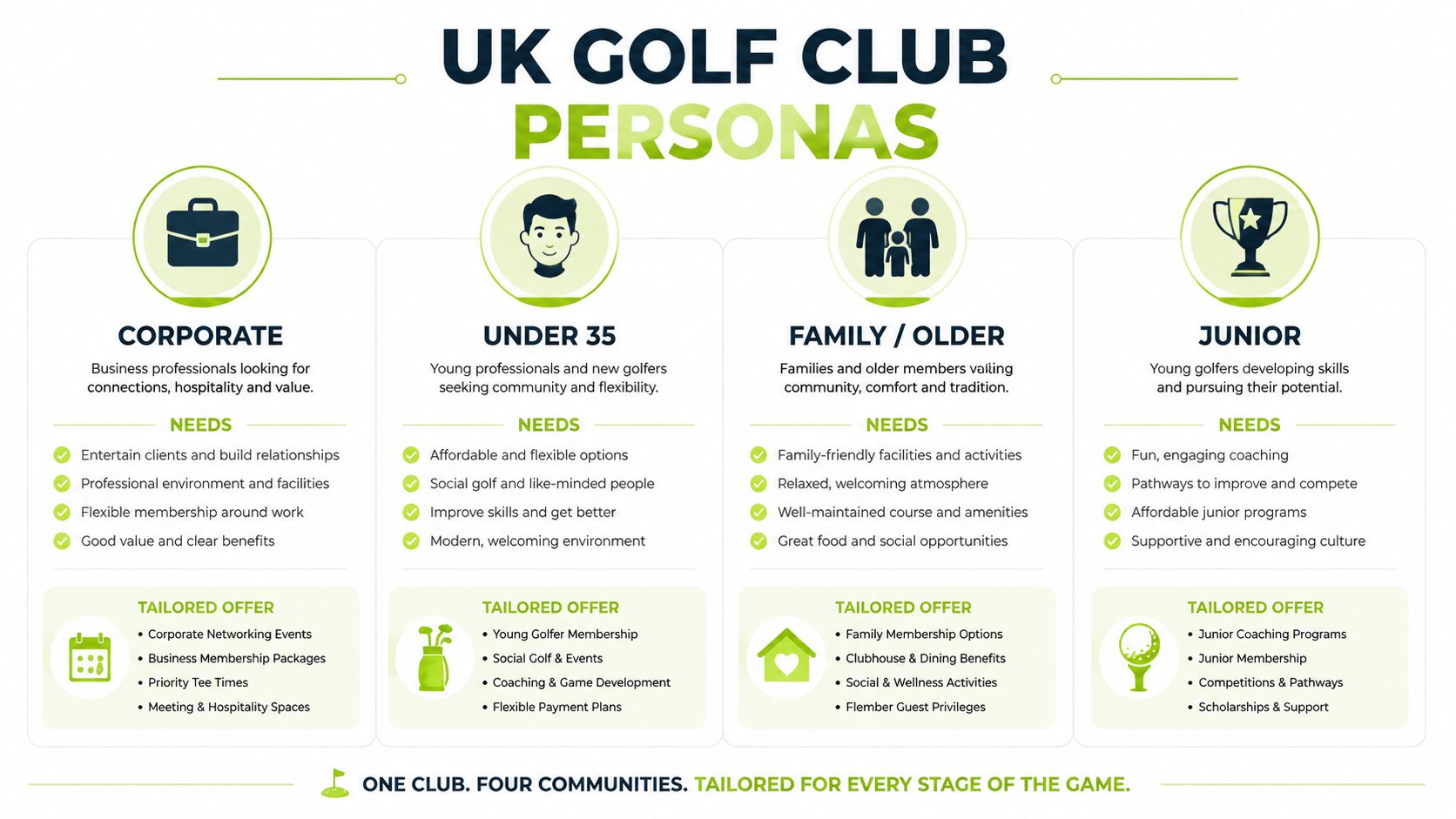
Each persona should alter the message, channel, creative and follow-up. A junior campaign might route to the academy team, while a corporate enquiry should reach the events or commercial manager. Record source, persona, response time, booked visit, outcome and next action in the CRM. That visibility exposes whether the offer fails, the landing page loses interest or staff leave enquiries unattended.
Keep an offer in test long enough to judge enquiry quality, booked visits and joins. Do not make the first 60 days a discount race. Test whether prospects understand the proposition, staff can deliver it and new members fit the club's retention aims.
Channel Strategy That Fills the Funnel Without Wasting Budget
Channels should have jobs. Referrals create trust, search captures intent, social content supplies proof, email supports follow-up and partnerships introduce audiences the club may not reach alone.
Begin with existing relationships. Hillier Hopkins found member referrals were used by 71% of members' clubs and regarded as the most successful activity by 53% (Hillier Hopkins Golf Clubs Report 2024-25). Build a member-get-member process with a trackable form, a simple introduction route and a prompt for the referring member to attend the visit.
Paid search should come after the landing page and response process work. Target local intent around membership, beginner golf, lessons, societies and hospitality. Keep the geography realistic for the club's catchment, then send each search theme to a relevant page rather than a generic homepage.
Match the channel to the buying stage
| Channel | Funnel stage | Primary role | Indicative cost per enquiry |
|---|---|---|---|
| Member referrals | Consideration | Trust and introductions | Calculate from incentive and staff time |
| Google Business Profile | Awareness and consideration | Local discovery and reassurance | Track staff time and content cost |
| Paid search | Conversion | Capture active local intent | Measure from platform and CRM data |
| SEO content | Awareness and consideration | Answer specific prospect questions | Measure production cost over time |
| Email automation | Consideration and conversion | Timely nurture after enquiry | Track tooling and management cost |
| Local partnerships | Awareness and consideration | Reach relevant community audiences | Record fees, exchanges and enquiries |
| Retargeting | Consideration | Reconnect with interested visitors | Measure platform cost and joined members |
Social media works best when it shows evidence, not when it becomes a daily obligation. Publish course conditions, member experiences, coaching moments, events and answers to common questions, then connect posts to a booking or enquiry route. A social calendar without a conversion path produces activity that may look busy but remains difficult to value.
SEO pages should cover membership categories, society days, lessons and practical questions prospects ask. Email can then continue the conversation with a member-style newsletter and automated messages triggered by an enquiry form.
Partnerships with local hotels, employers, county golf bodies and relevant community groups can add credibility. For club merchandise or event apparel, practical resources such as bulk golf polo buying tips can help teams think through quality, sizing and ordering before committing to branded kit.
Building the CRM and Automation Engine Behind the Plan
A CRM isn't a luxury add-on for a club that runs paid campaigns. It is the record of what the club promised, who owns the next action and whether the prospect moved towards a visit.
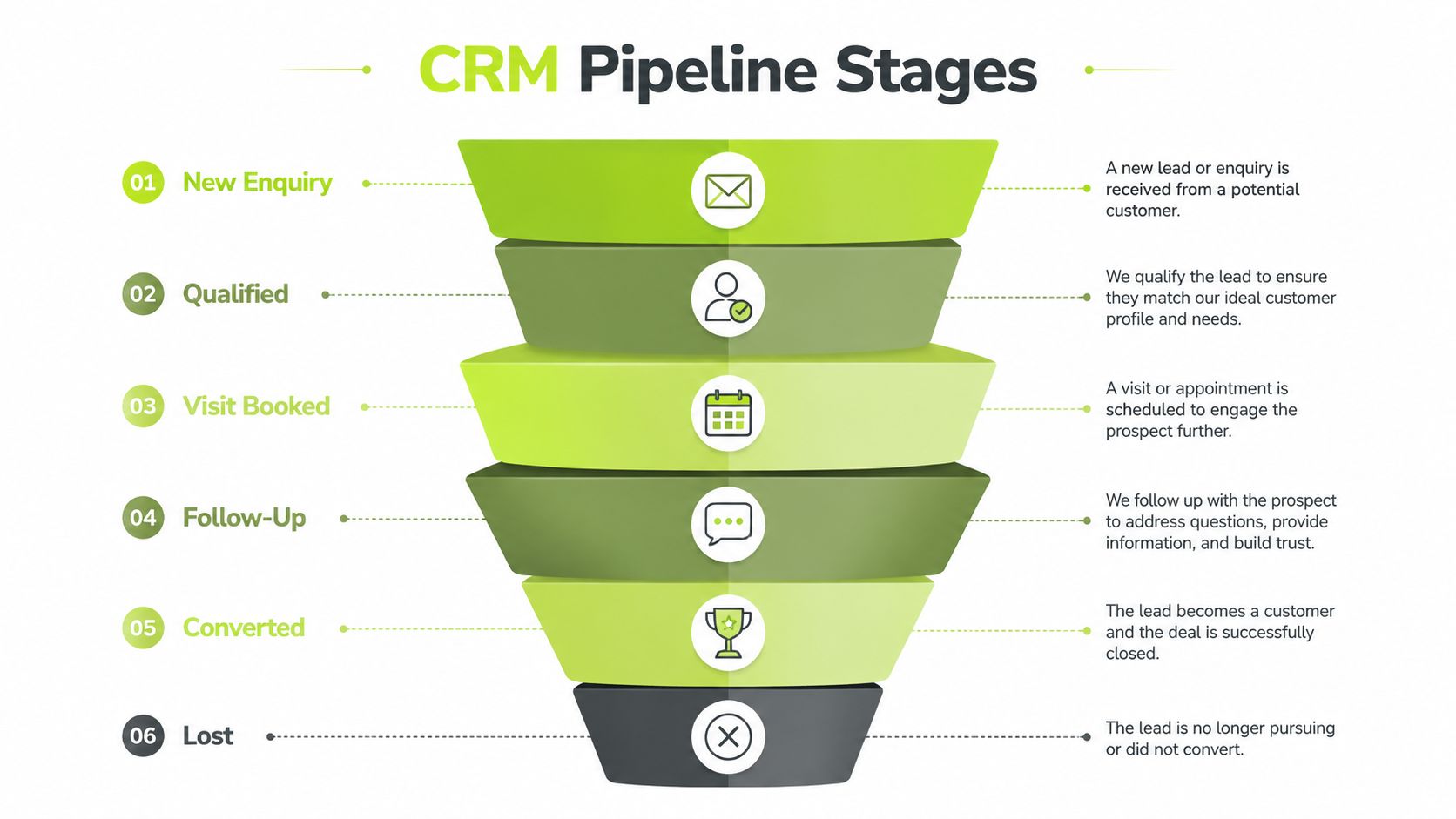
The pipeline should mirror the buying journey:
- New enquiry: Capture contact details, source, audience, product interest and consent.
- Contacted: Record the first response, channel and outcome.
- Visit booked: Store date, time, attendees and staff owner.
- Trial or tour completed: Add notes, questions, objections and likely decision timing.
- Offer sent: Record the package, price information and agreed follow-up date.
- Joined or lost: Mark the final outcome and, where possible, the reason.
Required fields prevent a record from moving forward without a next action. Time limits stop “contacted” becoming a permanent holding category.
Design the first response around action
The automation should acknowledge the enquiry within minutes, provide useful information and make the next decision easy. A sensible first sequence includes:
- Immediate confirmation that the enquiry reached the club.
- A same-day personal follow-up task for the named owner.
- A brochure, course video or relevant membership page.
- A booking link offering two suitable visit options.
- A reminder if the prospect doesn't book or reply.
The UK industry analysis cited an average lead response time of 47 hours, with only 7% of companies achieving replies within five minutes. It also reported that 78% of customers buy from the first company to respond (UK lead-response analysis). A club doesn't need a complicated stack to avoid this. It needs clear alerts, a shared queue and staff who know what counts as a completed response.
A 90-day nurture flow can mix member stories, course photography, event invitations, beginner reassurance and answers to common objections. Keep messages relevant to the segment. A corporate prospect shouldn't receive the same sequence as a junior parent.
Lead scoring can prioritise useful signals, such as a pricing page visit, repeat email opens or a booking-page return. The score should support human judgement, not replace it. A practical gym CRM implementation guide offers transferable thinking on pipeline stages, ownership and automation for membership businesses.
GolfRep combines lead generation with automated follow-up and CRM-based revenue tracking, so clubs can see the path from first enquiry to booked visit and membership outcome. For the broader application of those systems, see golf club marketing automation.
The dashboard should answer three questions: How quickly did we respond, how many prospects reached a visit, and how many joined?
Budget Allocation, Timeline and KPIs for the First 90 Days
Budget decisions should follow the bottleneck. A club with poor source tracking shouldn't put its entire allocation into advertising. A club with reliable follow-up can test acquisition more confidently because it can connect spend to joined members.
The first 90 days work best in three phases:
- Days 1 to 30, foundations: Build the CRM, connect forms, define ownership, prepare landing pages, create offer assets and repair tracking.
- Days 31 to 60, launch: Activate selected paid search, referral activity, email nurture and local partnerships.
- Days 61 to 90, optimisation: Move attention towards sources producing qualified visits and joined members, while reducing activity that creates noise.
A practical starter allocation for a UK private or resort club can sit between £2,500 and £6,000 per month, depending on catchment, proposition and internal capacity. That range should be treated as a planning guide, not a promise of results.
| Category | Monthly spend (£) | KPI | Target |
|---|---|---|---|
| CRM and automation | Allocate from approved budget | Enquiry visibility | Every enquiry assigned and tracked |
| Google Ads | Allocate largest acquisition share | Qualified enquiries | Measured by source and segment |
| Local partnerships | Allocate test budget | Partner enquiries | Source tagged in CRM |
| Content and creative | Allocate production budget | Landing-page engagement | Reviewed against booked visits |
| Email and nurture | Lower ongoing cost | Follow-up completion | Sequence active for each relevant segment |
| SEO and Google Business Profile | Lower ongoing cost | Local visibility | Pages and profile maintained |
| Reporting and optimisation | Allocate management time | Decision quality | Weekly or fortnightly review |
Operational KPIs deserve equal status with marketing metrics. Aim for an enquiry-to-contact response time under one hour during business hours, a contact-to-visit rate above 35%, and separate reporting for cost per joined member and cost per enquiry. These are planning targets, not verified industry outcomes.
Report weekly during the first month, then fortnightly. Review lead quality, response compliance, stage movement, visit attendance, offer acceptance and reasons for loss. If the club can't explain a result, don't just increase the budget.
Implementation Checklist and a Short UK Case Study
Before approving launch spend, the general manager or committee should confirm:
- Response SLA: A named person owns each enquiry and the business-hours response standard is agreed.
- CRM stages: The pipeline reflects enquiry, contact, visit, offer, join and lost outcomes.
- Source tagging: Forms, referral links, calls and campaign records identify where each opportunity came from.
- Offer assets: Landing pages, brochures, videos and visit options are ready for the first 90 days.
- Dashboard: Response time, contact-to-visit, joined members and cost per outcome are visible.
- Accountability: One owner is assigned to every task, including review and escalation.
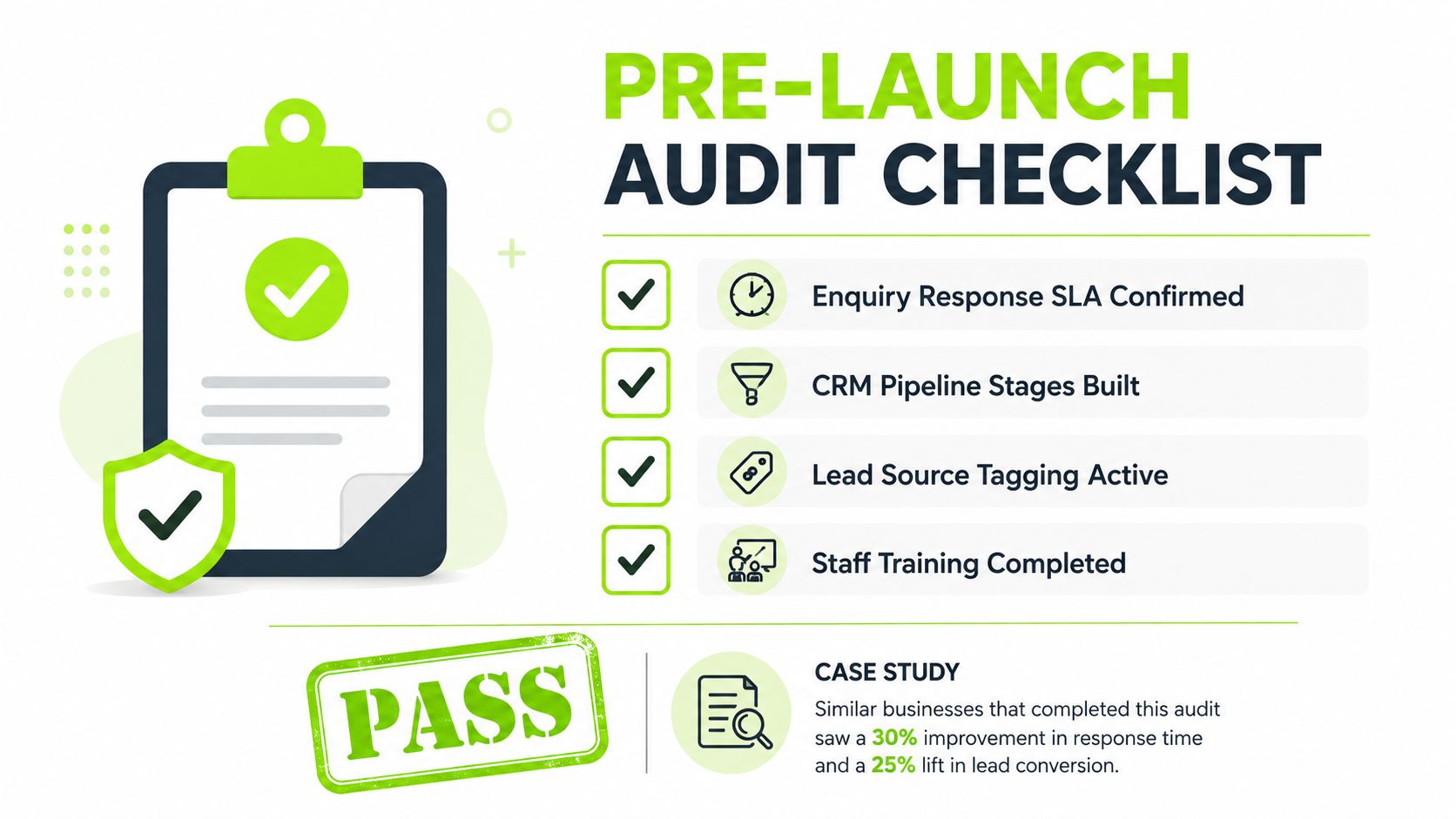
A condensed UK example illustrates the pattern. At a 600-member private club, enquiry-to-tour booking conversion rose from 18% to 34% over two seasons after the club reduced response time to under 30 minutes, added a five-step automated nurture sequence and introduced a referral incentive alongside existing member introductions. Those results belong to that specific case pattern and shouldn't be treated as a universal forecast.
The checklist links directly to the budget. CRM spend supports ownership and reporting, creative spend supports the offer, acquisition spend supplies qualified traffic and staff time protects the response KPI. For another perspective on structured customer communication in a golf setting, see this case study for The K Club.
During the first 14 days after launch, check that every enquiry has a source, every new record has an owner, personal follow-up happens on time, booked visits receive reminders and lost opportunities include a reason. Review the first conversations with staff, not just the monthly totals. Early process failures are easier to correct before they become expensive campaign habits.
GolfRep helps UK golf clubs build predictable pipelines by combining targeted lead generation, rapid enquiry handling, CRM visibility and structured nurture. Visit GolfRep to discuss the gaps in your current golf club marketing plan and identify the systems needed to turn more enquiries into booked visits and lasting memberships.
Ready to tap into our proven growth system?