A Guide to Golf Club Marketing Automation in the UK
When we talk about marketing automation for a golf club, it’s easy to think it’s just about sending more generic emails. In reality, it’s a strategic system designed to make sure every single enquiry for a membership or society day gets captured, nurtured, and converted without anything falling through the cracks.
For most UK golf clubs, the biggest barrier to growth is not a lack of interest from potential members. It is the operational struggle to manage the interest you are already generating. At GolfRep, we have seen first-hand that the main challenge is not generating enquiries, but handling, responding to, and converting them effectively.
The Real Growth Challenge Facing UK Golf Clubs
Ask any Club Manager what they need, and the answer is almost always "more leads." Clubs pour money into advertising and social media, hoping a fresh wave of enquiries will solve their growth problems. But having worked directly with clubs across the UK, we see a different picture. The real bottleneck is almost always what happens after an enquiry is made.
Think of it as a "leaky bucket." Your club might be getting dozens of valuable enquiries for memberships, society days, and corporate events every month. But where do they go? Too often, they land in a crowded inbox or get scribbled on a notepad, only to be forgotten when the next urgent task lands on the manager’s desk.
The Problem with Manual Processes
This reliance on manual processes creates huge, often invisible, holes in your sales pipeline. A busy Club Manager, juggling everything from course maintenance to member relations, simply cannot give a timely and personalised response to every single new lead. It is an impossible task.
This approach leads directly to several critical failures:
- Slow Response Times: A potential new member who has to wait 24 or 48 hours for a reply has likely already called two other local clubs. The first one to respond usually wins.
- No Lead Visibility: When leads are scattered across inboxes, spreadsheets, and notebooks, it is impossible for anyone to get a clear picture of the sales pipeline. You cannot manage what you cannot measure.
- Inconsistent Follow-Up: Without a proper system, following up is sporadic at best. A prospect who is not ready to commit right away is almost guaranteed to be lost forever because there is no process to nurture their interest over time.
This is not a criticism of hard-working club staff; it is a fundamental breakdown of the systems they are forced to work with. Expecting a small team to manually track hundreds of leads a year is an unrealistic path to sustainable growth.
The core challenge for most clubs is not a lack of interest, but a lack of robust systems. Success comes from building a predictable pipeline that can handle, respond to, and convert enquiries, not just from generating more of them.
An Expanding Market Full of Missed Opportunities
The demand for golf is stronger than it has been in years. Recent data from England Golf showed a record-breaking membership of 750,071 in 2026, building on over 100,000 new members since 2023. This boom, which includes a 34% rise in independent iGolfers who are prime candidates for full membership, represents a massive opportunity.
Yet, clubs that do not have the right tools in place risk missing out entirely on this expanding pool of players. You can review the full report on England Golf's membership surge to fully grasp the scale of the opportunity.
This is exactly where golf club marketing automation becomes an operational necessity, not just a marketing buzzword. It provides the framework to finally plug those leaks, ensuring every lead receives the immediate, professional attention needed to turn their initial curiosity into recurring revenue for your club.
Your Essential Technology Stack for Automated Growth
Forget the idea that you need a dozen complex software subscriptions to make marketing automation work. From our experience with clubs of all sizes, the most successful systems are built on just a few core pieces of technology that talk to each other. It is about creating a single, predictable pipeline for growth.
The aim is to replace the chaos of scattered spreadsheets, overflowing inboxes, and forgotten Post-it notes. You need one central place to see every enquiry, from the moment someone clicks an advert to the day they pay their membership dues. Getting this right comes down to three key components.
The CRM: Your Central Hub
At the heart of your system is a Customer Relationship Management (CRM) platform. Think of it as your club's operational brain for all things sales and marketing. It is the single database where every piece of information about your leads, prospects, and members lives.
Instead of a new membership enquiry getting lost in a manager's inbox or scribbled on a notepad, the CRM provides one source of truth. It logs who enquired, when they did it, what they were interested in, and every single touchpoint they have had with your team since. This clarity is the foundation for any structured follow-up process.
If you are wondering what makes a CRM different for a golf club, our detailed guide on the modern golf CRM system breaks down the specific features you will actually use.
Smart Lead Capture Tools
Next, you need the tools that feed new enquiries into your CRM. These are your digital receptionists, working 24/7 to make sure no opportunity ever slips through the cracks.
This is how they work in practice:
- Website Forms: When someone fills out your membership or society day form, their details should not just land in an email. They should instantly create a new contact record in your CRM, ready for follow-up.
- Digital Ad Tracking: Running ads on Facebook or Google? Tracking pixels connect the ad platform to your CRM. This lets you see exactly which campaigns are generating real, named leads, not just clicks.
- Landing Pages: For a big push, like a new flexible membership offer, a dedicated landing page with its own form ensures all leads are tagged correctly and you can easily see how that specific campaign is performing.
Automating this entry point eliminates human error and, crucially, the delays that kill so many warm leads.
Analytics and Reporting Dashboards
The final piece of this puzzle is making sense of it all. A good CRM does not just hold data; it helps you understand it at a glance. Through clear dashboards and reports, you get a complete, visual overview of your entire sales pipeline.
Here is a great example of what a clean, modern dashboard provides: your entire pipeline on one screen.
This is what moves you from guesswork to making decisions based on hard data. You can see in seconds how many new enquiries you had last month, what percentage have been contacted, how many have booked a tour, and what your final conversion rate is.
A well-built tech stack gives you undeniable proof of what is working and what is not. It shifts committee room conversations away from opinions and focuses everyone on the objective facts that actually drive revenue.
When these three components are properly connected, they create a powerful engine for predictable growth. Every new enquiry is captured automatically, its journey is tracked meticulously, and its value is measured accurately. It gives you a level of control that is simply impossible with manual methods. This is the bedrock of effective golf club marketing automation.
Designing Your First Automated Inquiry Handling System
This is where the theory stops and the practical work begins. Let's move past the abstract and build an automated workflow for one of the most valuable enquiries your club gets: a ‘7-Day Membership’ request. The aim is to create a system that is immediate, professional, and consistent, ensuring no potential member ever feels they have been left waiting.
What follows is a blueprint for managing an enquiry from the first click to the final handshake, giving your team a crystal-clear view of the entire process. It is a foundational workflow that lies at the heart of any successful golf club marketing automation strategy.
The Crucial First Impression: An Instant Response
The journey starts the second a prospective member hits ‘submit’ on your website's enquiry form. In a manual world, this is where the clock starts ticking and delays creep in, sometimes for hours, often for days. With automation, the response is instant.
Two things happen simultaneously, within seconds of the enquiry:
- Automated Acknowledgement: The prospect gets a personalised email and an SMS text message straight away. This is not a generic "thanks for your message." It confirms you have received their specific enquiry about membership and tells them what to expect next, for instance, that the Membership Secretary will be in touch personally within 24 hours.
- Internal Team Notification: At the very same moment, the system automatically alerts the right person on your team, like the Club Manager or Membership Secretary. This notification contains all the lead's details, so your team is ready to act without having to constantly monitor a cluttered inbox.
This immediate, two-pronged response reassures the prospect that their enquiry matters and equips your team with the information they need for a warm, effective follow-up.
To see just how different this is from the norm, look at the comparison below. It illustrates the gaps in a typical manual process versus the efficiency of an automated one.
Manual vs Automated Inquiry Handling
| Stage | Manual Process (Typical Club) | Automated Process (With CRM) |
|---|---|---|
| Initial Response | Hours or days later, if at all. Inconsistent messaging. | Instant, personalised email & SMS. Professional and consistent. |
| Lead Tracking | Relies on memory, spreadsheets, or cluttered inboxes. Leads get lost. | Every interaction is logged automatically in the CRM. Full visibility. |
| Follow-Up | Sporadic and inconsistent. Depends on staff availability and memory. | A pre-planned sequence of emails/SMS messages nurtures the lead over time. |
| Outcome | High risk of losing the lead to a more responsive competitor. | Builds value and keeps the club top-of-mind, increasing conversion odds. |
The difference is clear. One approach is based on hope and circumstance; the other is a reliable system designed for growth.
The Automated Nurture Sequence
Not everyone who enquires is ready to join on the spot. Many are just starting their research, comparing your club with others in the area. This is precisely where most manual systems fall apart. Without a structured process, these "not yet" leads are almost always forgotten.
An automated nurture sequence is the solution. It is a pre-built series of communications designed to keep your club top-of-mind and demonstrate its value over time. For a membership enquiry, a simple but powerful sequence could look like this:
- Day 3: An automated email sends them a link to a polished video tour of the course, showcasing its best features.
- Day 7: Another email lands in their inbox, this time with testimonials from a few new members sharing their great experiences.
- Day 12: A final automated message highlights a unique club benefit, like the vibrant social calendar or exclusive access to competitions.
This structured follow-up means every single lead is nurtured, not just the ones who are ready to buy today. It turns your follow-up from a sporadic, hope-based activity into a predictable system for building relationships.
We dive deeper into setting up these kinds of workflows in our guide to creating a golf club follow-up system.
Tracking the Journey in Your CRM
Throughout this entire process, your CRM acts as the command centre, giving you total clarity on the health of your membership pipeline. Every single action, both automated and manual, is logged against the contact's record. This lets you see exactly where a lead is in their journey.
This flow chart shows how leads from your website are fed directly into your CRM, unlocking powerful analytics and reporting.
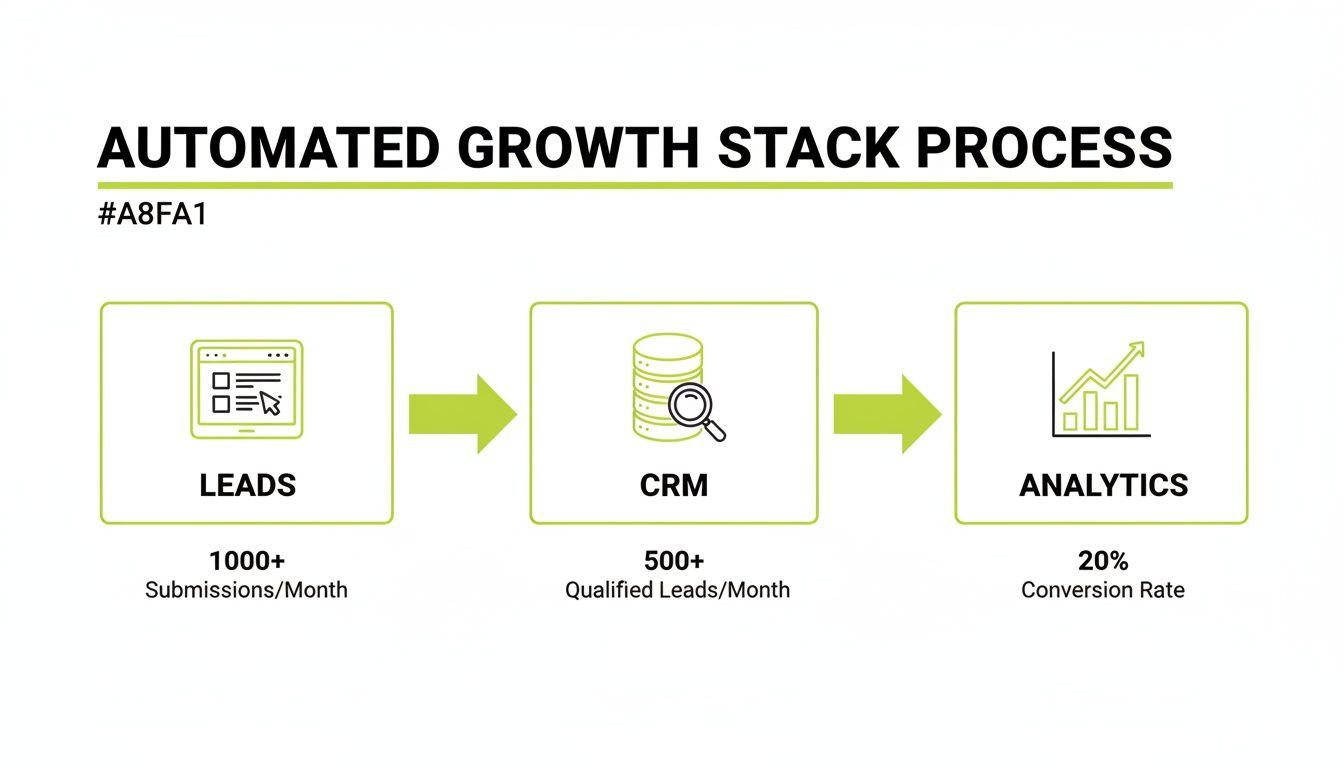
This visual makes it easy to understand how an automated system connects your marketing activities to real, measurable business outcomes. A committee member can log in and see, at a glance, exactly how many leads are at each stage:
- New Inquiry: The lead has just arrived and received the initial automated response.
- Contacted: A staff member has personally reached out by phone.
- Visit Booked: The prospect has scheduled a tour of the club.
- Converted: The prospect has officially joined and paid their subscription.
- Lost: The prospect chose another club or is no longer interested.
This level of insight is simply impossible with spreadsheets and email inboxes. It helps you spot bottlenecks, measure conversion rates accurately, and give your committee clear, data-driven reports on membership growth. This is the power of a true system over manual effort.
Automating Your Visitor and Society Booking Pipelines

While membership is the foundation of your club, do not neglect your other major income streams. Visitor green fees and society days are huge revenue drivers, but they often get bogged down by the same manual bottlenecks that stifle membership sales. By applying smart automation here, you are not just boosting the bottom line; you are dramatically improving the entire experience for every golfer.
The numbers speak for themselves. The Revenue Club’s latest report shows the average visitor income for their partner clubs hit £315k in 2026. That is a 13% increase on the previous year, with online sales specifically jumping by 38%. You can explore the full report on visitor revenue trends and see the clear pattern.
This data sends a clear signal: clubs with a slick digital booking process and automated systems are winning the lion's share of the casual golfer market. Those still chasing people with phone calls and emails are leaving serious money on the table.
Enhancing the Visitor Experience
For individual visitors, automation is not about creating a cold, robotic experience. It is the opposite. It is about delivering timely, helpful information that makes their visit feel polished and professional from the moment they book. A well-built system provides a level of consistent communication that even the most dedicated Pro Shop team cannot replicate manually.
Here are a few simple but powerful automations that work for visitor bookings:
- Abandoned Booking Reminders: A simple, automated email a few hours after a golfer starts but does not complete a booking can recover a surprising amount of lost revenue.
- Pre-Visit Information: The day before their round, send an automated email with key details. Think course dress code, where to check in, or a link to the clubhouse menu. It is a small touch that shows you are organised and helps their day run smoothly.
- Post-Round Feedback: A day after their visit, an automated email can thank them for playing and include a link to leave a quick review. This not only gathers fantastic feedback but also keeps you top-of-mind for their next round.
These small, automated touchpoints ensure every single visitor gets a consistent, high-quality level of service.
Automation ensures your club communicates with the professionalism of a high-end resort, even with the limited resources of a small team. It guarantees every visitor feels valued before they even step on the first tee.
Streamlining Society Day Enquiries
Society bookings are a high-value source of income, but they come with many moving parts. Managing these enquiries manually is a recipe for missed opportunities and administrative headaches. You are juggling proposals, price negotiations, deposit reminders, and final payment collections, all of which can easily get buried in a busy manager's inbox. This is where automation truly shines.
For a deeper look into this area, our guide on improving your golf club society marketing offers more strategies.
Imagine a smoother process with an automated workflow.
The moment an organiser enquires on your website, they instantly receive a professionally branded email. This contains your latest society packages and a link to a dedicated organiser’s info page on your site.
If they go quiet for a few days, the system automatically sends a friendly follow-up. This email can ask if they have questions or would like to chat about a bespoke package, preventing a warm lead from going cold.
Once you send a proposal, the system can take over the administrative work. It can send automated reminders if the proposal has not been accepted and, once it is, trigger reminders for the deposit deadline.
A few weeks before the event, an automated email goes out to collect final numbers, dietary requirements, and tee time preferences. This saves hours of back-and-forth phone calls.
This kind of structured, automated approach guarantees that every society organiser has a prompt, organised, and professional experience. It practically eliminates the risk of human error, freeing up your staff to focus on delivering a memorable event on the day.
How to Measure and Optimise Your Automation Engine
Getting your marketing automation up and running is a huge step, but the job is not finished. This is where the real value begins. An automated system that is not measured is just a more efficient way to guess. The goal is to constantly monitor its performance and make small, data-backed tweaks to improve your results.
This is how you turn your marketing from a cost centre into a predictable growth machine. It is about focusing on the numbers that actually affect your bottom line, not "vanity metrics" like social media likes. A well-configured CRM will do the heavy lifting, pulling all the crucial data into simple dashboards that you can easily share with your committee. Suddenly, you have a clear, objective view of what is working and what is not.
Defining Your Key Performance Indicators
To get a true picture of your performance, you need to track the KPIs that tell the complete story of a potential member's journey, from their first enquiry to signing up. These are the numbers that matter.
Your core metrics should always include:
- Inquiry Response Time: How fast does your system engage with a new lead? Your automated welcome email should be instant, but it is just as important to track how long it takes for a staff member to make that crucial first personal call.
- Lead-to-Visit Rate: What percentage of people who enquire actually book a tour of the club? This is a direct measure of how well your initial follow-up emails are working. If this number is low, you know exactly where to focus your attention.
- Visit-to-Conversion Rate: Of those who take the time to visit, how many become paying members? This KPI tells you how effective your in-person experience and sales process are.
All of these metrics ultimately feed into the one number that trumps all others.
The ultimate measure of success for any marketing effort is the Cost Per New Member Acquired. This figure tells you exactly how much you are investing to bring in each new member, giving you undeniable proof of your return on investment.
Tracking this single metric brings absolute clarity to your marketing discussions. It shifts committee meetings away from subjective debates and towards objective conversations about financial returns. When you can confidently state that spending £X on advertising reliably generates £Y in new membership revenue, the value of the system becomes indisputable.
Simple Tactics for Continuous Optimisation
Optimisation does not need to be a complex process. It is about making small, controlled changes and measuring what happens. Your CRM and automation platform give you all the tools you need to test different approaches. A brilliant place to start is with your emails.
A simple A/B test is a perfect example. This means sending two slightly different versions of the same email to see which one gets a better reaction.
You could easily test two different subject lines:
- Version A: An email with the subject line "Your Membership Enquiry at [Club Name]".
- Version B: An email with the subject line "Next Steps for Joining [Club Name]".
The system automatically sends each version to a portion of your audience and tells you which one got more opens or clicks. Over time, these small wins add up, making your entire nurture sequence more effective. You can apply the same thinking to other variables, like the time of day you send messages or the content you share.
By getting into this simple rhythm of measuring, testing, and tweaking, you ensure your automation is a living system that constantly adapts to deliver better results. This is how marketing stops being an unpredictable expense and becomes a reliable investment in your club's future.
Answering Your Questions About Golf Club Automation
Even when the benefits are obvious, bringing in a new system is a big decision. Club managers, secretaries, and committee members always have practical questions about what they are getting into.
Let's tackle some of the most common concerns we hear from clubs. Our goal is to clear up the confusion and show how a well-built system can become your club's most powerful asset.
"Isn't Automation Too Impersonal For Our Club?"
This is the first question we always get, especially from private members' clubs built on personal relationships. There is a fear that automation will feel cold and robotic. In our experience, when it is done right, the exact opposite is true.
Good automation does not replace the personal touch; it makes more room for it. The system handles repetitive tasks like sending an instant acknowledgement or a simple follow-up email. This frees up your staff to focus on the moments that build relationships.
Those moments are what matter: a personal phone call to an interested golfer, an unhurried tour of the clubhouse, a warm welcome for a new member. Automation ensures no one gets ignored while your team is busy, creating a foundation for brilliant service, not replacing it.
"What's The Real Cost of a Marketing Automation System?"
It is easy to focus on software fees, but that is not the right way to look at it. A marketing automation system is not a cost centre; it is an investment in growth and efficiency. The real question is not "what does it cost?" but "what does it return?"
The return on investment comes from converting the valuable enquiries you are currently losing. For most clubs we work with, converting just one or two extra members, people who would have otherwise been lost in a busy inbox, pays for the entire system for a year.
The true cost is not the software subscription. It is the missed revenue from every single lead that goes cold because you did not have a system to follow up effectively.
"Is This Too Complex For Our Volunteer Committee to Manage?"
This is another valid concern, particularly for clubs run by volunteer committees or those without a dedicated marketing person. The thought of setting up complex software can feel daunting.
This is exactly where having a specialist partner is crucial. A growth partner like GolfRep does the heavy lifting. We handle the strategy, the technical setup, and the complete configuration of your CRM and automation workflows. We build the engine; you just need to drive it.
Your committee’s role shifts from trying to be software experts to simply overseeing performance. We provide clear, simple dashboards that show you the exact numbers that matter: leads, bookings, and new members. This makes sophisticated marketing accessible to any club, no matter how much technical expertise you have in-house.
Ready to stop losing leads and build a predictable pipeline for growth? At GolfRep, we combine proven advertising strategies with robust CRM and automation systems to deliver real, measurable results for UK golf clubs. Discover how our Growth System works.
Ready to tap into our proven growth system?