Golf Club Lead Management: A Practical System That Converts

The most popular advice for golf clubs with weak membership numbers is to increase advertising. That advice is often premature. If a club can't show who received an enquiry, when somebody responded, what category the golfer wanted, and what happened next, more promotion feeds a leaky process.
The UK market already contains substantial demand. England Golf-affiliated membership reached 750,071 in 2025, its highest recorded level for at least 13 years, while junior membership climbed from 46,028 to 61,483, an increase of more than 34%, according to England Golf membership reporting. Hillier Hopkins also found that 46% of clubs had waiting lists, with an average of 51 people per list, while the average club welcomed 94 new members in 2023, as reported by Golf Business News.
The practical problem is rarely a complete absence of interest. It's an enquiry sitting unanswered, a phone call handled by whoever happens to be available, or a promising visitor whose details disappear when a committee member changes. Golf club lead management is therefore an operations discipline, not merely a marketing activity.
Why Most Golf Clubs Lose More Leads Than They Generate
More marketing isn't the automatic answer. A club can increase traffic and still produce fewer members if its response process remains slow, fragmented and dependent on memory.
The warning signs are familiar. A website form lands in a shared inbox and waits for somebody to notice it. A phone enquiry gets answered by the receptionist, then passed verbally to the secretary. A committee agrees to follow up, but the responsibility drifts after a captain or membership volunteer changes. Nobody can see whether the golfer asked about full membership, a junior pathway, flexible access or a society booking.
One UK club analysis recorded an average enquiry response time of 47 hours and 32 minutes. The same analysis reported that a lead answered within one hour was five times more likely to convert than one left for 24 hours, as outlined in GolfRep's UK golf club lead-management analysis. Broader UK lead-handling research also describes average response times in hours, while only 7% of businesses achieve a response within five minutes, according to the UK lead response crisis report.

The leak sits between interest and action
England recorded 11.83 million WHS scores in 2025, up 16% year on year, and more than 24,000 iGolf subscribers had progressed into club membership, including 9,600 in 2025 alone, according to Golf Times' coverage of England Golf's 2025 figures. That points to a conversion opportunity between flexible or off-course participation and traditional membership.
A useful comparison is the wider B2B lead generation strategies sphere. The channel may differ, but the operating principle holds: acquisition only creates value when the business has a visible process for handling and progressing interest.
Practical rule: Before increasing advertising spend, trace a sample of recent enquiries from first contact to final outcome. Missing owners, blank fields and delayed replies usually reveal the first growth constraint.
A private club doesn't necessarily have a lead generation problem. It may have an inbox, phone and rota problem. Process beats promotion when demand is already present.
Capturing Every Enquiry in One Place
The capture layer should create one enquiry record per person, regardless of where the conversation starts. A website form, phone call, walk-in and Instagram message must not become separate fragments that staff have to reconcile later.
Start by listing every entry point: the club website, Google and Meta landing pages, HowDidiDo and GolfPass listings, third-party tee-time aggregators, the main phone line, pro-shop visitors, member referrals, Instagram DMs and WhatsApp. Each channel needs a defined route into the same working system.
Website and paid landing-page forms should use controlled fields rather than unrestricted free text. At minimum, capture enquiry type, membership category, home club or current playing arrangement, contact details, preferred contact method and source. Keep the form short enough to complete, but structured enough to support routing and reporting.
Phone calls need a shared number or a simple logging screen. The staff member who answers should record the enquiry during the same shift, not leave a note for somebody else. A walk-in should have a digital record created before the visitor leaves the car park, while social messages should flow into a unified inbox rather than remain inside an individual employee's account.
Standardising every entry point
| Channel | Standard Capture Rule | Required Fields | Owner |
|---|---|---|---|
| Website form | Send directly into the CRM | Name, contact details, enquiry type, category, source | Marketing lead |
| Google or Meta landing page | Use dedicated form and source tag | Campaign, category, timeline, contact preference | Marketing lead |
| HowDidiDo or GolfPass | Create a tracked referral route | Directory source, enquiry type, contact details | Membership lead |
| Phone | Log during the same shift | Caller, question, category, next action | Front desk |
| Pro-shop walk-in | Create record before departure | Name, interest, contact permission, owner | Front desk or PGA pro |
| Member referral | Use referral form | Referrer, prospect, category, consent | Membership lead |
| Instagram or WhatsApp | Funnel into shared inbox | Handle or number, message, source, owner | Marketing lead |
Protecting data quality
Use required fields for information that affects ownership. Apply deduplication rules based on email address and phone number, then merge records rather than creating a second contact. Tag the original source even when the lead later replies by another channel. Without source tagging, the club can't distinguish a productive referral from a paid campaign or a directory listing.
Clubs reviewing their wider capture process may find this playbook for local business owners useful for thinking through local enquiry routes. For golf-specific workflows, the golf club enquiry management guide provides a more relevant operating frame.
Qualifying and Routing Leads Within Minutes
Speed matters, but speed without direction creates another queue. The first response should acknowledge the enquiry immediately, gather enough information to prioritise it, and place it with a named person.
Set an automated acknowledgement to trigger within 60 seconds. It should confirm receipt, state when a club contact will respond, and offer a same-day call slot where possible. The message shouldn't pretend to be a personal conversation. It should remove uncertainty while the CRM assigns the next action.
Four practical building blocks
Acknowledgement triggers create the first safety net. If the form arrives outside office hours, the reply can confirm that the message is recorded and invite the prospect to choose a convenient time. It should also make clear how urgent enquiries, such as event dates, will be handled.
Routing rules should use CRM fields rather than personal judgement. Membership-category questions go to the membership director. Junior pathway enquiries go to the PGA professional. Society and event requests go to the events lead. The secretary or general manager needs visibility across all routes, but shouldn't become the default owner of every enquiry.
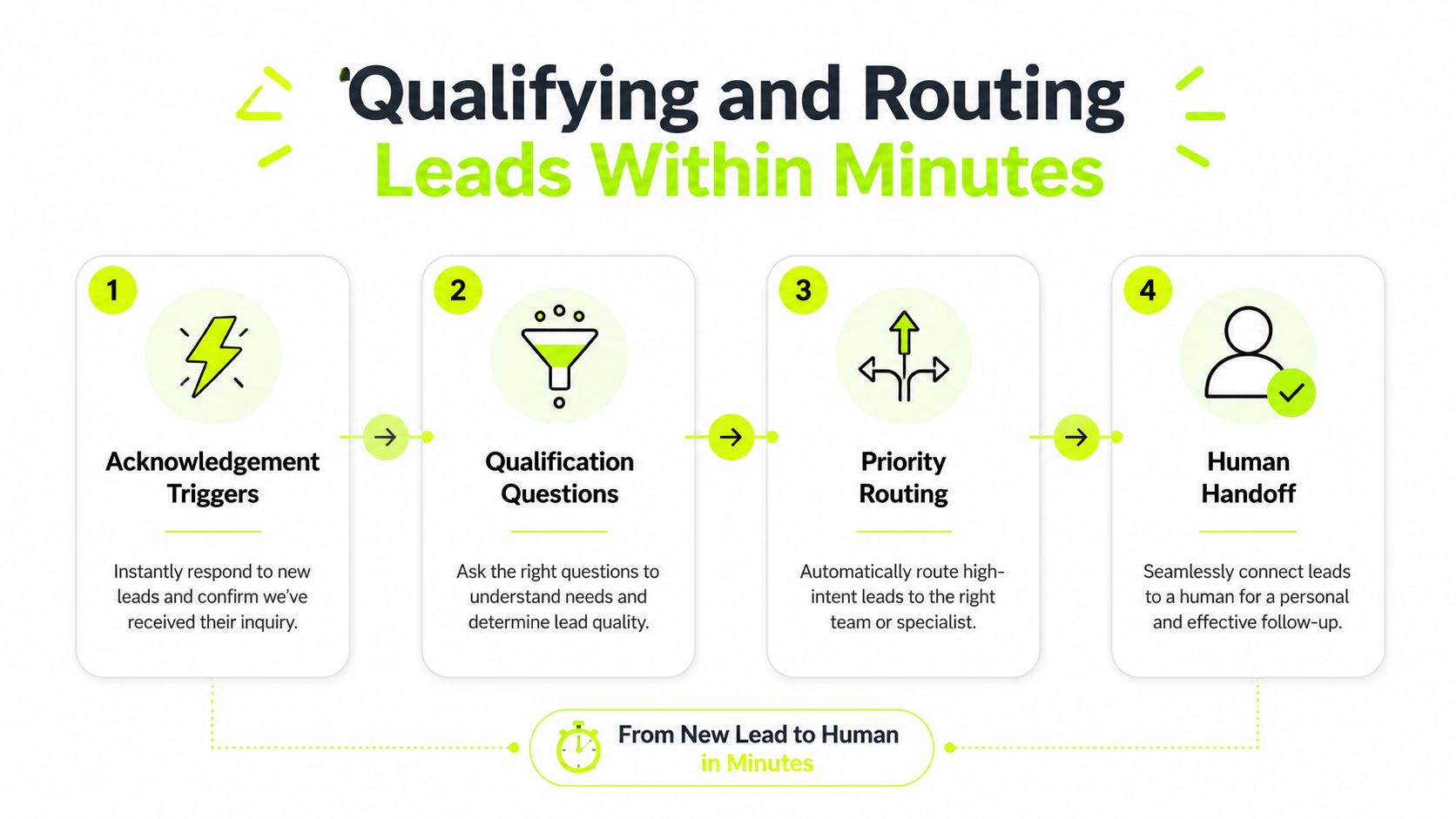
Qualification belongs in the first live conversation. Use a short scorecard covering budget range, playing frequency, joining timeline, current club status and decision role. The aim isn't to interrogate the golfer. It's to understand fit, urgency and the next useful step.
CRM configuration turns that conversation into an accountable record. Define pipeline stages such as new, acknowledged, contacted, qualified, visit offered, visit booked, application submitted, joined and not proceeding. Add source tags, owner assignment, next-action dates and SLA timers. A practical priority structure is:
- Priority A: call within five minutes.
- Priority B: call within 30 minutes.
- Priority C: call within two working hours.
The thresholds should be tested against staffing capacity rather than published and ignored. For more detail on the operating principle, see GolfRep's speed-to-lead guidance.
A fully qualified record should show the golfer's category, likely fit, timeline, playing needs, source, owner, last contact, next action and agreed follow-up date. If those fields are blank, the lead hasn't been qualified. It has only been received.
Building Nurture Flows That Book the Visit
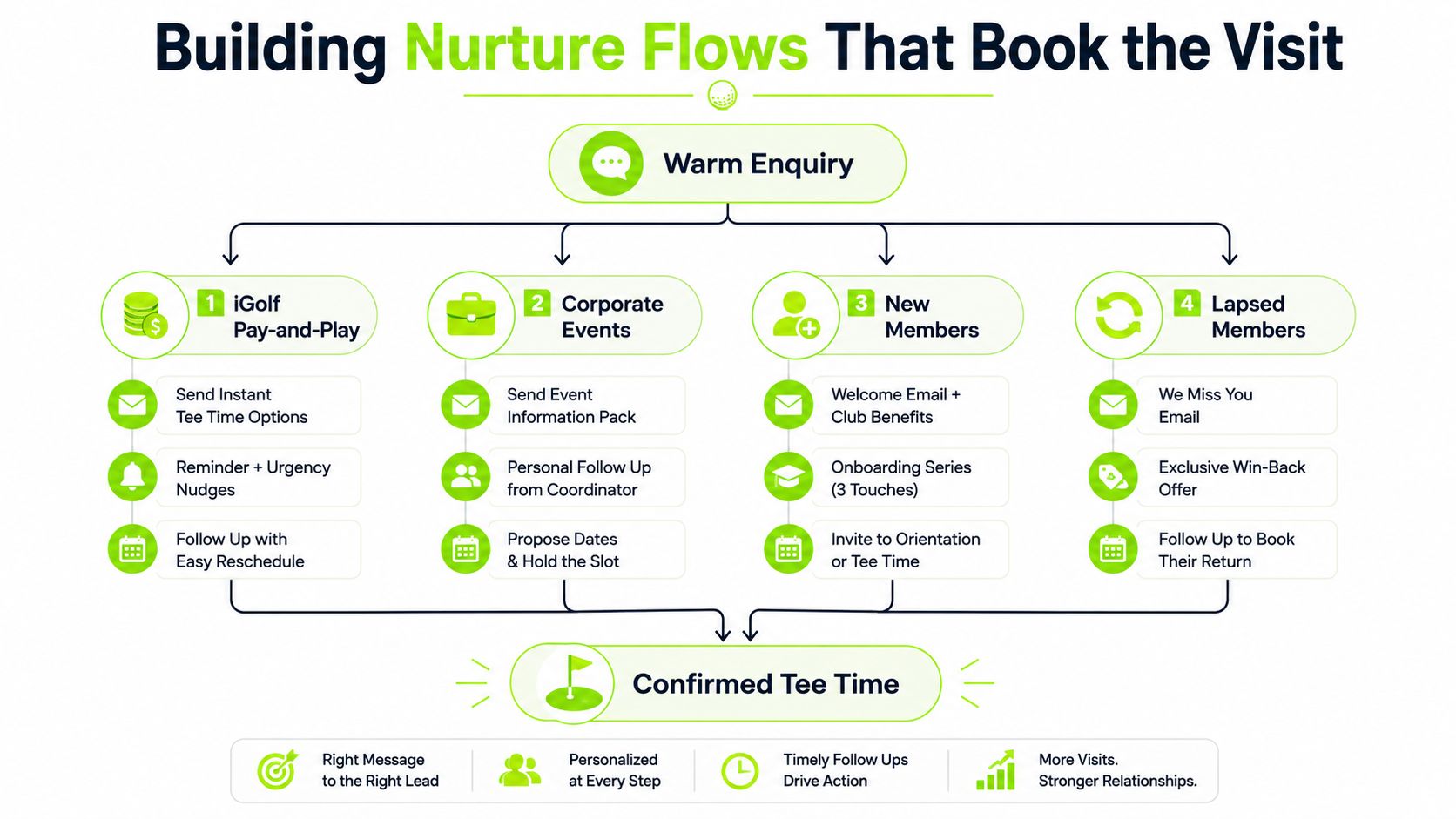
A nurture sequence shouldn't broadcast the same membership message to every golfer. An iGolf user who already plays regularly needs a different conversation from a parent asking about junior development, and a returning adult may need reassurance about fitting back into club life.
Use a 14-day sequence across email and SMS, with one voicemail drop on day 3 or 4. Every touch should follow a simple order: provide value first, explain club fit second, then ask for a specific action. The action might be a phone call, a course visit, a junior coaching conversation or a membership information appointment.
Four routes from enquiry to visit
iGolf pay-and-play users need a bridge from flexibility to belonging. Explain how membership changes access, competition, social opportunities and progression, then invite them to discuss the category that fits how they already play.
Returning adults often need a low-pressure route back into golf. Use practical information about playing partners, coaching, handicaps and introductory visits rather than assuming that a price-led offer will remove hesitation.
Family enquiries should separate the needs of the parent from those of the child. Explain access, scheduling, coaching and the club environment, then offer a conversation that discusses the household's playing pattern.
Junior pathway parents need a named PGA contact and clear next steps. The enquiry should move quickly from general information to an assessment of age, experience, coaching goals and availability.
A workable cadence might look like this:
- Day 0: acknowledgement email and SMS, with a call option.
- Day 1: category-specific email answering the main practical question.
- Day 3 or 4: personal voicemail from the named club contact.
- Day 5: SMS offering two visit or call windows.
- Day 7: email showing what a first visit involves.
- Day 10: personal follow-up for engaged leads.
- Day 14: final automated message that keeps the door open.
- After day 14: move non-responsive leads into a longer-term, permission-based nurture path.
Copy that staff can use
Email template
Subject: Finding the right membership route at [Club Name]
Thanks for contacting us. Based on what you've told us, [category or pathway] may be a sensible starting point. We can explain access, playing opportunities and what your first visit would involve. Would [option one] or [option two] suit you for a short call or visit?
SMS template
Thanks for contacting [Club Name]. We've received your enquiry and can help you compare the right membership route. Would you prefer a quick call or a visit this week? Reply with a suitable time and [named contact] will arrange it.
Voicemail talking points
- Introduce yourself and the club.
- Confirm why you're calling.
- Refer to the category or pathway requested.
- Offer a clear next step.
- Give a direct callback route.
- State when you'll follow up again.
Automation should stop when the prospect replies, books a visit, asks a specific question, or shows repeated engagement. At that point, the membership director owns the handoff. A useful script is: “You've looked at [category]. I'd like to understand how you play and show you the route that fits, rather than send another generic information pack.”
Assigning Roles, SLAs and Weekly Routines
A lead-management system fails when everybody is responsible. In a typical club, the secretary or general manager owns the pipeline, the membership director or committee lead handles first response, the PGA professional closes experience-led conversations, the marketing lead maintains sources and content, and front-desk staff capture enquiries.
That division doesn't need to match every club's job titles. It does need to be written down. A backup owner must be named for holidays, competitions, weekends and committee changes.
A practical operating table
| Process Step | Primary Owner | Backup | SLA |
|---|---|---|---|
| Enquiry capture | Front desk | Marketing lead | Same shift |
| Initial acknowledgement | Membership lead | Secretary or GM | Within 15 minutes during office hours |
| Qualified call | Membership lead | PGA professional | Within 24 hours |
| Visit offer | PGA professional or membership lead | Secretary or GM | Within 72 hours |
| Post-visit follow-up | Membership lead | Named committee backup | Continue for 30 days after visit |
| Pipeline review | Secretary or GM | Committee chair | Weekly |
The faster five-minute and priority response rules used at the qualification stage should sit inside these broader service commitments. A club can promise a rapid first call for high-priority leads while still giving every enquiry a reliable acknowledgement and a documented next step.
The weekly rhythm should be brief and disciplined:
- Monday pipeline review: inspect new, overdue and high-priority records.
- Wednesday stalled-lead clean-up: close duplicates, reassign untouched records and schedule next actions.
- Friday source snapshot: compare enquiries, visits and joins by channel.
- Monthly committee readout: show movement, blockages, capacity issues and decisions required.
Making handovers survive real club life
Volunteer handovers are a common failure point. So are summer holidays and the assumption that one enthusiastic individual will keep everything moving. The remedy is a handover checklist containing current owner, backup owner, open leads, next actions, promised callbacks, category notes and access to the shared system.
A pipeline record should be understandable to somebody who wasn't present for the original conversation. If the only context exists in a personal notebook or private WhatsApp thread, the club doesn't own the process.
Measuring What Actually Moves Membership Numbers
A full pipeline can look healthy while producing very few members. The secretary needs to know whether leads are being answered, whether visits are being booked, whether visits turn into applications, and whether any source consistently produces the right type of golfer.
The dashboard should contain five measures. The thresholds below are operating targets, not universal UK benchmarks, and should be adjusted after the club has established a trustworthy baseline.
The five measures to review
| KPI | Healthy Threshold | What a Breach Signals |
|---|---|---|
| Response time | Under 15 minutes | Weak routing, unclear ownership or an unattended inbox |
| Lead-to-visit rate | Above 25% | Poor qualification, weak offer or unsuitable traffic |
| Visit-to-join conversion | Above 40% | Experience, category fit or follow-up issue |
| Pipeline velocity | Under 30 days | Too many stages, delayed decisions or missing next actions |
| Source yield | Joins per 100 enquiries by channel | A source may create volume without producing suitable prospects |
Response time should measure the median minutes from form submission to human acknowledgement, not just the time a system sends an automated email. The club needs to know when a real person accepted responsibility.
Lead-to-visit rate should be split by source and membership category. A strong overall figure can hide a poorly performing paid campaign or a junior pathway that needs a different offer. Visit-to-join conversion should also be separated by owner and category, because the problem may sit in the visit experience rather than the original enquiry.
Pipeline velocity is useful because it exposes drift. A lead can appear active while waiting for a brochure, a committee decision or a promised call. Every active record needs a next action and date.
A dashboard is useful only when a named person changes something because of it.
The CRM should calculate stage movement from timestamps, source tags and outcome fields. Staff shouldn't need to assemble the monthly report manually from inboxes and spreadsheets. A monthly review should ask three questions: which source produced joins, which stage lost the most prospects, and what operational change will be tested next?
UK guidance supports structured follow-up rather than a single unanswered attempt. One source recommends at least 10 contact points across 10 days after an accepted enquiry, as set out in Unbiased's lead follow-up guidance. The exact cadence should reflect consent, category and club capacity, but the principle is sound. A visible sequence is more reliable than goodwill.
A 30-60-90 Plan to Make the System Stick
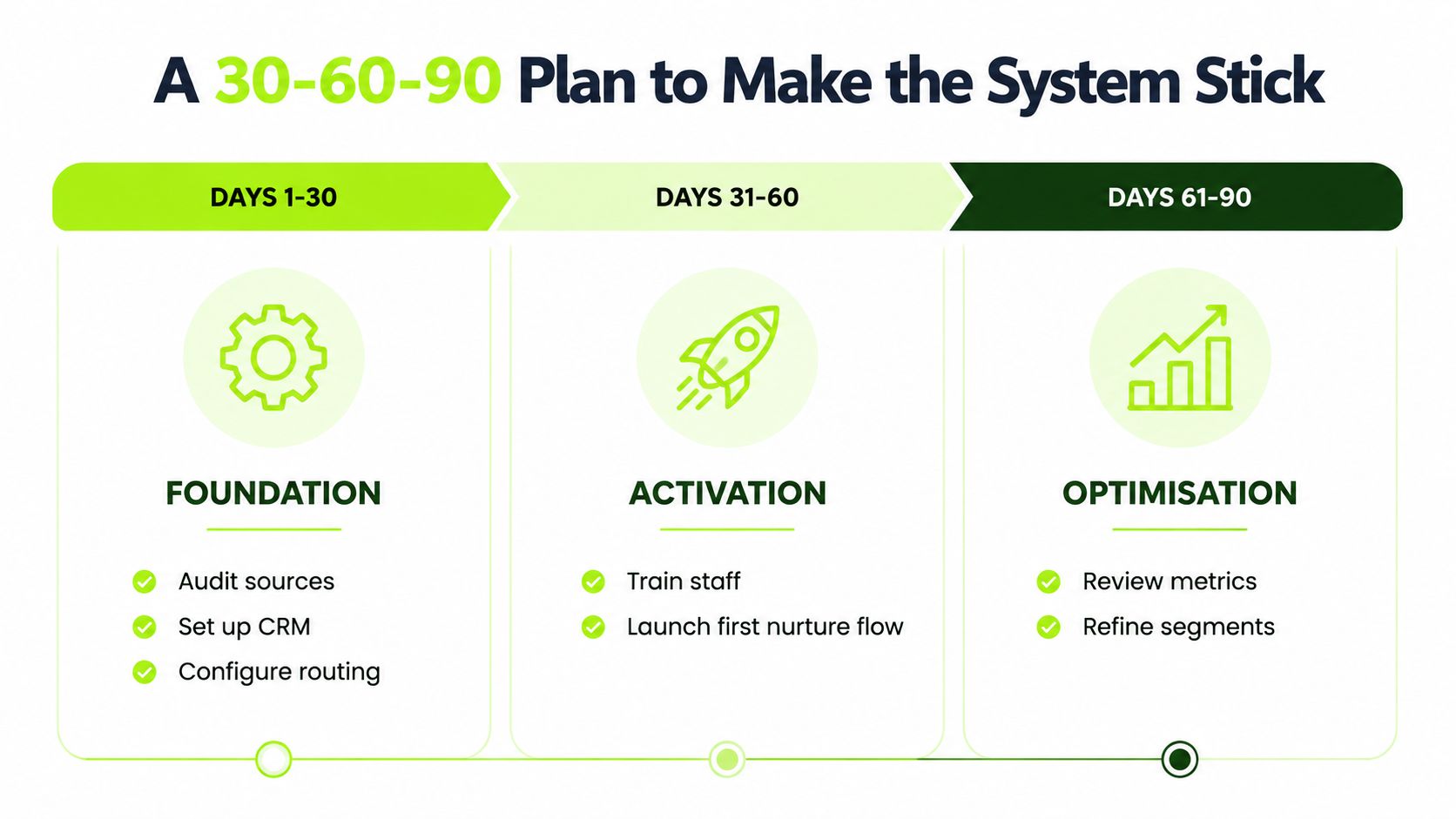
A golf club does not need to rebuild every system before it improves lead handling. It needs a controlled rollout, named owners and a review routine that survives holidays, committee changes and staff turnover.
Days 1 to 30, build the foundation
Audit every enquiry route, including forms, phone calls, directories, social messages, walk-ins and referrals. Create one CRM record structure with required fields for category, source, owner, stage, last contact and next action. If a route cannot create or update a record, it remains a leakage point.
Configure the acknowledgement message and routing rules. Agree the qualification scorecard, priority definitions and service levels with the secretary, membership director, PGA professional and marketing lead. Write the handover checklist before the first absence exposes the gap.
Days 31 to 60, activate the workflow
Switch on nurture cadences for iGolf users, returning adults, families and junior pathway parents. Start the Monday pipeline review, with overdue records visible to the person responsible for the next action.
Build the dashboard around response time, lead-to-visit rate and visit-to-join conversion. Retire at least two legacy inboxes once every relevant route has a tested destination. Parallel systems encourage staff to use whichever inbox feels quickest, leaving ownership and history unclear.
Test the human handoff. Automation can confirm receipt and provide useful information, but a named contact must take over when a prospect replies, books a visit or asks a detailed question. Record the handoff in the CRM, not in a private inbox.
Days 61 to 90, optimise the operation
Review source yield and tighten routes that produce poor-fit enquiries or incomplete records. Add referral and waiting-list reactivation plays, with clear ownership and consent controls. Waiting-list prospects may already understand the club, but their timing and eligibility still need recording.
Lock in the monthly committee report. It should show outcomes and decisions, not a decorative collection of traffic or open-rate figures. A useful report identifies where prospects stalled, which owners need support and whether the club has capacity to handle additional demand.
Informal implementation fails in predictable ways. Ownership drifts during the closed season. Follow-up falls to one overworked individual. Staff leave qualification fields blank, so later conversations become guesswork. A dashboard gets built, then nobody reviews it.
GolfRep helps clubs combine lead generation with structured follow-up and CRM systems, using one place to receive, qualify, assign and progress enquiries towards a booked visit and membership outcome. The operating principle is simple: predictable membership growth is an operations outcome, owned by named roles, policed by SLAs and measured weekly.
If your club generates enquiries but cannot see who owns them or what happens next, visit GolfRep to explore a practical lead-management system built around capture, rapid qualification, CRM visibility and structured nurture. Start by documenting the current enquiry journey, then turn its gaps into a pipeline the team can operate every week.
Ready to tap into our proven growth system?