Golf Club AGM Minute Taking: How to Do It Properly
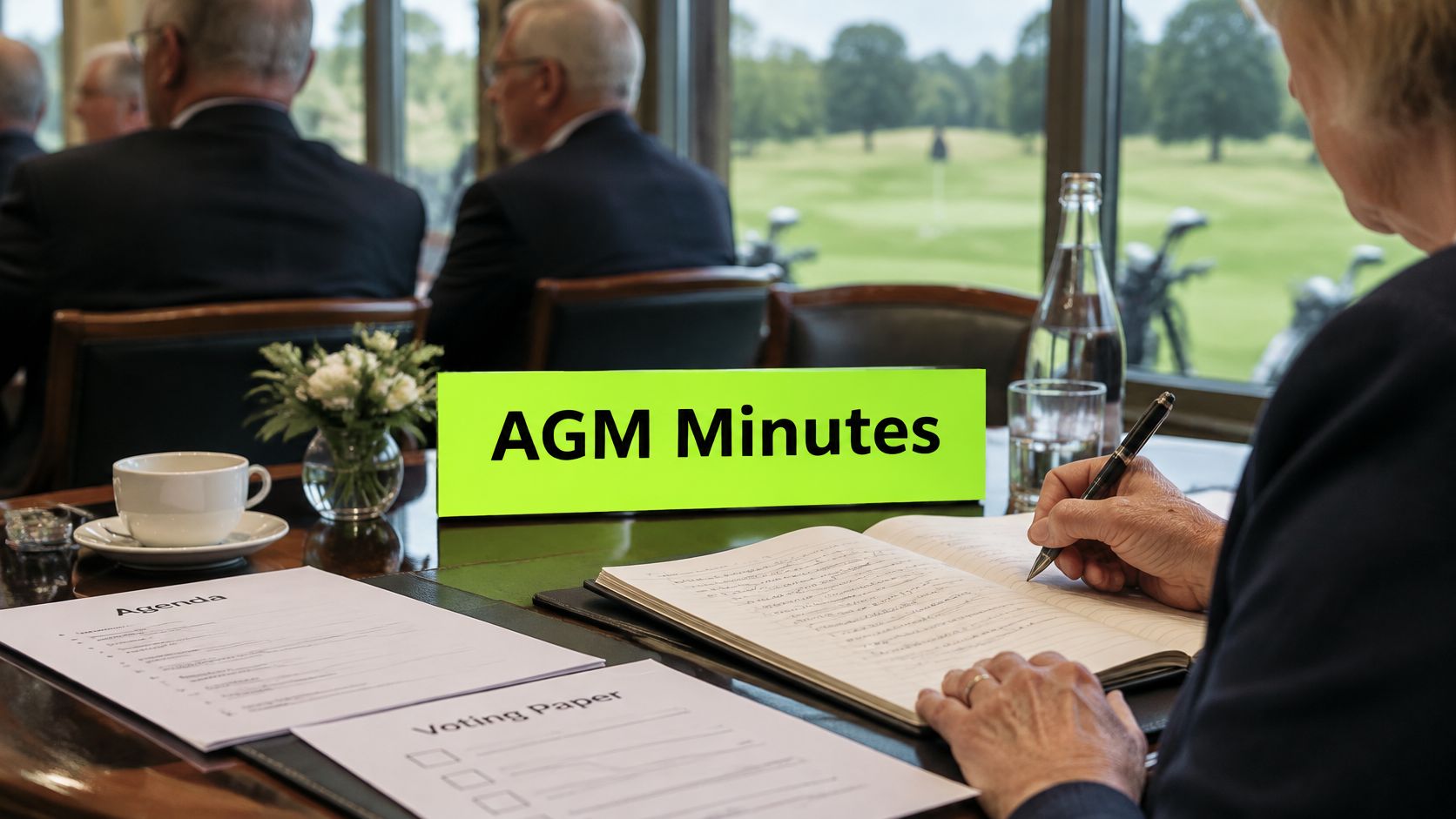
You're assembling the AGM papers when a member asks whether an earlier subscription increase was properly approved. The previous secretary has left, the chair remembers a show of hands, and the only document anyone can find says the increase was agreed.
That's the problem golf club AGM minute taking needs to prevent. At GolfRep, our view is that a commercial decision needs a record that survives a change of committee. Keep a complete formal master record, then prepare a clearly labelled member communication alongside it. They serve different purposes, and neither should be mistaken for the other.
The Required Contents of a Golf Club AGM Minute
Say a member challenges a subscription increase two years after the AGM. The committee needs to establish what members voted on, who was entitled to vote and what the chair declared, not reconstruct the evening from recollection.
For a UK golf club incorporated as a company, section 355 of the Companies Act 2006 requires minutes of general-meeting proceedings and copies of member resolutions passed outside general meetings to be retained for at least 10 years from the meeting or resolution date. That makes the minute a long-term governance record, not a report for the next newsletter.
Required contents of a golf club AGM minute
Use this checklist in meeting order. It combines the formal record with practical details that help a future committee understand and implement the decisions.
| Element | What to record | Why it matters |
|---|---|---|
| Meeting details | Date, venue or permitted electronic format, meeting type, time opened | Identifies the record and its meeting |
| Convening evidence | Notice date, agenda, how the meeting was called | Shows how the meeting was convened |
| Attendance | Chair, committee and members present, apologies, proxies, quorum confirmation | Establishes quorum and voting entitlement |
| Previous minutes | Approval of the prior AGM minute and any accuracy amendments | Keeps the record continuous |
| Reports | Summary of each report received, full reports attached separately | Gives context without bloating the minute |
| Resolutions | Exact wording, number matching the notice, proposer and seconder where relevant, result | Establishes what members agreed |
| Elections and appointments | Names, roles, term, vote count where taken | Evidences who holds office and since when |
| Declarations of interest | Who declared, nature of the interest, whether they abstained | Documents how conflicts were handled |
| Actions | Action, named owner, deadline | Makes implementation checkable |
| Closure | Time closed, chair signature | Authenticates the completed record |
Don't treat every entry in this table as an identical statutory requirement for every club. The club's legal form, articles and rules matter, particularly for proxies, nominations, seconders and voting procedures. Unincorporated clubs follow their constitution and applicable rules for record keeping, although this structure remains a useful working standard.
Record the authority behind the decision
A report being received isn't the same as its recommendations being approved. If the treasurer presents a subscription proposal, distinguish the financial report, the resolution put to members and the outcome.
Attach reports under identifiable filenames rather than pasting lengthy presentations into the minute. Preserve the version presented, especially where members were considering a capital project or budget.
This is part of sound country club management: managers need to know whether they've been authorised to investigate, negotiate or spend. Hold the checklist against every draft before it goes for review.
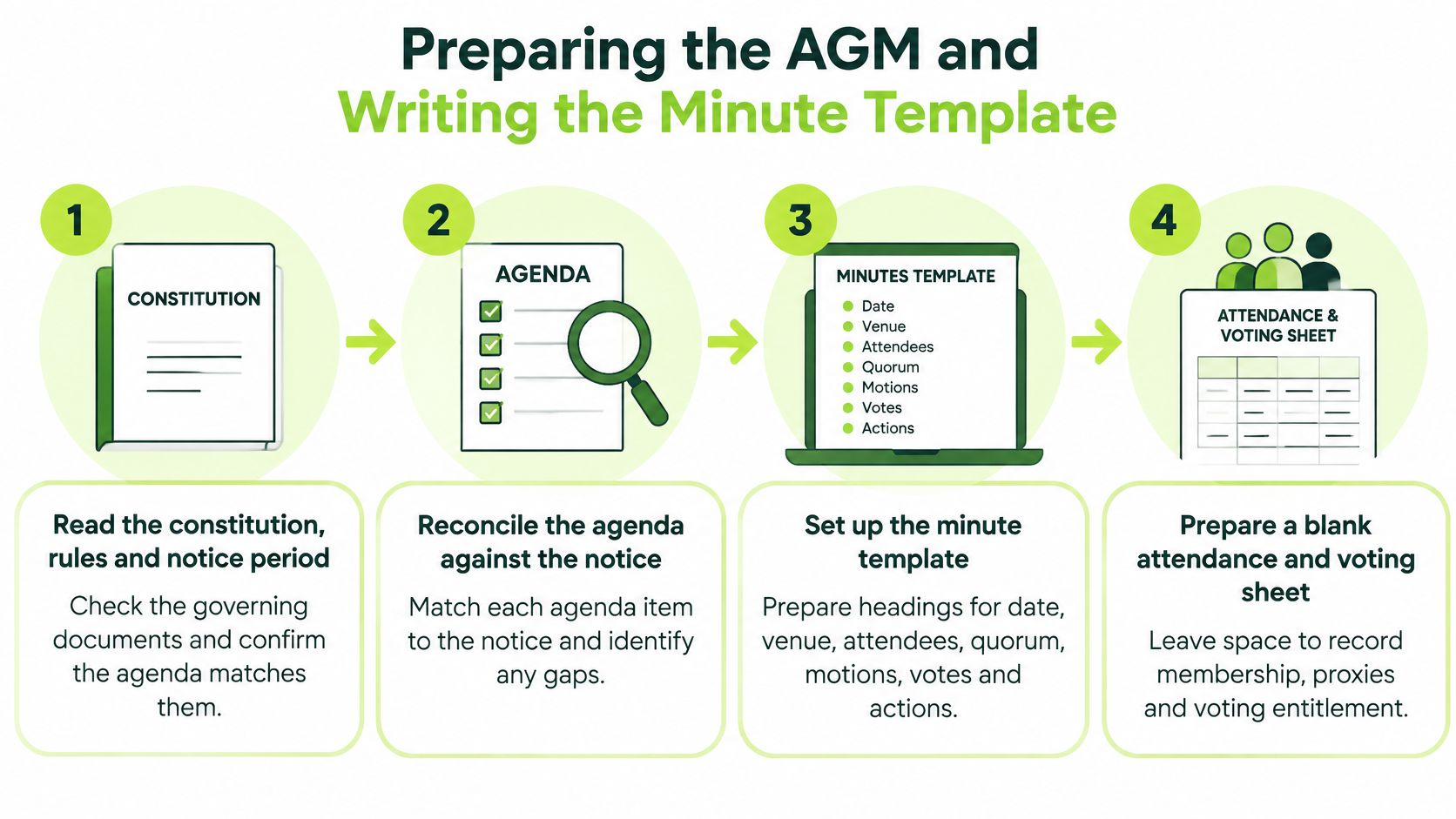
Preparing the AGM and Writing the Minute Template
Preparation should remove avoidable decisions from the minute taker's workload. You shouldn't be searching the constitution while the chair is putting an amendment to the room.
Use the fortnight before the AGM to complete the following process, provided all formal notice and submission deadlines have already been met.
Build the working pack
Read the governing documents. Check the constitution, articles, rules and applicable notice requirements. Confirm who can attend, vote, nominate candidates and submit motions. Don't rely on how the previous committee remembers doing it.
Reconcile the agenda against the notice. Give each resolution the same identifier used in the circulated papers. Flag missing items or inconsistent wording before preparing the final working pack.
Create the minute template. Build headings directly from the agenda, with blank fields for the exact resolution, amendments, result and action. AIDictation's minutes templates for board meetings can help with layout, but adapt the structure to a members' AGM rather than importing board procedures unchanged.
Agree voting arrangements with the chair. Establish when a show of hands, poll or ballot will be used, subject to the governing rules. Decide who counts and how the final wording and outcome will be confirmed aloud.
Prepare attendance and proxy records. Separate attendance from voting entitlement. Check the quorum rule itself, including how proxies or remote participation are treated, rather than assuming everyone in the clubhouse counts.
Agree the decision-log rules. Put the fields and attribution approach in writing for the chair's sign-off. Make clear that the minute records material considerations and decisions, not every contribution.
Allocate the checking roles. Name the minute taker, identify who keeps the chair's running notes and arrange an independent factual check. The person counting votes shouldn't also be expected to capture a complicated amendment unaided.
Create the archive first. Set up draft, corrected-draft and approved naming conventions. Give the secretary, chair and a named deputy appropriate working access, with secure backups and a year-based folder structure.
Check what can actually be decided
The preparation failure to catch is a popular motion that hasn't satisfied the applicable notice or submission rules. Enthusiasm in the room doesn't establish procedural authority. Ask the chair to resolve the issue before the meeting, seeking advice where necessary, rather than expecting careful wording afterwards to repair it.
Practical rule: A template helps you record a valid process. It can't make an invalid process valid.
On the morning of the AGM, check the final papers, attendance sheets, ballot materials and backup note-taking arrangements. At the start of each governance year, diary the intended approval deadline and member-summary date around the club's actual approval procedure.
If the committee is also reviewing member communication, our first call at GolfRep is an open strategic conversation, not a sales pitch, about the club's current setup, goals and challenges, and what a growth system could look like.
Recording Decisions and Votes During the Meeting
Keep distinct records of attendance and voting entitlement, material deliberation, and outcome and implementation. At registration, reconcile the membership list, proxies and constitutional restrictions, then record those present and represented. A full room doesn't establish that a particular motion can validly pass.
The minute taker needs a clear view of the chair and whoever confirms voting totals, with the working papers close at hand.
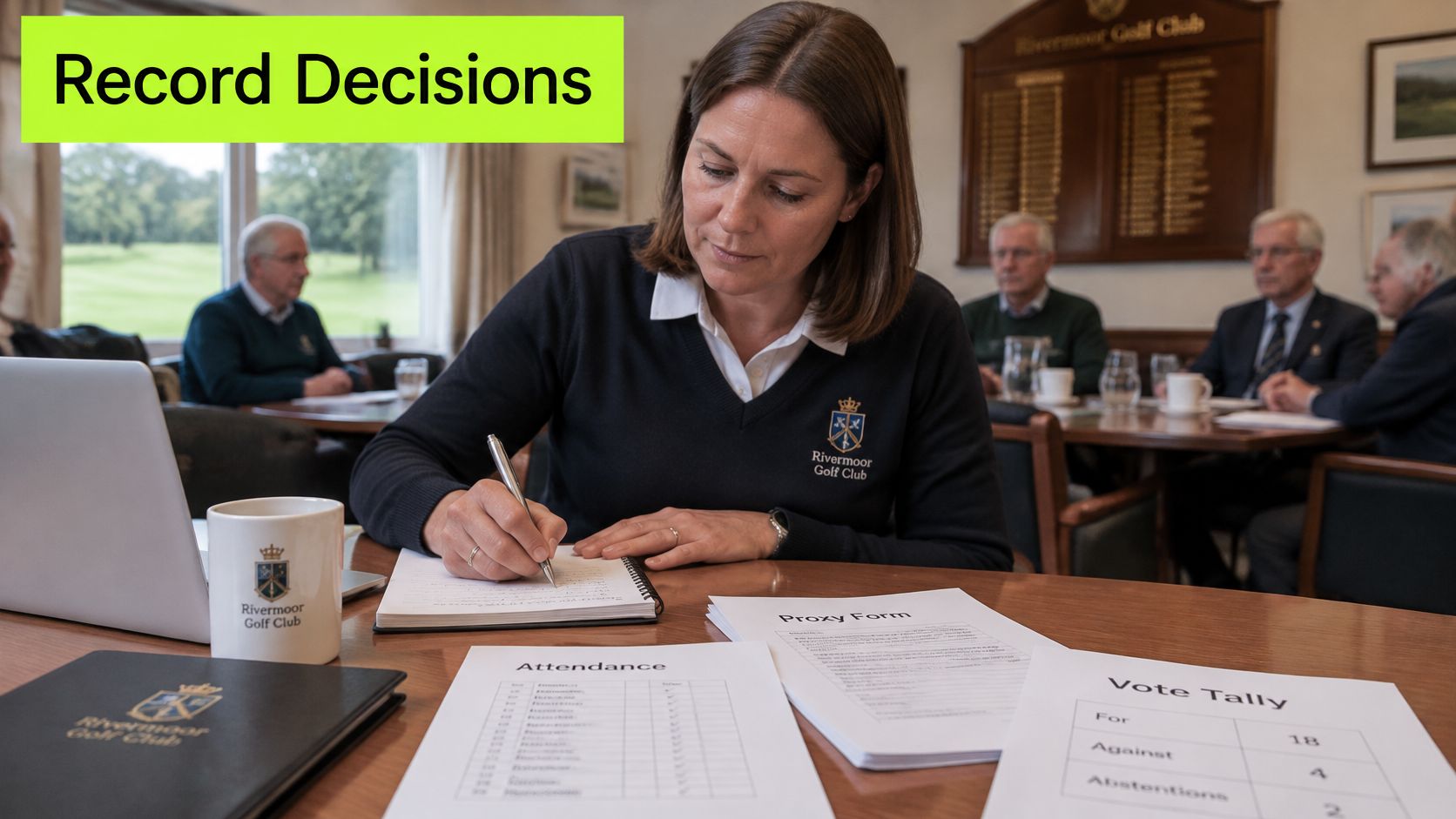
Decision log fields for each motion
| Field | What to capture | Why it matters |
|---|---|---|
| Motion text | Exact wording as printed on the notice | Establishes the proposal notified |
| Amendment text | Each amendment in the order proposed | Shows how the final wording was reached |
| Final question put | Precise question members voted on | Makes the result unambiguous |
| Votes for and against | Counted figures, or scrutineers' totals for a ballot | Provides an evidence trail |
| Abstentions | Number abstaining and any declared interest | Documents participation and conflict handling |
| Chair's ruling | Procedural ruling and reason given | Explains why a point was or wasn't put |
| Action owner | Named person and deadline where a task arises | Connects approval to implementation |
Follow the motion through to implementation
Suppose the notified motion concerns a subscription change. Start with its published text, record any amendment separately, and capture the chair's final question before the vote. Don't assume the room voted on the original wording if the discussion has changed it.
After the vote, read back the wording and result for the chair to confirm. Record the material considerations, such as affordability, course-maintenance commitments and member impact, without turning the minute into a transcript.
Name speakers where attribution is requested, a formal conflict or dissent needs recording, or a procedural ruling requires identification. Otherwise, summarise the relevant argument without attaching every comment to a member.
If the chair announces a result and a member disputes the count, mark it as unresolved and request confirmation. Don't alter the figure later to make the notes agree.
Afterwards, compare the draft with the chair's notes, ballot or poll output and signed attendance record. Keep the action register separate, with owners, deadlines and completion status. The distinction between AGM and board records also matters: section 248 of the Companies Act 2006 separately governs directors' meeting records.
For commercial implementation, distinguish member approval from subsequent delegated decisions. Our guidance on golf club committee marketing approval addresses that operational boundary.
Approving and Distributing Minutes to Members
Have the chair sign one approved master record, following the approval process required by the club's governing documents. Chair review and signature shouldn't be presented as a substitute for member confirmation where the club's rules require it.
Circulate the first draft to the chair and attending committee members within an agreed review period. Ask for factual corrections, missing information and discrepancies in recorded outcomes, not retrospective improvements to arguments.
The England Golf Club Governance Guide recommends openness with members while recognising that publishing full minutes can be inappropriate where they contain confidential or sensitive material. Apply that distinction carefully to AGM communications.
Minute versions, audiences and contents
| Version | Who sees it | Contents | Status label |
|---|---|---|---|
| First draft | Chair and attending committee members | Full minute with placeholders for missing detail | Draft |
| Corrected draft | Same group as first draft | Factual corrections marked and incorporated | Draft (corrected) |
| Signed master record | Secretary, chair and secure archive, with lawful access managed | Complete minute with exact resolutions and votes | Approved |
| Member summary | All members | Decisions, outcomes and key figures, with sensitive detail removed | Summary |
| Corrected approved minute | Archive, with a note to the next meeting | Original preserved, correction recorded separately | Corrected |
Publish clearly and preserve the original
Issue the member summary promptly after approval. Explain what was decided, what happens next and who members should contact with questions. Don't remove an unpopular outcome or material qualification merely because it might generate correspondence.
A summary isn't a replacement for the formal minute or any applicable member inspection rights. Manage access requests under the club's legal obligations and rules rather than treating a restricted working folder as authority to refuse access.
Members should be able to distinguish a communication about the decision from the authenticated record of the decision.
As an archive policy, retain the signed master permanently, subject to appropriate legal and records-management advice. Keep supporting personal information under a considered retention policy rather than preserving every working document indefinitely.
Use a folder for each AGM year containing the notice, agenda, reports, approved minute, voting evidence and member summary. Add a decision index listing the resolution identifier, subject and filename. A future secretary can then find the subscription decision without opening every historic document.
Handling Disputed Decisions and Awkward Moments
A member proposes an amendment that replaces the original subscription motion. Another member objects, the chair rules that discussion can continue, and the amended proposal passes. Writing only that the subscription proposal was approved removes the very information a later challenge will examine.
More detail isn't automatically better governance. The useful detail is the route to the decision, not the temperature of the debate. The Golf Club Governance Guide establishes expectations around communication and compliance with club rules, but offers limited operational detail for contested amendments and procedural disputes.
Recording awkward AGM situations
| Situation | How to minute it | Mistake to avoid |
|---|---|---|
| Contested amendment | Record the original motion, amendment, its outcome and final question put | Rewriting everything into a cleaner single motion |
| Chair's ruling challenged | Record the ruling, challenge and outcome of any procedurally permitted vote on it | Omitting the challenge because it failed |
| Motion withdrawn before vote | Record the withdrawal, who proposed it and the time | Leaving the motion looking as though it was voted on |
| Secret ballot | Record the method, counted totals and scrutineers | Giving a result without its method |
| Resolution amended from published agenda | Record the notified wording, change and authority relied upon | Substituting new wording without preserving the original |
| Declared conflict of interest | Record the declaration, relevant interest and whether the member abstained | Adding unrelated personal commentary |
Don't imply that recording an amendment establishes that it was permissible. Where authority is disputed, record the chair's stated basis and what happened next. If the meeting adjourns the item pending advice, that is the outcome to record.
For a conflict, distinguish abstaining from leaving the room or not participating in discussion. Record the actual handling rather than a vague statement that the conflict was dealt with appropriately.
Keep chair's notes in their proper place
An informal chair's note may explain the sequence of events or flag something needing verification. Label it as a working note, keep it with the controlled file where appropriate, and don't circulate it as the approved account.
The formal minute should contain the material procedural facts once checked. It shouldn't inherit speculation, personal impressions or unverified allegations from working notes.
For golf club managers, neutrality means recording an unsuccessful challenge accurately, not making it disappear. Before finalising an awkward passage, ask whether a future committee could understand and assess the decision without anyone present to explain the evening.
Pitfalls That Weaken Your Minutes
A polished document can still be a weak record. England Golf's board and AGM minutes archive provides a practical example of maintaining AGM records as a formal chronological series, rather than disposable meeting notes.
Correcting an unclear vote. Mark uncertainty, obtain the chair's confirmation promptly and retain the original evidence. Don't replace an unresolved count with a convenient recollection.
Producing a near-verbatim transcript. Record material considerations and decisions instead. Personal exchanges add privacy risk without necessarily helping anyone understand the outcome.
Burying actions in narrative. Transfer implementation tasks into a separate action register with named owners and deadlines. Review completion through the club's normal management process.
Allowing drafts to look final. Put the status in both the filename and document. Remove superseded drafts from everyday circulation without destroying the correction trail.
Reconstructing resolutions from memory. Work from the decision log and supporting voting evidence. If information is missing, identify the gap rather than writing a confident approximation.
Using a personal folder as the archive. Store the approved series in club-controlled storage with backup and handover arrangements. The next secretary shouldn't need a former volunteer's laptop to answer a governance question.
The practical test is traceability, not length. For decisions that create work, the record should connect approval to implementation without forcing the reader to search through correspondence.
Every approved resolution should be traceable to its exact wording, voting outcome and, where action is required, a named owner, deadline and recorded completion status.
GolfRep helps UK golf clubs improve commercial performance across acquisition, sales processes, CRM, conversion and retention. If your AGM has approved a membership or revenue initiative, visit GolfRep to discuss how to turn that decision into a measurable operating plan with clear ownership and reporting.
Ready to tap into our proven growth system?