Golf Club Reputation Management: A UK Playbook for 2026

Most advice on golf club reputation management starts too late.
It starts with the bad review, the awkward Facebook comment, or the complaint that lands in the secretary's inbox on a Friday afternoon. That advice isn't useless, but it misses the point. A club's reputation is usually shaped long before anyone leaves a public comment. It is shaped when an enquiry sits unanswered, when a membership prospect gets a vague reply, when a visitor can't tell what your club offers, or when staff give different answers to the same question.
At GolfRep, we've seen the same pattern repeatedly. Clubs worry about stars and comments, but the deeper problem is operational. Reputation is not just what people say about you. It is what your systems allow them to experience.
Why Most Golf Club Reputation Management Fails
The common mistake is treating reputation as a PR task.
That leads clubs to focus on reactive work. They check Google occasionally, reply when something negative appears, and assume the issue is one unhappy golfer. In practice, the bigger risk is process failure. If a prospect enquires about membership and hears nothing back, or gets a slow and unclear response, the club has already damaged trust before any review platform gets involved.
A GolfNow consumer insights study found that 52% of golfers check online ratings and reviews before booking a tee time. That makes reputation a commercial issue, not a side task for marketing admin. If golfers are checking reputation before they buy, your review profile, response quality, and visible professionalism sit right at the front of the booking journey.
Reviews are the symptom, not the full problem
A poor review often comes after a weak internal process.
The golfer who leaves a public complaint usually isn't reacting only to one bad moment. They are reacting to the full chain. The booking flow felt clunky. Nobody replied properly. The issue on the day wasn't resolved. The follow-up never came. By the time the review appears, the club has already failed in several places.
That is why golf club reputation management has to include:
- Enquiry handling: Who sees new leads, how quickly they respond, and whether anyone owns the next step.
- Message consistency: Whether the website, email replies, phone script, and social channels all tell the same story.
- Service recovery: Whether unhappy visitors are picked up quickly and given a human response.
- Follow-up discipline: Whether prospects and members receive clear next actions instead of vague promises.
Practical rule: If your club can't see every enquiry, track every reply, and spot dissatisfaction early, it isn't managing reputation. It's just reacting to noise.
There's also a wider shift in how clubs should think about brand perception. If you want a useful outside perspective on the difference between reactive review handling and broader perception management, it's worth reading explore Sift AI on brand management.
What actually builds trust
Trust is built in the gaps between touchpoints.
A prospect may first hear about your club through a recommendation, then search your name, then read reviews, then visit the website, then fill in a form, then wait for a reply. If any one of those stages feels neglected, the whole club feels neglected. That's why we often tell clubs that word of mouth is no longer enough for golf clubs.
The strongest clubs don't separate reputation from growth. They treat response speed, clarity, follow-up, and feedback capture as one connected system. That's what makes reputation dependable instead of fragile.
Conduct a Full Reputation Audit Beyond Google
A proper audit starts with the question most clubs avoid.
What is it like to enquire with us?
Not what the committee thinks. Not what the website designer intended. Not what staff believe happens at the front desk. What a real prospect sees, hears, and feels when they compare your club with two or three others in the same area.
Audit the first impression
Start with your public-facing assets. Search your club name as if you've never heard of it before.
Look at the website homepage, the Google Business Profile, social pages, recent imagery, contact details, membership information, visitor proposition, and any obvious gaps. Many clubs lose trust here because the information is technically present but hard to interpret. Prospects shouldn't have to hunt for prices, category details, dress expectations, contact routes, or how to arrange a visit.
Use this quick check:
| Touchpoint | What to inspect | Common failure |
|---|---|---|
| Website homepage | Clear offer, current imagery, obvious next step | Looks dated or generic |
| Contact page | Simple routes for phone, email, form | Too many dead ends |
| Membership page | Plain-English categories and process | Internal jargon |
| Google profile | Accurate hours, links, visuals | Out-of-date details |
| Social pages | Recent activity and consistency | Mixed messages |
A broader guide on how organisations boost your online trust and visibility can be helpful here, especially for checking whether the club's public presence feels coherent rather than pieced together.
Mystery shop your own enquiry journey
The actual audit happens.
Submit a website form. Send an email. Call the club during normal hours. Ask a basic membership question and a slightly awkward one about waiting lists, category rules, or guest access. Then record what happens.
Check for:
- Speed: How long until someone replies?
- Ownership: Does one named person take responsibility?
- Clarity: Is the answer specific, or does it sound improvised?
- Follow-up: Does anyone chase the enquiry if you don't respond?
- Consistency: Do phone, email, and website answers match?
If a mystery enquiry feels slow, confusing, or unwelcoming to you, it will feel worse to someone who has never visited the club.
Review the hidden trust signals
Not every reputation issue is public.
Some of the most damaging friction happens in private. Unanswered emails. Form submissions that disappear into a shared inbox. Membership leads stored in spreadsheets without status updates. Complaints mentioned verbally but never logged.
Audit your internal handling with the same seriousness as your public reviews. Ask:
- Where do enquiries land first
- Who can see them
- How is status tracked
- What triggers a follow-up
- When does management step in
If the answer depends on memory, habit, or one member of staff being especially diligent, the process is too fragile. The audit should expose that.
Build Your Central Reputation Monitoring System
Manual checking isn't a system. It's a hope.
A club that looks at Google reviews once a week, glances at Facebook notifications, and occasionally asks staff if there have been any complaints has no central visibility. The problem isn't effort. The problem is fragmentation.

Bring every signal into one view
Your monitoring setup should combine public sentiment with operational signals.
Most clubs already have the raw material. Google reviews. Social messages. Website forms. Emails. Post-round feedback. Visitor comments to the pro shop. The issue is that none of it sits in one place, so nobody sees patterns early enough to act.
Build a single monitoring view around four sources:
- Public review platforms: Google and golf-related booking or review environments where visitors leave visible feedback.
- Social channels: Messages, mentions, tagged content, and comments that often surface concerns before formal complaints do.
- Direct feedback: Email replies, contact forms, surveys, verbal notes from staff, and post-round comments.
- Internal performance signals: Enquiry response times, unresolved leads, recurring complaint themes, and missed follow-ups.
A lot of teams also want help interpreting tone at scale, especially when comments are spread across channels. If that's your challenge, this overview of modern approaches to sentiment analysis gives a useful summary of how businesses sort positive, neutral, and negative signals more consistently.
Decide what deserves an alert
Not every comment needs the same response.
The clubs that stay calm during busy periods are the ones that define alert rules in advance. They don't wait until someone is angry to decide whether the issue matters.
A simple triage model works well:
| Signal | Owner | Response expectation |
|---|---|---|
| New public negative review | Manager or designated responder | Acknowledge and route |
| Low private feedback score | Operational lead | Same-day recovery |
| Membership enquiry with no reply logged | Sales or membership lead | Immediate chase |
| Repeated complaint theme | Senior management | Process review |
The limitations of spreadsheets often become clear. Once more than one person is involved, visibility weakens quickly.
Treat enquiry handling as part of reputation monitoring
This is the step most guides ignore.
If a membership enquiry sits untouched, that is a reputation signal. If a visitor form gets a generic answer and no second contact, that is a reputation signal. A club can have decent reviews and still lose trust daily through poor response handling.
Operational insight: The first dashboard worth building is not a review dashboard. It's a dashboard showing new enquiries, response status, unresolved issues, and feedback themes in one place.
That single view gives staff and management a working picture of reputation as it is experienced.
Design Response Protocols That Convert Not Just Appease
A reply is not a strategy.
Many clubs respond to reviews in a polite but ineffective way. They apologise, thank the person for their feedback, and say they hope to welcome them back. That may look professional on the surface, but it often does nothing to resolve the issue, reassure future prospects, or improve internal performance.
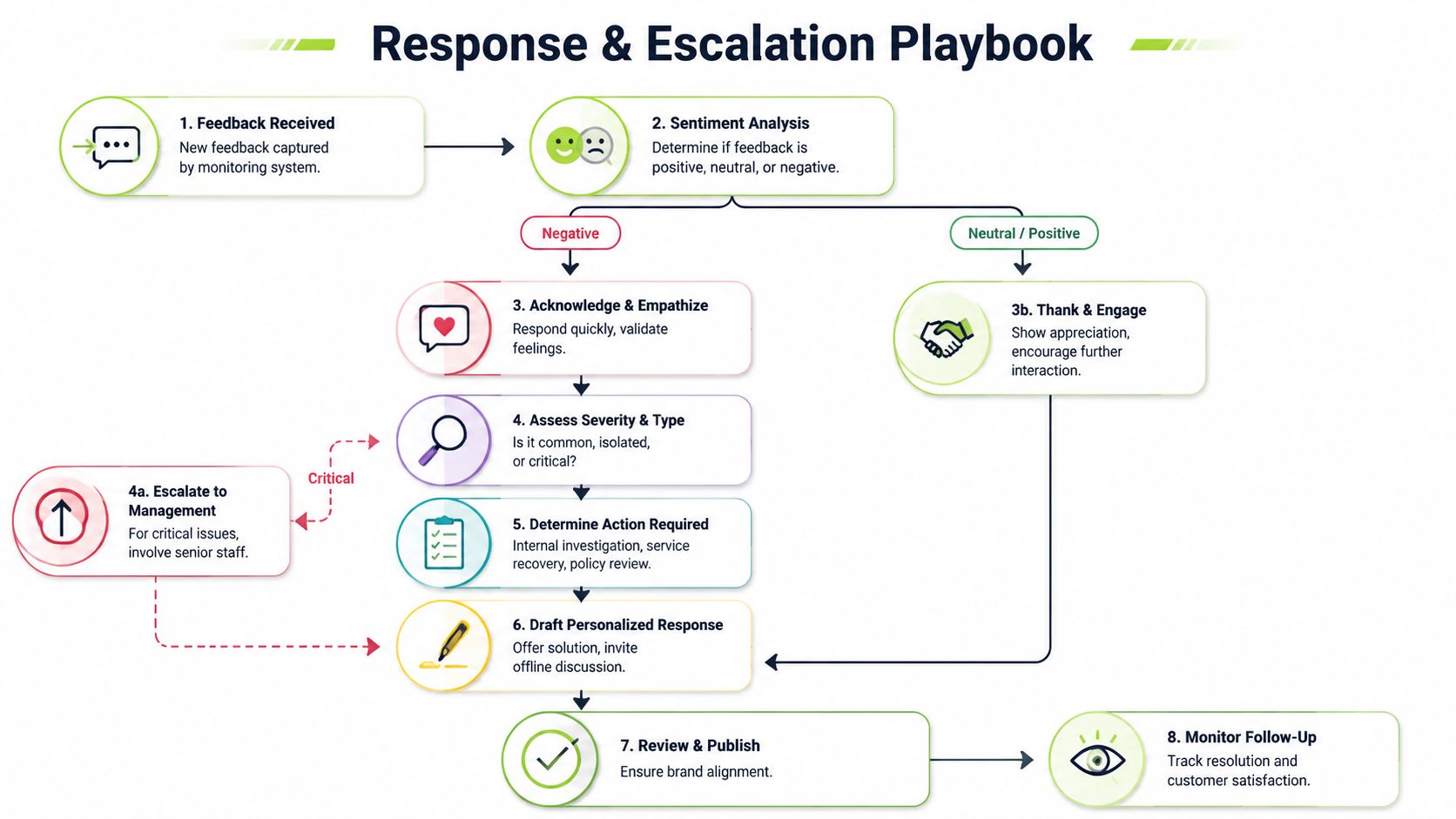
A better approach starts with timing and routing. A proven workflow involves capturing feedback immediately post-round. Real-time feedback systems can lift review generation by up to 68%, while integrated reputation management packages report gains of 70% in local search visibility. The important part is not just more reviews. It is using negative feedback for internal service recovery before it becomes public.
Separate public response from private resolution
These are two different jobs.
A public response is for everyone else reading. It shows the club is attentive, calm, and accountable. A private resolution is for the person who had the issue. It should aim to understand what happened, fix what can be fixed, and close the loop properly.
Use this distinction:
- Public response: Acknowledge the experience, show empathy, avoid defensiveness, and signal that the matter is being handled.
- Private follow-up: Contact the person directly, gather context, assign ownership, and agree the next step.
What doesn't work is writing a warm public paragraph while nobody inside the club investigates the actual problem.
Build a routing system by feedback type
Not all feedback belongs with the same person.
A complaint about catering should not sit with the membership lead. A booking issue should not wait for the next committee meeting. A concern about rules or fairness may need a senior response, not a front-desk one.
A practical workflow looks like this:
- Capture quickly: Ask for feedback soon after the round or interaction.
- Score the sentiment: Identify whether the feedback is positive, neutral, or negative.
- Route by issue: Send the case to the person who can act, not just the person who saw it first.
- Respond publicly where needed: Keep the tone professional and brief.
- Record the outcome: If the same complaint appears again, it is no longer an isolated issue.
Clubs that improve their reputation don't just answer more reviews. They reduce the number of preventable complaints entering public view.
For clubs that also rely heavily on public-facing channels, social comments and direct messages need the same discipline. This is where a clear social media process for golf clubs matters, because unmanaged inboxes quickly turn into unmanaged perception.
Response templates help, but only if they stay human
Templates are useful for consistency. They are dangerous when they remove judgement.
A strong negative-review template should include empathy, acknowledgement, and an invitation to continue the conversation privately. It should not sound legalistic or robotic. A strong positive-review reply should thank the golfer specifically and reinforce what the club wants to be known for.
Keep templates short. Leave room to customise. The more generic the wording, the more obvious it is that the club is going through the motions.
Manage Reputation During Price Rises and Rule Changes
The most difficult reputation moments often have nothing to do with review platforms.
They happen when the club raises fees, changes category rules, tightens guest access, adjusts waiting list priorities, or revises competition and booking policies. Those decisions may be commercially necessary. They can still cause resentment if the communication is clumsy.
A useful way to think about this is to follow a familiar scenario. A club has strong interest, busy tee sheets, and pressure on capacity. Leadership decides to raise subscription rates and review membership categories. On paper, the decision is sound. In practice, the risk begins when current members hear about it informally before they hear it properly from the club.
The communication problem is usually not the change itself
Members can accept difficult news if it feels fair, clear, and well handled.
They react badly when the club sounds evasive, rushed, or inconsistent. If one staff member says the increase is about inflation, another says it's about investment, and a committee member says it's to manage demand, the club creates uncertainty. Uncertainty becomes gossip. Gossip becomes reputational damage.
England Golf reported that club membership rose to 784,000 in 2024 in commentary cited by Synergy Golf Solutions on golf course reputation management. That makes trust during pricing and rule changes more important, not less. Clubs are under pressure to turn demand into long-term value, and poor communication can undermine retention and local word-of-mouth at exactly the wrong moment.
A steadier way to handle the message
Clubs tend to get better outcomes when they sequence communication carefully.
Start with internal alignment. Before anything goes public, staff and committee members need one agreed explanation in plain English. Then segment the audience. Existing full members, waiting-list prospects, flexible members, and visitors may all need different framing.
The message itself should include:
- What is changing: State the change directly. Don't bury it.
- Why it is changing: Link the decision to the member experience, capacity management, course standards, or service quality, if that is the reason.
- When it takes effect: Remove ambiguity.
- What happens next: Give people a route to ask questions and get a clear answer.
Members don't expect every decision to be popular. They do expect the club to be honest, prepared, and consistent.
Front-line staff must not be left to improvise
Many clubs falter at this point.
A secretary, membership manager, or bar team member gets cornered with questions and has no script, no briefing note, and no record of who has already raised concerns. That creates three problems at once. The answer may be inconsistent. The concern may go unrecorded. The member may feel fobbed off.
A simple internal briefing pack helps. It should cover the official explanation, common objections, escalation rules, and who owns follow-up. If a member is unhappy, the club should log that concern and make sure someone responds personally rather than leaving it to chance.
Handled well, a price rise can reinforce confidence because it shows the club is organised and transparent. Handled badly, it can trigger avoidable distrust that lingers long after the announcement.
Integrate Reputation into Your Growth Engine
Reputation data becomes useful when it changes what the club does next.
If reviews sit in one place, enquiries in another, member notes in someone's inbox, and complaints in a spreadsheet nobody checks, the club cannot act with consistency. That is why golf club reputation management should live inside the same operating system that tracks lead handling and member follow-up.
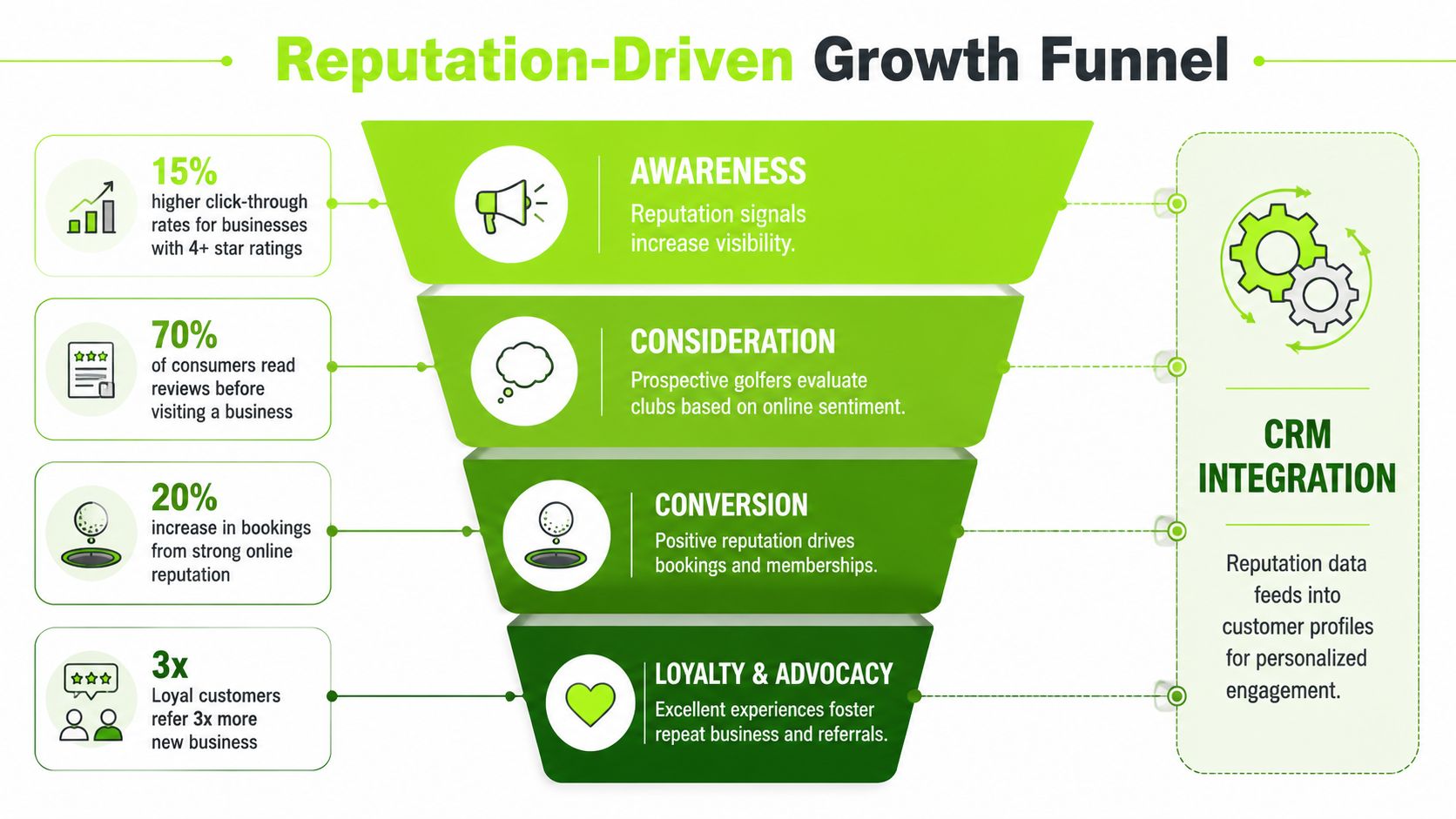
One of the clearest warnings here comes from Club Prophet's reputation management overview, which notes that many clubs lose visibility because they present an inconsistent story across channels. The issue is not only brand appearance. It is operational consistency across website, email response, CRM follow-up, and enquiry speed before a prospect ever visits.
Connect signals to actions
The best setup is not just a dashboard. It is a workflow.
If somebody leaves strong positive feedback, that can trigger a review request or a prompt for the team to ask for a testimonial. If someone submits an enquiry and nobody replies within your agreed window, the task should escalate. If a member gives poor survey feedback, that should create a follow-up task for the right staff member.
In practice, clubs should map these actions:
| Signal entering the system | Triggered action |
|---|---|
| Positive post-visit feedback | Request public review |
| Negative service feedback | Internal recovery task |
| New membership enquiry | Assigned owner and next step |
| No reply logged | Escalation to manager |
| Repeated complaint theme | Operational review |
This is the difference between passive monitoring and a growth engine. One tells you what happened. The other changes outcomes.
Use CRM as the control point
A CRM should hold more than contact details.
It should show lead source, communication history, current status, unresolved concerns, and upcoming actions. If a prospect downloads membership information, asks about a trial visit, then mentions concerns about category rules, that context should travel with the record. The next person speaking to them should not start blind.
That is why clubs looking at golf club CRM software should assess more than database features. They should ask whether the system supports follow-up discipline, visibility, and ownership.
Consistency is what prospects actually judge
Prospects rarely describe this in technical terms.
They don't say your reputation system is fragmented. They say the website looked good but nobody came back to them. They say social media felt active but the membership process was unclear. They say the club seemed nice, but they couldn't get a straight answer.
Those are not separate problems. They are one reputation problem expressed across multiple touchpoints.
This is also where tools need to serve process, not the other way round. A CRM-led setup, whether built internally or with a specialist partner such as GolfRep, works best when it ties lead capture, feedback routing, and follow-up into one accountable workflow.
Measure What Matters KPIs for Reputation Success
The clubs that improve fastest stop arguing about impressions and start measuring behaviour.
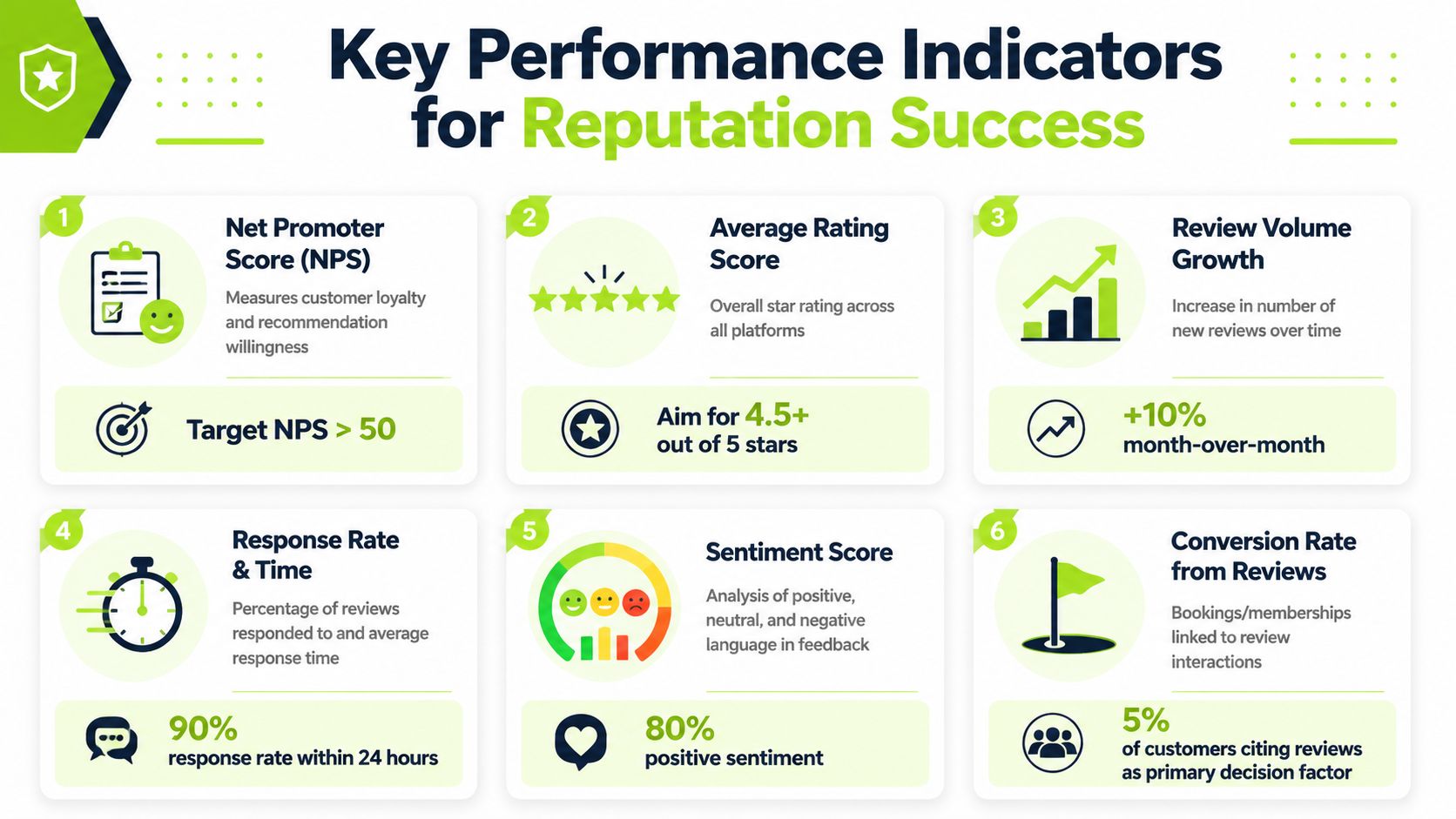
Codex Golf's guidance on club management recommends replacing perceptions with quantifiable indicators such as course occupancy rate, and it notes that moving from spreadsheets to dashboards allows each metric to link to an action plan in real time. You can read that directly in Codex Golf's article on using key metrics to improve golf club management. The lesson for reputation is simple. Track signals that staff can act on.
The useful KPIs
Vanity metrics can still have context, but they are not enough on their own.
A stronger KPI set includes:
- Enquiry response time: How quickly does the club reply to membership and visitor enquiries?
- Response rate: What proportion of incoming enquiries and review comments receive a reply?
- Lead-to-visit conversion: How many enquiries turn into a tour, meeting, or trial round?
- Issue resolution time: How long does it take to close the loop on complaints or low feedback scores?
- Sentiment trend: Are the same complaints appearing repeatedly across reviews and private feedback?
- Occupancy and retention links: Are experience improvements reflected in operational outcomes over time?
What to avoid: Counting likes, impressions, or followers as proof that reputation is healthy when enquiry handling and member confidence remain weak.
Tie every metric to an owner
A metric without ownership becomes a discussion point, not a management tool.
Each KPI should have a named person, a review rhythm, and an agreed action if performance drops. If response times slip, who steps in? If low-scoring feedback clusters around one area of service, who reviews the process? If membership enquiries are rising but conversion is weak, who audits follow-up quality?
That is how reputation becomes manageable. Not because the club watches numbers for the sake of it, but because the numbers expose where trust is being built or lost.
If your club wants a more structured approach to reputation, enquiry handling, and CRM-led follow-up, GolfRep helps UK golf clubs build systems that connect lead generation with visibility, response discipline, and conversion tracking so growth doesn't depend on manual chasing or guesswork.
Ready to tap into our proven growth system?