Golf Club Event Marketing: Boost Revenue in 2026
Most advice on golf club event marketing starts in the wrong place. It tells clubs to post more, boost more, design better flyers, and chase more enquiries.
That sounds sensible, but it misses the commercial bottleneck.
For most clubs, the problem isn't a total lack of interest. It's what happens after someone clicks, calls, fills in a form, or replies to an email. Enquiries sit in inboxes. A staff member means to reply after lunch. A committee volunteer plans to call back tomorrow. A society organiser asks for availability, then hears nothing useful until the date has gone cold.
That's where revenue leaks out.
Strong event marketing isn't just promotion. It's a joined-up system that captures interest, responds quickly, tracks the enquiry, and keeps the prospect moving towards a booking, attendance, and ideally a second transaction afterwards. If that system isn't in place, more promotion often just creates more unmanaged demand.
The Core Problem in Golf Club Event Marketing
Golf club event marketing usually breaks after the enquiry arrives, not before it.
Clubs can create interest in opens, corporate days, charity events, taster sessions, and society packages. The weak point is the handoff. An enquiry lands in a shared inbox, gets forwarded without context, sits on a paper pad in the pro shop, or depends on one staff member remembering to reply before the date goes stale. What looks like a promotion issue is often a booking process issue.
That distinction matters because event revenue is won in the follow-up window. If the club cannot capture every enquiry, assign ownership, log the conversation, and prompt the next action, extra campaign spend just produces more loose leads.
Why manual follow-up keeps breaking down
Manual follow-up sounds personal. In practice, it is inconsistent and hard to manage at volume.
A general manager might handle one high-value corporate enquiry well, then lose track of three smaller society leads while dealing with rotas, renewals, and supplier issues. A committee-run club might host a busy open day, collect names, and still fail to convert attendees because nobody enters them into a CRM or schedules the next contact. Staff are not the problem. The process is.
Practical rule: If event follow-up depends on memory, availability, or handwritten notes, revenue will leak.
The fix is not more admin. It is a simple operating system for enquiries. Forms should feed into one place. Auto-responses should confirm receipt straight away. Ownership should be clear. Status should be visible to anyone who needs it. Follow-up tasks should be scheduled, not left to chance.
This is also where clubs miss secondary spend. An event booking is rarely just green fee revenue. It can include catering, bar tabs, coaching, buggy hire, prizes, and sponsor value. Even something as small as how you boost café revenue changes event profitability if the club builds it into the sales process instead of leaving it as an afterthought.
What to focus on instead
Ask one operational question. What happens in the first 24 hours after someone enquires?
Strong clubs can answer that clearly. The lead is captured, tagged by event type, routed to the right person, followed up with the right information, and tracked until it books, declines, or enters a nurture sequence for later. That is what turns marketing activity into usable pipeline.
GolfRep has a useful breakdown of how golf clubs lose 30% of enquiries through poor follow-up processes. It highlights a problem many clubs recognise only after they audit response times and see how many opportunities were never properly worked.
Redefining Success Beyond Ticket Sales
A busy event can still be commercially weak.
Clubs often judge success by turnout because it is visible and easy to report. The harder question is whether the event created profitable next steps. Did attendees book another round, request a society date, start a membership conversation, spend in food and beverage, or give the team usable sales data for follow-up? If the answer is unclear, the event produced activity more than value.

The practical shift is to treat events as part of the club's revenue system, not as isolated diary dates. A member open evening should feed the membership pipeline. A society showcase should produce qualified organisers, quotes, and held dates. A themed clubhouse event should be measured against bar, catering, and repeat booking value, not room fill alone.
Set one commercial objective first
Each event needs one lead objective before any promotion goes live. Without that, teams end up with vague aims such as “raise awareness” and no clear way to judge whether the event worked.
A few examples:
- Membership pipeline: Judge a beginner session or open day by how many attendees progress to a membership conversation or club visit.
- Society revenue: Judge a hosted showcase by qualified enquiries, proposals sent, and dates converted.
- Visitor frequency: Judge an open competition by how many visitors return for another paid round.
- Hospitality spend: Judge a themed event by food, beverage, and function revenue per head.
That single choice affects everything that follows, from the offer and call to action to the data you capture on the form. Clubs that skip it usually end up with a decent attendance number and very little commercial insight.
Build the budget around conversion, not promotion alone
Event budgets usually overvalue front-end promotion and undervalue the sales process that sits behind it. Paid social, email design, posters, and print all have a role. They do not rescue weak lead handling.
A proper budget covers the mechanics that turn interest into booked revenue:
- Landing page setup: Clear event details, pricing, inclusions, FAQs, and a direct enquiry or booking path.
- CRM capture: Every enquiry should land in one system with source, event type, and owner attached.
- Automated follow-up: Confirmation emails, reminders, and next-step messages should send without staff having to remember them.
- Response capacity: Someone must own calls, quotes, and date holds within agreed service levels.
- Post-event sequences: Attendees should enter the right follow-up path based on what they did and what they asked for.
That back-end work rarely gets the same attention as promotion because members and committees do not see it. It still decides whether the event pays back.
The same commercial logic applies in other hospitality settings. Operators looking to boost café revenue do not rely on footfall by itself. They shape the offer, train staff on the upsell, and build repeat purchase prompts into the process. Golf club events need the same discipline.
A sold-out event can still underperform if the club cannot track who attended, what they were interested in, and what happened after the event.
Define success in a way your team can actually track
The scorecard should be simple enough to use and specific enough to guide decisions. Attendance still matters, but it belongs near the top of the funnel, not at the end of the analysis.
| Focus area | Better success measure |
|---|---|
| Attendance | Show-up quality and attendee fit |
| Revenue | Event income plus follow-on value |
| Membership | Attendees progressed into a membership conversation |
| Society sales | Serious organisers moved to quote or booking stage |
| Retention | Repeat visits or rebookings after the event |
Once the club tracks downstream outcomes, event marketing becomes easier to improve, as it can then see which formats bring in low-value footfall and which ones create pipeline the team can convert.
Targeting Your Audience and Choosing Your Channels
More channels do not fix weak event marketing. Better targeting does.
Clubs lose event revenue when they treat promotion as a visibility problem instead of a qualification problem. One generic email, one poster, one social post, and a basic contact form will produce some interest. It will not produce the right enquiries in a format the team can work quickly.
Segment by likely next step
Demographics help with tone. Buying intent shapes conversion.
A society organiser comparing three venues needs different information from a beginner considering a taster session. A corporate contact wants confidence that the day will run properly, guests will be looked after, and the admin will not become their problem. A prospective member usually needs lower-pressure entry points, clear pricing context, and signs that they will fit in socially.
Use segments that match the decision you want the person to make next:
- Corporate prospects: event quality, catering, hosting support, clear packages, quick answers
- Society organisers: availability, group value, pace of play, food options, easy quote request
- Prospective members: taster formats, club atmosphere, guided visits, follow-up conversation
- Families and juniors: accessible language, beginner-friendly structure, confidence-building sessions
- Women new to the club: inclusive imagery, social comfort, coaching-led formats, visible welcome
The message should match that intent. “Open day this Saturday” asks the prospect to do the interpretation. “Meet the team, try the course, and ask membership questions without a sales pitch” does the work for them.
Choose channels by job, not habit
Channel choice should reflect how the audience discovers the event and how the club will capture the enquiry.
Ofcom's online nation reporting remains a useful baseline for UK clubs because digital channels now sit at the centre of discovery and response behaviour, especially on mobile, as shown in Ofcom's Online Nation report. That does not mean every club needs to post everywhere. It means every promoted event needs a clear digital path from message to action.
If someone sees the event on Instagram, clicks through, and lands on a page with no clear next step, the problem is not reach. The problem is process.
A simple channel plan usually works better than a busy one:
| Audience | Best use of channel |
|---|---|
| Existing database | Segmented email, reminder sequences, priority booking access |
| Local awareness | Organic social, paid social, club partners sharing the event |
| Corporate and society prospects | Direct outreach, referral introductions, focused landing pages |
| Families and beginners | Community Facebook groups, visual social content, short signup forms |
| Past attendees | CRM follow-up, retargeting, tailored invitations based on prior interest |
Email gives the club control over timing and sequencing. Social creates awareness and social proof. The website decides whether interest becomes an enquiry. That is why the handoff between channels matters more than the number of channels in use.
Underserved audiences need different follow-up, not just different creative
Many clubs say they want more women, younger golfers, and families. Then they promote those events with generic artwork and send every responder into the same manual inbox.
England Golf has highlighted participation among women and girls and continues to publish guidance for clubs on inclusive marketing and female participation through its Women and Girls Hub. The practical takeaway is operational, not cosmetic. If a club runs a women-focused taster session, it should already know what follow-up path comes next. Beginner coaching offer, social session invite, membership conversation, or junior pathway for parents asking on behalf of children.
That is where segmentation becomes commercially useful. Capture what the attendee was interested in. Lessons, membership, junior activity, society booking, or corporate hosting. Route that enquiry into the right follow-up track inside your CRM instead of asking staff to remember who needed what. Clubs that want a clearer view of that handoff should review a structured golf club enquiry conversion process.
Without that level of targeting, clubs fill events with mixed intent and weak next steps. That looks busy on the day and thin in the pipeline a week later.
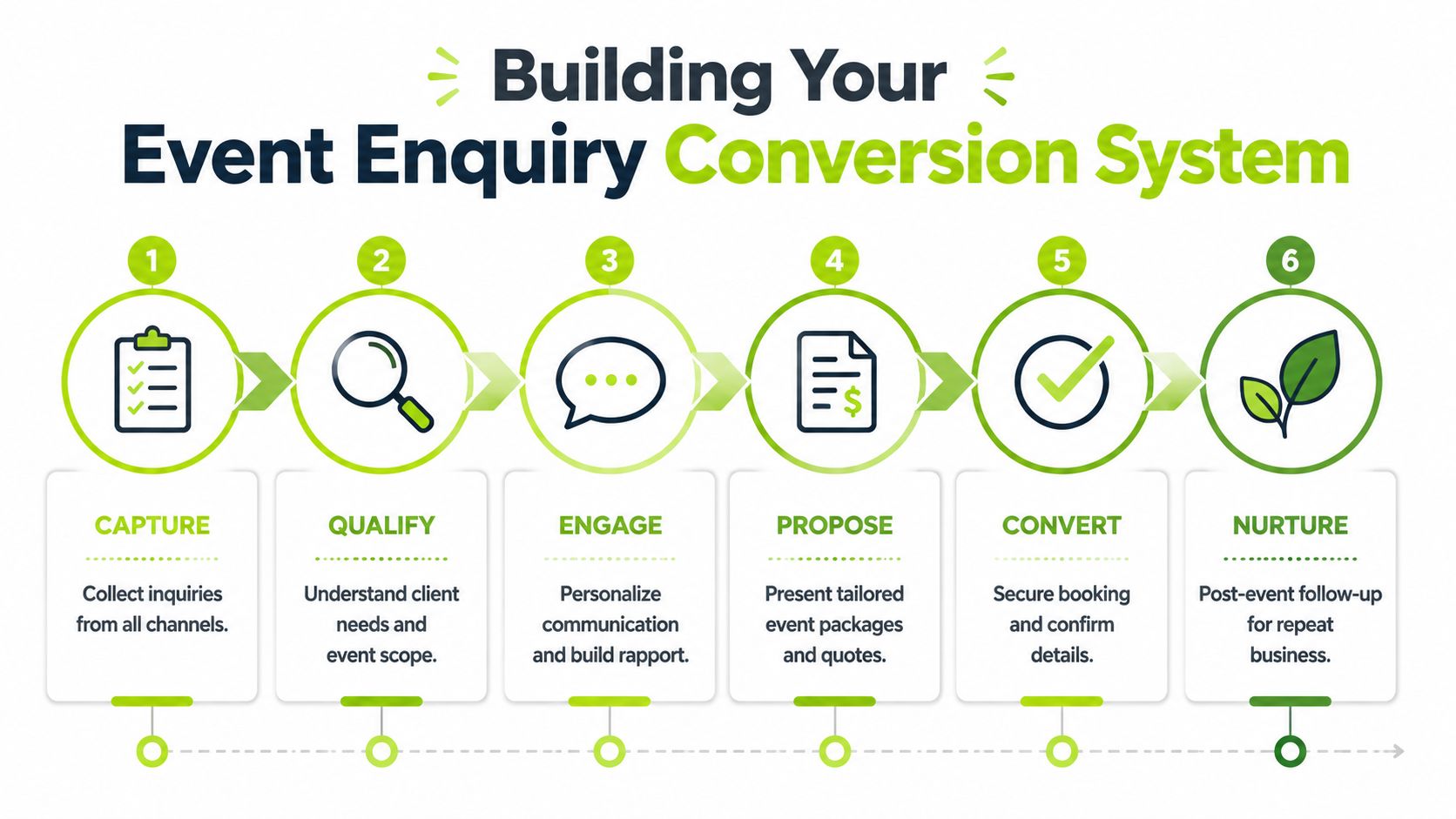
Building Your Event Enquiry Conversion System
Here, golf club event marketing either becomes reliable or stays frustrating.
A club can run excellent ads, have a strong reputation, and host appealing events. If the enquiry process is weak, those advantages still get wasted. The answer isn't to ask staff to work harder. It's to remove as much manual dependence as possible.
Start with a booking path that reduces hesitation
Many event pages fail because they bury the action. The visitor can see a poster, maybe a date, perhaps a downloadable PDF, but there's no clean next step.
A better event page does a few things well:
- Explains the offer clearly: What the event is, who it's for, what's included, and what happens next.
- Works on mobile: Most prospects won't wait for a clumsy form or a hard-to-read layout.
- Collects the right information: Enough to qualify the lead, not so much that people abandon the form.
- Sets expectations: Tell the prospect when and how the club will respond.
That last point matters more than most clubs realise. People don't just want to send an enquiry. They want to know they've entered a managed process.
Put every lead into one visible system
A CRM doesn't have to be complicated. It does need to become the single place where event enquiries live.
If the enquiry sits only in a personal inbox, the club can't track response time, stage progression, ownership, or outcome. If the lead enters a central system, the club can see whether the person has been contacted, what they asked for, which event they came from, and what should happen next.
Many clubs gain clarity quickly. They stop asking “did anyone reply to that society booking?” and start seeing an actual pipeline.
One practical option is a CRM with automated routing and nurture built around golf-specific enquiries. That's the kind of workflow GolfRep implements for clubs, but the principle applies whether a club uses GolfRep, an existing CRM, or another enquiry management setup. The key is visibility and consistency, not brand preference.
Build the follow-up sequence before the campaign goes live
The strongest event campaigns are built backwards from the enquiry journey.
A simple workflow often looks like this:
- Enquiry submitted through a landing page, paid ad form, website form, or phone call logged by staff.
- Immediate confirmation acknowledges receipt and confirms next steps.
- Internal notification alerts the responsible team member with context.
- Personal follow-up answers questions, qualifies fit, and moves the lead forward.
- Reminder sequence keeps the prospect warm if they haven't booked yet.
- Pre-event communications improve attendance and reduce drop-off.
- Post-event nurture offers the relevant next step, such as a membership visit, society date, or return round.
What works: automation for speed, humans for judgement.
What doesn't: automation as a substitute for ownership.
A society organiser is a useful example. They click from a paid campaign to an enquiry page for a summer golf day. The form captures preferred month, group size, and whether catering is needed. They receive an immediate confirmation. The sales or events lead gets notified. The CRM creates a task. If no proposal is sent promptly, the system flags it. If the organiser doesn't reply, a reminder goes out. If they book, they move into a pre-event planning flow. After the day, they receive a rebooking prompt and a thank-you follow-up.
That process is ordinary. It should be.
Where most clubs still lose the booking
The failure points are predictable:
- No instant acknowledgement: The prospect wonders if the enquiry even arrived.
- Slow first response: Interest cools and comparison shopping starts.
- No ownership: The lead bounces between manager, pro shop, and events contact.
- No stage tracking: Nobody knows whether the prospect is new, qualified, quoted, or lost.
- No nurture after the event: Valuable attendees disappear back into the market.
Clubs that want to improve conversion need to tighten those points first. More promotion can wait.
For a more detailed breakdown of process design, this guide on golf club enquiry conversion is worth reviewing alongside your current event workflow.
Your Tactical Event Promotion Timeline
A campaign calendar matters, but only if it's tied to the way clubs operate. Generic advice like “start early” isn't enough. You need a sequence that matches the type of event, the audience, and the club's internal capacity.
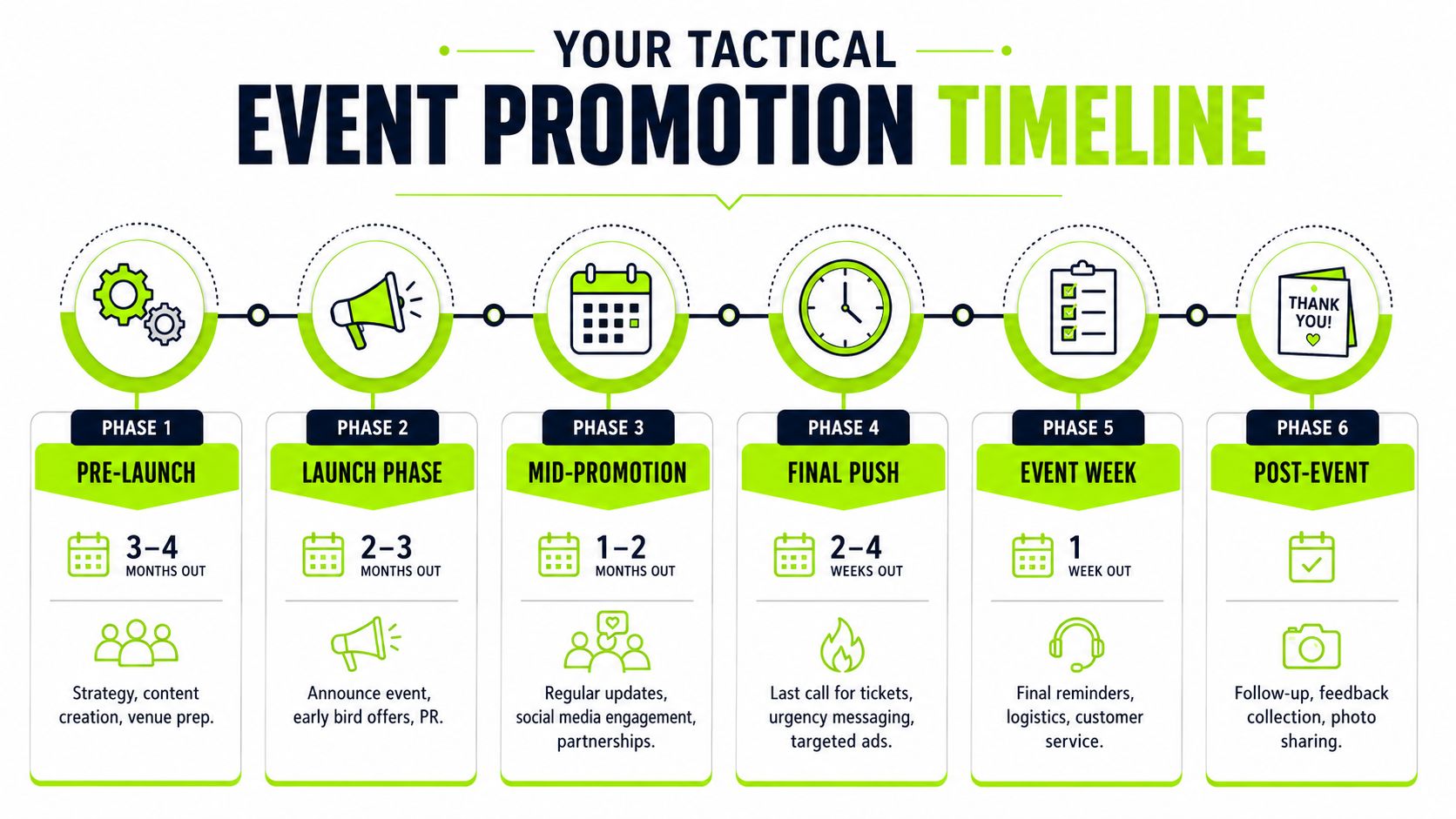
Industry guidance recommends starting promotion 1–3 months before major events and 4–6 weeks before smaller ones, with email cadence increasing in the final week and club-side promotion coordinated through the pro shop, clubhouse, and committee, according to this golf tournament advertising guide.
Early phase for setup and first demand
For major events, the early phase should be used to build the machinery before broad promotion starts.
That includes:
- Finalising the landing page: Dates, format, pricing, sponsor details, and enquiry path.
- Preparing content assets: Social graphics, email copy, posters, and FAQs.
- Segmenting the database: Past attendees, visitors, members, local businesses, and prospects should not all receive the same message.
- Checking operational readiness: Diary holds, staffing, catering, and response ownership need to be confirmed.
For smaller events, the same tasks still apply, just on a shorter clock.
Middle phase for proof and reinforcement
Once the event is live, clubs should avoid going quiet after the first announcement.
The middle phase is where steady momentum gets built:
- Email to warm audiences: Past attendees and known prospects usually convert earlier than cold traffic.
- Organic social proof: Share event details, visual content, sponsor involvement, and reasons to attend.
- On-site promotion: Posters in the clubhouse, pro shop conversations, and member referrals still work.
- Partner amplification: Sponsors, local businesses, and community groups can extend reach into nearby networks.
If the event includes presentations, prize-giving, or a business component, production quality also matters. Clubs planning corporate-facing days often benefit from understanding AV equipment for corporate events so the event experience matches the promise made in the marketing.
Promotion should never outrun operations. If enquiries are arriving and the team isn't responding cleanly, fix that before increasing spend.
Final week for urgency and attendance quality
The last week is not just for “last chance” messaging. It's for reducing drop-off.
A practical final-week plan usually includes:
| Timing | Action |
|---|---|
| Early in the week | Reminder email with core details and simple call to action |
| Midweek | Social posts that answer objections or highlight experience |
| Final days | Direct follow-up to warm leads who clicked or enquired but didn't commit |
| Event eve | Confirmation, arrival details, and contact point for questions |
This is also the point where internal coordination matters most. The pro shop should know who's arriving. The clubhouse team should know event timings. Committee and sponsor contacts should know what they're expected to promote and when.
For clubs running opens, member acquisition events, or beginner-focused days, this guide to golf club open day marketing can help align the promotional timeline with the follow-up plan.
Post-event work that most clubs skip
The event isn't over when the last guest leaves.
Within days of the event, clubs should sort attendees into practical follow-up groups. Some should receive a thank-you and a rebooking route. Some should get a membership-related next step. Some may need a personal call. Some are not a fit and should stay in the general nurture list.
Future revenue usually sits here. Clubs that stop at attendance leave it untouched.
Measuring What Matters for Future Growth
The quality of golf club event marketing becomes much easier to judge once you stop using vanity metrics as the main scorecard.
Reach, likes, and comments can be useful context. They don't tell a manager whether the event created revenue, qualified prospects, or future bookings. Clubs need measurement that ties back to commercial outcomes.

The numbers that actually help decisions
A useful event reporting view should answer a few basic questions:
- How many enquiries came in
- How many were qualified
- How many became bookings or attendees
- How much revenue the event generated directly
- How many attendees moved into a membership or repeat-visit pipeline
- Which channels produced serious prospects, not just clicks
These aren't complicated metrics. The challenge is that most clubs can't see them in one place because the data is split across inboxes, forms, till systems, and staff memory.
A simple measurement framework
This is the reporting framework we'd recommend for most clubs:
| Metric | Why it matters |
|---|---|
| Enquiry volume | Shows whether the offer and promotion created demand |
| Enquiry quality | Separates genuine prospects from casual interest |
| Response handling | Reveals whether the team acted quickly and consistently |
| Enquiry-to-booking rate | Shows whether follow-up is converting interest |
| Event revenue | Measures direct commercial return |
| Pipeline contribution | Tracks future rounds, membership conversations, and rebookings |
The final line matters most. An event can break even on the day and still be highly valuable if it creates a strong flow of future business.
Use comparisons, not isolated snapshots
One event report on its own is only mildly useful. Greater value comes from comparing similar events over time.
Look at patterns such as:
- Which event formats create better follow-on value
- Which audiences attend but never progress
- Which channels produce serious society or corporate leads
- Which follow-up sequences lead to actual next steps
- Which teams respond consistently and which need support
A club that tracks these patterns gets sharper every time it runs an event. A club that only counts turnout keeps starting from scratch.
There's a useful lesson in how other sectors approach measurement. Retail teams looking at campaign effectiveness for retail often separate awareness signals from commercial actions. Golf clubs should do the same. Interest is not the same as progression.
Good reporting doesn't just tell you whether an event worked. It tells you what to repeat, what to stop, and where the booking process broke.
When clubs install proper lead visibility and conversion tracking, future decisions become calmer. You stop debating opinions and start reviewing evidence. That's how event marketing becomes a predictable growth channel rather than an occasional burst of activity.
If your club wants a clearer system for handling event enquiries, follow-up, and conversion tracking, GolfRep helps golf clubs build structured pipelines around lead capture, CRM visibility, and automated nurture so events contribute to long-term revenue rather than one-off activity.
Ready to tap into our proven growth system?