Golf Club Duplicate Contact Management: A Practical Guide

Junior membership in England rose from 46,028 to 61,483 in 2025, an increase of more than 34%, according to The Golf Business. That makes an ordinary database decision commercially important: when a junior shares a parent's email address, should the club merge the records or preserve the relationship?
At GolfRep, our view is that golf club duplicate contact management should remove repeated identities, not legitimate relationships. A smaller database isn't necessarily a better one. The useful result is a reliable view of each golfer, their household, their activity and the evidence behind the club's commercial reporting.
Why Duplicate Contacts Cost Golf Clubs More Than Tidy Data
An estimated 18% of CRM records are duplicate entries, according to Dun & Bradstreet data cited in ServiceNow's 2024 CRM statistics roundup. That's a general CRM benchmark, not a measured duplicate rate for golf clubs. Your own database needs checking before anyone applies it to a committee paper.
Golf clubs rarely hold one self-contained customer list. Membership administration, visitor bookings, coaching records and society information may each describe a different part of the same golfer's relationship with the business.

The commercial distortion
Say a golfer makes several membership enquiries during the year, using a website form, an open day registration and a telephone conversation. If staff create a fresh opportunity each time, the pipeline shows several prospects rather than one person reconsidering the same purchase.
That changes how a manager reads performance:
- Enquiry volume looks stronger than the distinct prospect pool justifies.
- Conversion rate becomes unreliable when contacts and completed sales use different counting rules.
- Retention becomes harder to interpret when a renewing or returning member appears under a new identity.
A committee could interpret an inflated pipeline as strong demand and approve further acquisition spending. Alternatively, it could see an apparently weak conversion rate and challenge the membership team unfairly. Neither decision rests on a trustworthy denominator.
Commercial test: Can the club explain whether a report counts people, conversations or database records?
The answer isn't to delete every similar entry. Staff need clear merge rules, protected household relationships and an audit trail that preserves the original journey. Otherwise, a tidy contact list can conceal missing history, mistaken family merges and campaign results that nobody can reconcile.
Match Rules That Decide What Gets Merged
Use a written matching table rather than leaving each receptionist, secretary or commercial manager to make their own judgement. A matching field is evidence of identity, not automatic proof.
Before comparing records, normalise contact details. Trim spaces and lower-case email addresses. Store UK mobile numbers consistently, using the international country code rather than mixing domestic and international formats.
Match signals and the action each one justifies
| Match signal | Strength | Action taken |
|---|---|---|
| Verified email address, normalised | Strong | Merge after checking for a shared household address |
| Mobile number, normalised to one UK format | Strong | Merge unless the number is a shared family phone |
| Membership number within one club | Strong | Merge, or link to the same membership record |
| Name plus postcode | Supporting only | Flag for review, never merge on this alone |
| Name alone | Weak | Do not merge |
| Shared email with different first names | Household signal | Link as household, keep people separate |
A verified email and mobile agreeing across otherwise consistent records can justify an automatic merge once shared-family exceptions have been excluded. A membership number is strong within its issuing club, but don't assume another course uses the same numbering system.
Names need more caution. John Smith at the same postcode, but with different email addresses, belongs in the review queue. Membership history or direct confirmation may resolve the match; the postcode alone won't.
The trade-off is deliberate. Conservative rules leave some manual work, but aggressive matching can combine different people and expose one person's activity to another.
Suppression must survive the merge
The ICO's guidance on using marketing lists explains why organisations shouldn't delete opted-out details if that would allow someone to return to marketing lists later. It also requires appropriate checks on bought-in lists, including accuracy, fair collection and suitable consent.
Keep a person-level suppression status outside the disposable parts of an active profile. Check imports, reactivation audiences and multi-site campaign lists against it before sending marketing.
Retain the original consent evidence and subsequent preference changes, including the latest unsubscribe event. An old opt-in mustn't overwrite a later opt-out just because staff choose the older profile as the surviving record.
Where a group operates several courses, retain the golfer's venue relationships and the scope of their permissions. Enquiring at another course doesn't automatically authorise every venue to send promotions.
Merge where identity is certain, link where a relationship is clear, and review everything else.
Households, Juniors and Multi-Role Golfers Without Losing Them
Consider Sarah and David Taylor, who share an email address but hold different membership categories. Their daughter, Emily, uses Sarah's mobile number for junior coaching bookings. These are separate people with connected contact arrangements, not redundant records.
If staff collapse the family into a single profile, the club loses distinctions it needs for subscriptions, coaching, communications and family membership conversations. Shared contact details should trigger a relationship check, not a deletion decision.
Build around people and relationships
A workable identity model separates the person from their activities:
- Unique person ID stays with the individual when their contact details or membership category change.
- Relationship fields identify household members, parents, guardians and relevant booking contacts.
- Membership history records categories, joining dates, lapses and returns without replacing the past.
- Consent status records whose permission applies, to which channel and for what purpose.
- Interaction roles distinguish membership, visitor golf, coaching, society participation and organising.
Emily's coaching activity belongs to Emily. Sarah may be the booking contact and payer, but that doesn't make the lesson Sarah's activity. Nor should Emily inherit permission to receive adult membership promotions because her parent receives them.
Keep roles without multiplying identities
A golfer can be a member at one course, a visitor at another and a society organiser across both. Maintain a single person identity where the individual is confirmed, then attach the relevant roles and site relationships.
The operational decision is straightforward: merge repeated person profiles, link legitimate role records, and keep different people separate. If a system stores each role in a separate module, connect those modules through the person ID rather than deleting useful operational records.
Attribution should follow the same structure. An open day enquiry, a subsequent visitor round and a membership purchase should remain traceable events attached to the golfer. Updating their current status to member mustn't erase the earlier activity that helped produce the sale.
For a seasonal family-record check, list shared contact methods and confirm who each linked person is. Count juniors with their own verified contact method where appropriate, but don't collect extra details merely to improve a completeness score. The practical question is whether staff can contact the correct person through the correct responsible adult or agreed channel.
How to Run a Deduplication Pass Step by Step
A UK public-sector data-quality guide published by Melissa estimates that customer databases become stale at 2% per month, accumulating to about 25% over a year, and puts intermittent cleansing at an average £10 per record. These are general data-quality estimates, not golf-specific costs or duplicate rates.
They support a practical budget decision: allow for ongoing maintenance rather than treating a clean-up as a permanent fix. Stale records include more than duplicates, so don't turn a deterioration estimate into a claimed duplicate count.
Prepare, review and preserve
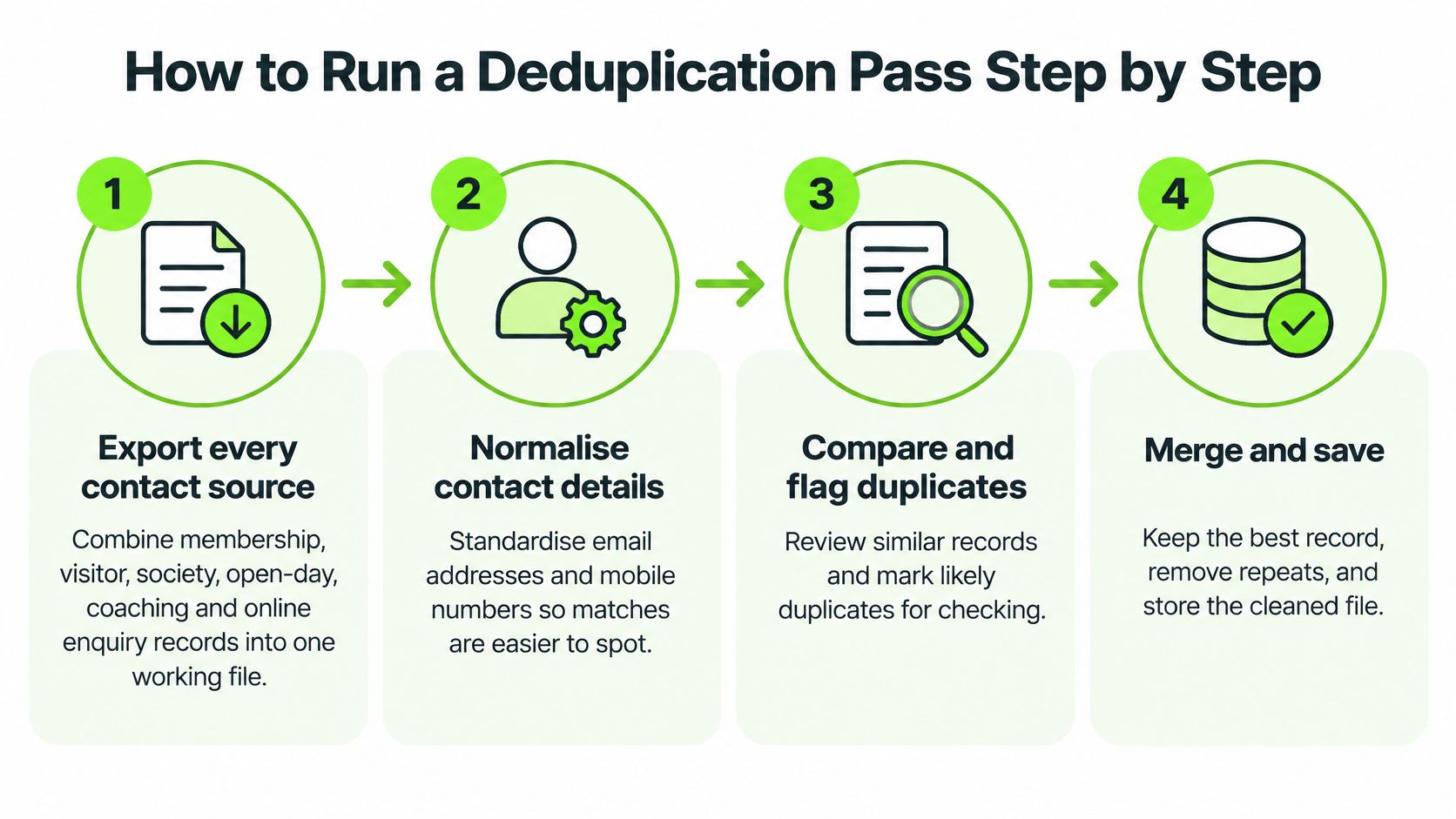
Export every relevant contact source. Bring membership, visitor, society, open-day, coaching and online enquiry records into a controlled working file, retaining original IDs and source labels. Limit access to authorised staff and avoid circulating copies containing unnecessary personal information.
Normalise the comparison fields. Standardise email and telephone formats in working columns while retaining the original values for checking. Don't overwrite an uncertain number to make it fit the expected format.
Group likely matches. Apply the agreed rules and separate confident matches from household signals and unresolved cases. A single weak identifier shouldn't trigger a bulk merge, however much faster that would make the spreadsheet exercise.
Review ambiguous groups against history. Check membership status, previous addresses, booking activity and relevant staff notes. A lapsed member returning as a new enquiry may be the same person, while family members sharing a telephone may not be.
Choose the surviving values. Use the most recently verified contact method, not automatically the newest imported row. Preserve relevant enquiry history, membership history, source attribution and permission evidence from every matched profile.
Merge or link, then log the decision. Record the date, decision-maker, original IDs and selected field values. Keep separate people linked where appropriate, and check that payments, bookings and memberships still attach to the correct individual.
Recheck suppression before sending. Validate the actual campaign audience after the changes have reached every connected system. Cleaning the CRM doesn't help if an older email-platform list remains active.
Make the result reversible
Merging before reviewing is the most damaging shortcut. Deleting older records without preserving consent and acquisition history is another, because the surviving profile may look complete while losing the evidence behind it.
If the exercise accompanies a system change, use a controlled golf club CRM data migration process rather than uploading a cleaned file and assuming every relationship will follow.
A clean result means a single authoritative person profile, correctly linked operational records, a visible audit trail and suppression that works across sites. Schedule a full pass quarterly and a lighter review before major campaigns.
Keep a split log with enough controlled information to reverse a mistaken merge. Retain recovery material only for a defined period under the club's retention policy, rather than keeping unrestricted copies indefinitely.
Preventing Duplicates at Every Entry Point
Give each route into the database a named owner and an explicit first check. Otherwise, a careful clean-up can be undone by the next form import or busy morning in the pro shop.
First check before creating a record, by entry route
| Entry route | First check before creating a record | Owner |
|---|---|---|
| Membership application form | Search by email, mobile and name | Membership secretary |
| Tee-time or visitor booking | Search by mobile and email | Reservations team |
| Open day registration | Search by email, then name and postcode | Membership team |
| Coaching booking | Search by mobile, then check membership status | PGA professional |
| Online enquiry or campaign sign-up | Check consent status and existing record | Commercial manager |
Search before creating should be the default workflow. Where staff confirm an existing identity, add the interaction to that person rather than opening another profile. Where the match is uncertain, flag it for review without attaching private history to a potentially different person.
Restrict merge permissions to trained staff. Routine users can suggest matches, but a named data owner should resolve conflicts and record which value wins.
Test the connection, not the feature list
The Annual Golf Club Software Report, based on a 2025 survey of 134 UK and Irish golf-club managers, found that two-thirds were considering changing software providers and highlighted the need for member and visitor systems to recognise details without retyping.
A claimed integration isn't enough. Test whether a returning visitor is recognised, whether an existing customer becoming a member keeps their history, and whether changed contact details reach the systems staff use.
The ICO's records-management guidance supports controlled record creation, effective retrieval and regular checking. Apply that discipline to imports as well as manual entry: give each imported batch an owner and review exceptions before making records available for campaigns.
Corrections need the same reach. The ICO's right-to-rectification guidance explains that individuals can challenge inaccurate information and request correction or completion.
When someone changes an email address or opts out, locate their linked profiles and connected lists. Update the authoritative record and apply the appropriate correction or suppression everywhere, without retaining unnecessary obsolete details.
A maintained golf club database depends on these responsibilities being clear. Software can support the checks, but staff still need one consistent habit: search before every create.
Reporting Metrics That Survive a Clean-Up
A cleaner database can produce a more attractive report without producing better commercial evidence. If a merge removes campaign history or confuses household influence with individual acquisition, the committee may receive fewer rows but less understanding.
Define the unit behind each measure before comparing performance. A person, membership, enquiry and payment are different things.
Reporting metrics and what each one counts
| Metric | What it counts | Duplicate risk |
|---|---|---|
| Unique people | One living golfer across all records | Inflated when one golfer holds several records |
| Active memberships | Paid memberships in force | Overstated if one golfer holds duplicate records for the same membership |
| Households | Groups sharing an address linked to members | Lost if shared emails are merged |
| Enquiries | Distinct sales conversations | Inflated when repeat contacts about the same purchase are counted afresh |
| Revenue | Money received, by acquisition source | Misattributed if a merge erases the source |
Legitimate memberships at different sites shouldn't disappear from the membership total just because the golfer has a single identity. Likewise, a fresh society-booking conversation can be a valid enquiry even if the organiser already holds membership.
The European Golf Participation report notes that registered-golfer figures can change through measurement or CRM/database updates; the cited England figures distinguish 750,071 club members in 2025 from 835,554 registered golfers. The management lesson is to state what's being counted rather than treating differently defined totals as interchangeable.

Reconcile the campaign before judging it
Consider a hypothetical campaign costing £2,000. Staff initially report eight new-member records, giving an apparent acquisition cost of £250. Review then confirms six distinct new members, because redundant profiles inflated the original count, so the corrected cost is approximately £333 per member.
The campaign hasn't changed. The evidence has. Keep the original record IDs and reconciliation so the committee can understand the adjustment rather than interpreting it as deteriorating performance.
Preserve first-touch and last-touch source, alongside dated interactions. The first campaign that introduced the golfer and the later activity preceding their purchase can both matter without each claiming the entire sale.
Use a monthly control report containing:
- Duplicate rate, with its calculation and review scope stated.
- Unresolved matches, assigned to an owner.
- Missing verified contact methods, separated from legitimate guardian-contact arrangements.
Break these down by acquisition source and site. Revenue Nomad's discussion of which RevOps metrics actually matter provides useful context for choosing decision-relevant measures, while a golf club marketing dashboard should translate those measures into the club's own commercial categories.
Audit the underlying audience before judging acquisition cost. An unchecked contact export isn't a campaign result.
Confirm Your Duplicate Rate Before Your Next Campaign
Start with a manageable diagnostic, not a commitment to replace the club's software. The aim is data reliable enough to judge the next campaign, with clear ownership of anything unresolved.
Use this suggested sequence during the coming month:
Sample the database. Randomly select 100 records and check how many are redundant profiles for golfers already represented elsewhere. State that the resulting percentage is a sample estimate, not a full audit.
Separate uncertainty from confirmed duplicates. Count unresolved matches and missing verified contact methods by acquisition source. Don't classify a shared family email as an error without checking.
Agree acceptance thresholds. Set a tolerable duplicate-rate target with the committee and require zero marketing sends that bypass an applicable opt-out.
Fix the busiest problem route. Use the findings to choose between membership applications, visitor bookings or another source, rather than assuming which creates the most errors.
Repeat after 90 days. Use the same sampling method and definitions so the comparison is meaningful.
These are proposed operating controls, not industry benchmarks. A club may need a fuller review where the sample reveals widespread uncertainty.
The first improvement is often a named owner, a documented decision rule and time allocated for exceptions. Buying software without those decisions leaves staff making the same judgements in a different interface.
GolfRep helps golf clubs connect CRM accuracy with acquisition, conversion, retention and reliable revenue reporting. Visit GolfRep to arrange an open, strategic first conversation, not a sales pitch, about your current setup, goals and challenges, and what a growth system could look like. You can then decide whether it's worth pursuing.
Ready to tap into our proven growth system?