Hire a Golf Marketing Agency UK: Manager's Guide

Most advice about hiring a golf marketing agency UK starts in the wrong place. It starts with traffic, ads, social posts, and lead generation. For most clubs, that isn't the primary bottleneck.
The bigger problem is what happens after someone shows interest.
A membership enquiry comes in on a Sunday evening. A visitor asks about society days. A golfer clicks an ad, lands on the site, fills in a form, and hears nothing until Tuesday. By then, interest has cooled, the prospect has looked elsewhere, and the club thinks it has a marketing problem when it really has a follow-up problem.
That distinction matters because clubs are operating in a market with clear revenue opportunity. In 2025, UK and Ireland golf clubs saw an average 17 percent increase in green fee income over 2024, building on a record-breaking 2023, according to The Golf Business state of the UK golf industry report. More demand is already there. The question is whether your systems convert that demand into booked visits, memberships, and recurring revenue.
Beyond Enquiries The Real Challenge for Golf Club Growth
Clubs often assume that if they hire a golf marketing agency UK, the agency's job is to produce more enquiries. That sounds sensible, but it misses the operational reality inside most clubs.
Enquiries are rarely the only issue. They're often being lost in inboxes, passed between staff, answered inconsistently, or never logged in a way the club can measure. A committee sees a quiet month and asks for more advertising. In practice, the club may already be generating enough interest, but lacks a reliable process to capture, respond, and convert it.
Why more leads can make a weak system worse
If a club has no clear ownership of enquiries, no CRM, and no automated follow-up, more leads don't fix the problem. They increase the strain on a manual process that was already underperforming.
Typical symptoms look like this:
- Forms without visibility. Staff can see the enquiry email, but nobody can see its status, next action, or outcome.
- Slow response times. Prospects enquire when it suits them, not when the office is staffed.
- No nurture sequence. If a golfer doesn't join after the first reply, the club goes quiet.
- No reporting. The board hears that campaigns are "working" but can't link spend to signed members.
Practical rule: If your club can't tell you what happened to each enquiry after it arrived, the issue isn't demand. It's process.
This is why a flashy campaign can disappoint. The advert may be fine. The offer may be fine. The club just hasn't built the machinery behind it.
The opportunity clubs keep missing
The increase in visitor revenue across the market matters because visitor demand is often the front door to larger commercial outcomes. A green fee customer can become a repeat visitor, a flexible member, a society organiser, or a full member later. But only if the club tracks that journey and follows up in a structured way.
Many agencies stay at the top of the funnel. They talk about awareness, content, reach, and impressions. Those things have a place, but they don't solve the handoff from marketing to sales. That's the gap explored in why most golf club marketing fails.
What works is simpler and less glamorous. Capture every enquiry. route it properly. respond quickly. automate the first layer of follow-up. track every stage. Then improve conversion points one by one.
A club manager choosing an agency should judge them on that system first. Creative comes second.
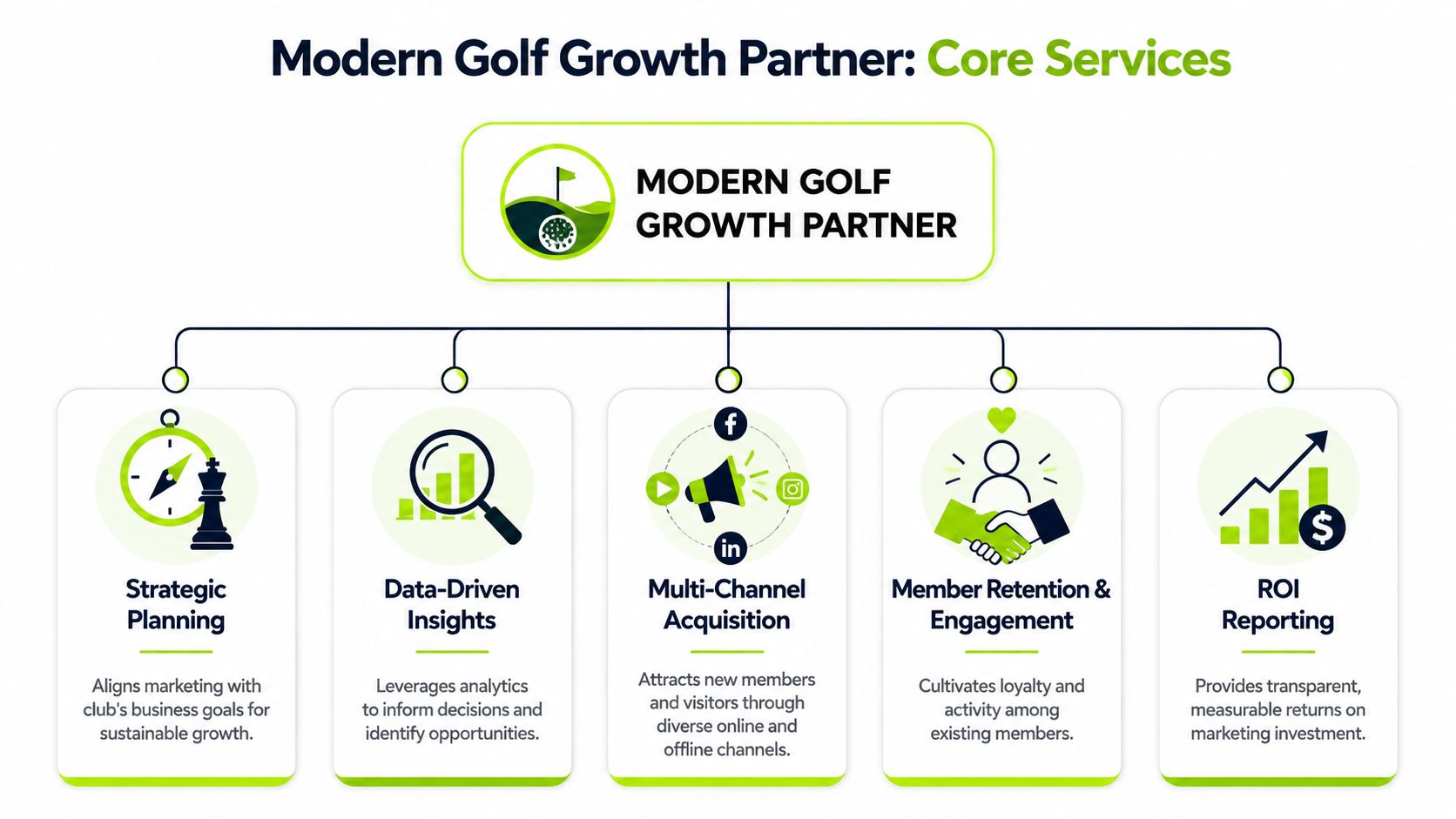
What to Expect from a Modern Growth Partner
A modern growth partner doesn't just run ads and send a monthly report. It builds a connected system that turns attention into booked tours, conversations, and signed members.
That system has four moving parts. If one is missing, performance suffers.
Acquisition that feeds the right pipeline
Paid campaigns, local SEO, Google Business Profile optimisation, and a clean website still matter. They create demand and help golfers discover the club at the right time.
But traffic on its own isn't useful. The website needs a clear path to action. Membership pages should make it obvious what to do next. Visitor and society pages should reduce friction. Forms should be connected to tracking so the club knows which channels are creating serious interest, not just casual clicks.
A structured digital marketing approach for UK clubs, beginning with a strong online presence and progressing to integrated CRM and paid campaigns, can yield 2-3x ROI, while neglecting those fundamentals can lead to 40% missed conversions, according to ProfileTree's guide to digital marketing strategies for UK golf clubs.
A CRM that gives the club memory
A good CRM is where clubs stop relying on individual staff memory and start operating with consistency. Every enquiry should land in one place, with source, status, notes, tasks, and follow-up history attached.
Without that, clubs rely on inboxes, spreadsheets, and good intentions. That's fragile. Staff change. Committee members rotate. Enquiries get forwarded. Nobody has a clean view of pipeline.
A proper CRM answers basic commercial questions fast:
- Where did this lead come from
- Has anyone replied
- Was a tour booked
- Did they join
- If not, why not
GolfRep is one example of a system built around this approach, combining lead generation with CRM-tracked follow-up so clubs can see movement from first click through to recurring revenue.
Automation that protects conversion
Most clubs don't lose leads because staff don't care. They lose them because manual follow-up breaks under everyday pressure.
Automation solves the first layer of that problem. It can send an immediate acknowledgement, qualify intent, assign the enquiry, and trigger the right next step even when the office is closed. That matters because golfers often enquire outside office hours.
A campaign is only as strong as the process that catches the response.
Automation isn't there to replace staff. It's there to make sure no prospect drops into silence.
Nurture that continues after the first reply
Many clubs stop after one email. That's rarely enough. A golfer comparing clubs may need reminders, social proof, pricing clarity, or an invitation to visit.
Nurture sequences matter for these reasons. They keep the conversation moving without relying on someone to remember every follow-up manually. Strong nurture uses useful information, not pressure.
Visual assets also play a role here. If a club wants to present membership categories, event spaces, or course condition more professionally, teams can create studio-quality videos with LunaBloom AI to support campaigns and follow-up content without slowing production.
If you're assessing a golf marketing agency UK, ask whether they can show how these four pieces connect. Agencies that only discuss ads are only discussing one quarter of the job.
For a wider view of what that service mix should include, see GolfRep's perspective on golf marketing agency services.
How to Measure Performance and Demand Accountability
Most clubs get shown the wrong numbers.
They get impressions, reach, click volume, and social engagement. Those numbers can be useful diagnostic signals, but they don't tell a club manager whether marketing is producing revenue. If an agency can't connect activity to commercial outcomes, the reporting is incomplete.
The standard should be much higher.

The numbers that actually matter
A golf club should care about movement through the pipeline, not just attention at the top of it.
Useful questions include:
- How many enquiries became booked visits
- How many booked visits became members
- Which channels create the best-fit leads
- Where are prospects dropping out
- What is the return on spend by campaign or offer
Effective golf marketing agencies track lagging metrics such as lead-to-member conversion rates, with a benchmark of 12-20%, and they target 3-5x ROI on campaigns, according to Mumble Marketing's explanation of how a marketing agency measures success. The same source notes that poor attribution modelling can lead to 25% budget waste.
Those are the benchmarks that change boardroom conversations. They move the discussion away from "did the post do well" to "did the campaign produce signed members at an acceptable return".
Why attribution is usually the weak point
A golfer might discover your club through search, come back later from an email, then enquire after seeing a retargeting ad. If the agency only credits the final click, the club gets a distorted picture of what's working.
That leads to bad decisions. The club cuts the channel that started the journey because it didn't appear to "convert", or keeps funding low-quality traffic because the reporting is shallow.
If the agency can't map the route from first enquiry to signed membership, they're reporting activity, not performance.
Clubs should ask to see attribution logic, CRM stage definitions, and reporting examples. The agency should be able to explain the whole path in plain English.
A practical reporting standard for clubs
A monthly report should show both leading indicators and lagging outcomes. It should also show what changed and what action follows. If there is no decision attached to the data, it isn't management information.
A solid report usually includes:
| Reporting area | What the club should see | Why it matters |
|---|---|---|
| Enquiry volume | Total new enquiries by channel | Shows demand creation |
| Speed to contact | Whether leads were acknowledged and followed up | Exposes operational gaps |
| Pipeline stages | Enquiry, booked call, tour, join, lost | Reveals where conversion breaks |
| Campaign return | Spend against tracked outcomes | Protects budget allocation |
| Lead quality notes | Patterns in fit, objections, and intent | Improves targeting and sales handling |
Presentation tools also influence conversion quality. For example, clubs considering digital venue walkthroughs may find boosting marketing ROI with virtual tours useful when evaluating how immersive media supports enquiries and decision-making.
If an agency gives you polished dashboards but can't show member outcomes, challenge it. Clubs need financial accountability, not decorative reporting. That's the point made in the real ROI of golf club marketing.
Your Vetting Checklist for Choosing an Agency
Choosing a golf marketing agency UK should be treated like procurement, not a casual browse through portfolios. Good agencies are often persuasive in a pitch. Vetting is what tells you whether the operation behind the pitch is sound.
Use the checklist below before you take a sales call.
Agency Vetting Checklist
| Vetting Area | What to Look For | Why It Matters |
|---|---|---|
| Golf sector relevance | Evidence they understand golf club operations, member journeys, visitor revenue, and committee-led decision making | Golf isn't a generic leisure product. The buying cycle and internal politics are different |
| Enquiry handling process | A clear explanation of what happens when a lead arrives, including routing, ownership, and follow-up | This exposes whether they solve conversion problems or only generate form fills |
| CRM capability | Whether they can work inside a structured CRM, define stages, and maintain lead visibility | Without this, reporting and accountability break down |
| Automation approach | Practical examples of automated acknowledgements, reminders, and nurture flows | Clubs need consistency outside office hours and during busy periods |
| Reporting depth | Sample reports that connect enquiries to outcomes, not just traffic or social activity | You need commercial visibility, not vanity metrics |
| Website conversion thinking | Evidence they review booking paths, forms, calls to action, and mobile experience | A good-looking site can still leak enquiries |
| Content quality | Work that fits a golf club's brand and pricing position instead of generic promotions | Poor positioning attracts the wrong audience |
| Paid media discipline | Proof they can explain offer strategy, targeting logic, and how success is measured | Ad spend without control quickly becomes expensive noise |
| Sales alignment | Whether they understand how staff handle tours, calls, and objections after a lead arrives | Marketing and front-of-house need to work together |
| Contract clarity | Defined scope, responsibilities, access, ownership of assets, and reporting cadence | Ambiguity creates disputes and weak accountability |
| Multi-site ability | Experience dealing with centralised data, shared reporting, and location-level execution | Resort groups and operators need a different operating model |
| Client references | Conversations with current or recent clients about responsiveness, communication, and delivery | References reveal what the relationship is actually like once the sale is made |
What matters more than the pitch deck
A polished deck can hide a weak process. Ask for operating detail.
Specifically, look for whether the agency can show:
- A real workflow. Not just "we generate leads", but how those leads are acknowledged, assigned, and progressed.
- An honest view of constraints. Serious partners talk about internal resourcing, staff buy-in, and data quality.
- Commercial understanding. They should care about memberships, visits, retention, and recurring revenue, not just campaign launch dates.
The most expensive agency mistake isn't overpaying. It's hiring a team that creates activity your club can't convert.
What to verify yourself
Don't rely on what the agency says about itself. Check the details.
Review their client work closely. Read case studies with a critical eye. Look at whether they explain process and measurement, or just show visuals and broad claims. If they say they understand golf, see whether their examples reflect private members' clubs, resorts, societies, visitor play, and membership enquiries in a way that feels operationally real.
Vetting done properly removes a lot of sales theatre before the first meeting even starts.
Critical Questions to Ask and Red Flags to Avoid
Once an agency passes basic vetting, the interview should test how they think. Not how well they present.
The right questions force specifics. They show whether the agency understands that the commercial problem is conversion after enquiry, not just lead generation at the top.
Questions that expose the real capability
Ask these directly and let the agency talk. Good answers are usually clear, operational, and easy to follow.
Walk me through what happens the moment a new membership enquiry is submitted on our website.
You're listening for routing, speed, ownership, CRM entry, and first follow-up.How do you track an enquiry from first click to signed membership?
This reveals whether they have a real measurement model or only channel reporting.What would you need from our team each week to make this work properly?
Strong partners know growth depends on internal process, not just agency output.How do you handle prospects who don't convert after the first reply or first visit?
If there's no answer beyond "the club follows up", the system is incomplete.How do you distinguish a serious membership lead from low-intent interest?
This tests qualification thinking and protects staff time.What does your reporting show beyond traffic and impressions?
You want pipeline stages, outcomes, and actions.How would you support a resort group or operator with several sites? Weaker agencies often get vague regarding multi-site support. A more advanced partner should be able to discuss centralised CRMs, shared workflows, and scalable automation. As noted by MB Golf Marketing's discussion of this gap, multi-site golf operators need centralised CRM structures and scalable automation to maintain brand consistency and avoid duplicate marketing spend, which generalist agencies rarely address well.
Red flags that should slow the process down
Some warning signs appear in tone before they appear in performance.
Over-focus on top-of-funnel activity
If the agency keeps returning to reach, awareness, and lead volume but avoids the post-enquiry process, that's a concern. It usually means they don't own the commercial outcome.
Vague answers about systems
If they can't explain how leads are tracked, assigned, and nurtured, they probably don't have a reliable framework. That will become your club's problem later.
No curiosity about club operations
A serious partner asks about your admin capacity, sales process, membership categories, pricing stance, and internal bottlenecks. If they don't ask, they're planning to run campaigns in isolation.
Defensive responses to ROI questions
You don't need guarantees of exact outcomes. You do need a willingness to discuss accountability. Agencies that dodge ROI conversations often rely on metrics that don't stand up to scrutiny.
Ask one question twice in different ways. If the answer changes, the process probably isn't stable.
What a strong answer sounds like
A strong agency answer is usually practical. It names systems, people, decision points, and next actions. It doesn't hide behind jargon.
It might explain how a lead is acknowledged instantly, placed into a CRM, tagged by enquiry type, assigned to a staff member, and followed by a nurture sequence if no tour is booked. That's the level of thinking you want.
An agency that only talks about campaign creativity may still produce attractive work. That isn't the same as producing a predictable pipeline.
Choosing a Partner Not Just a Supplier
The final decision isn't really about hiring a supplier to "do some marketing". It's about deciding whether the club wants a partner that can help build a predictable commercial system.
That system starts with lead generation, but it doesn't end there. It includes response handling, CRM visibility, follow-up discipline, and clear reporting. Without those pieces, clubs often buy activity that feels productive but doesn't create dependable revenue.
Many buying decisions falter at this stage. Committees compare agencies by deliverables: number of posts, number of ads, design quality, and monthly fee. These factors are important, but they do not indicate whether a partner can bridge the gap between enquiry and income.
Many UK golf club decision-makers struggle to measure marketing ROI because most agencies don't provide transparent, sector-specific KPI frameworks. A stronger partner closes that ROI measurement gap by making performance visible from first click to recurring revenue, as discussed by Your Golf Marketing's perspective on the measurement gap in golf club marketing.
The better way to judge fit
A supplier completes tasks. A partner improves the system.
Look for a team that can challenge weak internal process, not just accommodate it. Look for one that understands your club's operating reality and can explain growth in plain English. If they also work across search and local visibility, broader resources like this guide to choosing the right London SEO partner are useful because they show the same core principle: channel expertise matters, but only when it's tied to commercial accountability.
The clubs that get the most from a golf marketing agency UK don't just ask for more enquiries. They ask for a process that makes every enquiry count.
That's the standard worth holding.
If you're reviewing partners and want a second opinion, GolfRep helps golf clubs build tracked enquiry pipelines with CRM-led follow-up and automation, so interest doesn't disappear between form submission and signed membership.
Ready to tap into our proven growth system?