Golf Club Automation: How to Convert More Enquiries

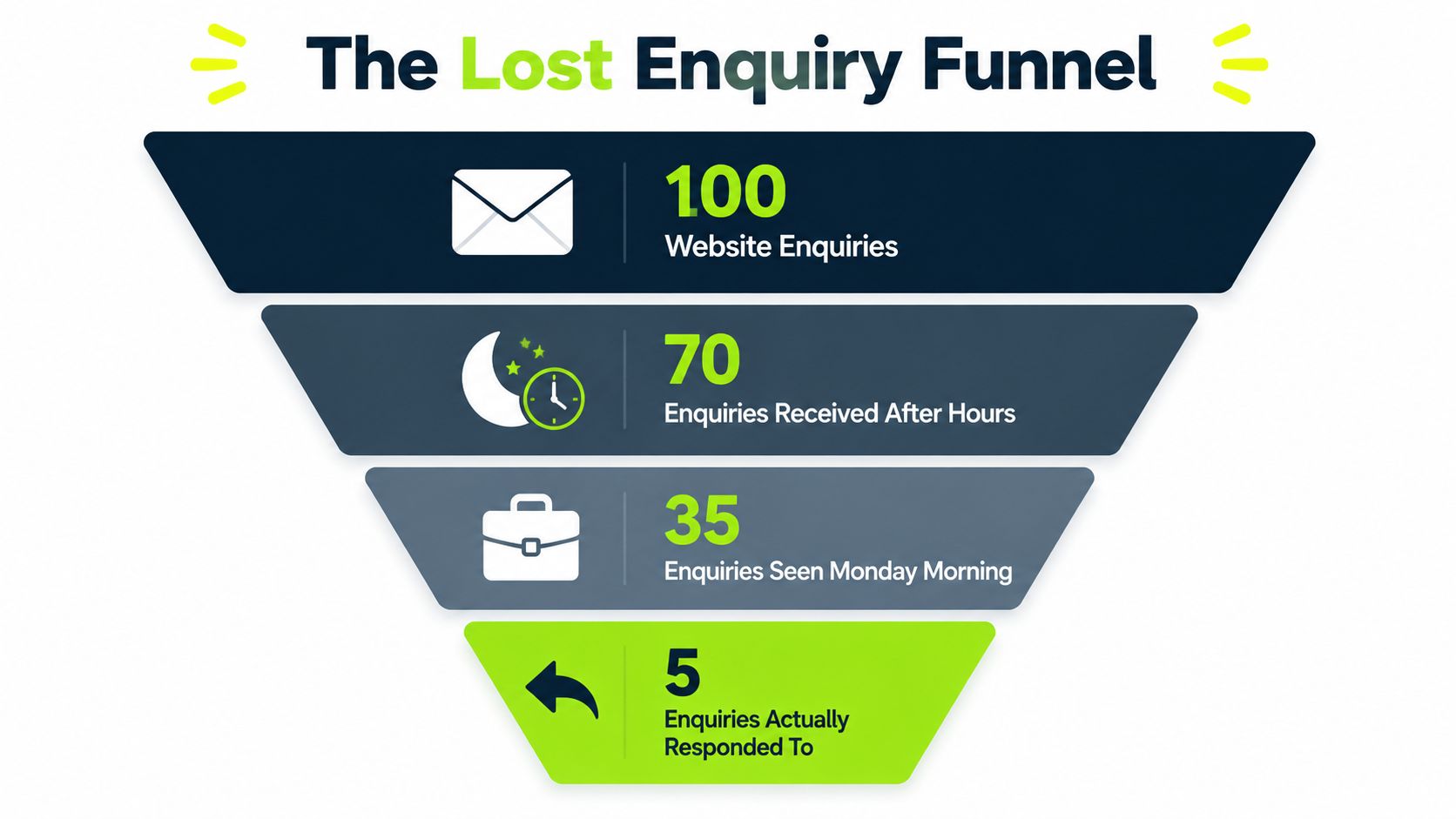
At 9:47 pm on a Tuesday, a prospective member submits an enquiry through your website. The office is closed, the membership manager's inbox is already crowded, and nobody owns the next action. By Thursday morning, a friendly reply finally arrives. The prospect has already visited two rival clubs, downloaded several membership brochures, and joined elsewhere.
That isn't a marketing failure. It's a lead-handling failure.
Most golf clubs don't struggle because nobody knows they exist. They lose opportunities between the web form, the shared inbox, the spreadsheet, and the eventual human follow-up. Golf club automation should fix that gap first. It should catch every enquiry, make ownership clear, respond quickly, and show managers which conversations become visits, memberships, and recurring revenue.
Why Most Golf Clubs Lose Enquiries Before the Weekend
Clubs often blame weak campaigns, pricing, or a quiet tee sheet when membership growth stalls. Those factors can matter, but they're frequently investigated before the club answers a simpler question: what happened after each enquiry arrived?
A message that sits in an inbox has no owner, no deadline, and no reliable place in the sales pipeline. A manager may intend to reply, but daily operations intervene. The enquiry gets buried under competition entries, supplier messages, staffing issues, and member requests. By the time somebody responds, the prospect's motivation has cooled.
The problem is particularly obvious outside office hours. Evening website forms, Friday lunchtime requests, society booking questions, and open-day registrations all arrive when the person best placed to respond may be on the course, serving members, or away from the club. Without an automatic acknowledgement and an assigned follow-up task, the club relies on memory.
The shared inbox creates a false diagnosis
A shared mailbox looks efficient because everyone can see it. In practice, it often creates the opposite result. Multiple people assume somebody else has replied, while nobody can see whether an enquiry is new, being qualified, awaiting a tour, or ready for a membership conversation.
The 2025 national research project into UK and Ireland golf-club software surveyed 134 golf club managers and was commissioned in July 2024 by the GCMA, The Golf Club Secretary, SGCMA, UK Golf Federation, and CMAI. Its headline finding was that clubs use software primarily to improve the member experience through operational efficiency, with implementation time highlighted as a key adoption metric. That supports a practical view of automation, it's infrastructure for removing manual work, not a decorative technology project. The GCMA summary of the research provides the wider context.
Practical rule: If a manager can't identify every open enquiry, its current stage, its owner, and its next action, the club doesn't have a pipeline. It has an inbox.
Automation should acknowledge the enquiry immediately, capture the relevant details, qualify intent, and route the conversation to the right person. Clubs that want to improve their internal handling can also review guidance on how to automate client intake with Inbox Zero, particularly where email remains the first point of contact.
The rest is straightforward operational discipline. Measure response time, record every stage, and stop treating missed follow-up as an unavoidable part of club life.
What Golf Club Automation Actually Means
Golf club automation is the connected set of software and workflows that handles an enquiry from first contact through to a measurable outcome. It captures the prospect, stores the record, assigns responsibility, sends timely communication, reminds staff what to do next, and reports whether the enquiry became a visit or membership.
That's different from generic marketing automation. A retail brand may automate abandoned carts. A club needs workflows for trial-day bookings, membership categories, society enquiries, waiting-list movement, renewals, tours, and open-day attendance. The system must reflect how the club operates.
Four connected layers
Lead capture brings together website forms, phone enquiries, social channels, third-party booking sources, and walk-ins. The objective is simple: no prospect should live only in a personal inbox or on a scrap of paper at reception.
The CRM holds the prospect and member record. It should show the enquiry source, preferred course or facility, membership interest, previous visits, communications, owner, stage, and next task. This ends the spreadsheet shuffle and gives managers a consistent view.
AI-driven automation handles immediate acknowledgement, basic qualification, routing, scoring, and escalation. It doesn't replace the membership manager. It makes sure the manager receives the right enquiry with the relevant context before the opportunity disappears.
Nurturing and analytics keep the conversation moving through email, SMS, and task reminders. Reporting then connects activity to outcomes, including conversion stages, source attribution, and revenue impact. Resources on integration with CRMs and webhooks are useful when clubs are assessing how separate systems should pass information between one another.
| Capability | Generic Marketing Automation | Golf Club Automation |
|---|---|---|
| Lead capture | Website forms and campaign responses | Website, phone, social, walk-ins, events, and booking enquiries |
| Record management | Contact profile and marketing activity | Prospect, member, membership category, visit history, source, and owner |
| Workflow | Campaign triggers and email sequences | Qualification, tour booking, trial day, renewal, society, and open-day workflows |
| Routing | General sales assignment | Membership manager, site, facility, or department assignment |
| Measurement | Opens, clicks, and campaign engagement | Response time, enquiry-to-visit conversion, signed membership, and revenue attribution |
The plumbing matters more than the label. A platform that doesn't connect capture, ownership, follow-up, and reporting will still leave the club guessing.
The Speed-to-Lead Problem Hidden in Every Inbox
A prospect's first hour is commercially important because intent is strongest immediately after they submit an enquiry. If the club waits, the conversation becomes harder before anyone has discussed membership benefits, joining fees, or playing rights.
The UK lead-response analysis linked in GolfRep's guide to golf club speed-to-lead reports that UK businesses average 47 hours to respond to leads, while only 7% achieve a response within five minutes. The same analysis reports that 78% of customers buy from the first company to respond. These figures make speed a conversion issue, not a customer-service preference. The lead-response analysis sets out that evidence.
A separate UK survey found that only 9.9% of firms responded within five minutes and 46.2% responded within an hour. The Survey Booker lead-response study shows how frequently enquiries remain unattended during the period when prospects are most likely to continue comparing options.
What this looks like at a club
An evening membership form may be answered the next morning. A Friday request for a trial round may wait until the following week. A society captain may ask for a package proposal while the events team is busy delivering another booking.
Each enquiry has a different value and urgency, but a shared inbox treats them alike. There's no automatic distinction between a general information request and somebody asking to book a tour. Staff must open the message, interpret its importance, copy details into a spreadsheet, and remember to follow up.
UK research materials also report an average response time of about 42 hours, with the odds of qualifying a lead falling sharply after the first five minutes. First Knock's research supports the operational case for immediate acknowledgement, visible ownership, and automated first-touch communication.
Automation should enforce three controls:
- Immediate acknowledgement: Confirm receipt and explain what happens next.
- Qualified routing: Send the enquiry to the correct manager based on category, location, or request.
- SLA tracking: Show when the response is due and escalate when nobody acts.
That turns speed-to-lead from a hopeful habit into a managed metric. It also exposes the hidden cost of slow handling, the prospective members who never reach the stage where the club can report them as lost.
Core Components of a Modern Club Automation System
A useful system doesn't begin with a feature list. It begins with the daily jobs that currently depend on somebody remembering what to do.
Capture and record
Lead capture should collect website forms, third-party tee-time platforms, social advertising responses, referrals, and reception conversations in one controlled flow. The CRM then creates a record with the information staff need to act, rather than forcing them to reconstruct the enquiry from separate messages.
A membership manager should be able to see whether a prospect wants a full membership, flexible category, academy route, trial experience, or group booking. That context determines the next action.
Route and respond
AI-driven automations can acknowledge the enquiry, ask basic qualifying questions, assign it to the correct person, and create a task. If the enquiry concerns a particular course in a multi-site group, the workflow should route it to the relevant site rather than a central queue with no clear owner.
A connected operational stack can also reduce the need for staff to jump between systems. Clubs assessing specialist connections may find it useful to review a Claude connector for Clubspeed as an example of how an AI layer can interact with club-management data.
Nurture and report
Not every prospect is ready to join after one conversation. Email and SMS sequences can provide relevant information, invite a tour, confirm an open-day booking, or remind a manager to call. The timing should reflect the enquiry stage, not send every contact the same generic newsletter.
Analytics should show enquiry volume, response time, stage movement, visits, memberships, and revenue by source. GolfRep's golf club CRM guidance focuses on the same principle, tracking the path from initial enquiry to commercial outcome rather than stopping at contact volume.
| Component | Club Job It Replaces | Failure Mode If Absent |
|---|---|---|
| Lead capture | Copying enquiries from forms, inboxes, and reception notes | Enquiries remain invisible or get lost |
| CRM | Updating spreadsheets and separate member records | Staff lack history, ownership, and stage visibility |
| Response automation | Manually acknowledging every new message | Prospects wait while intent declines |
| Routing and tasks | Deciding who should call and when | Follow-up has no accountable owner |
| Nurture flows | Remembering every reminder and information email | Warm prospects go cold after the first reply |
| Analytics | Building reports from disconnected data | Managers can't connect activity to revenue |
The right architecture is usually less glamorous than a new app. It's clean data, dependable handoffs, and one accountable workflow.
Real Club Use Cases and the KPIs That Prove It Works
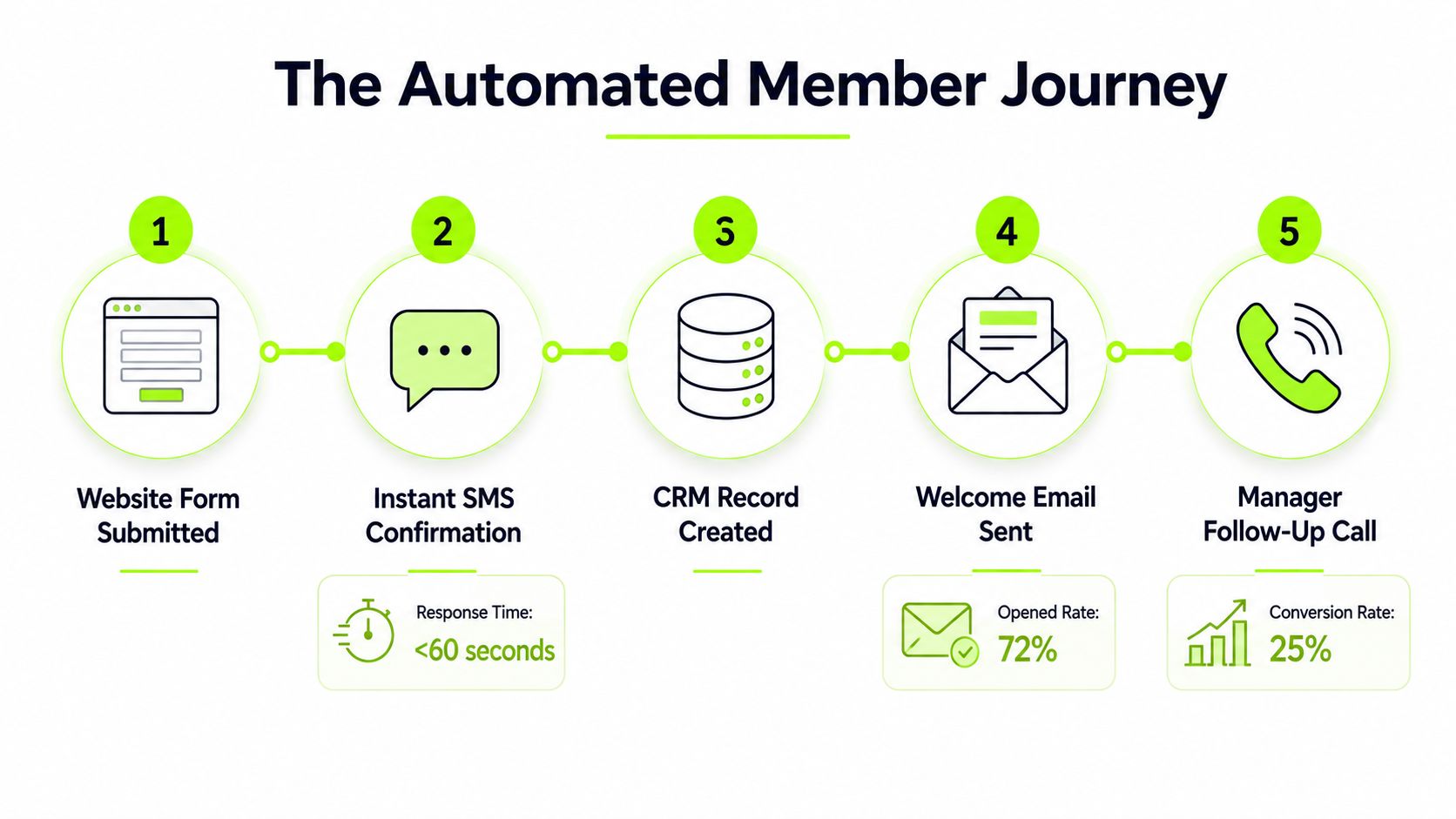
A good automated journey begins when a prospective member submits a website form. The system records the enquiry, sends an SMS confirming receipt, creates a CRM record, and delivers a welcome email with the next useful action, such as booking a tour or choosing a suitable time to speak.
The membership manager then receives a task with the prospect's stated preference and source. The manager isn't starting with an empty inbox. They're continuing a structured conversation.
One journey, several club models
A multi-site operator can use the same structure while varying the routing rules. A prospect interested in a particular course can be assigned to the nearest membership manager, while a prospect asking about hotel packages or a society day follows a different path.
Event-driven workflows make this more useful. An open-day registration can trigger confirmation, practical visit information, attendance tracking, and a follow-up task. A junior membership drive can send age-appropriate information to the relevant parent or guardian contact. A society enquiry can move through package details, availability, proposal, and booking stages.
The value comes from matching the workflow to the decision the prospect is trying to make. Automation shouldn't send more messages for their own sake. It should remove delays and give staff the context to have a better conversation.
Measure the commercial journey
The dashboard should answer questions a committee can understand:
- Enquiry-to-tour conversion: How many enquiries become a booked visit?
- Average response time: How quickly does each source receive a first response?
- Cost per acquired member: What did the club spend to generate each signed membership?
- Lifetime membership value: What revenue follows from members acquired through each channel?
- Source attribution: Which campaign, referral, event, or page produced the member?
These measures stop the club rewarding activity instead of progress. A high volume of enquiries means little if managers can't see whether those contacts become tours, serious conversations, or signed memberships.
The test is not whether the automation sends an email. The test is whether the club books more useful conversations and can trace the resulting revenue.
Use the same definitions across sites and departments. If one team calls a visit a qualified lead and another calls it an opportunity, the dashboard will create confusion rather than control.
An Implementation Roadmap Clubs Can Follow in 90 Days
A committee doesn't need to approve a huge transformation before the first improvement appears. It needs a controlled rollout with a named owner, a defined workflow, and evidence at each stage.
Days one to thirty, audit and foundations
Start by mapping every enquiry source. Include website forms, direct email, phone calls, social channels, referrals, events, and walk-ins. Record where each enquiry goes, who sees it, how it's logged, and what happens next.
Select the CRM against the club's actual workflow, not the longest feature list. Consolidate lead capture, agree the pipeline stages, clean duplicate records, and define who owns membership, societies, events, and site-specific enquiries.
Milestone: every new enquiry has a recorded source, owner, stage, and next action.
Internal owner: general manager, membership lead, or an appointed operations owner.
Measure: capture completeness, ownership completeness, and time from submission to visibility.
Days thirty-one to sixty, build and test
Add instant acknowledgement, routing rules, task creation, and source attribution. Build the first nurture sequence around new membership enquiries. Keep it practical, a confirmation, useful club information, a tour or call invitation, and a clear route to ask a question.
Test unusual cases. Submit enquiries outside office hours, use different membership categories, and check that the right staff member receives the task. A workflow that works only for the easiest form submission isn't ready.
Milestone: new enquiries receive a consistent first response and appear in the correct pipeline.
Internal owner: membership manager with support from the CRM administrator.
Measure: response time, task completion, routing accuracy, and stage progression.
For clubs planning acquisition alongside automation, GolfRep's 90-day membership enquiry framework offers a useful way to connect campaign activity with follow-up discipline.
Days sixty-one to ninety, launch and optimise
Add dashboards, manager scorecards, and event-driven campaigns for open days, junior recruitment, and society activity. Review missed tasks and stalled stages in weekly management meetings. Fix the workflow before adding more complexity.
Milestone: managers can report the full journey from source to visit and membership.
Internal owner: general manager or commercial lead.
Measure: enquiry-to-visit conversion, signed memberships, source performance, and revenue attribution.
Speed improvements can appear within weeks. Conversion reporting needs a full quarter of clean, consistently staged data before it tells the truth.
Vendor Selection and Measurement Checklist
A vendor demo can make almost any platform look impressive. The committee should ignore the polished screen and test whether the system can prove what happened to a real enquiry.
Start with four pillars: enquiries in, conversion visibility, response-time reporting, and retention attribution. Every vendor should demonstrate the complete journey using the club's own scenarios, including an after-hours membership enquiry, an open-day registration, and a society request.
Questions that protect revenue accountability
Ask how the system records the original source and submission time. Ask whether a manager can see every open opportunity without exporting a spreadsheet. Ask how the platform identifies a booked visit, a signed membership, and the revenue attached to each source.
Then test the operating details. Does the system integrate with the existing tee sheet or club-management platform? Who owns the data? What training is included? What happens when staff change? Can the club export its records and leave without losing the history it has created?
| Evaluation Pillar | What to Ask the Vendor | Proof Required | Pass / Fail Threshold |
|---|---|---|---|
| Enquiries in | Can every source create a record automatically? | Test submissions from each active channel | Pass only when each source appears with a timestamp and owner |
| Conversion visibility | Can stages be customised to the club's journey? | Demonstration from enquiry to visit and membership | Pass only when managers can report stage movement |
| Response-time reporting | Can the club measure first response and overdue tasks? | Live test with an unassigned or delayed enquiry | Pass only when ownership and escalation are visible |
| Retention attribution | Can member revenue be linked to acquisition source? | Member record and source-to-revenue report | Pass only when the club can analyse acquired cohorts |
| Integration | Does it connect with current operational software? | Documented integration method and test environment | Pass only when staff won't need duplicate entry |
| Training and exit | What support, data ownership, and export terms apply? | Written training plan and contract terms | Pass only when the club controls its records and transition |
Set a 90-day measurement window before renewal discussions. Track average response time, enquiry-to-visit conversion, signed memberships, source attribution, booked visits, and member revenue. Don't accept email sends, dashboard logins, or contact counts as proof that automation is working.
GolfRep works with clubs on lead generation, structured follow-up, AI-driven enquiry handling, and CRM visibility, so managers can connect the first enquiry with the eventual membership outcome. Visit GolfRep to discuss a practical automation and growth system built around your club's existing operation, not another disconnected tool.
Ready to tap into our proven growth system?