Business Development Manager Jobs Scotland: Golf Clubs 2026
Most advice on business development manager jobs in Scotland gets the job wrong.
Golf clubs are told to hire someone who can "bring in more leads". That sounds sensible. It usually isn't. Most clubs don't have a lead problem first. They have a conversion problem. Enquiries come in through the website, social media, email, referrals, visiting parties, corporate interest, and membership forms, then they sit in inboxes, on scraps of paper, or inside one staff member's head.
That's where revenue leaks.
From GolfRep's perspective, a Business Development Manager should not be hired as a glorified salesperson. The right hire builds a repeatable commercial system. They make sure every membership enquiry, society booking request, and corporate day lead is seen, answered, tracked, followed up, and moved forward. If your club still relies on memory, goodwill, and manual chasing, you don't need more noise at the top of the funnel. You need control.
Your Club Needs a System Not Just More Enquiries
A committee often makes the same mistake. It sees patchy membership growth or inconsistent visitor revenue and concludes that marketing must be the issue. So it looks for more campaigns, more adverts, more social posts, more enquiries.
That's backwards.
If your club cannot respond quickly, assign ownership, track status, and follow up consistently, more enquiries create more waste. A Business Development Manager's real value is operational. They bring structure to commercial activity and stop good opportunities from disappearing between reception, the pro shop, the general manager, and the membership team.
A proper BDM at a golf club should own questions like these:
- Who responds first: Is there a named person for every new lead?
- What happens next: Does every membership enquiry trigger a clear follow-up sequence?
- What gets measured: Can the committee see enquiry volume, stage, and outcome?
- Where leads sit: Are they in a CRM, or buried in inboxes and notebooks?
- Why deals stall: Does anyone know the recurring objections and drop-off points?
Practical rule: If your club can't see every live enquiry in one place, you are not managing growth. You are hoping for it.
That's why the strongest clubs think in systems, not isolated sales activity. Enquiry response time matters. Lead visibility matters. Conversion tracking matters. Manual processes break as soon as the club gets busy, someone goes on leave, or responsibility becomes unclear. Structured follow-up doesn't just tidy things up. It protects revenue.
If you want a more disciplined model for this, GolfRep's view on predictable revenue for golf clubs is the right starting point. The core idea is simple. Don't hire someone to create activity. Hire someone who can turn interest into predictable outcomes.
The Scottish BDM Market Landscape and Career Path
Hiring a Business Development Manager in Scotland is harder than many golf club committees expect. The strongest candidates are already in demand, and they usually avoid roles that sound vague, isolated, or badly supported. If your advert reads like a generic sales job, you will attract generic sales applicants.

Where the demand sits
Scotland's market is concentrated around the main commercial centres. Jobsite's Scotland business development manager listings show strong activity around Glasgow and the wider Central Belt. That matters because clubs are not competing only with other leisure venues. They are competing with employers in construction, professional services, technology, finance, and business services that already know how to define pipeline ownership, CRM discipline, and commercial targets.
Edinburgh also remains a serious hiring market for this role. TotalJobs salary data for Business Development Manager jobs in Edinburgh shows a median salary of £40,000 per year based on recent vacancies. That gives committees a useful benchmark. If your club wants someone who can build structure, improve conversion, and report clearly on pipeline health, you are not shopping in a bargain market.
What the career path actually signals
The title covers a wide range of people. Some candidates have built their careers in disciplined B2B sales teams with weekly reporting, clear stages, and forecast accountability. Others come from account management roles where relationship retention mattered more than winning new business. Both can call themselves BDMs. Only one of them is likely to fix a weak enquiry-to-sale process.
My World of Work's profile for Business Development Manager sets out the broad pay range and typical progression into senior commercial roles. The more useful point for a golf club is practical, not academic. Progression usually follows evidence of commercial control. Candidates move up when they can show they managed a pipeline, hit targets, used CRM properly, and improved conversion over time.
Regional familiarity can still matter. That is not a claim about formal promotion routes. It is a hiring observation. Someone who knows the corporate networks around Aberdeen, Stirling, Glasgow, or Edinburgh may get to productive conversations faster than someone learning the area from scratch. For clubs selling memberships, society days, event packages, and sponsorship, that local knowledge has real value if it sits on top of process discipline.
What clubs should take from the market
Treat the Scottish market as a filter. It exposes whether your club understands the job.
A weak brief asks for an outgoing personality and plenty of contacts. A strong brief asks for evidence of CRM use, follow-up design, reporting discipline, and ownership of conversion from first enquiry to signed business. That difference decides who applies.
The career path also matters for retention. Good BDMs do not stay where success depends on chasing scattered enquiries across inboxes, paper notes, and verbal handovers. They stay where the committee gives them clean reporting lines, authority to tighten the process, and a clear commercial remit.
That is the standard to hire against. You do not need a smooth talker. You need someone who can make demand visible, measurable, and easier to convert.
The Core Responsibilities of a Modern BDM
Most clubs still describe this role badly. They say they want someone "good with people", "proactive", and "commercially minded". That's thin. A modern Business Development Manager isn't there to smile, network, and hope business turns up.
They own a commercial process.
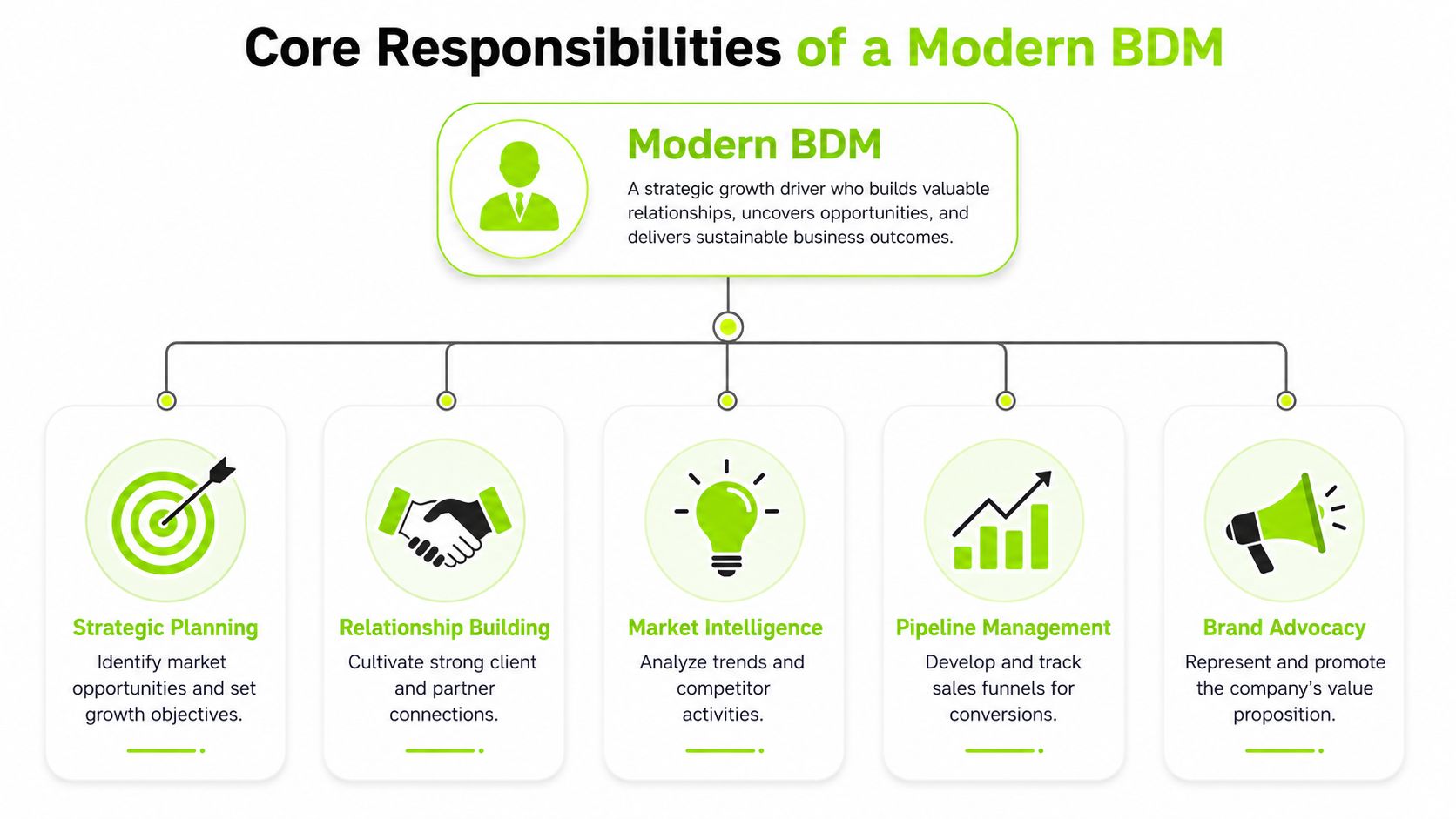
A good BDM doesn't just generate conversations. They create visibility, accountability, and movement across the whole pipeline.
What they actually do day to day
At senior level in Scotland, the job specification gets very clear. A key technical requirement is leading a regional work-winning function and maintaining CRM systems properly. Robertson's Senior Business Development Manager role in Stirling makes the link explicit. If CRM data integrity slips, business plan targets and pipeline security slip with it.
That's exactly the lesson golf clubs need to take seriously.
At club level, the modern BDM should be responsible for:
- Lead capture discipline: Every enquiry from the website, phone, email, social media, and referral route goes into one visible system.
- Response ownership: Someone responds quickly, and the BDM makes sure that responsibility never becomes vague.
- Pipeline staging: Enquiries are not treated as one pile. They are separated into stages such as new, contacted, visit booked, proposal sent, follow-up due, won, or lost.
- Commercial reporting: The committee gets reports based on actual movement, not vague impressions.
- Offer refinement: The BDM spots where the club's membership or event proposition loses momentum and feeds that back into pricing, messaging, and sales process.
What weak clubs ask for instead
Weak hiring briefs focus on personality and contacts. Strong briefs focus on process ownership.
A club that hires a "people person" without asking how they manage pipeline, follow-up, and reporting often ends up with a pleasant employee and the same commercial blind spots. A club that hires a systems-builder gets something far more valuable. It gets a working sales engine.
Here is the practical distinction:
| Focus area | Reactive sales behaviour | Modern BDM behaviour |
|---|---|---|
| Enquiries | Replies when there's time | Builds a response process |
| Follow-up | Chases selectively | Runs consistent sequences |
| Reporting | Gives verbal updates | Uses CRM-based visibility |
| Offers | Sends generic information | Tailors proposals by lead type |
| Committee confidence | Low, because pipeline is unclear | Higher, because status is visible |
What this means for a golf club
In a golf setting, the BDM should sit at the centre of membership sales, society bookings, corporate golf days, sponsorship conversations, and strategic partnerships. They don't have to personally do every task. They do need to make sure every commercial opportunity moves through a defined system.
Committee test: Ask any candidate to explain how they would track a new membership enquiry from first contact to signed direct debit. If the answer is vague, they are not ready to build predictable growth.
The role is operational before it is promotional. That's the shift clubs need to make.
Business Development Manager Salary Expectations in Scotland
Salary is where many golf clubs expose a weak hiring plan.
If the package is built around a modest base and a vague promise of commission, you will attract candidates who chase quick wins, protect their own patch, and leave the pipeline messy behind them. That is the wrong hire for a club. You need someone who can build repeatable commercial process across membership, societies, corporate days, and partnerships.

What clubs should actually pay for
As noted earlier, the Scottish market for BDM roles spans from junior commercial hires through to experienced operators with meaningful variable pay attached. That range matters, but the committee should focus on fit before fixating on headline salary.
A golf club is rarely buying pure sales volume. It is buying commercial control. The better candidate will usually cost more because they know how to set standards for response times, proposal quality, CRM hygiene, follow-up cadence, and weekly reporting. Those habits protect revenue. They also make results more predictable.
Pay for that.
Why base salary alone is a poor measure
Base pay gets someone into the seat. It does not guarantee disciplined conversion.
A sensible package separates three parts:
- Base salary: High enough to attract a credible operator who has already run a pipeline, not someone hoping to learn on your budget
- Variable pay: Tied to revenue the club can verify, such as completed memberships, confirmed event income, or signed partnership value
- Process accountability: Part of success should depend on clean reporting, accurate forecasting, and proper lead tracking
That last point gets missed all the time. A candidate who closes the occasional deal but leaves no usable system has not solved the club's problem. They have delayed it.
Committee rule: If a result cannot be tracked in your CRM or reporting process, it should not trigger commission.
What a golf club should budget for
Set the package according to the job you want done.
If your club needs somebody to respond to inbound interest and tidy up administration, keep the scope narrow and pay accordingly. If you want someone to take ownership of enquiry handling, conversion process, pricing discipline, outbound partnership activity, and pipeline forecasting, budget for a stronger operator with a stronger upside.
For many clubs, the mistake is underpaying the base and overpromising the bonus. Serious BDMs do not join for fantasy earnings. They join for a realistic package, clear authority, decent systems, and measurable targets.
A better approach is to match incentives to the club's real commercial leaks:
- Membership growth focus: Reward signed members, retained value after an agreed period, and show-up rates from booked tours
- Society and event focus: Reward confirmed revenue, margin protection, and repeat bookings
- Partnership focus: Reward signed agreements that produce cash value or contracted commercial benefit
Keep the scheme simple. Keep it auditable. Make sure it rewards conversion, not activity.
The club is not paying for optimism. It is paying for a reliable sales process that turns interest into income.
Why Your Golf Club Needs a Business Development Manager
A golf club's commercial problem usually isn't visibility alone. It's inconsistency after interest appears.
A prospect fills in a membership form. A visiting group asks about a society day. A local company wants to discuss a client event. Someone asks about flexible membership. Another person wants a show-round. All of those are sales opportunities. Most clubs handle them with goodwill, not systems.
That's why many clubs need a Business Development Manager.
The role inside a golf club
At club level, the BDM sits between marketing, operations, and revenue. They make sure enquiries turn into conversations, conversations turn into visits, and visits turn into signed business. If that chain breaks, it's usually because nobody owns it properly.
This role is especially valuable when a club has any of the following problems:
- Membership enquiries arrive but stall: People ask for information, then hear nothing useful or nothing quickly enough.
- Corporate and society leads are handled casually: Staff answer the phone, send a brochure, and hope the date gets booked.
- No one can see the pipeline: The committee hears anecdotes rather than pipeline stages and next actions.
- Follow-up depends on individuals: When one person is busy or absent, leads go cold.
- Commercial accountability is fuzzy: Everyone is involved, which usually means no one is accountable.
Comparing approaches to golf club sales
The difference between an old-school sales approach and a proper golf club BDM is sharp.
| Metric | Traditional Sales Rep | Modern Golf Club BDM |
|---|---|---|
| Main objective | Generate interest and chase deals | Build a controlled pipeline that converts enquiries |
| View of leads | One-off opportunities | Managed assets with stages, owners, and next steps |
| Follow-up method | Personal reminders and ad hoc calls | Structured CRM tasks, sequences, and reporting |
| Reporting style | General updates | Conversion visibility and pipeline tracking |
| Membership sales | Reactive | Process-led |
| Society and corporate sales | Quote-led | Relationship and pipeline-led |
| Committee value | Activity | Predictability |
Why golf-specific commercial experience commands attention
The golf sector isn't generic hospitality and it isn't pure field sales either. You need someone who understands long consideration cycles, emotional buying decisions, member objections, recurring value, and local relationship selling.
That's why specialist golf BDM roles can pay well. A BDM role for the UK golf industry in Scotland or Northern Ireland offers OTE of £60,000, built on a £30,000 to £35,000 basic salary plus an uncapped performance-related bonus of £25,000 to £30,000, according to The Revenue Club's golf industry BDM vacancy.
That should tell committee members something important. The market already values the role when revenue growth is on the line.
What clubs often get wrong
Many clubs hire too late, define the job too loosely, or bury the person under admin. Then they say the role "didn't work". In truth, the role was never properly set up.
A BDM should not become the person who updates posters, fills in random admin gaps, covers front desk duties, and squeezes sales in around the edges. If that happens, the club hasn't hired a Business Development Manager. It has hired a busy generalist.
The purpose of the role is simple. Convert interest into revenue through a visible, repeatable process.
If your club wants stable membership growth, stronger event revenue, and fewer missed opportunities, this hire stops being optional. It becomes part of the club's infrastructure.
How to Recruit and Hire a Growth-Focused BDM
Most clubs write weak BDM job descriptions because they start with tasks instead of outcomes. They ask for "excellent communication", "a passion for golf", and "self-motivation". None of that tells a serious candidate what success looks like.
Start with the commercial job that needs to be done.
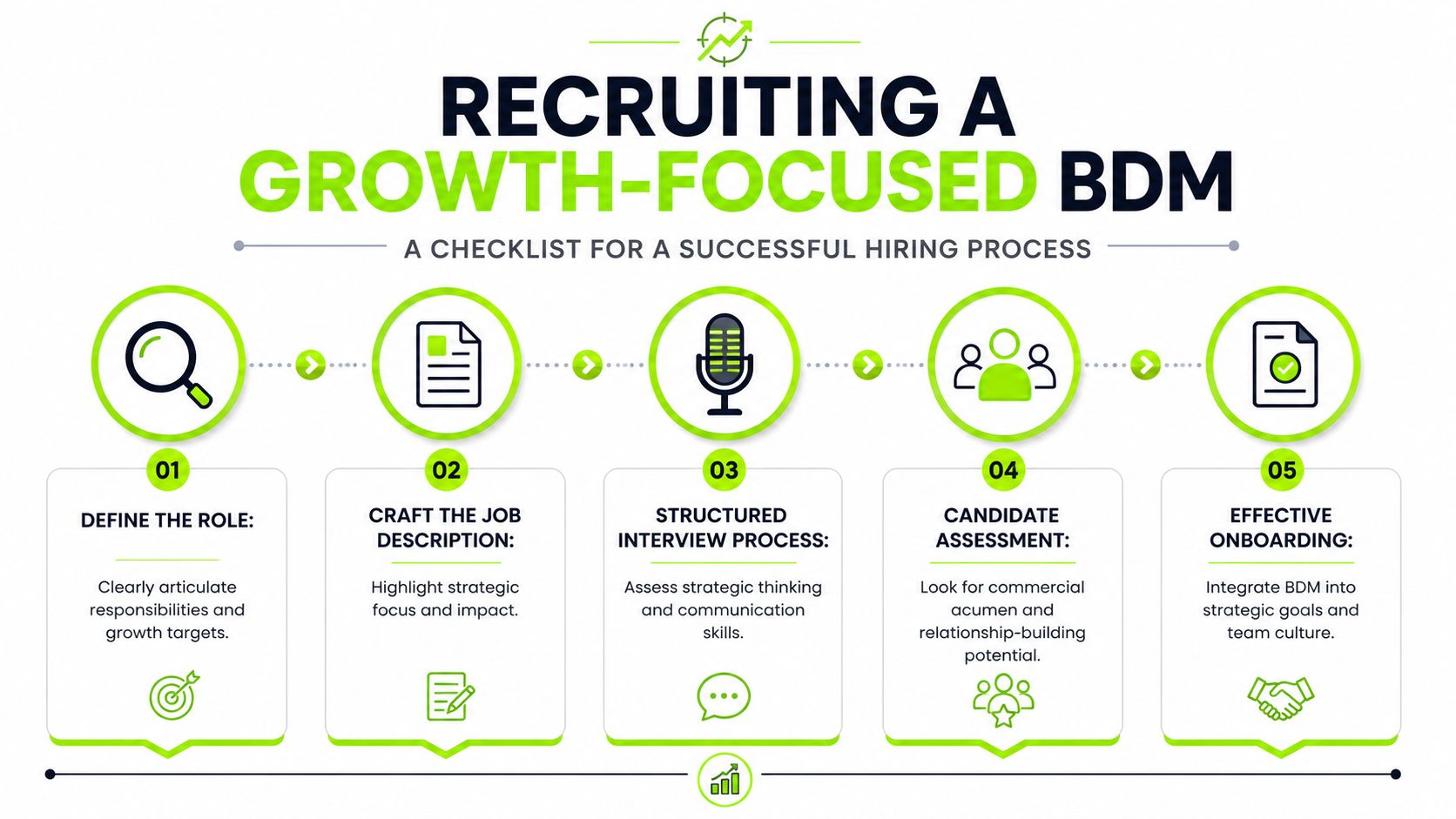
Write the role around pipeline ownership
The best job descriptions are blunt. They explain what the person will own, what systems they'll use, and what commercial areas matter most.
Your brief should cover:
Core revenue lines
State whether the person will focus on memberships, societies, corporate golf days, sponsorship, visitor revenue, or a mix.System responsibility
Make it clear they will manage CRM hygiene, follow-up workflows, lead stages, and reporting to the manager or committee.Operational expectations
Spell out response standards, sales process discipline, proposal handling, and follow-up responsibility.Decision rights
Clarify what they can price, what they can offer, and where approval is needed.
What to look for in candidates
There are no mandatory formal entry requirements, but employers in Scotland typically expect GCSEs in maths and English plus proven experience in sales or marketing. For career progression, formal qualifications such as a Level 4 Higher Apprenticeship are becoming increasingly important, according to the National Careers Service profile for Business Development Managers.
That's useful background, but clubs shouldn't stop there. The better filter is evidence.
Look for candidates who can show they have:
- Built process, not just chased deals: Ask what system they used to manage follow-up and lead stages.
- Worked with CRM discipline: If they talk only about relationships and never about records, reminders, and visibility, be cautious.
- Handled mixed commercial cycles: Golf clubs rarely sell one thing. Memberships, events, and partnerships all move differently.
- Reported upward clearly: Committee-led clubs need someone who can turn activity into understandable commercial reporting.
A more rigorous way to think about this is through skills-based hiring. Talent Pronto's insights on hiring are useful here because they push employers to assess demonstrable capability rather than rely too heavily on familiar backgrounds or polished CVs.
Questions that expose the right and wrong hire
Don't ask, "Are you good with people?" Ask questions that force operational detail.
Try these:
- Walk us through your follow-up process after a new enquiry arrives.
- What fields must always be completed in a CRM record, and why?
- How do you stop hot leads from being forgotten when the business gets busy?
- What commercial report would you show the committee every month?
- Describe a situation where lots of leads were coming in but conversion was weak. What did you fix first?
Hiring advice: The best candidates explain process in plain English. The weak ones hide behind personality, contacts, and generalities.
If you need a wider view of how specialist commercial roles differ from generic promotion roles, this guide on what a golf marketing specialist does helps clarify where marketing ends and conversion ownership begins.
Building a Predictable Growth Engine for Your Club
The smartest reason to hire a Business Development Manager isn't headcount. It's control.
A golf club with no structured commercial ownership relies on chance. Staff reply when they can. Follow-up happens if someone remembers. Management hears fragments. Committee members debate marketing spend without seeing where leads stall. That model produces frustration because it hides the underlying issue.
A proper BDM changes that by giving the club a working commercial engine. Not just lead generation. Not just sales calls. A system that captures interest, assigns ownership, tracks movement, and creates accountability.
What the committee should expect
If the hire is right, the club should gain:
- Clear lead visibility: One place to see what is live, stalled, won, or lost.
- Structured follow-up: Fewer missed chances because response and nurture are consistent.
- Better decisions: The committee can act on pipeline evidence rather than instinct.
- Less dependence on memory: Process replaces informal handover and guesswork.
What to do next
Before you recruit, tighten your scorecard. Decide what this person must own. Decide how leads will be tracked. Decide what the committee needs to see each month. If you want help shaping interview criteria, resources like screening questions for TA leaders can be useful as a prompt for sharper candidate assessment.
And if your club is serious about building the systems around the role, not just filling the seat, this perspective on golf club automation is worth reviewing. The role works best when the person and the process are designed together.
A Business Development Manager is not a quick fix. They are an investment in predictability. For clubs that want sustainable growth, that's the point.
If your club wants a clearer path to predictable membership and revenue growth, GolfRep helps golf clubs combine lead generation, structured follow-up, and CRM-enabled systems so enquiries don't get lost and revenue doesn't depend on chance.
Ready to tap into our proven growth system?