Find Top Business Development Jobs Aberdeen in 2026
Most advice on business development jobs in Aberdeen gets the first step wrong. It tells clubs to write an advert, post it everywhere, and hope a strong salesperson turns up.
That's backwards.
If your club can't track enquiries, can't see who replied, and can't follow up consistently, hiring a business developer won't fix the problem. It will hide it for a while. Then the same leads get missed, the same prospects go cold, and everyone blames the person you hired.
For Aberdeen golf clubs, the issue is even sharper. You're not hiring into a soft market. You're hiring in a city where commercially minded candidates already have options, especially in sectors with larger budgets and harder-edged sales structures. So the smart move isn't to copy generic sales hiring advice. It's to build a role that suits your club, your pipeline, and the way golf membership decisions take place.
The Aberdeen Job Market Before You Write the Advert
Aberdeen is not a casual hiring market for commercial talent. LinkedIn shows 206 active Business Development jobs and Indeed lists 77, with demand driven largely by industrial and energy employers, according to Indeed's Aberdeen business development listings. If you're a club manager looking at business development jobs Aberdeen candidates might consider, that matters immediately.
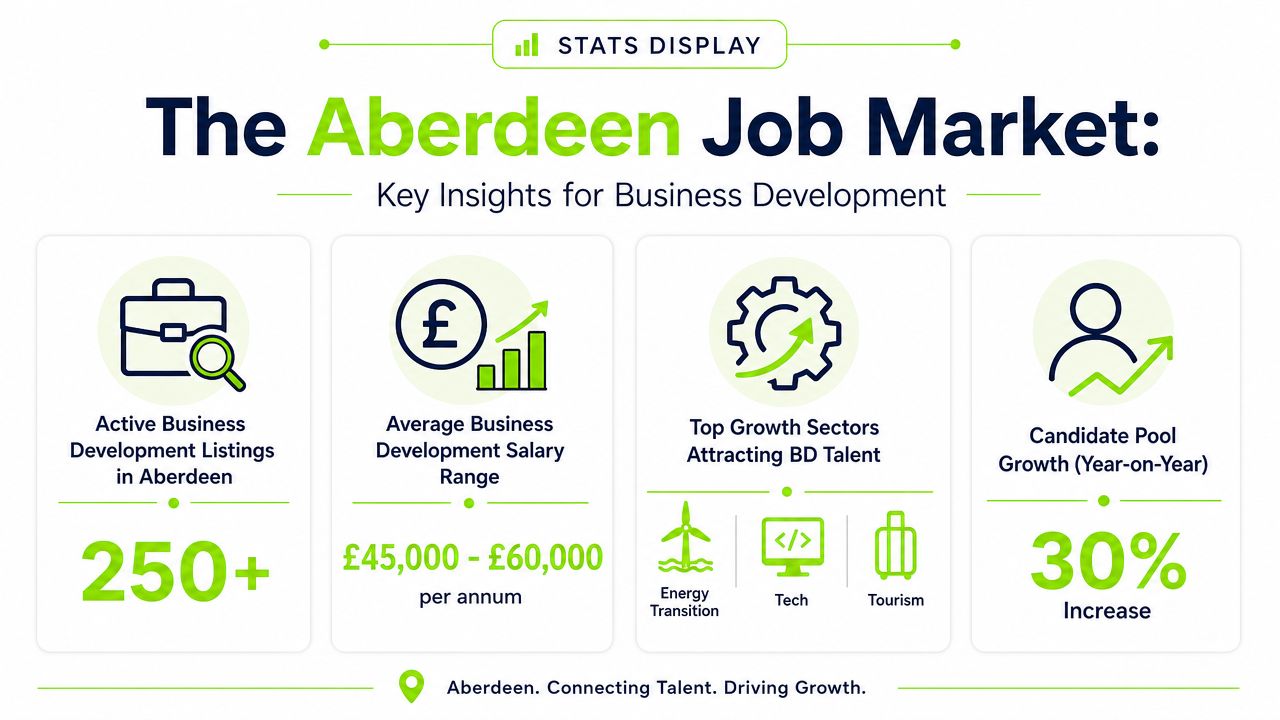
A golf club isn't competing with another golf club first. It's competing with the wider Aberdeen commercial market. That means if you write a vague advert asking for a “dynamic sales professional” with a “proven track record”, you'll either attract the wrong people or get ignored by the right ones.
Why salary isn't your main advantage
The blunt truth is that many clubs can't and shouldn't try to outpay energy or engineering firms. That's a losing game.
What a club can offer is different. It can offer a more grounded role, a recognisable local product, a better lifestyle fit, and the chance to improve something tangible in the community. That appeals to a certain kind of candidate. Usually, it's someone who's tired of chasing accounts across a broad territory and would rather build a stable commercial engine in a place they actually care about.
A club wins the hire when it sells the role honestly, not when it pretends to be a corporate sales team.
That only works if the opportunity is clear. “Sell memberships” is not a serious brief. “Own the enquiry pipeline, run structured follow-up, and convert interest into tours and joins” is.
What the local market is really telling you
Aberdeen's business development market is active, but it's also segmented. Some candidates are used to outbound prospecting, travel, and major account acquisition. Others come from hospitality, events, leisure, or membership environments where relationship handling matters more than cold outreach.
For clubs, the second group is often more valuable.
Here's the practical reading of the local market:
| Hiring reality | What it means for a golf club |
|---|---|
| Strong demand for BD talent locally | Your advert needs to be sharper than average |
| Energy and industrial employers shape expectations | You need a differentiated offer, not a copycat salary pitch |
| Candidates have options | Slow hiring and unclear briefs will cost you good people |
If you want a broader view of how commercial hiring differs across the country, GolfRep's guide to business development manager jobs in Scotland is worth reading alongside your local planning.
The opportunity clubs often miss
A golf club can still be an attractive employer in Aberdeen. But only if it stops treating the role as a classic sales job.
The candidate you want may not be chasing the highest package. They may be looking for structure, autonomy, local credibility, and less chaos. If your club offers that, say it clearly. If it doesn't, fix that before you recruit.
Because the wrong advert doesn't just waste applications. It attracts the wrong mindset from day one.
Crafting a Job Spec for Growth Not Just Sales
Many Aberdeen business development roles ask for a “hunter mentality”, focused on winning new accounts and travelling extensively. That's visible in Reed's Aberdeen Business Development Manager listing. A golf club's version of the role is different. It needs someone who can handle inbound interest properly, follow process, and convert enquiries without dropping them.

If your job description reads like an oil and gas sales post, you'll recruit the wrong profile. Clubs don't need a roaming account hunter as their first commercial hire. They need a pipeline manager with sales discipline.
Write the role around the real job
Primary job at most clubs isn't “generate demand from nothing”. It's this:
- Respond fast: Enquiries need prompt, professional replies while interest is still warm.
- Track every lead: Someone must know where each prospect sits, what they asked, and what happens next.
- Move people forward: The goal is to convert interest into calls, visits, trial experiences, and membership decisions.
- Keep follow-up consistent: Most clubs lose opportunities because nobody owns the next step.
That means your job spec should focus less on charisma and more on operating rhythm.
Practical rule: If a responsibility can't be observed or tracked, it's probably too vague for a useful job description.
Better wording for a golf club advert
Generic language attracts generic applicants. Replace it with operational language that reflects how clubs grow.
Use phrases like:
- Manage the membership and visitor enquiry pipeline using the club CRM
- Ensure all new enquiries receive a timely response and are assigned a clear next action
- Track conversion from enquiry to visit, visit to join, and join to onboarding
- Maintain accurate notes, follow-up activity, and pipeline visibility
- Work closely with management to improve lead handling, scripts, and follow-up process
- Support outbound relationship development with local businesses, societies, and event partners where appropriate
Avoid phrases like “must be a natural closer” unless you want performative salesmanship instead of reliable execution.
What good candidates look for in the advert
Strong candidates read job descriptions with one question in mind. “Will I be set up to succeed?”
If your advert doesn't answer that, they'll move on. Borrowing a few principles from DynamicsHub HR insights can help here, especially around clarity of responsibilities and reporting lines.
A club advert should answer:
Who owns the commercial target
Is this person supported by the manager, committee, or owner, or left alone with a number?What system they'll use
Is there a CRM, a lead inbox, a phone process, and a clear way to track activity?What success means
Is it memberships sold only, or does the role include response time, show-up rate, and conversion management?What type of selling is involved
Is the role mostly inbound conversion, local partnerships, event sales, or a mixture?
If you're unsure how this differs from broader golf marketing roles, GolfRep's breakdown of what a golf marketing specialist does helps clarify where marketing ends and pipeline management begins.
The best advert filters people out
A strong job spec shouldn't try to appeal to everyone.
It should put off the applicant who wants a loose brief, no admin, and freedom to “do deals” without reporting. It should attract the person who likes order, follows up properly, and knows that conversion comes from process.
That's the difference between filling a seat and building a growth role.
Where to Find Your Ideal Candidate in Aberdeen
Posting on major job boards is fine. Relying on them is lazy.
If you want a better candidate for business development jobs Aberdeen clubs are trying to fill, source locally and deliberately. Reed.co.uk shows 61 active Business Development jobs within a 10-mile radius of Aberdeen as of June 2026, which tells you the market is busy enough that good people won't stumble into your role by accident. They need a reason to notice it, and you need a plan to find them through Reed's Aberdeen business development listings.
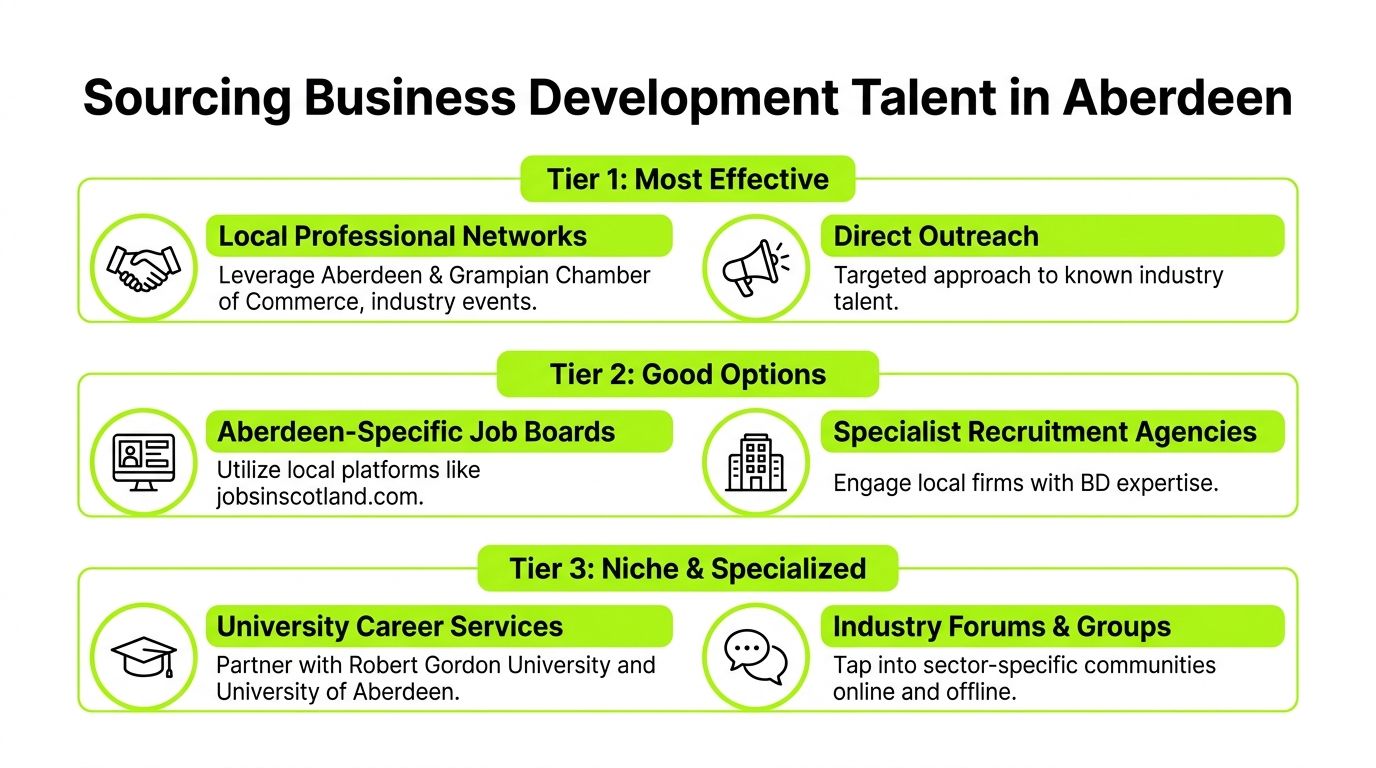
Start with the obvious local overlaps
Golf clubs often ignore adjacent talent pools that are a better fit than traditional BD candidates.
Look first at people with backgrounds in:
- Hospitality and events: They already understand bookings, relationships, and service recovery.
- Membership organisations: They're used to retention, communication, and long sales cycles.
- Leisure and tourism: They know how to convert interest into visits and repeat spend.
- Local account management roles: Some want a less aggressive environment and a more rooted role.
A club role suits people who can follow through, not just sell in.
Use networks that match the buyer journey
The best Aberdeen hires often come through trusted networks rather than mass application volume.
Consider these channels:
| Channel | Why it works |
|---|---|
| Aberdeen business networks | Good for commercially minded people who know the local market |
| Hospitality-focused recruitment routes | Better for service-led candidates with conversion discipline |
| LinkedIn search and direct outreach | Useful when you target specific profiles instead of waiting for applicants |
| University and graduate channels | Best for junior roles where you can train process from the start |
Ask one blunt question before posting anywhere: does this channel attract people who can manage a pipeline, or just people who like the word sales?
Don't just post on LinkedIn. Search on it
Most clubs use LinkedIn badly. They post a role and wait.
A better approach is to search for candidates in and around Aberdeenshire with experience in membership, events, account handling, business support, hospitality sales, front office leadership, or local partnerships. Then message them with a short note that explains the role clearly. Not fluffy. Specific.
Mention the substance of the role. Enquiry handling, club visits, relationship building, CRM discipline, and commercial ownership. That combination gets attention from candidates who may never search for “business development manager” but are a much better fit than the usual applicants.
Build a bench, not just a shortlist
If your club may hire later rather than now, start conversations anyway.
Keep names of strong candidates. Stay in touch with local colleges, universities, PGA contacts, hospitality managers, and commercial staff in nearby leisure businesses. Aberdeen clubs that treat recruitment as an ongoing relationship process do better than clubs that panic-post when a committee decides they need growth “for the season”.
The best local hires are rarely the loudest ones. They're usually the people already handling customers well somewhere else.
Interviewing for Systems Thinking Not Sales Charm
Most sales interviews are useless for a golf club.
“Sell me this pen” tells you almost nothing about whether someone can manage a live enquiry pipeline, record notes properly, chase the next step, and keep a warm prospect from disappearing for three weeks. Clubs don't need theatre. They need repeatable behaviour.
Ask for process, not personality
A good interview should reveal how a candidate thinks when work lands quickly and unpredictably. Give them real operating scenarios and listen for sequence, judgement, and ownership.
Use questions like these:
- You arrive on Monday morning and there are multiple new membership enquiries waiting. Walk me through your first hour.
- A prospect visited the club, said they were interested, and then went quiet. What happens next?
- You've spoken to someone who wants to join, but they need to discuss it with family or review finances. How do you handle that without being pushy?
- How would you keep management updated on pipeline health each week?
- If you notice many enquiries are coming in but very few are booking visits, what would you check first?
You're not looking for polished slogans. You're looking for signs that they understand handoffs, reminders, notes, prioritisation, and follow-up logic.
What strong answers usually include
A capable candidate tends to mention the mechanics of the role naturally.
Listen for references to:
- Logging every enquiry in a CRM or shared tracking system
- Prioritising new inbound leads before lower-value admin
- Setting next actions during or immediately after each contact
- Using templates or call structures without sounding robotic
- Creating follow-up cadence rather than relying on memory
- Reporting conversion bottlenecks instead of hiding them
Weak candidates often default to confidence language. “I'd get on the phone and build rapport.” Fine. Then what? If there's no method behind the energy, you'll feel it in the first month.
A charming candidate can still be disorganised. A systematic candidate can learn polish much faster than a disorganised one can learn discipline.
Use a simple interview scorecard
Committees and managers often make hiring messy by discussing “gut feel” for too long. Use a basic scoring table instead.
| Area | What to assess |
|---|---|
| Process discipline | Do they describe a clear sequence of actions? |
| Lead ownership | Do they take responsibility for next steps? |
| Communication quality | Can they speak clearly without over-talking? |
| Commercial judgement | Do they understand value, urgency, and fit? |
| Cultural fit for a club | Will they represent the club professionally and calmly? |
Score each area directly. Strong, acceptable, or weak. That stops one charismatic interview from taking over the room.
Give them a real task
The best hiring test is practical.
Ask the candidate to review a short fictional list of enquiries and explain how they'd prioritise and respond. Include different types of lead. A family membership question, a corporate enquiry, a visitor asking about trial rounds, and someone who asked for prices but hasn't replied.
Then ask:
- Which lead gets first attention and why?
- What would you send by email?
- Who gets called?
- What gets logged?
- When do you follow up again?
That exposes how they work under normal club conditions. Not how well they can perform in a rehearsed interview.
If they can't organise a basic lead queue in conversation, they won't organise your pipeline in practice.
Setting KPIs and Realistic Aberdeen Salaries
Salary conversations go wrong when clubs start with market averages and stop there.
Aberdeen has a wide spread in business development pay. Totaljobs gives an average of £42,499, some listings show £45k to £60k ranges that are shaped heavily by energy-sector bonus structures, and Glassdoor estimates can reach £102,000 to £131,000 for Business Development Manager roles, based on Glassdoor's Aberdeen salary view. That doesn't mean a golf club should benchmark itself against the top end. It means averages are noisy and often misleading.
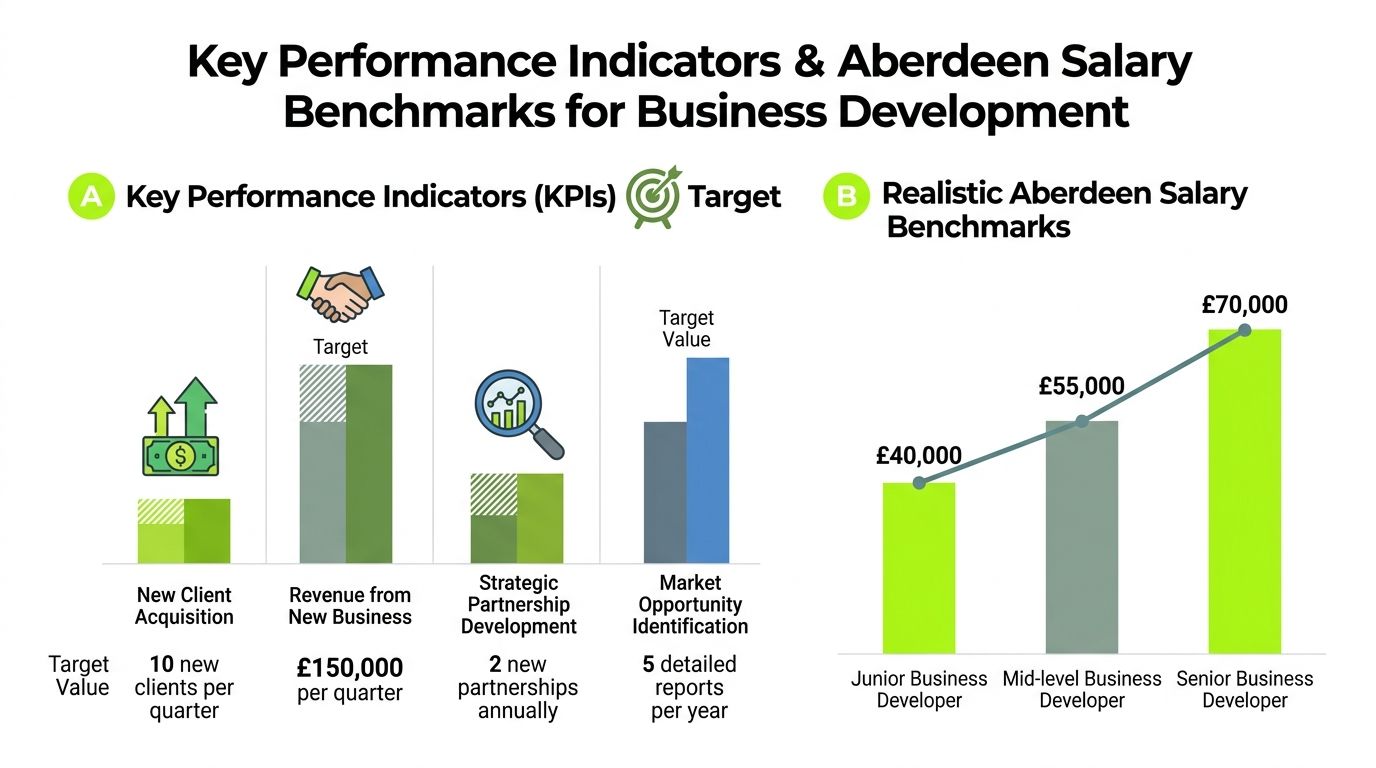
What to measure instead of just memberships sold
If you only pay attention to memberships closed, you'll miss the actual causes of weak performance.
For a golf club, the best KPIs usually sit earlier in the pipeline:
Lead response time
Fast response matters because interest fades quickly.Contact rate
Are enquiries indeed being reached and engaged?Enquiry to visit conversion
This shows whether messaging and follow-up are working.Visit to join conversion
This exposes the quality of the club tour, offer presentation, and follow-through.Pipeline hygiene
Are notes complete, stages updated, and next actions scheduled?
These measures are better because they tell you what's broken. A missed sales target only tells you the result.
If a club can't see response time, follow-up status, and conversion stage, it isn't managing performance. It's guessing.
Build a package around role reality
A sensible package for a club should use a solid base salary with clear OTE tied to behaviours and outcomes the person can influence. That's far more credible than dangling an inflated top-line number with no clear path to earning it.
A useful structure looks like this:
| Pay element | Club-friendly approach |
|---|---|
| Base salary | Stable enough to attract capable operators |
| Variable pay | Tied to conversion and revenue outcomes |
| Review points | Linked to measurable pipeline improvements |
| Non-cash value | Flexibility, club environment, and local impact |
Clubs should explain the package plainly. Candidates don't trust fuzzy bonus language, and they shouldn't.
If you want a useful external reference for shaping pay logic, the HR compensation survey guide from Synopsix is a practical read. Not because it gives a golf-specific answer, but because it helps you think clearly about market context, role scope, and internal fairness.
Don't import corporate KPIs into a club
Corporate business development targets often reward things that don't fit golf.
You don't need metrics built around account territories, long travel schedules, or abstract top-of-funnel activity quotas. A golf club should focus on what turns local commercial interest into predictable revenue. Enquiries handled properly. Visits booked. Joins completed. Onboarding finished cleanly.
That also helps with salary conversations. If the role is measured sensibly, the incentive structure becomes easier to defend to both candidates and committees.
Be honest about what the role is worth
A club can still make a compelling offer in Aberdeen, but only if it's coherent.
State the base. Explain the OTE. Show what drives the bonus. Clarify what support exists. Be upfront about reporting and systems. Candidates respect realism much more than bravado.
The package doesn't need to look like an energy-sector deal. It needs to look achievable, transparent, and properly managed.
The Alternative Systemise Your Growth Before You Hire
There's a harder truth behind most failed business development hires at golf clubs. The person wasn't the only problem. The setup was.
Clubs hire someone into a blurry role, give them patchy data, no meaningful CRM discipline, inconsistent enquiry handling, and a manager who's already overloaded. Then they expect that person to “drive growth”. That's not a role. That's a rescue mission.
Why the system matters more than the seat
A business developer can only perform inside the environment you give them.
If the club has no proper lead visibility, no automated acknowledgement, no structured follow-up sequence, and no clear reporting, the hire will spend half their time rebuilding basic operations instead of converting demand. In that situation, even a good recruit looks average.
That's why many clubs should systemise first.
Create one place for enquiries. Define response standards. Track lead stages. Set task ownership. Build follow-up rules. Make conversion visible. Then decide whether a person is needed full-time to run the engine.
Good hiring amplifies a good system. Bad systems neutralise good hiring.
A lower-risk route for many clubs
For some clubs, the smarter move is not hiring immediately. It's putting the commercial infrastructure in place first, then deciding whether internal recruitment still makes sense.
That means using a proven process for:
- Capturing enquiries properly from every channel
- Responding automatically and consistently when staff are busy
- Routing leads into a CRM with clear ownership
- Running follow-up without relying on memory
- Tracking conversion from first contact to joined member
If you want to see how structured automation changes lead handling in practice, Internal Systems' lead automation case study is a useful example of the principle. Different sector, same operational lesson. Speed, structure, and visibility beat manual chasing.
For golf clubs specifically, this becomes even more powerful when paired with workflow design and CRM discipline. That's exactly why topics like golf club automation matter before recruitment, not after.
A hire should sit on top of a system, not compensate for the absence of one. If you get that order right, your next commercial recruit has a real chance of succeeding. If you get it wrong, you're paying someone to absorb avoidable chaos.
If your club wants predictable membership growth without guessing, GolfRep helps build the systems behind it. That includes lead generation, CRM structure, follow-up automation, and conversion tracking, so enquiries don't get lost and your pipeline doesn't rely on manual chasing.
Ready to tap into our proven growth system?