Solving Why Golf Club Leads Don’t Convert
The usual advice is to get more leads. Run more adverts. Refresh the website. Offer another promotion. For many golf clubs, that advice misses the core issue.
Most clubs are not suffering from a complete lack of interest. They are suffering from conversion failure after the enquiry arrives. A prospect fills in a form, sends an email, or calls the club. Then the process slows down, fragments, or stops altogether.
This highlights why golf club leads don’t convert. The problem usually sits between enquiry and membership, not at the very top of the funnel.
The Core Problem is Not Generating Leads
A club can generate enquiries and still feel like marketing is not working. That happens when the team measures success by lead volume rather than signed memberships.
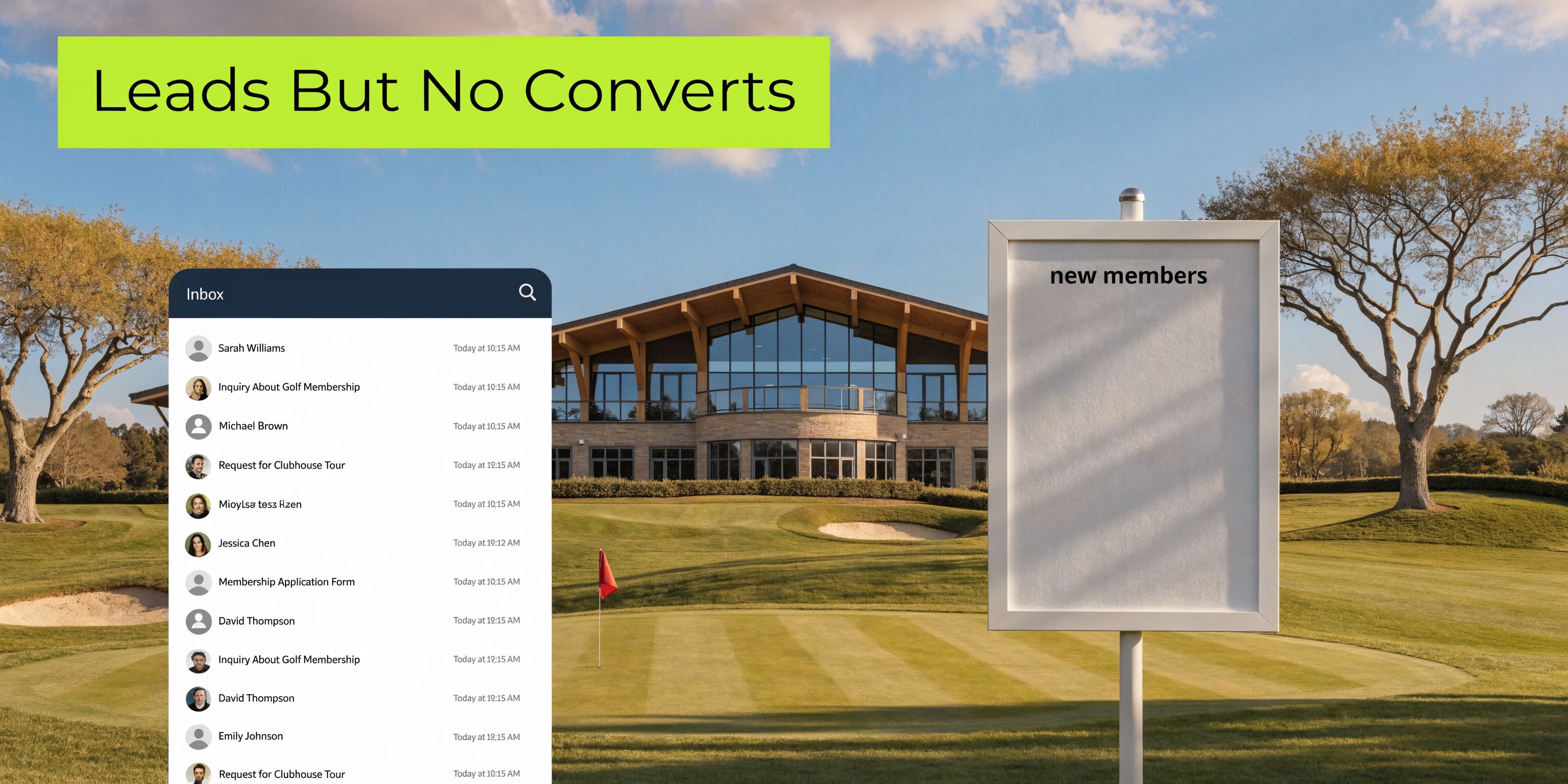
In practice, many clubs already have enough interest coming in to grow. The issue is what happens next. Enquiries arrive through the website, paid campaigns, social media, open days, referrals, and phone calls. Then they land in a shared inbox, on a manager’s desk, or in someone’s memory.
That is where performance starts leaking.
According to industry analysis of golf club sales process failures, UK golf clubs typically convert only around 50% of their membership leads without a structured sales process. The same analysis notes that timely nurturing, qualification, and personalised outreach can more than double effective conversion rates.
Why more leads often make the problem worse
When a club with weak follow-up buys more traffic, it increases workload faster than it increases membership.
A few things then happen at once:
- Inbox pressure rises: More enquiries mean more chances for delays, missed replies, and inconsistent handling.
- Low-priority leads crowd out high-intent prospects: Staff spend time on everyone, instead of identifying who is most likely to join.
- Visibility gets worse: Nobody can see which leads are waiting, which are booked, and which have gone cold.
The result looks like a marketing problem, but it is an operations problem.
A leaky funnel does not need more water first. It needs the holes fixed.
Clubs that improve conversion tend to do something simple. They stop treating the enquiry as the finish line for marketing and start treating it as the start of a managed process.
Mapping Your Club's Conversion Funnel
Before fixing conversion, a club needs a clear view of the journey a prospect takes. Many teams know the steps loosely. Fewer have them defined in a way that can be tracked.
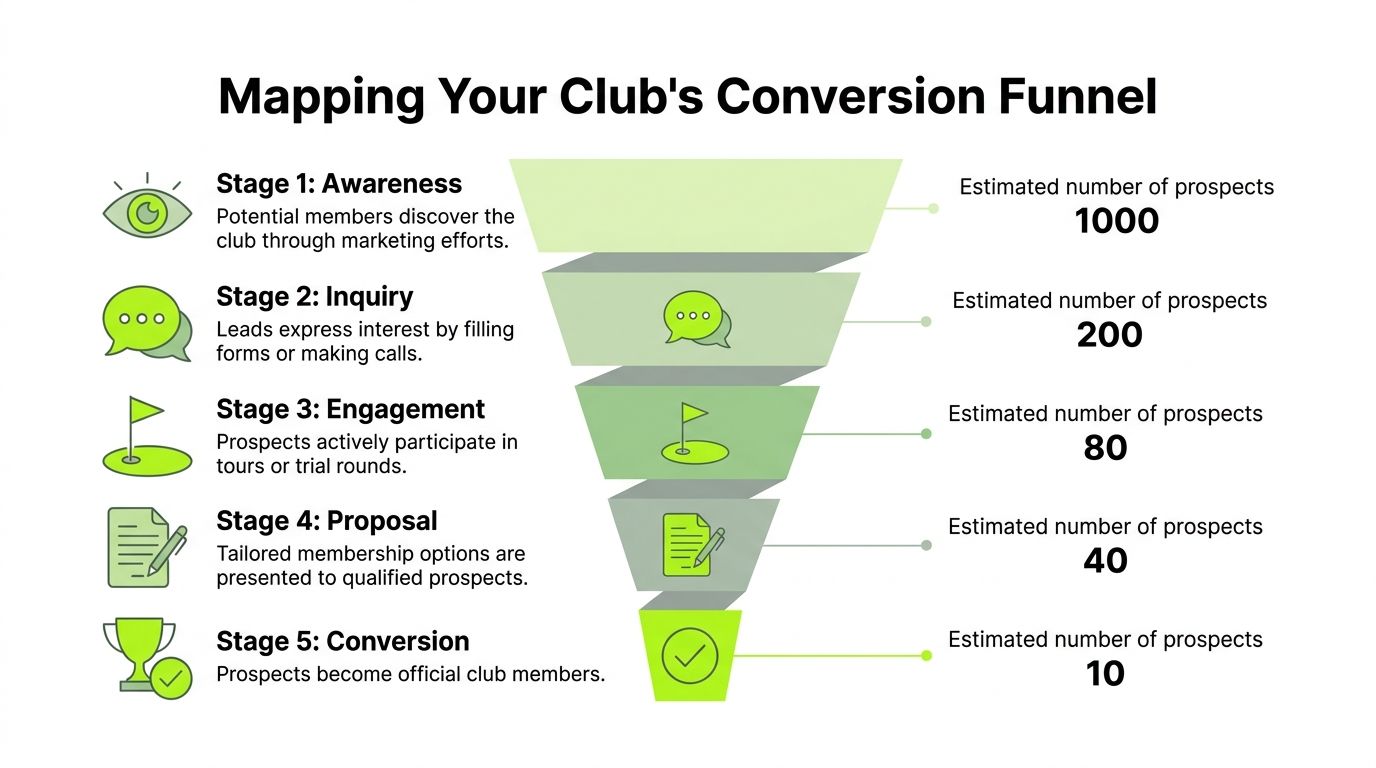
A practical golf club funnel is not complicated. It has five stages.
The five stages that matter
| Stage | What it means in a golf club context | Typical risk |
|---|---|---|
| Enquiry | Someone fills in a form, calls, emails, or asks for membership information | The lead is missed or logged poorly |
| Qualification | The club works out fit, intent, timing, and likely membership type | Time is wasted on casual interest |
| Engagement | The lead receives useful follow-up and stays in contact with the club | Interest fades after the first reply |
| Visit | The prospect books a tour, trial, or meeting | Booking becomes awkward or slow |
| Decision | The club presents the right next step and handles objections | The lead hesitates and disappears |
Each stage has a different job. Many clubs blur them together.
For example, a website form submission is not the same as a qualified prospect. A tour request is not the same as a person ready to sign. A warm conversation is not the same as a confirmed membership decision. When these stages are mixed, reporting becomes unreliable and staff often assume more progress has been made than is the case.
What a mapped funnel gives you
Once the funnel is visible, the club can ask much better questions.
- Are enquiries being logged in one place or scattered across inboxes and notebooks?
- Do staff know how to distinguish curiosity from buying intent?
- Is every lead receiving the same follow-up, regardless of age, budget, or membership interest?
- Can a prospect book the next step immediately, or do they have to wait for someone to call them back?
These questions matter because lead conversion problems are seldom random. They are often tied to one broken stage.
If you cannot name your funnel stages clearly, you usually cannot see where prospects are being lost.
A mapped funnel also helps committee-led clubs. It removes guesswork. Instead of discussing whether marketing is “good” or “bad”, the club can look at where the handover breaks and fix that point directly.
Diagnosis One Poor Lead Quality and Capture
A weak conversion rate starts before the first reply is ever sent. The club is collecting names, but not always collecting the right names in the right way.
According to Infinity’s analysis of why the best leads do not convert, many club funnels contain 70-80% unqualified leads because campaigns are optimised for form fills rather than genuine buying readiness. The same analysis notes that clubs fail to track high-intent touchpoints like phone calls, even though those conversations are critical in golf membership acquisition.
Volume can hide weak intent
A campaign can look productive on paper and still underperform in reality.
That happens when success is measured by:
- Form submissions rather than conversations
- Clicks rather than qualified interest
- Cost per lead rather than likelihood to join
A person who wants a quick price list is different from a person asking about joining with their partner, moving clubs, or booking a visit. If both sit in the same spreadsheet with the same label, the team cannot prioritise properly.
This is one reason clubs say they have “plenty of leads” but very few become members. They are counting activity, not intent.
Capture problems lower quality further
Even strong interest can be weakened by poor capture.
Common examples include:
- Forms that ask too much too early: Long forms often attract low-effort completions or put off serious prospects who are short on time.
- No clear next step: If the form says “submit” but gives no expectation of what happens after, confidence drops.
- Mobile friction: Many prospects enquire on their phone. If the page is clumsy, the club loses them before sales even begins.
- No call tracking: A club may think a campaign failed when, in fact, the best prospects rang directly and nobody logged it.
The top of the funnel needs filtering, not just filling.
That is why many clubs are now moving toward faster pre-qualification rather than handing every enquiry to a busy manager. A useful example is the approach covered in this guide to AI lead qualification for golf clubs, where the goal is to identify intent early and route the right people into the right follow-up path.
What better capture looks like
Better capture is simpler, not more complicated.
Ask for enough information to understand likely fit. Make the next step obvious. Give prospects a reason to enquire. Most of all, treat phone calls as part of the funnel, not as something separate from “digital”.
If the club feeds weak or invisible leads into the pipeline, everything downstream becomes harder.
Diagnosis Two The Critical Failure of Follow-Up
This is the most expensive mistake in the whole process. A lead arrives at the exact moment a golfer is curious enough to act. If the club waits too long, that intent weakens.

According to Golftec’s write-up on delayed follow-up in golf, UK golf clubs experience 28% lead drop-off within 24 hours due to delayed follow-up. The same source states that clubs with manual processes average 47 hours to respond, while clubs converting effectively respond in under 12 hours, using automated nurture systems.
Manual follow-up breaks under normal club conditions
Most clubs do not ignore leads on purpose. They just rely on systems that were never designed for speed.
A typical pattern looks like this:
- An enquiry comes in during the evening.
- The email sits unread until the next day.
- The manager is in meetings, on the course, or handling member issues.
- A reply is sent later, often generic and without a clear next step.
By then, the prospect may already have heard back from another club.
This is why manual follow-up creates such a large gap between interest and action. The problem is not effort. It is dependence on human availability.
Speed does more than acknowledge
Fast response is not only about politeness. It changes the quality of the conversation.
A quick, relevant follow-up does three things:
- Confirms the club is organised
- Keeps the prospect in buying mode
- Creates momentum toward a visit or call
A slow response does the opposite. It tells the lead that joining may also be slow, unclear, or difficult.
Prospects judge the membership experience before they visit. They do it through your response speed.
Here, simple systems outperform good intentions. An automated first response can acknowledge the enquiry immediately, gather useful qualification details, and point the lead toward the next action while staff are still busy elsewhere.
For clubs reviewing their current process, this guide on a golf club follow-up system is a useful model because it treats response handling as infrastructure rather than admin.
What does not work
Some approaches feel reasonable but usually fail in practice:
| Approach | Why it fails |
|---|---|
| One shared inbox | No ownership, no urgency, no visibility |
| Replying when time allows | High-intent windows close quickly |
| A single generic email | It answers little and advances nothing |
| Depending on one staff member | Holidays, meetings, and busy days create gaps |
The club that responds first does not always win. But the club that responds late puts itself at a serious disadvantage before the sales conversation has even begun.
Diagnosis Three Inconsistent Nurturing and Booking Friction
The next failure point usually happens after the enquiry is logged and the first reply goes out. Marketing did its job. The club still loses the lead because the middle of the process has no structure.
That middle matters more than many clubs admit.
A membership enquiry rarely turns into a visit after one exchange. Prospects pause. They compare options. They ask a partner. They want to know how often they will play, whether the club suits them, and what joining will feel like. If the club goes quiet, interest cools and uncertainty fills the gap.
Most prospects are not saying no
They are delaying a decision.
Clubs often misread that delay. A prospect does not book in the first few days, so the enquiry gets marked as cold or sits untouched until someone has time to revisit it. That is not lead management. That is passive admin.
A working nurture process gives the prospect steady progress toward a decision. It usually includes:
- Clear information on membership routes, access, pricing, and next steps
- Context on club atmosphere, playing experience, and who the membership is right for
- A reason to respond such as booking a tour, arranging a call, or asking one simple qualifying question
The standard is straightforward. Each touch should answer a real question or remove a real concern. Clubs that want to tighten that process can borrow from these lead nurturing best practices, particularly around sequencing messages so prospects do not depend on one-off replies.
Good nurturing reduces uncertainty. Weak nurturing leaves the prospect to do the club's work for it.
Booking friction kills intent
Many clubs lose warm prospects at the exact moment the person is ready to take the next step.
The lead wants to visit, but the process is clumsy. They have to call during office hours. Tour availability is unclear. A staff member needs to check with someone else. The booking takes three emails. Nobody explains what the visit includes, who they will meet, or how long it will take.
Each bit of friction feels small inside the club. To the prospect, it signals hassle.
That matters because booking a visit is not an admin task. It is a conversion event. If arranging it feels slow or uncertain, the prospect starts to question what joining will be like too.
Consistency beats individual effort
Many clubs have one person who handles enquiries well. They remember to follow up, answer questions properly, and keep things moving.
That is useful, but it is not a system.
Once results depend on one membership manager, one assistant in the office, or one salesperson who happens to be organised, conversion becomes fragile. Busy weekends, annual leave, events, and handover gaps break continuity. Prospects feel that inconsistency immediately.
A stronger setup gives every lead the same path. After the first response, there should be a defined sequence of follow-ups, a clear booking method, visible ownership, and a trigger for what happens if the prospect does not respond. Clubs do not need more enthusiasm here. They need fewer loose ends.
The pattern is consistent across underperforming clubs. Leads are generated. Initial interest exists. Then the process asks the prospect to chase, wait, or guess. That is where conversion drops.
The Systemic Fix A Predictable Conversion Engine
Most conversion problems look separate on the surface. Poor visibility. Slow replies. Missed calls. Weak nurturing. Trust issues. In reality, they come from the same root cause. The club does not have one connected system.
A connected system starts by centralising enquiries. Every form, call, email, and campaign response should enter one place. Once that happens, the club can see what is waiting, what has been qualified, who has booked, and who needs another touch.
That visibility matters because trust breaks before a prospect even reaches the visit stage. A 2025 UK Leisure Report summary on golf lead trust hesitation found that golf clubs lose 35% of qualified leads to “trust hesitation” amplified by a weak online presence. Stronger brand authority and thorough follow-up help reduce that pre-sales doubt.
What the engine needs
A predictable conversion engine has four working parts.
Central capture
Every enquiry source feeds into a single CRM. Not some leads. All leads.
That includes phone calls, because high-intent conversations often happen there first.
Immediate first action
The first response happens automatically, not when someone notices an email.
This first touch should acknowledge the enquiry, set expectations, gather useful detail, and move the lead toward a call or visit if they are ready.
Structured nurture
Leads should not depend on ad-hoc reminders. They need a planned sequence.
That sequence can include confirmation messages, relevant club information, visit prompts, and follow-up after a missed booking or unanswered email.
Sales visibility
Managers need to see pipeline status without chasing staff for updates.
A simple dashboard should answer practical questions fast:
| Question | Why it matters |
|---|---|
| How many enquiries came in this week? | Shows demand level |
| How many have been contacted? | Reveals operational discipline |
| How many are qualified? | Separates interest from intent |
| How many visits are booked? | Indicates sales momentum |
| Where are leads stalling? | Shows which part of the system needs attention |
Systems beat effort
The clubs that convert well are not always the clubs with the biggest budget. They are frequently the clubs with the clearest handover from marketing to sales process.
That is the practical shift. Stop asking only how to generate enquiries. Start building a system that handles enquiries properly from the moment they arrive.
Your Action Checklist and Simple A/B Tests
A club does not need a full rebuild to start improving conversion. It needs an honest audit and a few controlled tests.
Start with this checklist
- Time your response properly: Submit your own membership enquiry outside office hours and see when the first useful reply arrives.
- Check where leads are stored: If enquiries sit across email inboxes, handwritten notes, and missed calls, visibility is already weak.
- Review your form experience on mobile: Complete it on a phone. If it feels awkward, prospects will feel that too.
- Map your actual follow-up: Write down every message a prospect receives in the first days after enquiring. Many clubs discover there is no real sequence at all.
- Test the booking step: Try to arrange a tour as if you were a prospect. Count the friction points, not just whether it is technically possible.
- Look at trust signals: Search your club as a prospect would. Check reviews, search results, and whether the membership journey feels credible before contact.
Run a few simple A/B tests
Do not test everything at once. Change one variable and watch what happens.
Initial email subject line
Compare a generic subject with one that refers clearly to membership enquiry next steps.SMS versus email prompt
Test whether a short message prompting a visit gets better engagement than another email.Booking link versus call-back request
Give one group a direct route to book and another group a request form. See which creates more visits.Short form versus longer form
Reduce fields on one version and compare lead quality qualitatively, not just volume.
If you cannot measure the step, you cannot improve the step.
The goal is not endless experimentation. It is to identify which part of the conversion path is slowing the club down and remove that bottleneck first.
From Leaky Bucket to Predictable Pipeline
Golf clubs do not lose leads because nobody is interested. They lose leads because interest is handled inconsistently after it appears.
That is why golf club leads don’t convert. The breakdown happens in qualification, response speed, nurturing, booking, and trust. Each one is fixable.
A club that builds a clear system gains control. Fewer leads are missed. More visits are booked. Membership growth becomes easier to forecast. The change is practical, not theoretical. Stop relying on manual effort alone, and the pipeline becomes far more predictable.
GolfRep helps UK golf clubs build that kind of predictable pipeline with CRM-led follow-up, automated nurture, and structured conversion systems designed for membership growth. If your club is generating enquiries but not turning enough of them into visits and members, learn more at GolfRep.
Ready to tap into our proven growth system?