Increase Golf Club Revenue: Proven 2026 Strategies
Most advice on how to increase golf club revenue starts in the wrong place. It tells clubs to buy more ads, post more on social media, run more open days, and chase more enquiries.
That isn't usually the actual problem.
At many clubs, the bigger issue sits in the middle. An enquiry comes in through the website. Another arrives by Facebook message. A prospect leaves a voicemail asking about membership. Someone asks about lessons, guest packages, or society bookings. Then the day gets busy. The team is dealing with members, visitors, staffing, tee sheets, and clubhouse issues. By the time anyone replies, the prospect has moved on.
The club assumes it needs more leads. In reality, it needs a system.
Your Golf Club Is Leaking Revenue Not Leads
Most clubs already have demand coming in. What they lack is lead visibility and a reliable process for handling that demand properly.
A membership enquiry isn't valuable because it exists. It's valuable if someone sees it quickly, qualifies it, follows up, and moves it towards a visit or a joining decision. If that process depends on one busy manager checking a shared inbox between other jobs, revenue gets lost in plain sight.
That's why the clubs that grow predictably don't just ask, "How do we get more enquiries?" They ask better questions:
- Where does every enquiry land
- Who owns the next action
- How quickly does the prospect hear back
- Can anyone on the team see the current status
- Do we know which enquiries convert and which go cold
Those are operational questions, not marketing ones.
The hidden problem is response time
A lot of clubs still run enquiry handling through memory, inbox folders, paper notes, or ad hoc handovers. That approach works until volume increases or one member of staff is off site, on annual leave, or overloaded.
Practical rule: If your club can't see every live enquiry in one place, you're not managing a pipeline. You're relying on luck.
That matters even more when committees ask why growth feels inconsistent. The answer is often simple. The club has no structured process between first contact and signed membership form.
A proper sales pipeline doesn't need to feel corporate. It just needs to be visible, owned, and followed. If you want a clearer picture of what that looks like in practice, this guide to a golf club sales pipeline is a useful starting point.
Revenue leaks rarely look dramatic
They look ordinary.
A website form gets answered tomorrow instead of now.
A Facebook lead isn't copied into the membership list.
A visitor who asked about flexible membership gets a generic reply.
A promising prospect says they'll "think about it" and nobody follows up again.
None of that feels like a crisis in the moment. Over time, it becomes one. Clubs then try to solve the shortfall with more promotion, when the core fix is to stop losing the opportunities they already have.
Shift Focus from Generating Enquiries to Converting Them
Buying more attention won't fix a weak conversion process. It only feeds a broken one faster.
That matters because external conditions can hit clubs hard. UK golf clubs faced exceptional pressure in 2024, with the third wettest summer on record and 20% fewer rounds played compared to 2023, according to Golfshake's reporting on golf club revenue pressure. When footfall drops, clubs need a digital pipeline that keeps conversations moving even when the course is quiet.
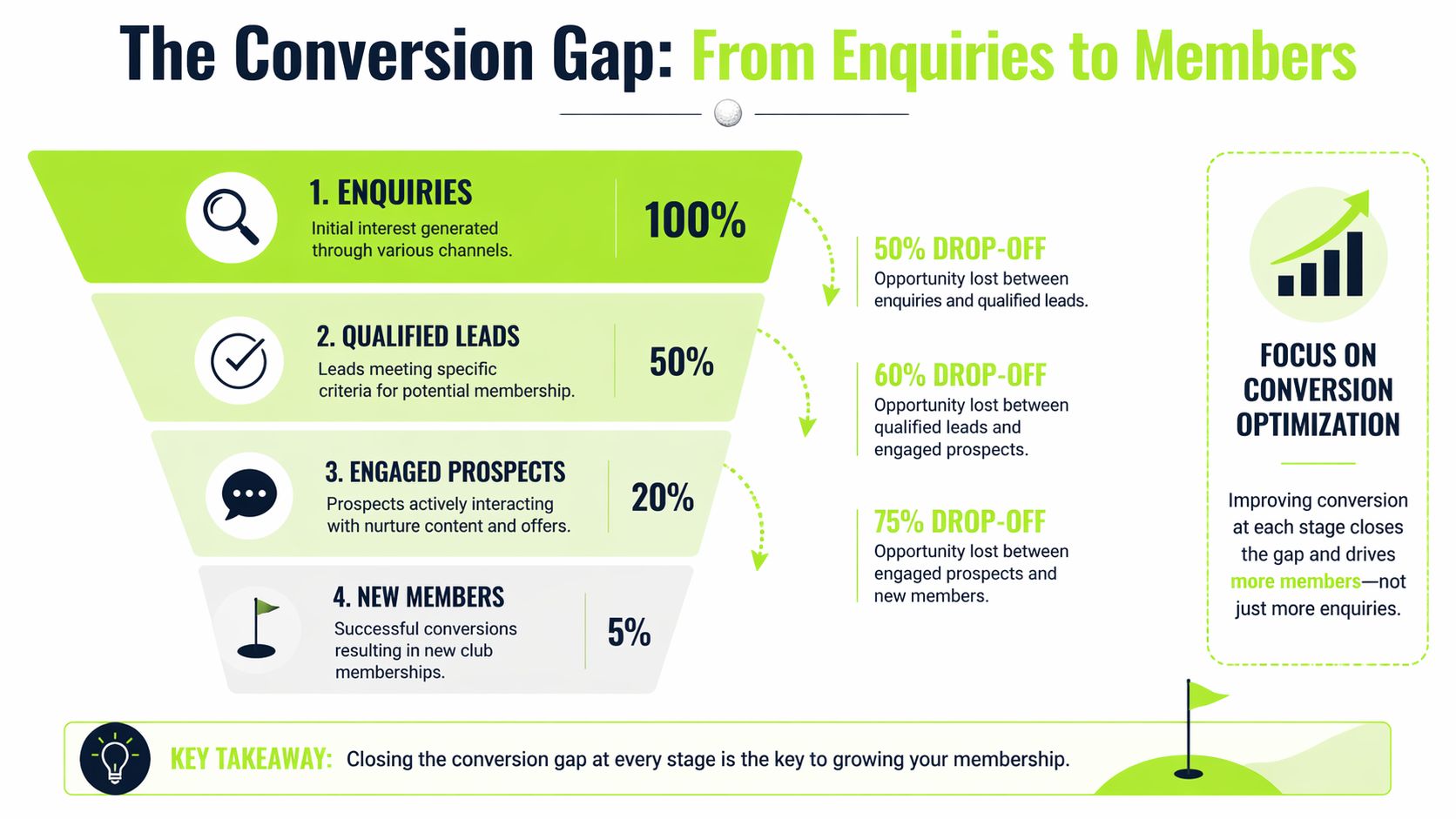
The common reaction is to push harder on lead generation or to discount. Both can create activity. Neither guarantees profitable growth.
More enquiries can make weak clubs perform worse
If ten enquiries arrive and the club mishandles half of them, doubling the enquiry volume doesn't solve the underlying issue. It just creates more missed follow-up, more patchy communication, and more uncertainty about what's working.
That's why enquiry conversion is a management discipline.
A club needs to know:
| Stage | What should happen |
|---|---|
| New enquiry | Captured instantly in one system |
| Initial response | Sent immediately, even outside office hours |
| Qualification | Membership type, timing, budget, playing habits, objections |
| Follow-up | Assigned to a person with clear next action |
| Outcome | Visit booked, nurture started, or lead closed with reason |
Without that structure, staff stay reactive. They answer the loudest message first, not the most valuable opportunity.
Weather pressure exposes weak systems
Poor weather doesn't just reduce rounds. It exposes clubs that rely too heavily on walk-ins, casual traffic, and manual follow-up.
The better response isn't to chip away at price. It's to build a system that keeps qualified prospects moving through the pipeline when they aren't physically at the club. The same Golfshake reporting notes that clubs can increase revenue by up to 50% via targeted digital nurtures, rather than relying on discounting during off-peak periods. The important lesson isn't the headline figure on its own. It's the mechanism. Clubs need ongoing communication that keeps interest alive until the timing is right.
A prospect who enquires today may not be ready to join today. That doesn't make them a poor lead. It means the club needs a better follow-up process.
Audit the middle of your funnel
Most clubs know roughly how many enquiries they receive. Far fewer know what happens next.
Ask your team these questions:
- Can we see every enquiry from website, Meta ads, email, phone, and walk-ins in one place
- Do we respond immediately, or when someone gets time
- Do we have a consistent qualification process
- Can we tell which source produces members, not just leads
- Do prospects hear from us again if they don't reply first time
If the answer to several of those is no, the priority isn't more top-of-funnel activity. It's fixing conversion.
Clubs that increase golf club revenue consistently usually don't win because they market louder. They win because they respond faster, follow up properly, and stop letting promising prospects disappear between departments.
Build a 24/7 Automated Lead Conversion System
A club doesn't need a complicated tech stack. It needs a system that captures every enquiry, organises it, and triggers the next action automatically.
That system should work whether the enquiry arrives at 11am on a Tuesday or late in the evening when nobody is at a desk. If the first response depends on office hours, the club is already behind.

Start with one source of truth
The first fix is simple. Every enquiry source should feed into one CRM.
That includes:
- Website forms for membership, society days, visitors, lessons, and events
- Meta lead forms from Facebook and Instagram campaigns
- Phone enquiries logged by staff instead of written on scraps of paper
- Email enquiries that create a contact record automatically
- Walk-in conversations entered into the same system before they're forgotten
A CRM is not just a database. For a golf club, it's the operating system for revenue follow-up. It shows who enquired, what they wanted, when they last heard from the club, and what should happen next.
If your current process still depends on inboxes and memory, it's worth reviewing how golf club automation changes the day-to-day workload.
Respond in seconds, not when someone is free
The first automated action should be immediate acknowledgement.
That doesn't need to sound robotic. It just needs to confirm receipt, set expectations, and keep the lead warm. For example:
Thanks for your enquiry. We've received your membership interest and will be in touch shortly. In the meantime, you can reply with the membership type you're considering, your ideal start date, and any questions you'd like answered before a visit.
That message does three jobs at once. It reassures the prospect, starts qualification, and buys the team time without leaving silence.
The next action depends on lead type. A membership prospect might get an email plus SMS. A society enquiry might get a customized booking response. A lesson lead might be routed to the professional team. The important point is that the club isn't starting from zero every time.
Use automation for routing and qualification
Not all enquiries deserve the same treatment.
A useful CRM workflow can tag and route leads based on the information provided. Someone asking about flexible membership can enter one nurture path. A family membership enquiry can enter another. A visitor asking about trial rounds can be treated differently again.
A strong qualification workflow usually covers:
Intent
Are they asking casually, comparing clubs, or looking to join soon?Fit
Do they live locally, want the right membership category, and match the club's target profile?Urgency
Is this a current decision or something they may revisit later in the season?Next best action
Should the club offer a call, a tour, a hosted round, or a nurture sequence first?
A lot of clubs still rely on staff judgement alone. Staff judgement matters. But systems make that judgement visible and repeatable.
Make the pipeline visible to the whole team
One of the biggest improvements a club can make is shared visibility.
If a general manager, membership lead, and office team all work from separate notes, handovers break down. A CRM should show clear stages such as new enquiry, contacted, qualified, visit booked, follow-up due, and joined. That gives the club a live picture of revenue opportunities instead of a vague sense that "we've had a few good leads this month".
A basic pipeline view should answer:
| Question | What the system should show |
|---|---|
| What came in today | New contacts by source and enquiry type |
| Who needs a reply | Outstanding tasks and overdue follow-up |
| What's progressing | Prospects with booked visits or active conversations |
| What's stuck | Leads with no recent activity |
| What's converted | Memberships and other booked revenue tied back to source |
Automation should reduce admin, not remove human contact
Automation presents a point of hesitation for some clubs. They worry automation will feel impersonal.
Poor automation does. Good automation doesn't.
The system handles speed, routing, reminders, and consistency. Staff still handle conversations, visits, and judgement. The result is a better member experience because no prospect gets ignored while the team is busy with operations.
The best automated conversion systems don't replace people. They protect people from avoidable admin and make sure the club responds professionally every time.
Deploy Nurture Sequences That Convert Without Discounts
Most prospects don't join on the first reply. That's normal.
What matters is what happens after the initial enquiry. At many clubs, momentum often disappears at this stage. Someone asks about membership, receives a brochure, and then hears nothing unless they chase again. The club assumes they weren't serious. More often, they just weren't ready yet.

A nurture sequence fixes that gap. It keeps the conversation moving without forcing staff to remember every follow-up manually.
What a strong nurture flow looks like
Think about two clubs handling the same membership enquiry.
Club one replies with a PDF price list and waits.
Club two sends an immediate response, follows up with a short introduction to the club, answers common membership questions over the next several days, invites the prospect to visit, and reminds them that the club can help them choose the right membership route rather than pushing a generic package.
The second club hasn't discounted anything. It has stayed present.
A practical nurture flow might include:
- Day one with confirmation, brief welcome, and a simple call to reply with questions
- Day two or three with membership options explained in plain English
- Later touchpoint focused on the club experience, not just the price
- Visit invitation with clear booking options
- Follow-up after no response that feels helpful rather than pushy
- Longer-term check-in for people who showed intent but didn't move immediately
Sell clarity, not urgency theatre
A lot of follow-up fails because it tries to force a decision too early.
Prospects usually want reassurance on practical points. Can they play at the times they want? Is the membership structure right for their stage of life? Will they feel comfortable at the club? How does the joining process work? If the club answers those questions well, conversion improves without needing to chip away at price.
The best nurture sequences don't chase blindly. They remove uncertainty one step at a time.
That applies to lessons, visitor conversion, society business, and event bookings too. Customers don't need more hype; they need the next piece of relevant information.
An example journey that works
Consider a golfer who enquires online after seeing an ad for membership.
They receive an instant message confirming the club has their enquiry. The next morning, they get a short email from the membership team that explains the most relevant category based on their interest. A couple of days later, they receive a message inviting them to visit the club and ask questions in person. They don't respond immediately. No problem. The CRM triggers another follow-up with a member-focused message about weekday access, competitions, and social side of the club. A week later, they click through and book a visit.
That journey feels organised because it is organised.
Now compare it with the usual alternative:
| Weak follow-up | Structured nurture |
|---|---|
| Generic reply | Tailored response by enquiry type |
| Manual chasing | Automated reminders and sequenced contact |
| Long gaps between messages | Consistent timing |
| Discount offered early | Value communicated first |
| No record of engagement | Every open, click, reply, and task tracked |
Use SMS and email together
Email works well for detail. SMS works well for prompts, confirmations, and visit reminders.
For clubs, the combination is useful because it mirrors how people respond. Some prospects will read a longer message later in the evening. Others will act when a short text lands at the right moment. The CRM should log both so staff can see the full conversation history.
That creates continuity. If a prospect replies after several days, the team can pick up naturally instead of starting again from scratch.
Discounting is usually a symptom
When clubs don't trust their follow-up, they often lean on price cuts to create movement.
That's risky. Discounts may get attention, but they can weaken positioning and attract enquiries that don't fit the club well. A disciplined nurture system does the opposite. It protects value by improving communication, timing, and consistency.
A prospect who joins because they understand the club is a stronger long-term member than a prospect who joined because the club panicked.
Grow Lifetime Value with Upsell and Retention Programmes
New member growth matters, but it isn't the whole revenue picture. Clubs that increase golf club revenue well usually do two things at once. They convert more enquiries, and they raise value from the members and visitors they already have.
Many clubs leave money on the table. The membership database exists. The till data exists. The booking data exists. But none of it gets used in a coordinated way to drive pro shop sales, food and beverage, lessons, guest rounds, or repeat clubhouse use.

Focus on the members who already drive value
A useful principle here is the Pareto pattern. 80% of a club's revenue often comes from 20% of its customers, as outlined in Golfmanager's guide to golf club revenue strategy. That doesn't mean other members don't matter. It means clubs should know who their most valuable members are and stop treating every contact the same.
When member activity is tracked inside a CRM, the club can identify people who regularly spend across multiple categories, then build retention and upsell around that behaviour.
Examples include:
- Frequent players who may respond well to guest round offers
- Regular clubhouse users who can be invited to themed dining or events
- Lesson buyers who may want bundled coaching and fitting
- High-spend members who should receive better-timed pro shop outreach
Retention improves when data connects departments
The clubs that do this well don't run each revenue stream in isolation.
The office knows who renewed late last year. The pro shop knows who buys regularly. The food and beverage team can see who hasn't visited the clubhouse in months. The professional team knows which players are active in coaching. If those signals sit in separate places, nobody can act on them properly.
A connected approach is more useful:
| Revenue area | What member data can trigger |
|---|---|
| Food and beverage | Re-engagement offers for members with low clubhouse usage |
| Pro shop | Personalised product suggestions based on previous purchases |
| Lessons | Follow-up offers after taster sessions or lapsed coaching |
| Guest rounds | Invitations linked to playing frequency and social activity |
| Events | Targeted invitations based on household or member interests |
Loyalty should reward behaviour you want repeated
A loyalty programme doesn't need to be complicated to work. It does need to be tied to behaviour that increases value.
The same Golfmanager guidance notes that clubs can use points redeemable for rounds, merchandise, or food and beverage, while identifying VIPs for targeted upselling during bookings. That's a practical model because it connects reward directly to spend and engagement rather than handing out blanket incentives.
A loyalty scheme should make good members feel recognised, not give away margin randomly.
That same principle works for visitors too. A well-run visitor follow-up can encourage a return round, a clubhouse spend, or a membership conversation if the fit is right. Many clubs separate visitor revenue and membership growth when they should be linked.
Increase value without making the club feel transactional
Some committee-led clubs resist retention systems because they worry it will make the club feel too commercial.
Handled badly, it can. Handled well, it does the opposite. It creates relevance.
A member who gets an invitation to something they care about is more likely to engage than one who receives the same monthly email as everyone else. A visitor who receives a thoughtful follow-up about another round and a meal package is more likely to remember the club positively than one who hears nothing again.
The club stays personal by using better information, not by doing everything manually.
For a deeper look at how clubs can structure this, see this guide to a golf club upsell strategy.
Optimise Yield with Dynamic Pricing and Clear KPIs
Revenue growth isn't just about more members and better follow-up. It also depends on how the club prices inventory and measures performance.
Many clubs still run pricing by habit. The Saturday morning rate sits where it's always sat. Off-peak pricing gets lowered when bookings feel soft. Decisions happen by instinct, often without a clear view of what each round is worth.
That's where dynamic pricing and better KPIs become useful.
Price for demand, not guesswork
A structured dynamic pricing approach starts with booking behaviour. Historical data shows which slots fill early, which require support, and where the club is underpricing strong demand.
According to Golfmanager's dynamic pricing benchmarks for golf clubs, UK clubs adopting dynamic pricing have achieved a 20-25% uplift in Average Revenue Per Round, with examples showing peak-time ARPR rising from £35 to £44 without volume loss. The same guidance recommends maintaining ARPR at 60%+ of rack rate to protect profitability.
Those numbers matter because they shift the conversation. The question is no longer "Should we discount to fill times?" It's "Are we pricing this inventory in line with real demand?"
A practical dynamic pricing method
This works best when the club follows a simple operating process rather than changing prices randomly.
A sensible sequence looks like this:
Review historical booking patterns
Identify times that fill quickly and times that stay exposed.Set pricing rules in advance
Strong-demand slots can increase automatically as remaining availability tightens.Monitor local market positioning
Competitor pricing matters, but it shouldn't dictate every decision.Review monthly
Look at actual booking response and refine pricing by segment.
The same Golfmanager guidance describes a methodology where clubs analyse historical booking data, raise remaining tee times by 15% during high demand, and then refine decisions through monthly review and A/B testing. That is much more disciplined than broad, last-minute discounting.
Watch the metrics that actually change decisions
Too many clubs measure activity and call it performance. They look at enquiry volume, website traffic, or social engagement but can't link those numbers to revenue.
For commercial decisions, a tighter KPI set is more useful:
- Average Revenue Per Round to judge tee-time yield
- Revenue Per Available Round to understand how efficiently tee-sheet capacity is being monetised
- Average Revenue Per Member to assess member value beyond subscriptions
- Pipeline conversion by source to understand which enquiry channels create members
- Follow-up completion to see whether prospects are being worked
A club doesn't need a board pack full of vanity metrics. It needs a short list that drives pricing, staffing, and sales decisions.
Margin comes from more than green fees
Profitability improves when clubs look at the full commercial model, not just the tee sheet.
Industry profitability models highlighted by Financial Models Lab's golf club profitability analysis point to benchmark targets of 35-40% EBITDA margins for well-run clubs. The same analysis shows how a club with 300 projected members can generate $150,000 to $250,000 in additional annual revenue through tiered pricing, while targeting $50,000 in pro shop sales and $80,000 in cart revenue. It also notes that a 20% increase in cart utilisation via dynamic peak-time pricing can materially improve returns, and references post-stabilisation projections of a 36% margin.
Those figures won't map directly to every UK club. The bigger lesson does. Margin usually improves when clubs segment value properly, manage payroll against demand, and treat ancillary revenue as a core growth lever rather than an afterthought.
If your revenue model depends too heavily on one stream, every weather event, staffing issue, or pricing mistake hits harder than it should.
Dynamic pricing works best when it's paired with a CRM-led view of member and visitor behaviour. Pricing raises yield. Systems protect conversion. Reporting shows where the gains are real.
Your 90-Day Implementation Plan for Predictable Growth
Most clubs don't need a complete commercial overhaul on day one. They need a sensible order of operations.
Trying to fix advertising, sales, membership retention, pricing, and reporting all at once usually leads nowhere. A phased plan works better because it gives the team control and creates momentum quickly.
Days one to thirty
The first month is about visibility.
Pull every enquiry source into one system. Map the current journey from enquiry to visit to joining decision. Standardise lead stages so everyone uses the same language. Build automatic acknowledgement messages for website forms, paid lead forms, and key enquiry routes.
At the same time, clean up ownership.
- Assign responsibility for membership, visitor, society, and lesson enquiries
- Set response expectations so no enquiry sits unattended
- Define lead stages that the whole team understands
- Track source and outcome from the start
The aim isn't sophistication. It's control.
Days thirty-one to sixty
The second phase is where conversion improves.
Launch nurture sequences for your main enquiry categories. Write follow-up that answers common questions, invites visits, and keeps the prospect warm without sounding scripted. Make sure staff can see message history before they pick up the phone or reply by email.
This is also when training matters. A good CRM won't rescue poor habits if nobody updates it.
A useful internal checklist at this stage looks like this:
| Area | What good looks like |
|---|---|
| Response handling | Enquiries acknowledged immediately |
| Staff follow-up | Tasks assigned with deadlines |
| Qualification | Key details logged consistently |
| Visit booking | Clear process for scheduling and reminders |
| Reporting | Managers can see pipeline status at a glance |
Days sixty-one to ninety
Once the system is live, the club can start improving the economics.
Review where prospects stall. Tighten nurture messaging. Remove steps that create delay. Add reporting for conversion by source, by staff owner, and by enquiry type. Then look at pricing and yield. If the club has enough booking data, introduce structured pricing reviews instead of one-off reactive changes.
A predictable growth system isn't built by one campaign. It's built by repeated visibility, fast follow-up, and steady refinement.
This final phase is also where retention and upsell should come into view. Once the club can trust its enquiry pipeline, it can use the same CRM discipline to improve clubhouse usage, lesson follow-up, visitor conversion, and member spend.
What not to do
Clubs waste time when they:
- Buy more leads before fixing response handling
- Rely on one staff member's memory to manage follow-up
- Discount too early because conversion feels patchy
- Track enquiries but not outcomes
- Treat CRM as admin rather than revenue infrastructure
Increase golf club revenue by fixing the operating model behind demand. That's the shift that makes growth repeatable.
GolfRep helps golf clubs build predictable pipelines with lead generation, CRM systems, and structured follow-up that turns enquiries into booked visits and long-term revenue. If your club wants a clearer view of where opportunities are being lost, visit GolfRep.
Ready to tap into our proven growth system?