How to Get More Golf Club Members: The 2026 Playbook
Most advice on how to get more golf club members starts in the wrong place. It starts with ads, social posts, open days, referral drives, and lead generation campaigns. Those things matter, but they rarely fix the underlying problem.
For most UK clubs, the bottleneck isn't demand. It's what happens after someone shows interest.
A prospect fills in a form. The email sits in an inbox. A committee member means to call tomorrow. The brochure goes out late. Nobody records whether the person visited, joined, or disappeared. Then the club concludes it needs more enquiries. In practice, it usually needs a better system.
The Real Growth Bottleneck in UK Golf Clubs
For many UK clubs, the primary constraint on membership growth is not lead volume. It is the club's ability to respond, follow up, track progress, and move an interested golfer through to a paid membership without delay.
That distinction matters because it changes where management time and budget should go. A club can run ads, hold open days, and sponsor local competitions, then still miss target because enquiries sit in inboxes, calls are returned late, and nobody owns the next step. I see this often. The club is active, the diary feels full, but the process between first enquiry and signed membership is manual and opaque.
That is a conversion system problem.
A lot of clubs still treat membership sales like hospitality admin. Someone asks for information, a brochure gets sent, and the team hopes the golfer comes back when ready. That approach made more sense when demand was steadier and member expectations were lower. It works poorly now, especially when prospects compare several clubs at once and expect prompt replies, easy booking, and consistent follow-up.
What usually breaks first
The weak points are rarely dramatic. They are operational.
- Response times slip because enquiries are handled around other jobs.
- Ownership is unclear because one person opens the email, another arranges the visit, and no one is responsible for conversion.
- Follow-up becomes inconsistent because there is no set sequence after the first contact.
- Reporting is thin because the club records joins, but not stages, drop-offs, or reasons for loss.
Each issue on its own looks manageable. Together, they make growth unpredictable.
That is why the "we need more leads" diagnosis is so often wrong. More enquiries pushed into a slow, manual process usually produce more missed calls, more forgotten follow-ups, and more wasted spend. A better view is this: marketing creates opportunity, but systems convert it.
Why process beats effort
Effort is not the problem in most clubs. Good people are already working hard. The problem is that hard work without structure does not scale, and it is almost impossible to manage.
A club manager should be able to answer a few basic questions at any point. How many active enquiries are in play. How quickly are they being contacted. How many have booked a visit. How many visited but did not join. If those answers live across inboxes, paper notes, and one committee member's memory, the club does not have a pipeline. It has activity.
That is the gap many clubs need to fix first. This analysis of why most golf club marketing fails explains the same pattern from a marketing angle, but the underlying issue is operational discipline.
The strongest membership growth comes from a simple, visible system: one place for enquiries to land, one owner for the next action, one follow-up path, and one record of what happened. Clubs that tighten those basics usually find they can get far more from the enquiries they already generate before increasing marketing spend.
Supporting technology can help, provided it solves a process problem rather than adding another platform to manage. Tools that improve digital touchpoints around visits and member experience, such as Purple networking for private member clubs, can be useful when they fit into a clear operating model.
More leads are only helpful when the club can convert them on purpose. Predictable growth starts there.
Attracting Your Ideal Member Not Just Any Golfer

Once a club has a reliable way to handle enquiries, the next job is choosing who to attract. Too many clubs still market for volume and then wonder why conversion stays weak, visits are poorly attended, and new joiners leave after a short spell. The problem is usually not reach. It is relevance.
A club grows faster when it targets golfers who fit its offer, price point, culture, and playing patterns.
Research cited by Golfshake on membership attitudes points in a useful direction. Cost and time are common barriers for non-club golfers. Younger golfers tend to care more about affordable access, while golfers under 50 often put more weight on competitions and maintaining a handicap. That is a practical reminder that one generic membership message will underperform.
Start with three or four clear member profiles based on local demand, not committee assumptions. In practice, that often looks like younger flexible golfers, competitive regular players, social returners, and time-poor professionals. Each group needs a different promise, a different route into the club, and in some cases a different membership product.
Many clubs struggle at this stage. They create a single brochure, one membership page, and a solitary campaign, then expect the market to organize itself. It rarely does.
A younger golfer comparing clubs usually wants simple monthly pricing, fewer barriers to entry, and language that does not feel tied to old joining rules. A competitive golfer is looking for a fixture list, active comps, handicap administration, and signs that members play. A social returner is assessing atmosphere before price. A busy professional wants clarity on access, booking, and whether the club fits around work and family life.
Specific messaging converts better because it answers a real buying question.
Channel choice should follow the same logic. Paid social can work well for awareness among local golfers who are not actively searching yet. Search works better when someone already knows they want to compare clubs. Referral pathways matter because guests who have already experienced the venue are often easier to convert than cold traffic. Local partnerships can also produce high-quality prospects, especially with employers, new housing developments, and business communities near the club. For a practical look at targeted acquisition channels, see this guide to golf club lead generation.
Events can help if they are built to start conversations with the right prospects, not just generate footfall. A local expo, driving range roadshow, or community event can be worthwhile if staff are qualifying interest and booking follow-up visits on the spot. In that setting, hiring a golf simulator for exhibitions can create a better first interaction than a table full of leaflets, especially if the club uses it to start a discussion about membership fit rather than hand out generic offers.
The strongest acquisition message is not "join our club". It is a clear answer to a narrower question. Why should this type of golfer join this club now?
That usually means saying less, with more precision. If your advantage is competitive golf, lead with the calendar and standards. If your advantage is flexibility, show exactly how the membership works. If your advantage is community and welcome, prove it through visits, testimonials, and the tone of your outreach. Broad marketing attracts attention. Specific positioning attracts the members you can keep.
Building Your 24/7 Automated Conversion Engine
Manual follow-up breaks down under ordinary conditions. One person is off. The office is busy. A voicemail gets missed. An enquiry arrives on a Sunday evening and receives no reply until Tuesday. By then, the golfer has already spoken to another club.
A modern club needs a conversion engine, not a heroic administrator.
What the engine needs to do
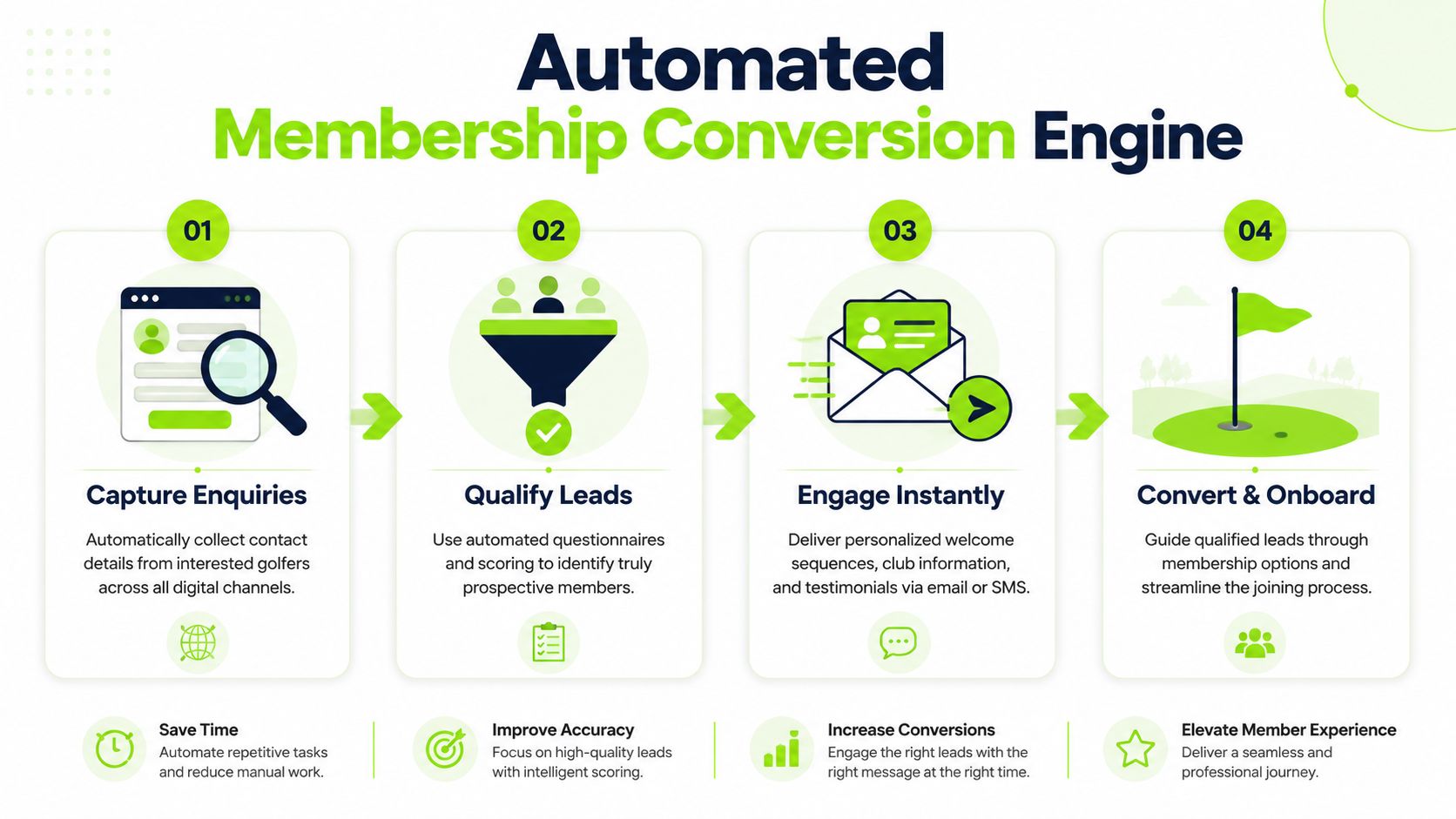
The process is straightforward in principle. Every enquiry should be captured centrally, acknowledged immediately, qualified quickly, and moved into the right next action without relying on someone's memory.
A workable setup usually includes:
- A central CRM so every enquiry sits in one place with status, notes, source, and next step
- Automated acknowledgement by email or SMS the moment someone enquires
- Qualification questions to separate active prospects from casual browsers
- Task and sequence triggers so follow-up happens even when staff are occupied
- Pipeline reporting so management can see where prospects are dropping out
This isn't about replacing human contact. It's about protecting it. Staff should spend their time on club tours, phone conversations, and meaningful objections, not on copying contact details from web forms into notebooks.
Automation doesn't make the process cold
Poor automation feels robotic because it is robotic. Good automation feels organised.
If someone requests membership information, they don't need silence followed by a generic PDF three days later. They need confirmation that the club received their interest, a simple route to the next step, and communication that reflects what they asked for.
A fast, relevant response feels personal even when the first part is automated.
The club also needs channel discipline. Social media creates interest, but interest needs a clean handoff into the CRM and follow-up process. If your team is trying to manage content across platforms, a tool such as the PostPlanify social media dashboard can help keep outbound activity organised so prospects aren't being driven into a chaotic back end.
For clubs reviewing this properly, GolfRep's golf club automation approach is one example of how AI-supported qualification, CRM workflows, and structured follow-up can be combined into one system. The principle matters more than the platform. Every enquiry should be visible. Every lead should have a next step. Every stage should be trackable.
The difference between a process and a gamble
A manual system depends on good intentions. An automated conversion engine depends on rules.
That distinction matters. Good intentions disappear when the office gets busy. Rules don't.
If a prospect downloads membership details, there should already be a path for what happens next. If they click pricing but don't book a visit, there should already be a prompt. If they enquire out of hours, the club should still be present and responsive. That's how you get more golf club members without asking staff to work harder every week.
From Enquiry to First Visit A Guided Nurture Journey
Most membership enquiries aren't ready to join on day one. They are comparing clubs, checking affordability, asking a partner, reviewing distance from home, or deciding whether they would use the membership enough.
That means the period between first enquiry and first visit matters far more than many clubs realise.
The weak version
The weak version is common. A golfer asks for details. The club sends a brochure. Nothing happens for a week. Then someone follows up with “just checking you received this”. The prospect says thanks and disappears.
The problem isn't effort. The problem is that there was no journey.
The stronger version
A stronger nurture flow guides the prospect towards a visit through useful contact at the right moments.
It might look like this:
Day one
An immediate message confirms the enquiry and explains the next step. The prospect can reply, ask questions, or book a call.Shortly after
A follow-up email explains the most relevant membership category and removes obvious confusion around playing rights, competitions, or joining process.Next touchpoint
The club shares a reason to visit in person, such as seeing the course, clubhouse atmosphere, practice areas, or meeting the membership contact.Later message
A polite nudge invites the golfer to book a tour or visitor round, without sounding desperate.
Many clubs underperform in this area. They contact prospects only when they want something. Better nurture gives the golfer enough confidence to take the next step.
If the first visit feels like work to arrange, membership will feel hard to join.
The key milestone is the visit. Once a golfer is physically at the club, the sales conversation becomes far easier because they can picture themselves there. They can see the course, judge the culture, and ask questions that never appear in an online form.
A guided nurture journey should also adapt to behaviour. If someone opens emails but doesn't book, the follow-up should differ from someone who has gone quiet completely. If they reply with a timing objection, the club should have a relevant response ready rather than dropping them into the “not interested” pile.
Clubs don't need to overcomplicate this. They need a simple sequence that keeps momentum alive until the first meaningful in-person interaction happens.
Onboarding and Retention For Sustainable Growth

Many clubs treat the membership payment as the win. It is only the handover point between sales and retention, and that handover is where a lot of avoidable loss starts.
A new member has made a commitment, but they still have doubts. They may not know how to book competitions, who they should play with, what the etiquette is at that specific club, or how to get value from the membership in the first few weeks. If the club leaves all of that to chance, early buyer's remorse sets in fast.
The growth mistake is obvious once you see it. Clubs chase more enquiries at the top of the funnel, then run a loose, manual process after the join date and wonder why net membership stays flat. Retention is not a soft, cultural extra. It is part of the same growth system.
What good onboarding looks like
Good onboarding is planned before the member pays, not improvised after the paperwork is done.
At a minimum, the club should give each new member:
- A welcome pack with practical answers on tee booking, competitions, handicaps, guest rules, dress expectations, and key contacts
- A named contact who owns the first 60 to 90 days, so questions do not drift between office, pro shop, and committee
- A clear first-month plan that prompts a few early actions, such as booking a first game, attending an induction, or joining a roll-up
- Introductions or hosted touchpoints that help the member meet people, not just collect information
- A check-in process to catch issues early, before disappointment turns into quiet disengagement
That social side gets underestimated. A member can understand the locker code, the booking app, and the competition calendar and still leave if they never feel known.
Why retention is operational, not sentimental
The clubs that hold members well do not rely on goodwill alone. They run a visible process.
That means tracking who joined, whether they are using the club, whether they attended any early events, whether they brought guests, whether they dropped off after the first few weeks, and which member groups are most likely to stall. Without that visibility, managers are left with anecdotes. Anecdotes rarely fix churn.
The National Golf Course Owners Association has published private-club membership guidance that points clubs toward structured onboarding, clear follow-up, and better use of CRM tracking across the member journey. The point is straightforward. If the club cannot see what happens after someone joins, it cannot manage retention properly.
Many committees misinterpret the issue. They assume a member resigned due to price. While price is sometimes the factor, the member often never got integrated into the club quickly enough to justify the cost.
New members rarely leave for one dramatic reason. They drift out because nobody took ownership of their first few months.
Process beats hope. Assign ownership. Schedule check-ins. Flag inactivity. Give new members easy ways to meet other golfers. Review early drop-off by membership type and age group, not just as one blended number across the whole club.
If feedback is collected, it should be specific enough to act on. Ask what mattered most to the member, where the joining experience slowed down, what felt unclear, and whether they made playing connections early. General satisfaction scores are tidy in a board pack, but they do not tell the office team what to change on Monday morning.
The strongest clubs treat onboarding with the same discipline they apply to sales follow-up. That is how membership growth becomes predictable. You do not just add members. You keep the right ones long enough for referrals, guest revenue, competition participation, and renewals to compound.
Measuring What Matters The KPIs for a Predictable Pipeline
A club can be busy and still be underperforming.
I see this often. The board pack is full of activity metrics, but nobody can answer three basic questions with confidence. How many genuine membership enquiries came in this month? How many progressed to a visit? How many became paying members within a defined timeframe?
Those are management numbers. Website traffic, social engagement, and email opens are secondary. Useful in context, yes, but they do not show whether the club has a growth system or just a marketing feed at the top of the funnel.
England Golf reports an affiliated membership base of 730,000 golfers in England in 2023 (England Golf market context). That matters because most clubs are competing inside a finite market. The practical implication is simple. Wasted enquiries are expensive, slow follow-up costs joins, and poor tracking hides both problems until months later.
The KPI view that actually helps management
A useful dashboard should show where prospects move, where they stall, and where staff intervention changes the outcome. If it cannot do that, it is reporting activity rather than performance.
Start with a minimum set of KPIs the manager, membership team, and committee can review in the same way every month.
| KPI | What It Measures | Why It Matters |
|---|---|---|
| Enquiry volume | The number of membership enquiries received | Shows whether the club is creating enough opportunities |
| Enquiry-to-visit rate | How many enquiries progress to a club visit or membership meeting | Exposes whether response speed, qualification, and follow-up are working |
| Visit-to-member conversion rate | How many visits become paid memberships | Tests the strength of the proposition, the tour, and post-visit follow-up |
| Response time | How quickly the club replies to new enquiries | Delays reduce intent, especially for prospects comparing several clubs |
| Pipeline stage visibility | Where each prospect currently sits in the journey | Prevents prospects disappearing between first contact and decision |
| Member retention trend | Whether new members stay beyond the early months | Connects sales performance to actual commercial value |
One more point matters here. Track these by membership type where possible. A family membership enquiry behaves differently from a full seven-day prospect, and both behave differently from a younger flexible member. Blending them into one average usually hides the real leak.
What good looks like
Good performance depends on the club's price point, location, capacity, and sales discipline. A private members' club with a waiting-list reputation should not judge itself by the same standards as a modern club competing on accessibility and flexible joining options.
The right question is not, "Are our numbers good?" It is, "Which stage is constraining growth?"
If enquiry volume is healthy but visits are weak, the issue is usually speed, contact quality, or the lack of a structured nurture sequence. If visits happen but conversions are soft, look at the offer, the clarity of pricing, the quality of the club tour, and whether anyone follows up properly after the visit. If joins are coming in but net membership barely moves, acquisition is not the bottleneck anymore.
That is the shift many clubs need. Growth becomes more predictable when the team treats membership as a managed pipeline, not a monthly scramble for more leads.
The committee does not need another round of opinions. It needs a clear view of stage-by-stage performance, ownership for each part of the process, and regular review of where prospects are being lost.
If your club wants a more structured way to attract, track, and convert membership enquiries, GolfRep helps golf clubs build predictable pipelines with lead generation, CRM visibility, and automated follow-up systems that support the whole journey from first enquiry to joined member.
Ready to tap into our proven growth system?