How to Drive Golf Membership Sales with Predictable Systems

Most clubs still hear the same advice, get more enquiries. That advice is too shallow. Golf membership sales do not fail because the market is silent, they fail because clubs let good enquiries cool off, drift through inboxes, and disappear before anyone has booked a visit.
The problem is conversion infrastructure. If your club cannot see where each lead came from, who owns it, how fast it was answered, and whether it moved to a tour or trial round, then more traffic only creates more noise. UK guidance is blunt about this, every unrecorded enquiry is effectively lost because it cannot be followed up, and healthier clubs treat every lead as a tracked pipeline event rather than a casual message in a shared inbox (GolfRep guidance on golf club sales process).
Why Most Golf Membership Sales Stall Before the Funnel Even Starts
More enquiries do not automatically create more members. In many clubs, the bottleneck is not demand; it is the habit of treating membership interest like routine admin instead of a sale that needs immediate ownership. Once that happens, response times slip, nobody is clearly accountable, and the prospect moves on.

The symptoms are easy to spot
Weak sales operations usually fail in the same places. Enquiries come in from the website, phone, social media, and referrals, then get split across spreadsheets, inboxes, and staff memory. A committee member says, “I'm sure we replied,” but nobody can show when, by whom, or what happened next.
Practical rule: if a lead cannot be traced from first contact to final decision, it was never really inside a sales process.
That is why UK guidance recommends a tracked pipeline, one CRM, and stage-by-stage conversion instead of counting sign-ups alone (GolfRep's sales process guidance). The pattern is obvious when the system is weak. Enquiries keep arriving, but tours are thin, callbacks are vague, and the same few names keep saying “we're still waiting to hear back.”
What a speed problem really means
A slow first reply is rarely just a delay. It signals that the club is disorganised, or that the enquiry is not being treated as a priority. UK-facing guidance says a healthy New to Contacted rate of 90%+ is the standard to aim for, and lower performance usually points to a speed-to-lead problem (GolfRep CRM pipeline guidance).
The fix is not a better brochure. It is a clear response rule, a named owner for every lead, and follow-up that continues until the prospect has clearly said no. If your club still relies on generic callbacks, you are not running sales, you are hoping.
Mapping the Membership Sales Funnel Into Measurable Stages
The quickest way to improve Golf membership sales is to stop treating the pipeline as one blob. Break it into stages that staff can see, measure, and own. In a UK club, that usually means New, Contacted, Toured, Offered, and Joined.
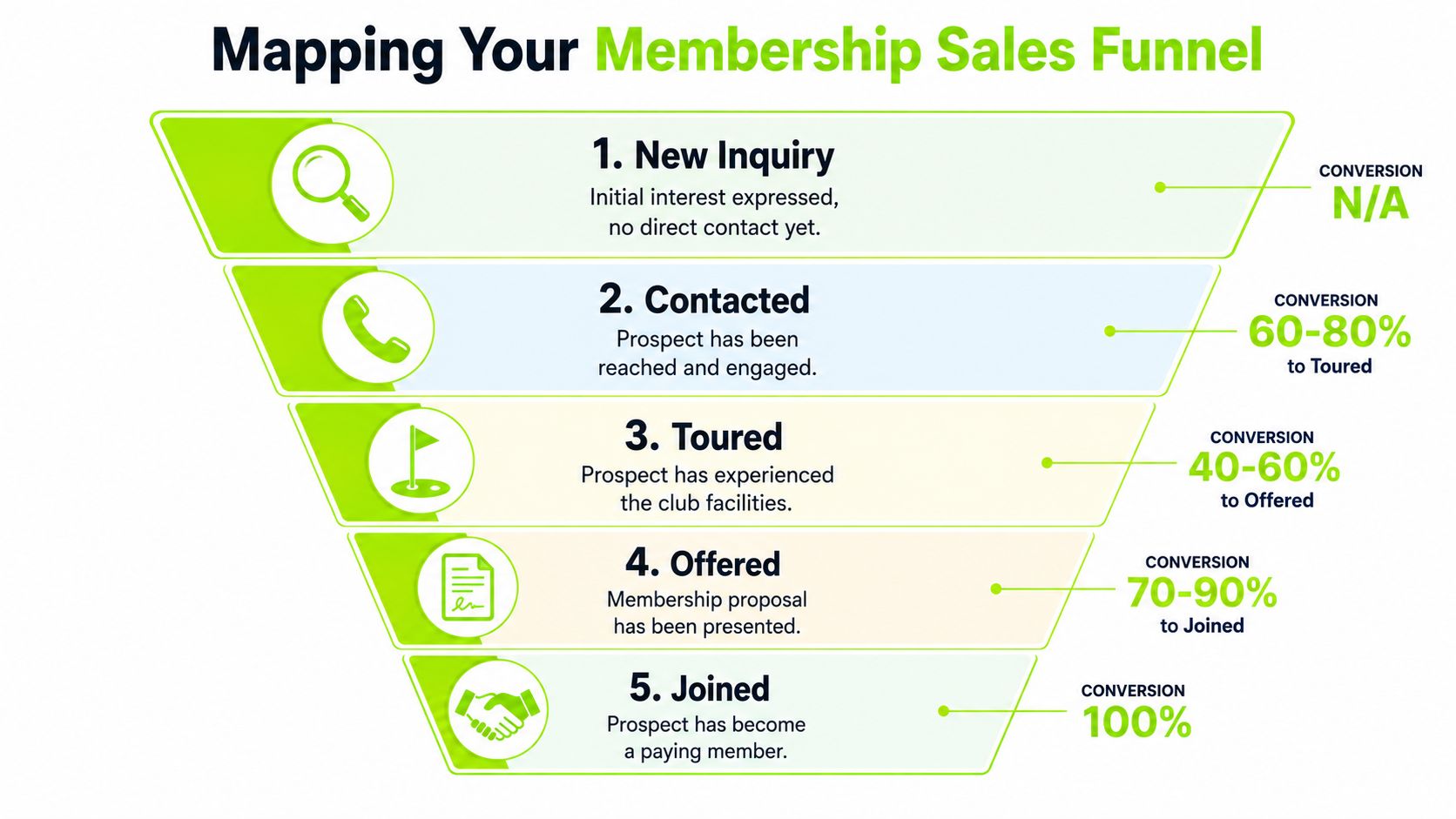
A useful starting point is the simple framework in GolfRep's membership funnel guide. It keeps the conversation anchored in movement from enquiry to member, which is where clubs either make money or lose it.
Where the numbers matter
The question is not overall growth, but where the funnel leaks. A well-run club should expect strong performance at each stage, with New to Contacted close to healthy levels, Contacted to Toured sitting in a workable range, Toured to Offered moving most prospects forward, and Offered to Joined doing the final conversion work. UK-facing guidance also points to the same stage-by-stage approach in a tracked pipeline, rather than relying on sign-ups alone (GolfRep CRM pipeline guidance). That is the right way to diagnose the process.
If the first stage is weak, speed-to-lead is the problem. If tours are thin, the message is too vague or the handover is sloppy. If people visit and still do not join, the offer, objection handling, or membership category is not doing its job. The numbers tell you where to act, which is far more useful than committee guesses about whether “interest feels strong.”
Build one page, not ten reports
Every club should be able to review a simple monthly view.
- Source attribution for each enquiry.
- Inquiry-to-tour rate by channel.
- Tour-to-member rate by membership type.
- Average days to close.
- 90-day retention after joining.
That last point matters because early attrition shows whether onboarding, communication cadence, and category fit are working. A club can attract enquiries and still run a poor sales engine if the first few weeks after joining feel disjointed or unclear. Keep the review to one page. If the numbers are hidden across spreadsheets and inboxes, they are not being managed.
Choosing the Right Lead Channels for Your Club and Market
The wrong debate is, “Which channel gets the most leads?” The actual debate is, “Which channel brings qualified enquiries into one CRM at the lowest cost per serious conversation?” That shift matters because every source has a different job, and some channels are far more useful for trust than for raw volume.
Pick channels that suit the club, not the trend
Paid search works when someone is already looking for membership. Organic content builds authority over time. Social media keeps the club visible in the local market and gives prospects repeated touches before they enquire. Partnerships with PGA professionals and nearby businesses can open doors to households that already trust a recommendation. Member referrals still matter because they usually arrive with more intent than a cold click.
Open days need their own place in the mix. They create a booked experience rather than a vague promise, and that matters in golf, where trial rounds and accompanied visits convert better than generic promotion, a point UK guidance stresses repeatedly (GolfRep sales process guidance). The job is not to run separate campaigns. Feed one pipeline, then compare source quality inside the CRM.
Start with a narrow channel mix
If a club's budget is tight, start with two or three sources, not six. One high-intent channel, one trust-building channel, and one relationship channel is enough to show what converts. If a channel keeps sending low-quality enquiries that never book a visit, pause it and move the spend elsewhere.
For clubs using social content as a lead source, a useful external reference on converting social media audiences into leads shows the importance of moving people from attention to an actual contact step. That principle matters in golf too, because attention alone does not pay subscriptions.
Use channels as feeders, not trophies. A channel that looks busy but never books tours costs you time twice.
Capturing and Qualifying Leads Without Losing the Moment
A web form that only says “contact us” is too weak for modern Golf membership sales. It gives you an email address, but not enough context to prioritise the lead properly. A better form asks just enough to let the club respond with relevance, not friction. The job is to reduce uncertainty before a staff member picks up the phone.
Ask the questions that help a human follow up
Keep qualification light. Golfing experience, household make-up, and intended timing usually give enough shape for the first conversation. You do not need a long questionnaire that puts off interested prospects. You need enough signal to know whether the lead is a solo golfer, a family household, or someone exploring social access first.
That means collecting the right details at the point of enquiry. For a practical reference on how contact and visitor details can be organised, setting up visitor info tracking is useful for thinking through what to ask and why. The same logic applies to membership forms. Ask only for information that supports response, qualification, and booking.
Keep the form short enough that people finish it on the first pass. If a prospect has to work to give you basic details, you will lose them before the conversation starts.
Route every lead into one place
A lead only matters when someone owns it immediately. That means one CRM, clear assignment rules, and an instant acknowledgement that sets expectations for the next step. UK-facing guidance also recommends tracking every enquiry through to booking or loss, because clubs often lose motivated prospects by letting the message sit untouched (GolfRep's AI lead qualification guidance).
If the club still handles enquiries through shared inboxes and sticky notes, fix that first. Form, CRM, and reply process need to work together. A prospect should never wonder whether their message reached the club, and the club should never wonder who is following up.
The best first response is specific. Tell the prospect who will contact them, when, and what they should do next.
GolfRep or any similar system should do the same basic job, capture the lead, log the details, and make ownership obvious. The point is not the brand name. The point is that the enquiry has to move cleanly from form fill to human follow-up without anyone guessing what happened in between.
Running 24/7 Automations and CRM Workflows That Actually Convert
A lot of clubs lose membership enquiries overnight because the office closes and the form sits untouched. Automation earns its place here. It keeps the conversation alive until a person can step in with context, ownership, and a clear next step. The job is simple, get the first reply out fast, then move the lead to the right person before interest cools.
A late-night family enquiry, handled properly
A parent submits a family membership form at 22:30. Within minutes, an automated reply thanks them, confirms receipt, and gives them a bookable visit link. The system logs the enquiry in the CRM, tags it as family interest, and flags it for a same-day call the next morning.
At 08:15, the membership lead leaves a voicemail and follows up by email. The prospect has already seen what happens next, so the call does not feel cold. It feels organised. Over the next two weeks, a short nurture sequence sends relevant information about family access, visit options, and the easiest way to book.
What the workflow needs to contain
Keep the sequence simple. Make it consistent.
- Instant acknowledgement: confirm receipt and set the expectation for the next contact.
- Qualification prompt: ask for the few details needed to tailor the conversation.
- CRM logging: store responses automatically so nothing gets lost.
- Lead scoring: flag engaged leads for human follow-up.
- Nurture messages: keep the club visible while the prospect decides.
- Human handover: move high-intent leads to a real conversation quickly.
That is the kind of workflow GolfRep automation guidance is built around, along with the broader discipline of handling enquiries through a clear CRM process. The software matters less than the operating rule behind it. Every enquiry needs a reply, a next action, and an owner that staff can see at once.
Pricing, Offers, Onboarding and Retention as the Hidden Conversion Layer
Most clubs stop at the joining fee and call that the sale. That approach misses the true work. Pricing, offer structure, onboarding, and the first months after a member joins decide whether the relationship holds, whether the member moves into a better fit later, and whether they recommend the club to someone else. If you only count sign-ups, you are looking too early.
Offer design matters more than slogans
A club that sells one rigid entry route will keep attracting the same kind of buyer. UK strategy content identifies the young professional family as a markedly underserved private golf market segment, and that should shape how clubs set up their entry points (underserved private golf market insight). These households usually care more about convenience, family logistics, coaching, and flexible access than about tradition-heavy membership language.
Discounting is not the answer. The better move is to build categories that let the right people enter in the right way, through social, academy, or family-linked pathways before they upgrade. A club that only sells to established golfers keeps fighting for the same pool, and that pool is already crowded.
Onboarding is part of the sale
The first 90 days show whether the member fits. UK guidance recommends reviewing that period closely because early attrition often exposes weak onboarding and weak communication cadence (GolfRep CRM pipeline guidance). A rushed handover from “sold” to “see you around the club” wastes the effort that went into winning the deal.
A practical onboarding rhythm should include a welcome message, a clear explanation of how to book, a named contact for questions, and a check-in before habits go stale. If the member feels ignored after joining, the club has bought a short-term number and nothing more.
Retention is a sales outcome. Weak onboarding means the club is paying to acquire the wrong experience.
Tracking the Right KPIs and Putting It All Together
A monthly review should cover source attribution, enquiry-to-tour rate, tour-to-member rate, average days to close, 90-day attrition, and net growth versus gross sign-ups. That is the point where club committees see whether the pipeline is healthy or merely active. UK clubs that monitor these stages stop guessing and start managing the conversion process properly.
The order matters. Fix response speed first, make the CRM visible second, then tune channels and offers. If those systems are in place, the club stops chasing random enquiries and starts running a predictable membership pipeline with clear accountability. That is the essential work. Lead generation only matters once the handoff, follow-up, and close process are working.
A useful dashboard also separates activity from outcome. A high enquiry count means little if tours stall, if the same prospects sit untouched in the CRM, or if new members leave before they settle in. Clubs that review the whole journey can spot weak points early, whether the issue is the enquiry source, the booking step, the sales conversation, or the first few weeks after joining.
GolfRep helps clubs build that structure around their existing membership process, from lead capture and automated follow-up to CRM visibility and conversion tracking. If you want a calmer, more measurable membership pipeline, visit GolfRep and see how the system is built for golf clubs rather than generic marketing.
Ready to tap into our proven growth system?