Boost Your Golf Club Membership Revenue Predictably

Most committees ask the wrong question about membership growth. They ask how to get more enquiries, more traffic, more reach. The better question is simpler. Can your club reliably convert the interest it already generates into recurring revenue?
That gap matters because golf club membership revenue rarely improves from one lever alone. Even industry coverage that talks about growth often doesn't break down whether the result came from pricing, retention, ancillary spend, or new-member acquisition. As noted in this private-club membership marketing analysis, UK-focused discussion often highlights demand and positioning, but rarely gives clubs a practical breakdown of which lever matters most.
In practice, many clubs don't have a demand problem first. They have a leaky bucket problem. Enquiries sit in inboxes. Follow-up depends on who is on shift. Tours aren't booked while interest is still warm. Notes live in someone's head, a spreadsheet, or a half-used system nobody trusts.
That's why predictable growth starts lower down the funnel. Before a club spends more on advertising, it should ask whether its current process is built to capture, track, and convert the opportunities it already has. If not, extra lead volume often just creates extra waste.
The Real Question for Your Membership Revenue
A committee can spend months debating fees, social media, brochures, and open days. Those decisions matter. But they don't fix the central issue if the club can't handle enquiries consistently from first contact through to sign-up.
The clubs that struggle with golf club membership revenue often aren't short of interest. They are short of process discipline. A prospect fills in a form, sends an email, or asks about membership after a visitor round. Then the path goes unclear. Who responds? How quickly? What happens if that person is off? When is the second follow-up sent? Who knows whether the prospect booked a tour, asked for pricing, or disappeared?
Why more enquiries can be the wrong first move
If a club already loses a meaningful share of inbound interest through slow or inconsistent handling, adding more leads doesn't solve the problem. It just feeds a broken system.
A common pattern looks like this:
- Marketing creates interest: Paid ads, visitor traffic, referral activity, or word of mouth bring in fresh enquiries.
- Operations absorb the lead manually: A manager, secretary, or pro shop team member tries to respond between other duties.
- Follow-up becomes inconsistent: Some prospects get called. Others get a late email. Others get nothing at all.
- Reporting stays vague: The committee sees enquiry volume, but not where prospects stall or why they don't convert.
Practical rule: If you can't see every membership enquiry in one place and track its next step, you don't have a pipeline. You have a guessing process.
The biggest missed opportunity is that this problem is usually fixable without dramatic repositioning or discounting. Better handling often beats louder marketing.
The revenue mindset that changes decisions
Golf club membership revenue grows more predictably when committees stop treating sales as an occasional admin task. It needs to be run as an operational system, with ownership, visibility, response standards, and clear stage-by-stage tracking.
That changes the conversation. Instead of asking, "How do we get more leads?", the club starts asking better questions:
- Where do current enquiries come from?
- How fast are they being answered?
- How many are booking visits?
- How many proposals are sent?
- How many sign, and how many go cold?
Those questions lead to action. More importantly, they reveal whether your next pound should go into acquisition, pricing work, retention, or fixing conversion.
How to Measure Your Revenue Engine Correctly
Most clubs still look at headline member count first. That's understandable, but it can hide what's happening. If one category is shrinking, another is growing, and fees have changed, a simple headcount tells you very little about the strength of the revenue engine.
A better method is to treat dues as the core recurring cash base and measure performance in a way that normalises different membership categories. The most useful benchmark here is Full Member Equivalent, or FME. Club Benchmarking's model shows clubs derive a large share of available cash from dues, with an average of 78% of Available Cash coming from dues revenue, and it recommends tracking revenue and attrition through FME rather than raw member count in order to separate pricing effects from true growth, as explained in the Club Benchmarking white paper.
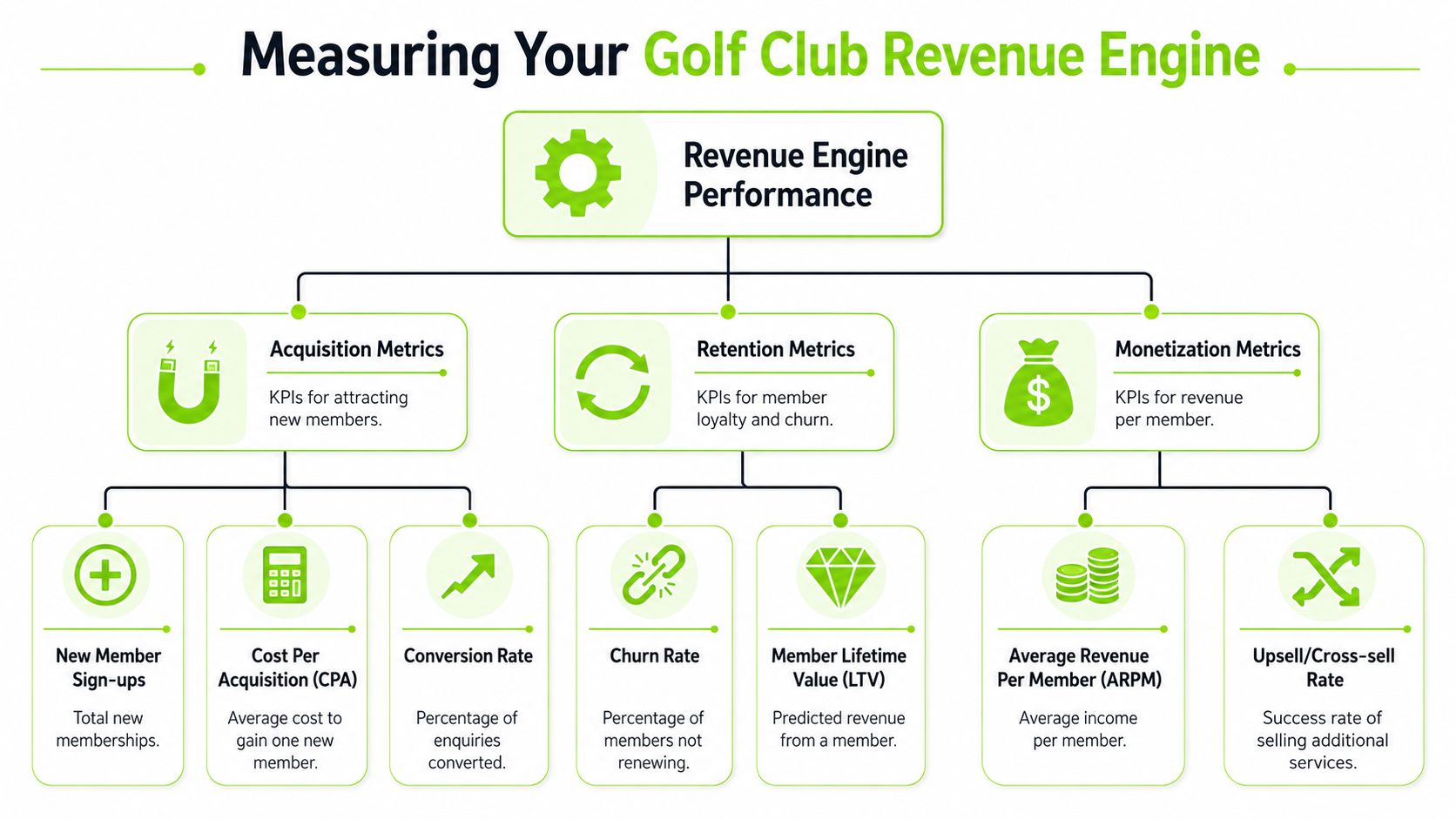
What FME actually tells you
FME converts mixed membership categories into a comparable revenue unit based on annual dues. That means you can see whether growth came from:
- Pricing changes
- Shifts in membership mix
- Actual underlying member growth
- Attrition hidden by new joiners
For committee decision-making, that's much more useful than saying, "We're up a few members this year." A club can be up on count and still weaker on revenue quality. It can also hold count steady while improving revenue density.
A practical way to calculate and use it
You don't need a finance background to use this properly. You do need clean data.
Segment every membership category clearly
Separate full 7-day, ակումբ 5-day, intermediate, academy, flexible, corporate, social, and any discounted or transitional category.Tie each category to annual dues revenue
Use actual dues income rather than assumptions. This matters if pricing has changed mid-year or if categories are bundled differently.Convert categories into FME
Treat the full membership dues level as the reference point, then express other categories relative to it.Compare current-year FME with prior-year FME
That shows whether your club expanded its recurring membership base or adjusted price and category mix.Track operating revenue per FME
This helps you judge whether each equivalent member is becoming more valuable over time.Monitor attrition on the same basis
Headline resignations can look manageable while high-value categories weaken.
A club that only tracks joins and resignations usually misses the bigger story. Revenue quality sits inside the mix.
The reporting mistake most committees make
Many committees receive updates that combine marketing activity, visitor numbers, and membership commentary into one broad narrative. The result is noise. Revenue decisions need a tighter scorecard.
A monthly board view should answer four things:
| Question | What to review |
|---|---|
| Is recurring revenue base growing? | FME compared with prior period |
| Is value per member improving? | Operating revenue per FME |
| Are we replacing losses or creating net growth? | Attrition alongside new member sign-ups |
| Which channels actually convert? | Enquiry source linked to membership outcome |
If your club promotes across several channels, your reporting also needs attribution discipline. A useful parallel sits outside golf. Teams using PostSyncer's analytics insights tend to focus less on vanity metrics and more on what each channel contributes to outcomes. Membership reporting should do the same. Clicks and impressions are interesting. Signed members are what matter.
Clubs that want a clearer commercial view often start with a basic audit of channel performance, enquiry handling, and conversion tracking before changing spend. That's the same reason many managers find value in reading GolfRep's breakdown of the real ROI of golf club marketing. It pushes the conversation beyond surface-level lead numbers and into revenue visibility.
Plugging the Leaks in Your Enquiry Process
A lot of clubs lose money. Not because demand isn't there, but because the handoff from interest to action is weak.
A prospect enquires on a Sunday evening. The email is seen on Monday afternoon. A reply goes out on Tuesday. No call is made because the membership secretary is busy with other work. By Friday, the prospect has heard back from another club, booked a visit there, and mentally moved on. Nobody at your club marks the lead as lost because nobody ever owned it.
That isn't a marketing failure. It's a process failure.

What a reliable enquiry system looks like
A proper membership pipeline doesn't need to be complicated. It does need to be structured. Every enquiry should move through defined stages such as received, contacted, qualified, visit booked, proposal sent, follow-up due, and closed.
The important point is visibility. If a lead sits idle, somebody should know. If a tour was booked but no proposal followed, the gap should be obvious. If a prospect asked about a flexible category for a spouse as well, that should be in the record rather than buried in someone's inbox.
A workable process usually includes:
- Immediate acknowledgement: The prospect gets a prompt confirmation that their enquiry has been received and will be handled.
- Assigned ownership: One person is responsible for the next action, even if several people contribute.
- Central CRM logging: Notes, contact history, status, and next step live in one system.
- Follow-up rules: If no reply comes back, the system prompts the next touch rather than relying on memory.
- Conversion tracking: The club can see how many enquiries become visits, proposals, and members.
Why manual handling breaks down
Committee-led clubs and busy management teams often say, "We already follow up." Usually they do, some of the time. The issue is consistency under pressure.
Manual follow-up fails for familiar reasons:
- Shared inboxes create ambiguity
- Staff holidays interrupt momentum
- Phone calls aren't logged
- Tour notes aren't visible to others
- No one knows which leads need chasing today
Slow response doesn't just lose a lead. It signals how the club may operate after someone joins.
That point matters more than many clubs realise. The prospect is not only judging your course and price. They're judging whether joining will feel organised, welcoming, and professional.
Mapping the journey before adding spend
One of the simplest ways to improve conversion is to map the actual customer journey, not the imagined one. Useful examples from outside golf can help here. These essential customer journey mapping examples are worth reviewing because they show how small friction points create drop-off long before a sale is formally lost.
For golf clubs, the practical version is straightforward. Audit every step from first enquiry to signed direct debit. Then ask where delay, confusion, duplication, or silence appears.
A club doesn't need flashy software first. It needs discipline. But once volume grows, software becomes the mechanism that protects discipline. That might be a CRM such as HubSpot, Pipedrive, or another system configured around membership stages. In golf-specific growth work, providers such as GolfRep also build these structured follow-up and visibility systems so clubs can track enquiries from first contact through to membership without relying on manual chasing.
If your team wants a blunt picture of how much opportunity often disappears before anyone notices, this article on how most golf clubs lose enquiries without realising is a useful prompt. The exact number will vary by club. The pattern is common.
Smarter Acquisition for a Systemised Club
Once the bucket is patched, more water makes sense. That's when acquisition spend starts working harder, because the club is no longer feeding leads into a patchy process.
The shift in golfer behaviour is already clear. In 2025, 67% of casual green fees in the UK were booked online, up from 62% in 2024, and online bookings accounted for approximately 34% of total green fee revenue. Average visitor income reached £315,000 per club, up from £274,000 in 2024, while total online sales grew 27% to £125,855 on average, according to The Revenue Club's 2025 UK golf booking data. For membership growth, the practical lesson is simple. Digital demand is real, and visitor traffic is often the feeder pool for future members.

Treat visitors and prospects as one connected system
A club's acquisition strategy shouldn't split visitor revenue and membership growth into separate worlds. The golfer who books a casual round online, attends an open event, or browses membership options after a positive visit is already moving through a decision journey.
That means your acquisition setup should connect:
- Paid social for local awareness and membership interest
- Search activity for active intent
- Visitor booking data
- Open-day or trial-day registrations
- CRM capture for every identifiable prospect
A common error is running isolated campaigns with no shared tracking. The club sees website traffic rise, green fee bookings come in, and some membership forms arrive, but can't tell which touchpoints influenced the final sign-up.
Channel choice should reflect fit, not fashion
Not every club needs the same mix. A value-led members' club in a competitive local market may need clear paid social offers and strong retargeting. A premium club with limited membership capacity may get better results from search, referral capture, and highly controlled enquiry flows. A resort site may benefit from linking visitor databases and membership nurture more tightly.
The question isn't whether Facebook Ads, Google Ads, email, events, or referral campaigns are good in theory. It's whether each one brings the right type of golfer for your club's price point, location, and membership model.
A practical acquisition review should ask:
| Channel | Useful question |
|---|---|
| Paid social | Is it attracting local golfers who fit your category and budget? |
| Search | Are you capturing people actively comparing memberships nearby? |
| Visitor database | Are frequent visitors being nurtured toward joining? |
| Open events | Are attendees followed up as leads, not just counted as turnout? |
Acquisition works best when every campaign has a defined route into the CRM, a named owner, and a next action.
Track from first click to signed member
That last part is where clubs either become efficient or stay reactive. Every campaign should feed a central system that records source, response, visit status, proposal history, and outcome. Without that, spend decisions stay political. With it, they become commercial.
If your club is still relying on broad assumptions about "what usually works", it's worth reviewing how golf clubs can add members using paid advertising. Not because paid media is a magic answer, but because it only becomes useful when the club can attribute outcomes and scale what converts.
Optimising Pricing, Packaging, and Member Retention
Acquisition gets the attention. Retention protects the economics.
For most clubs, the strongest revenue gains don't come from chasing constant replacement. They come from keeping the right members, improving category fit, and increasing lifetime value without leaning on blanket discounts. Broader golf-club guidance cites target annual retention of 85% to 92%, while benchmark retention in comparable top-tier private clubs is commonly 92% to 94%, according to Golfmanager's guidance on membership retention. That gap tells a clear story. Many clubs still have room to improve through better systems rather than louder promotion.
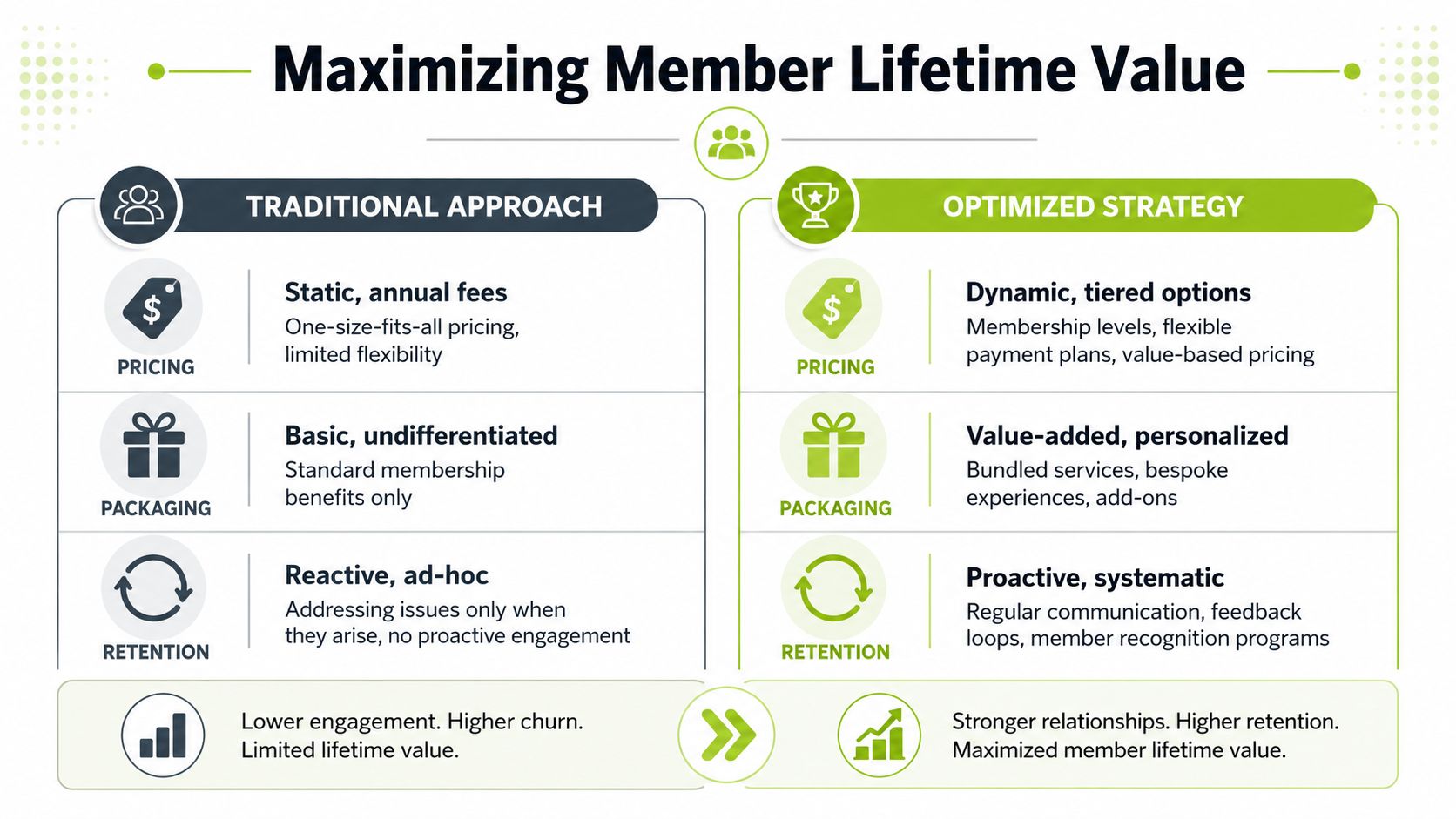
Build packages around real demand
Traditional categories still work when they match the market. Full 7-day, 5-day, off-peak, intermediate, academy, and social-linked structures all have a place. The problem comes when clubs defend old packaging even after buying habits have changed.
A better pricing review asks:
- Which categories attract strong interest but low conversion?
- Where are prospects hesitating on value, not just price?
- Which members are underusing their package and becoming resignation risks?
- Does the club have a flexible entry route that protects value without cheapening the brand?
Sometimes the answer is not to cut fees. It's to improve fit. A younger golfer may not need a full traditional package immediately. A returning player may prefer a staged path into full membership. A household may be more likely to commit if the joining experience reflects how they plan to use the club.
Retention should be run like a system
Too many clubs treat retention as a year-end save attempt. By that point, the decision is often already made.
A stronger retention model includes several layers:
Structured onboarding
The first weeks after joining set the tone. Introductions, booking guidance, competition information, and early social integration all reduce buyer's remorse.Segmented engagement
Not every member needs the same communication. New members, low-usage members, active competition players, and lifestyle members behave differently.Trigger-based intervention
If usage drops, event participation falls away, or direct interaction goes quiet, someone should act before the resignation arrives.Win-back workflow
Former members and resigned joiners shouldn't disappear into archive folders. Some leave for timing reasons, not permanent objections.
The clubs that retain well usually spot disengagement early. They don't wait for a cancellation email to start caring.
What doesn't work
Retention quality falls when clubs default to poor habits:
- Last-minute discounting: It may save a few renewals, but it can weaken perceived value and train members to wait.
- Generic communication: Monthly newsletters don't solve low engagement if they aren't relevant to the member's behaviour.
- No ownership: If everyone is responsible for retention, nobody is.
- No feedback loop: Exit reasons need to be logged, categorised, and reviewed, not discussed anecdotally.
Golf club membership revenue becomes more stable when pricing, packaging, and retention are reviewed together. A category that's hard to sell may not have a marketing problem. It may have a fit problem. A member who resigns may not have left over price alone. They may have drifted because nobody noticed reduced engagement early enough.
Building Your Predictable Growth Flywheel
The clubs with the healthiest membership revenue don't operate in bursts. They don't run one campaign in spring, panic in autumn, and then argue over numbers at committee meetings. They run a continuous system.
That system has four moving parts. Measure the recurring base properly. Handle every enquiry through a visible process. Add acquisition only when conversion is under control. Then protect member value through retention and category fit. When those parts connect, the club stops relying on hope and starts building a repeatable growth cycle.
The long-term importance of that recurring base is hard to overstate. In the United States, 3,887 private clubs generated an estimated $32.6 billion in revenue in 2023, within a total industry impact of $157 billion and 1.5 million jobs, according to CMAA's economic impact summary. The UK market is different, but the strategic lesson carries across. Membership revenue is what supports staffing, facilities, planning, and resilience.
What the flywheel looks like in practice
A predictable model usually works like this:
| Stage | Operating question |
|---|---|
| Measurement | Do we know whether recurring member revenue is actually improving? |
| Enquiry handling | Can every lead be seen, owned, and followed up without gaps? |
| Acquisition | Are we buying and generating the right kind of demand? |
| Retention | Are we keeping members engaged before attrition appears? |
Each stage improves the next. Better measurement sharpens decision-making. Better enquiry handling increases conversion. Better conversion makes acquisition spend safer. Better retention lowers pressure on acquisition and improves lifetime value.
The checklist committees should use
Most clubs don't need another strategy deck. They need implementation discipline. Start with the basics:
- Audit enquiry flow: Find out where leads arrive, who sees them, and how next actions are assigned.
- Centralise records: Move notes, status, and follow-up into one trusted system.
- Review membership categories: Check whether your packaging still reflects buyer demand and usage patterns.
- Set monthly revenue reporting: Include recurring member performance, conversion visibility, and attrition signals.
- Forecast from pipeline, not optimism: Use actual stage data to estimate likely joins and exposure.
Good forecasting comes from pipeline visibility. Not from saying, "We had a decent level of interest this month."
A better operating model for the next few years
The most important shift is cultural. Membership growth can't sit on one enthusiastic staff member, one committee champion, or one seasonal campaign. It needs process, ownership, and reporting that survive staff changes and busy periods.
That's where many clubs make their biggest commercial improvement. Not by becoming more aggressive marketers, but by becoming more organised operators.
If your club wants more predictable golf club membership revenue, start by fixing the leak before widening the funnel.
If you're reviewing how your club handles membership enquiries, conversion tracking, and recurring revenue visibility, GolfRep helps golf clubs build structured pipelines that connect lead generation with CRM-led follow-up and clearer reporting. The value isn't in more noise at the top of the funnel. It's in making sure genuine interest doesn't disappear before it has a chance to become a member.
Ready to tap into our proven growth system?