Golf Club Membership Declining What To Do: A Guide
The most common advice on golf club membership declining what to do is to “do more marketing”. That's often the wrong first move.
Most clubs don't have a pure demand problem. They have a handling problem, a follow-up problem, or a retention problem. They're losing members without realizing it, responding to enquiries slowly, and relying on busy staff to remember who needs chasing.
If you pour more budget into that setup, you usually don't fix decline. You just create a larger pile of missed opportunities.
Is Your Membership Really Declining or Just Changing?
The idea that UK golf club membership is falling everywhere doesn't hold up. A 2025 Golfshake survey found that 57.4% of UK golfers said membership is growing at their club, while 20.64% said it was not. The same survey found 77% planned to renew, with 4% saying they would not renew and 19% undecided. That points to something more specific than blanket decline. Clubs that deliver clear value and adapt to how people want to play are in a stronger position.

A lot of managers still frame the issue like this: “We need more enquiries.” Sometimes that's true. Often it isn't.
The better question is simpler. How much interest are you already failing to convert? If your website form submissions sit unanswered until the next day, if trial visitors never get called, or if resigned members disappear without any intervention before renewal, your problem isn't top-of-funnel volume. It's leakage.
The problem usually sits inside the process
Most clubs are sitting on two underused assets:
- Unconverted enquiries that were never followed up properly
- At-risk members who showed signs of disengagement before they resigned
That's where the quickest gains usually sit.
Practical rule: Don't buy more leads until you know what happens to the ones you already get.
Membership is also changing shape. Golfshake reported that junior participation showed the biggest year-on-year gain and female membership continued to rise in that same survey. Clubs that adapt to families, women, and younger golfers are more likely to stabilise or grow, rather than defend a shrinking base.
What managers often misread
Clubs often mistake a systems issue for a demand issue. They look at the final membership number and assume the market has turned against them. In practice, the actual failures tend to be more ordinary:
- Slow response times to new enquiries
- No visibility on who booked a tour and who didn't
- No structured nurture after a visit
- No early warning system for members whose usage is dropping
- One rigid membership option that leaves resignation as the only way out
None of that gets fixed by a new advert on its own.
When a club says membership is declining, the right response isn't panic. It's diagnosis.
Before You Spend a Penny Look at Your Data
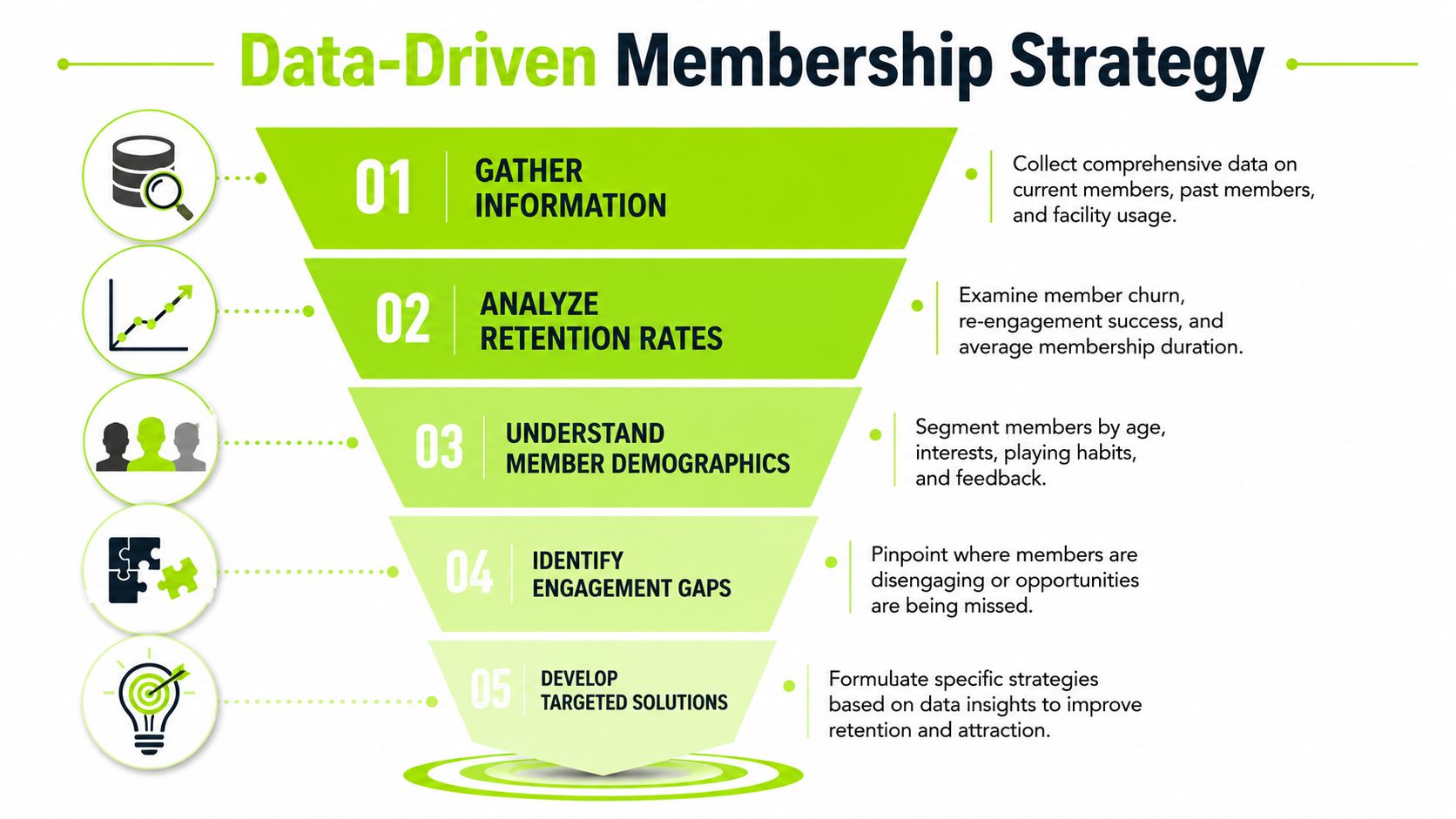
Before you touch pricing, redesign the website, or launch a campaign, audit the pipeline you already have. That means moving beyond “how many members did we lose?” and asking where the process breaks.
The UK market is still substantial. National Club Golfer reports that there are over 730,000 golf club members in England. The practical takeaway is not that every club should chase the same audience. It's that retention and conversion matter more than broad assumptions about collapsing demand.
The three numbers you need first
If you only track one number, which is total membership, you'll keep guessing. Split the journey into stages.
Track these separately:
| KPI | What to check |
|---|---|
| Renewals | Who renewed, who resigned, who is undecided |
| Enquiry-to-visit conversion | How many enquiries became a club tour, trial, or meeting |
| Visitor-to-member conversion | How many visits actually turned into membership |
That separation matters. National Club Golfer makes the same point. When clubs blend those metrics together, they often misdiagnose a systems problem as a pricing problem.
What a useful audit looks like
You don't need complicated software to start. A spreadsheet is enough if the data is clean and someone owns it.
Review the last few months and answer these questions:
- How many membership enquiries came in? Include website forms, phone calls, social media messages, and walk-ins.
- How quickly did someone reply? Not eventually. First response.
- How many were invited to visit?
- How many visited?
- How many got follow-up after the visit?
- How many joined?
- How many existing members resigned without any intervention beforehand?
If you want a broader framework for thinking this way, Menza's guide on data-driven decision making is a useful read because it focuses on turning raw information into operational decisions, not just reporting.
A golf-specific version of that discipline matters even more in committee-led clubs, where knowledge often sits in people's heads instead of in a repeatable process. That's also why we've written about data-driven golf marketing through the lens of lead handling and conversion, not just campaign performance.
If you can't see where prospects stall, you can't fix decline. You can only speculate about it.
Segment leavers before you react
Not every resignation means the same thing. Treating all leavers as “price objections” leads clubs into blunt discounts that damage value.
Split them into practical groups:
- Price-sensitive casual golfers who still want some access but can't justify full dues
- Disengaged members who stopped booking, stopped entering competitions, and drifted away
- Lifestyle-change leavers whose work, health, or family situation altered their play pattern
- Lapsed but recoverable members who may return if the right pathway exists
That last point is where many clubs leave money on the table. They wait for the renewal form, hear “I'm leaving”, and then scramble.
By then, the decision usually wasn't made that week. It was made much earlier.
How to Keep The Members You Already Have
Retention usually improves when a club stops thinking in two boxes: full member or gone.
That all-or-nothing model creates avoidable resignations. A member's playing pattern changes, their budget tightens, or their availability shifts. If the only answer is full annual subscription at the same terms, many will leave even if they still want a relationship with the club.

That's why the smarter approach is a membership ladder. PlayMoreGolf's retention discussion highlights the need for step-down, pause, and transitional pathways rather than a rigid single product. In practice, that means giving members a route to stay connected without forcing a resignation.
What a membership ladder can include
The exact structure depends on your tee sheet, pricing, and peak-time pressure. But the principle is the same. Build options between “full member” and “former member”.
Common examples include:
- Off-peak membership for golfers who can play midweek or quieter times
- Points-based access for members whose usage has become irregular
- Seasonal or pause pathways for members facing temporary life changes
- Corporate or shared-use categories where individual full membership isn't the right fit
- Transitional packages for people stepping down from full membership but not leaving entirely
The wrong way to do this is to launch random discounted categories because a few people complained. The right way is to design products that match real usage patterns and protect your busiest inventory.
What works and what doesn't
What works is proactive communication. If someone's booking activity drops, if they stop entering competitions, or if they go quiet after years of regular use, contact them before renewal.
What doesn't work is waiting for the resignation letter and then offering a panicked concession.
Here's the distinction clubs miss:
| Approach | Likely result |
|---|---|
| Reactive discounting at resignation | Trains members to threaten leaving |
| Structured step-down options offered early | Preserves value and keeps the relationship alive |
Key judgement: A step-down product should protect the member relationship, not undercut your core membership.
Retention is also a service issue
Clubs often talk about retention as if it's purely a pricing discussion. It isn't. Members stay when the whole experience feels organised, welcoming, and relevant.
Look at the pressure points:
- New member onboarding that ends after the welcome email
- Poor communication about competitions, events, or club life
- No clear route for families, women, juniors, or newer golfers to feel included
- Administrative friction around booking, billing, or understanding benefits
Golf Monthly's reporting on UK membership pressure points to rising subscription costs over time and a value-for-money challenge. The clubs coping best are those with more flexible, inclusive offers and a more modern operating model. That aligns with what many managers already know from the ground. Members will tolerate a lot less friction when fees feel high.
A retention plan should therefore include both product and process. The product is the membership ladder. The process is how and when you offer it.
A simple retention rule for managers
Don't frame the conversation as “how do we stop them leaving at the last moment?”
Frame it as “how do we notice change early and give them a better-fit option before resignation feels like the only answer?”
That shift improves retention because it respects how people behave. Most members don't wake up on renewal day and suddenly decide to leave. They drift first.
Attracting the Right Golfers Not Just Any Golfers
Once retention is under control, acquisition becomes more efficient because you're no longer trying to fill a bucket with a hole in the bottom.
This is where many clubs waste budget. They run broad campaigns for “new members wanted” and invite anyone with passing interest to submit a form. The result is a pile of weak enquiries, patchy attendance at tours, and price-led conversations from the first contact.
A better model is to target the golfer who fits your club.
Start with fit, not reach
Most clubs already know who tends to stay and who tends to leave quickly. Use that knowledge.
Build your acquisition around a few real profiles, such as:
- Committed local golfers looking for a proper home club
- Families who value social use as much as the course
- Women returning to the game who want a more welcoming route in
- Younger professionals who need flexibility around work
- Corporate decision-makers who want member benefits with business use
Those aren't just marketing segments. They affect pricing, messaging, visit format, and follow-up.
If your club wants to attract families or social users, your offer can't only talk about medals and handicaps. If you're targeting serious players, don't lead with generic lifestyle language. Match the message to the person.
Ask for a specific action
Most clubs make a weak ask. “Enquire now” sounds simple, but it creates ambiguity. The prospect doesn't know what happens next, and the club doesn't shape the process.
A stronger approach is to offer one clear next step:
- Book a guided club tour
- Attend a new member open day
- Request a membership fit call
- Join a taster session for a specific audience
- Visit with a partner or family member if that's relevant to the buying decision
That gives the prospect a concrete action and gives the club a structured sales moment.
A good campaign doesn't just collect interest. It moves the golfer to the next stage in a controlled way.
Build campaigns around operational reality
There's no point promoting twilight access if your evening tee sheet is already tight. There's no point pushing family use if the clubhouse experience doesn't support it. Good acquisition starts with operational honesty.
That same principle applies outside membership too. For example, clubs thinking about visitor experience, fleet usage, or on-site transport can benefit from practical resources like this golf course fleet management guide, because the member proposition is shaped by operations as much as by advertising.
The clubs that grow sustainably usually do three things well:
- Target locally and precisely
- Offer a relevant first step
- Follow up fast and consistently
What they don't do is spray generic adverts across a wide area and hope the right golfer sorts themselves out.
Don't confuse volume with quality
A long list of raw enquiries can make everyone feel busy. Busy isn't the same as effective.
If most of those names were never the right fit, or if nobody followed them up properly, the campaign didn't work. It just produced admin.
The standard should be simple. Attract people who match your culture, your price point, and your usage model. Then move them quickly into a visit, a conversation, and a decision.
Why Your CRM is Your Most Valuable Player
A club can have the right pricing, the right target audience, and a solid membership ladder, but still lose ground if follow-up relies on memory.
That's the core job of a CRM. It doesn't replace personal contact. It makes sure personal contact happens at the right time, with the right context, every time.

GolfRep's guidance on member loss makes an important point. The most effective clubs monitor usage and trigger automated re-engagement within days of a lapse, not weeks. That changes the whole retention model. Instead of asking how to win someone back after they've mentally checked out, the club identifies early-warning signals before resignation happens.
What a CRM should be doing for you
A useful CRM setup tracks both prospects and members.
For prospects, it should record:
- Where the enquiry came from
- When someone responded
- Whether a tour was booked
- Whether the prospect attended
- What follow-up was sent next
For members, it should flag behavioural change:
- No recent booking
- No competition entries
- A drop in frequency after strong early engagement
- No attendance at events they previously joined
Those signals matter because disengagement usually appears in behaviour before it appears in a resignation email.
Automation fixes inconsistency
Most clubs don't ignore leads on purpose. Staff are busy, phones ring, visitors arrive, and membership follow-up slips.
Automation covers the repeatable parts so the team can focus on the human parts.
A workable setup often includes:
| Trigger | Automated action |
|---|---|
| New web enquiry | Instant email and SMS confirmation, then task for staff follow-up |
| Tour booked | Confirmation message and reminder sequence |
| Tour no-show | Rebooking message within a short window |
| Member usage drops | Check-in message and internal alert |
| Renewal risk identified | Prompt for outreach and alternative membership discussion |
That's the difference between hoping someone follows up and knowing the process is running.
Clubs don't usually need more effort. They need fewer manual handoffs.
If you're evaluating systems, a practical starting point is to understand what a golf CRM system should track from first enquiry through to renewal risk. The point isn't software for software's sake. It's visibility, speed, and accountability.
The CRM is the link between growth and retention
Clubs often split acquisition and retention into separate conversations. They shouldn't.
The same system that chases a new enquiry can also identify a fading member. The same visibility that shows where tours are being lost can show where resignations were predictable. That's why CRM isn't an admin tool. It's the operating system behind predictable growth.
One practical option in this category is GolfRep, which combines lead generation with CRM-enabled follow-up and automation for golf clubs. That kind of setup matters when clubs want clear visibility from enquiry through to booked visit and membership outcome, rather than relying on scattered notes and inboxes.
Without that system, clubs tend to fall back into manual habits. Some prospects get chased. Others don't. Some members are noticed when they disappear. Others resign without a word.
That inconsistency is expensive.
Your 90-Day Plan to Reverse Membership Decline
If your golf club membership is declining and you want to know what to do next, don't try to fix everything at once. Build control first.
Days 1 to 30
Audit the current pipeline and member journey.
Pull together one view of enquiries, visits, conversions, and resignations. Identify where leads stall and where members drift. If you need extra operational ideas beyond membership sales, this piece from Caddie Wheel on effective golf course management strategies is useful because it ties club growth back to day-to-day management standards.
Create a simple dashboard and review it weekly. If you want a practical example of what a focused acquisition system can look like once the foundations are in place, this guide on how to generate 50 golf membership enquiries in 90 days is a good reference point.
Days 31 to 60
Fix the leaks before scaling demand.
Introduce fast response rules for new enquiries. Standardise tour booking and post-visit follow-up. Build at least one step-down or transitional membership option for at-risk members. Set triggers for disengagement so the team intervenes before renewal pressure peaks.
The first win is control. Growth comes after control.
Days 61 to 90
Launch one targeted campaign for one audience with one clear next step.
Don't market to everyone. Choose the best-fit segment, create a relevant offer, and drive prospects to a tour, taster event, or membership call. Track every stage and review conversion weekly.
Key Performance Indicators for Membership Growth
| Metric | What It Measures | Good Target |
|---|---|---|
| Renewals | How well you retain existing members | Upward trend, reviewed separately from new sales |
| Enquiry response time | How quickly prospects hear back | Same day and consistent |
| Enquiry-to-visit conversion | Whether interest turns into a real sales opportunity | Improving month by month |
| Visitor-to-member conversion | How effectively visits become memberships | Stable and improving with follow-up |
| At-risk member interventions | Whether disengaged members are spotted early | Every flagged member gets actioned |
| Lead source visibility | Which channels produce the right-fit prospects | Clear tracking across all channels |
A club doesn't reverse decline by guessing better. It reverses decline by running a better system.
If you want help building that system, GolfRep works with golf clubs on enquiry handling, CRM setup, follow-up automation, and conversion tracking so managers can see exactly where membership growth is being won or lost.
Ready to tap into our proven growth system?