Your Golf Club Marketing Agency Playbook: A 2026 Guide

Most advice about hiring a golf club marketing agency starts in the wrong place. It starts with traffic, impressions, and lead volume.
That sounds sensible until a club gets enquiries it can't see clearly, can't respond to quickly, and can't follow up consistently. Then the problem isn't marketing reach. The problem is operational conversion.
A modern club doesn't need a supplier that sends clicks and disappears. It needs a growth partner that links demand generation, CRM visibility, automation, and staff workflow into one accountable system. That's the difference between sporadic campaigns and a predictable pipeline.
The Real Problem Marketing Should Solve for Your Club
Plenty of clubs say they need more leads. In practice, many need better control of the leads they already generate.
That matters more in crowded local markets. England had 1,848 affiliated clubs in 2023/24, according to Hampton Golf's strategic market view. In that environment, winning isn't just about making the phone ring. It's about protecting membership value, avoiding unnecessary discounting, and converting the right local golfers without creating administrative chaos.
A weak process usually looks familiar. An enquiry comes in through the website, social media, a form on a paid ad, or a phone call. Someone forwards it. Someone else plans to reply later. Notes sit in inboxes. Follow-up depends on who is on shift. A committee asks how marketing is performing, and the only answer available is a report full of clicks.
Why more enquiries can make things worse
If your team doesn't have a clear system, extra demand can expose the weakness rather than solve it.
Common failure points include:
- No single view of enquiries. Different channels create separate conversations, so managers can't see source, status, or outcome in one place.
- Slow first response. Prospective members lose momentum when replies depend on manual admin.
- No structured follow-up. Staff handle today first, then try to remember who to chase tomorrow.
- Poor qualification. Clubs treat every enquiry the same, even when the primary priority is fit, intent, and local relevance.
- Reporting with no sales context. Activity looks busy, but nobody can tie it to visits, applications, or joined members.
Practical rule: If a club can't answer where each enquiry came from, who owns it, and what happened next, it doesn't have a marketing problem alone. It has a pipeline problem.
That's why value-based thinking matters. A useful outside read on this is DialNexa Labs on marketing growth, which looks at growth through customer value rather than surface metrics. For golf clubs, that lens is especially useful because the wrong type of demand can waste staff time and pressure pricing.
The right brief before you hire anyone
Before you compare agencies, define the actual requirement.
You're not buying ads, SEO, or content in isolation. You're buying a system that should improve:
- Enquiry visibility
- Response speed
- Booked visits or calls
- Conversion quality
- Membership integrity without defaulting to offers
If a committee only asks, "How many leads will we get?", it invites the wrong proposal. A better question is, "How will this partner help us turn interest into tracked outcomes without creating more manual work?"
That's the standard clubs should apply when reviewing marketing performance internally too. GolfRep's view on the real ROI of golf club marketing makes that point clearly. Revenue quality, follow-up discipline, and conversion control matter more than vanity metrics.
How to Evaluate a True Golf Club Growth Partner
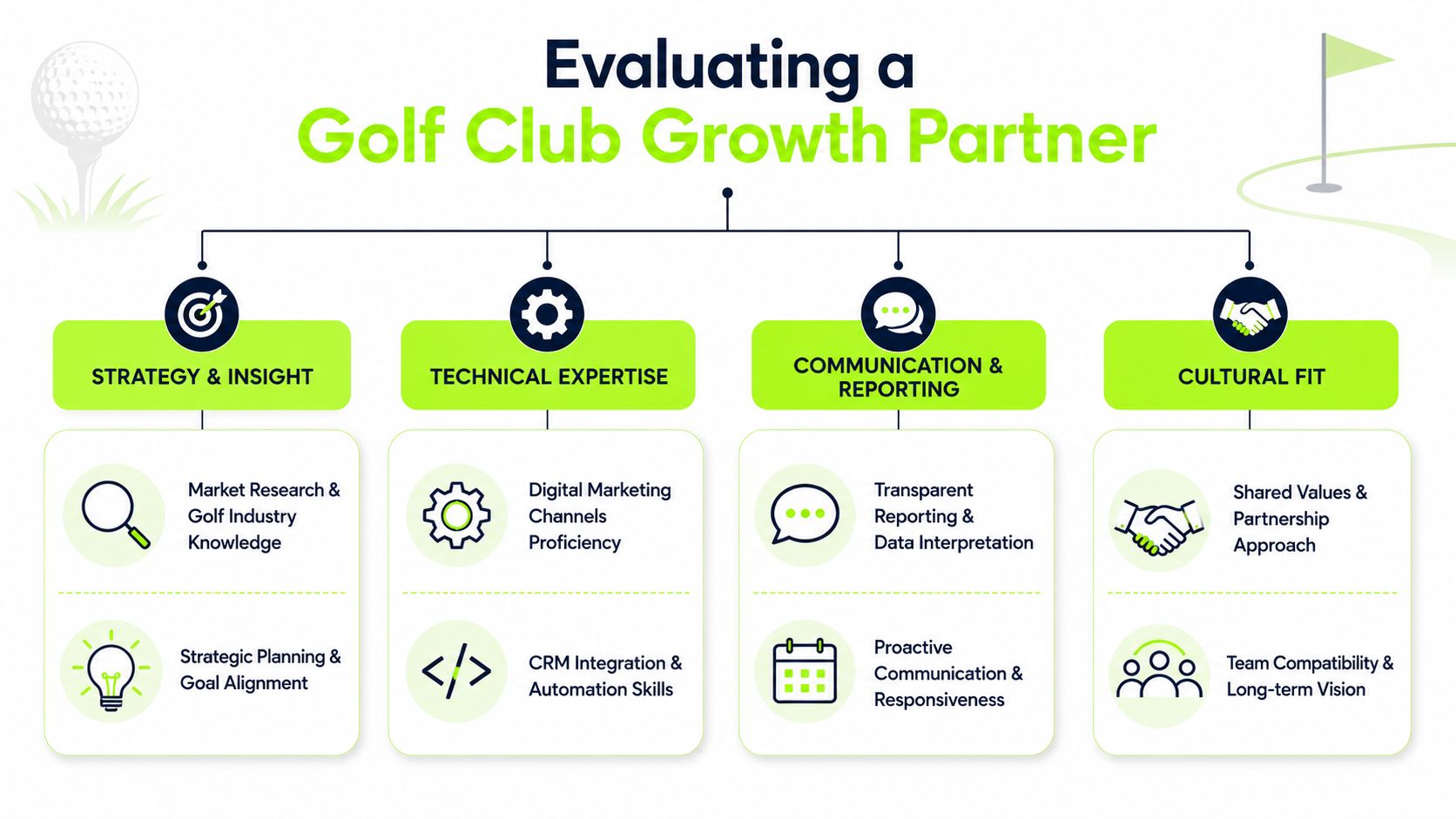
A credible golf club marketing agency shouldn't be judged on creative samples alone. Nice visuals don't tell you whether the partner can handle membership growth, committee reporting, CRM setup, or response automation.
The better test is whether the agency can operate across the full commercial chain, from first search to signed member.
Look for sector understanding, not just channel skills
Golf clubs aren't standard lead-generation businesses. They have committees, member expectations, pricing sensitivities, seasonal pressures, and operational bottlenecks around tours, callbacks, and applications.
An agency should understand the difference between:
- Private member clubs protecting rate and brand position
- Resort venues balancing tee-time demand with wider guest revenue
- Multi-site operators needing central reporting with local execution
- Committee-led clubs where follow-up often breaks down because ownership isn't clear
That context changes the marketing plan. It also changes the CRM design, the nurture sequence, and the way reports should be presented to decision-makers.
Check whether they understand trust signals
Modern golfers research before they commit. A GolfNow consumer study found 52% of all golfers consult online ratings and reviews before booking a tee time, rising to 74% among GolfNow users, and the same study found 56% of surveyed golfers purchase food and beverages during their visit while 27% buy merchandise or range balls, as reported by GolfNow Business.
That means reputation, landing page quality, and on-site conversion aren't side issues. They're commercial assets. A golf club marketing agency should be able to explain how it will improve trust before the enquiry, not just traffic to the form.
A campaign that drives interest into a weak review profile or a vague membership page usually amplifies friction, not growth.
Use a practical scorecard
When clubs compare agencies, a simple scorecard is more useful than a pitch deck. This is the shortlist I recommend:
| Area | What to ask |
|---|---|
| Strategy | How do you define the target golfer by membership product, location, and intent? |
| CRM | How will every enquiry be logged, assigned, and tracked to outcome? |
| Automation | What happens if we miss a call or don't reply immediately? |
| Reporting | Will you show pipeline stages or just campaign metrics? |
| Governance | Who attends review meetings, and who owns action points on the club side? |
If you want a broader non-golf perspective on vetting paid search expertise, mastering SEM consultant selection is a useful comparison piece. The principles carry over well, especially around accountability and fit.
Ask how the funnel works after the click
Many can explain targeting; however, far fewer can articulate what happens after an enquiry arrives. This disparity often exposes weak providers.
Ask for specifics on:
- Form handling
- Lead routing
- Auto-response setup
- Follow-up tasks
- Lead stage definitions
- Sales pipeline reporting
A partner that can answer those questions in plain English is usually operating at the right level. GolfRep's guide to golf club marketing agency selection is built around that full-funnel view, which is the standard clubs should use when comparing options.
Running an RFP and Trial That Reveals True Capability
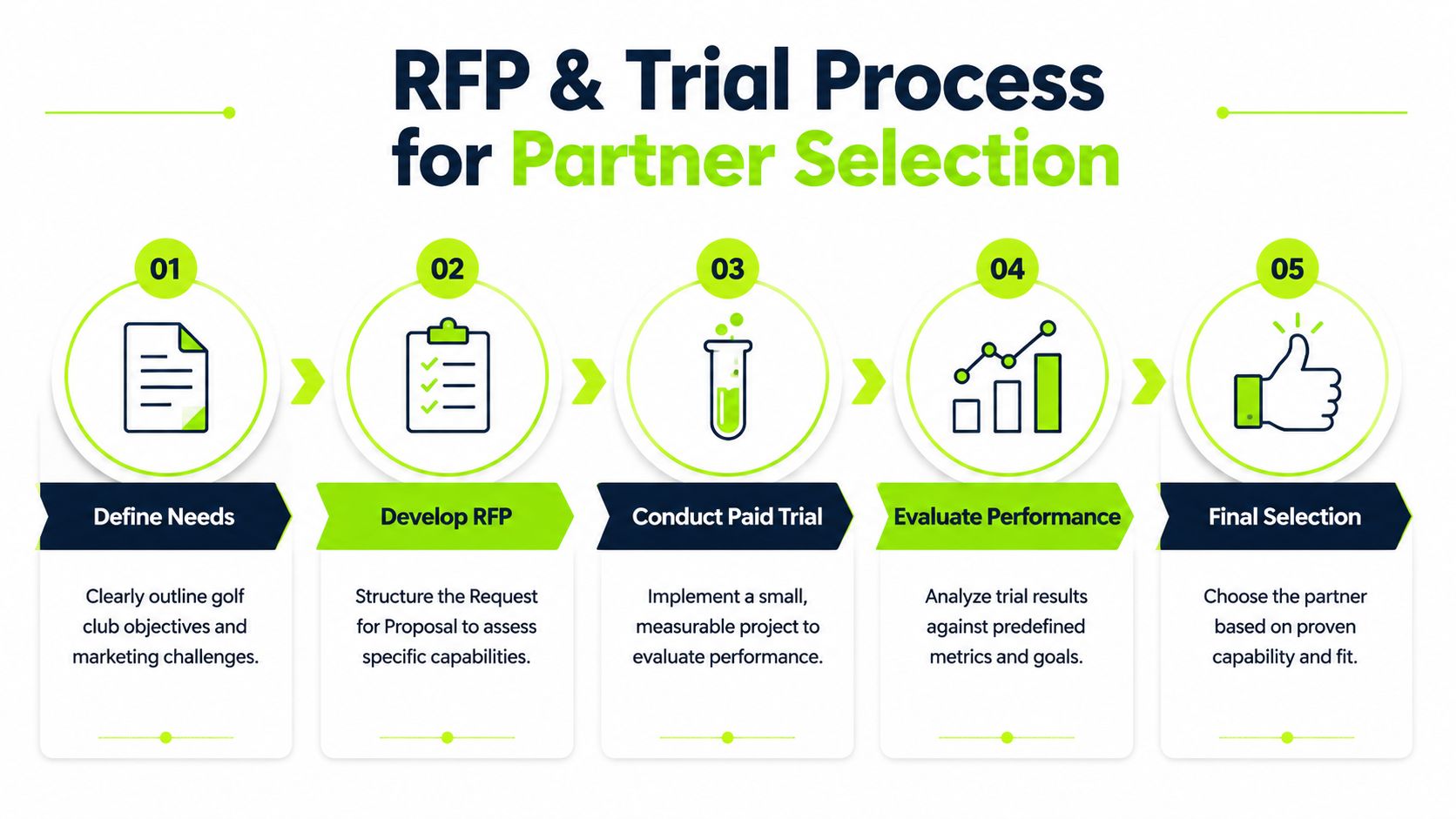
A polished proposal can hide a weak operating model. That's why the selection process should force agencies to show how they think, how they work, and how they measure.
The most useful RFPs don't ask for generic ideas. They ask for process, accountability, and proof of operational discipline.
What your RFP should actually test
Before budget approval, a club should demand a full-funnel operating model with KPIs for enquiries received, speed to contact, booked visits or calls, and conversion. A practical framework is to allocate 50 to 60% of effort to SEO, local SEO, and AI search, with the rest supporting conversion and nurture rather than vanity activity, as set out in GolfRep's UK golf club marketing agency framework.
That changes the RFP completely. Instead of asking, "What channels do you offer?", ask:
- How will you give the club visibility of every enquiry from source to outcome?
- What happens if an enquiry isn't answered inside the agreed window?
- How do you separate membership interest from society, visitor, and event demand?
- What report will a club manager see each month?
- Which parts of follow-up are automated, and which stay with staff?
Those questions reveal whether the agency is thinking commercially or cosmetically.
Run a paid trial, not a beauty parade
Committees often feel pressure to choose after presentations. A limited paid trial is usually safer.
Good trial scopes include:
- A landing page and enquiry workflow for one membership category
- A local search and paid search test tied to a clear follow-up path
- A CRM stage setup for inbound enquiries already being generated
- A reactivation sequence for dormant membership prospects already in your database
The point isn't to get instant scale. The point is to see whether the partner can build a usable system with clean ownership and visible outcomes.
Don't judge a trial by clicks alone. Judge it by whether staff can see what to do next.
What to watch during the trial
Performance matters, but behaviour matters too. Some agencies produce decent early numbers and still create long-term friction because they're disorganised, vague, or dependent on one account manager.
Watch for signs like these:
- Clear implementation plans. You know what is being built, by whom, and by when.
- Structured feedback loops. The agency asks how leads are behaving after hand-off.
- Operational realism. Recommendations fit your team's actual capacity.
- Clean reporting language. Reports make sense to a manager and to a committee.
If an agency can't run a small test with discipline, it won't run a larger account with discipline either.
Setting KPIs, SLAs, and Onboarding for Predictable Growth
Once you've chosen a partner, the actual work begins. This stage decides whether marketing becomes measurable and manageable, or whether it slips back into ad hoc activity.
Most clubs underinvest in setup. They approve the campaign budget, but they don't lock down the operating rules that make the spend accountable.

Choose KPIs that reflect the pipeline
Modern golf marketing is judged on measurable outcomes. One golf-industry campaign reported a 138% increase in membership leads and a 305% increase in stay-and-play revenue, illustrating the shift toward CRM-led nurture and automation as core commercial tools, as shown in TriMark Digital's golf industry work.
That doesn't mean every club should chase the same outcome. It means your KPIs should track the movement from interest to revenue, not just front-end activity.
Useful KPIs often include:
- Enquiries received
- Speed to first contact
- Booked visit or call
- Show-up to visit
- Application started
- Joined member
- Source-to-outcome attribution
- Pipeline stall points
A poor KPI set focuses on impressions, reach, and engagement without tying them to member acquisition or secondary spend.
Write SLAs that remove ambiguity
An SLA sounds formal, but it solves a practical problem. It tells everyone what must happen after an enquiry arrives.
A club should define:
| SLA area | Decision to make |
|---|---|
| Lead ownership | Which role owns first response and which role owns later follow-up |
| Response handling | What happens in and out of office hours |
| Escalation path | Who is alerted if a lead sits untouched |
| Data hygiene | Who updates status, notes, and outcome fields |
| Review cadence | How often results and bottlenecks are reviewed |
This matters even more in multi-site groups, where central marketing and local operations can easily lose alignment.
Treat onboarding as systems work
Good onboarding is part technical build, part operational design. Ad accounts, forms, call routes, CRM stages, automations, and reporting dashboards all need to join up.
That can include platforms such as HubSpot, Pipedrive, GoHighLevel, or a club's existing CRM if it can support structured lead stages and tasking. GolfRep is one example of a golf-specific partner that combines advertising, CRM visibility, and automation in that way, but the principle matters more than the vendor name. The club should insist on a setup where each enquiry is trackable and each hand-off is visible.
Board-level test: If spend increases next month, will the system become clearer and stronger, or will the admin burden get worse?
If the answer is the latter, onboarding isn't finished.
Managing Nurture Flows and Reporting That Matters
Most membership decisions don't happen on the first touch. People enquire, compare, get busy, revisit the idea, ask a partner, check the location again, and delay.
That's why clubs need nurture flows, not just notifications.

Build follow-up that sounds like the club
The strategic bottleneck for many clubs is lead handling speed and follow-up consistency, not demand creation. With UK consumers thoroughly embedded in digital communication, clubs need local search, instant responses, and CRM-based nurture working together, as discussed by Straight North's golf digital marketing perspective.
The challenge is tone. Automated follow-up shouldn't sound robotic or over-eager. It should sound like the club.
A strong nurture flow usually includes a mix of:
- Immediate acknowledgement so the prospect knows the enquiry was received
- Useful next-step messaging such as a visit invitation or membership guide
- Trust-building content like course imagery, member experience, or practical FAQs
- Timed reminders when the prospect hasn't booked or replied
- Staff prompts when a human call or email is the right next action
If you're comparing platforms and messaging options, this round-up of top drip campaign tools is a helpful starting point. The tool matters less than the sequence design and the hand-off rules.
Ask for reports that show movement
A monthly report should help a manager make decisions. It shouldn't read like a media agency spreadsheet.
What matters is pipeline movement:
| Report view | Why it matters |
|---|---|
| New enquiries by source | Shows where demand is entering the system |
| Open leads by stage | Shows what needs attention now |
| Booked visits or calls | Measures progress beyond initial interest |
| Uncontacted or stale leads | Exposes response and follow-up failures |
| Closed outcomes | Shows whether marketing is producing commercial results |
Nurture and reporting become one discipline. If a stage is clogging up, you don't just ask for more traffic. You fix the email sequence, task timing, message quality, or sales ownership.
For clubs reviewing how automated follow-up works in practice, GolfRep's guide to golf club AI lead nurture gives a useful picture of how these systems are structured around speed and consistency.
A report is only useful if it tells the club what to change next week.
Assessing Long Term Performance and Mitigating Risk
After several months, the conversation should move beyond campaign updates and into commercial performance. Through this, many clubs either gain confidence in the partnership or realise they've hired a channel supplier instead of a growth partner.
Long-term assessment should focus on trend quality. Are you attracting the right prospects, booking the right conversations, and converting without damaging pricing or member perception? If not, more spend won't solve it.
What good review meetings look like
A useful review meeting doesn't revolve around "how many people saw the ad". It asks tougher questions.
For example:
- Are more enquiries progressing to visits?
- Are certain sources producing poor-fit prospects?
- Is follow-up slipping at weekends or during staff holidays?
- Is one membership product converting better than another?
- Are reporting definitions still clean and consistent?
Those questions keep the agency tied to club outcomes rather than media activity.
Reduce risk before it becomes expensive
Clubs should also protect themselves contractually. That doesn't mean demanding unrealistic guarantees. It means being clear about ownership, deliverables, access to data, and exit terms.
At minimum, a club should know:
| Risk area | Protection to ask for |
|---|---|
| Data access | The club keeps access to ad accounts, CRM records, and reporting dashboards |
| Dependency risk | Processes are documented, not trapped inside one person's inbox |
| Performance drift | Review points are scheduled with agreed corrective actions |
| Handover risk | Landing pages, workflows, and creative assets are transferable |
A mature golf club marketing agency won't resist that. Clear structure protects both sides.
Judge the asset, not the activity
The best agency relationships create an asset for the club. That asset is a working pipeline with visible stages, dependable follow-up, and reporting that can survive staff changes.
That's the benchmark. Not whether an ad looked polished. Not whether a monthly report had enough charts. Whether the club is more predictable, more organised, and better able to convert demand without relying on discounts.
When a partner builds that properly, marketing stops feeling like a gamble. It starts operating like a managed growth function.
If your club wants a clearer view of how that system should look in practice, GolfRep works with golf clubs on pipeline design, CRM-enabled follow-up, and conversion-focused marketing that gives managers and committees better visibility from enquiry to outcome.
Ready to tap into our proven growth system?