Golf Club Marketing Strategy: A Practical UK Guide

Most golf club marketing advice starts in the wrong place. It tells you to run more Facebook adverts, publish more social posts, or organise another open day. Those activities can create attention, but more enquiries don't automatically produce more members. If your club takes nearly two days to answer a membership enquiry, extra demand gives your team more opportunities to lose warm prospects. GolfRep's cited UK analysis puts the average response time at 47 hours and 32 minutes, while an enquiry answered within an hour is reported as five times more likely to convert than one answered after a day, according to GolfRep's enquiry response guidance.
The stronger golf club marketing strategy is a complete pipeline. It connects local acquisition, fast response, visible ownership, structured visits, relevant nurture, onboarding, retention, and referrals. The clubs that grow predictably aren't necessarily the ones making the most noise. They're the ones that know what happens to every enquiry after it arrives.
Why Most Golf Club Marketing Plans Leak Revenue
A club can have a good course, competitive membership options, and a steady flow of local interest, yet still struggle to grow. The common assumption is that the club needs more leads. In practice, the bigger problem is often what happens between enquiry received and membership decision.
A prospect submits a form during a lunch break. Nobody owns the follow-up. The membership secretary sees the message later, sends a generic reply, and waits for the prospect to call back. The prospect has already contacted another club or moved on. By the time someone calls, the original interest has cooled.
Practical rule: Treat every enquiry as a live commercial opportunity until a clear outcome is recorded.
The response-time problem is not theoretical. Independent UK business guidance cited by Load Off's lead-response research says that replying within five minutes can make a company roughly seven times more likely to qualify a lead than waiting an hour longer. That source also reports an average response time of 42 hours among companies that replied at all. The exact benchmark matters less than the operational lesson. Delayed follow-up is a system failure, not a personality problem.
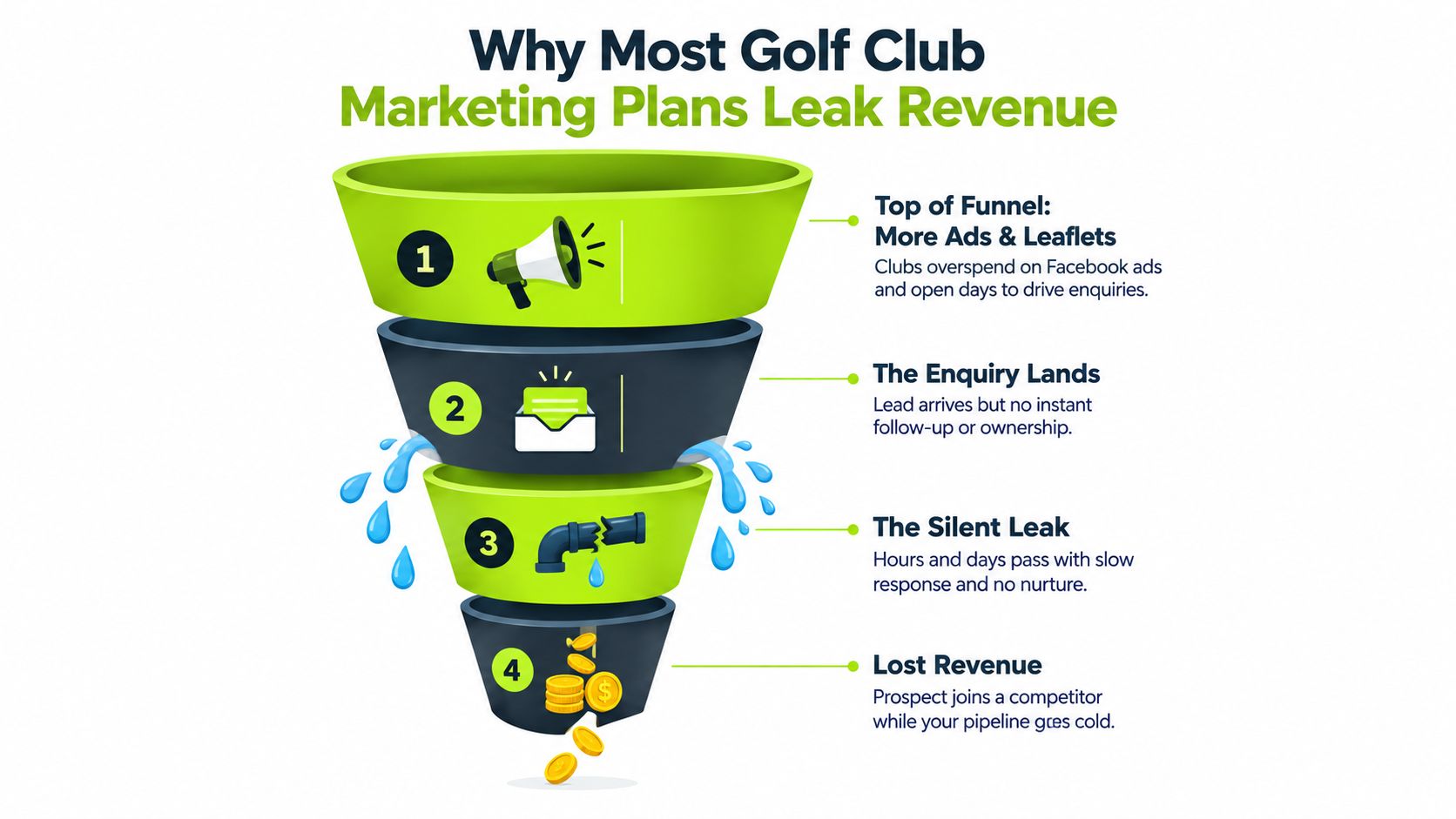
Where the leak usually appears
Most clubs inspect the top of the funnel because it's easy to see. They count website visits, advert clicks, open-day attendance, and form submissions. Few committees examine the less visible stages with the same discipline:
- First response: Was the prospect contacted quickly?
- Ownership: Did one named person take responsibility?
- Qualification: Did the club understand the golfer's needs and timing?
- Visit: Was a structured, welcoming experience offered?
- Decision: Did someone follow up with a clear next step?
- Retention: Did the new member become involved quickly?
England Golf's 2023 membership figures show why this matters. Club membership in England reached about 722,000, compared with roughly 720,000 in 2022 and about 737,000 before that. Clubs welcomed an average of 94 new members each in 2023, but 64% of members were aged 51 or over, while female membership represented 18% and junior membership 9%, as reported by The Golf Business. The opportunity isn't served by one generic campaign. It requires better segmentation and a more reliable journey after the click.
For a deeper breakdown of the commercial leakage that happens after form submission, see how most golf clubs lose enquiries without realising. More traffic can help, but only after the club can handle the interest already arriving.
Setting Goals, Personas, and the KPIs That Matter
Start with one commercial goal. Don't give a committee a long list of ambitions that nobody can prioritise. Choose whether the immediate focus is net new members, member retention, or revenue per member, then break that objective into quarterly targets using the club's own historic conversion data.
If the club doesn't know its current conversion rates, that's the first project. Establish the baseline before setting a target. A target without a baseline is a preference dressed up as strategy.
Build personas from conversations
Personas should come from real member conversations, not marketing stereotypes. Speak to recent joiners, long-standing members, and people who enquired but didn't join. Look for recurring motivations and objections.
A useful starting set might include:
- The time-poor professional: Values convenient tee times, a straightforward joining process, and a club that doesn't make every interaction feel like an administrative task.
- The retired regular: May care about daytime playing groups, competitions, social belonging, and the quality of the clubhouse experience.
- The family or beginner pair: Needs reassurance about welcome, coaching, flexibility, equipment, and whether the club feels intimidating.
For each persona, record the channels that generated the enquiry, the questions raised during the visit, the reason for joining or delaying, and the message that moved the conversation forward. This information should shape landing pages, advert copy, call scripts, and follow-up emails.
Keep the committee dashboard small
A committee doesn't need a wall of platform metrics. It needs a compact view of the numbers that change decisions.
| KPI | How to Calculate | Realistic Benchmark |
|---|---|---|
| Enquiries | Count of new qualified membership enquiries in the period | Establish your own baseline |
| Speed to lead | Time from enquiry receipt to first human response | Under 15 minutes during office hours |
| Visit-to-sign-up rate | New members divided by completed membership visits | Track by source and persona |
| 90-day retention | New members active after 90 days divided by new joiners | Set a baseline before improving |
| Member referral rate | New members attributed to existing member referrals divided by total new members | Measure monthly and by campaign |
The response target above is an operating standard, not a claimed industry average. It gives the duty manager a clear expectation during staffed hours. Outside those hours, an automatic acknowledgement should confirm receipt and state when a named person will call.
One dashboard rule matters more than the rest: every number needs an owner and an action. If speed to lead worsens, review staffing and routing. If visits rise but sign-ups fall, inspect the visit experience. If new members leave early, fix onboarding before buying more advertising.
Acquisition Channels That Work for UK Clubs
There isn't one universally superior acquisition channel. A sensible mix gives the club speed from paid activity, durability from search visibility, trust from members, and local reach through partnerships. The mistake is funding channels because they feel familiar rather than because they produce joined members.
The UK market is active enough to justify a disciplined acquisition programme. BRS Golf recorded 25.6 million member rounds across the British Isles in 2023, including 12.53 million in England, with the overall figure up by 860,000 rounds compared with 2022 and 2.6 million compared with 2021, according to BRS Golf's participation report. Clubs have a substantial pool of active golfers to reach, but local relevance still matters.
| Channel | Typical Cost per Enquiry | Conversion Strength | Time to Result |
|---|---|---|---|
| Local paid search | Variable, based on competition and targeting | Strong for high-intent searches | Fast |
| Meta advertising | Variable, based on audience and creative | Useful for demand creation and events | Fast |
| Organic search | Requires content and site work rather than a fixed enquiry cost | Strong once visibility develops | Gradual |
| Social media | Staff time and production resources | Better for trust and community than direct selling | Gradual |
| Member referrals | Incentive or recognition cost | Often strong because trust transfers | Variable |
| Local partnerships | Relationship and activation time | Strong when audiences overlap | Variable |
Use paid channels for speed
Google Ads can capture people actively searching for membership or a local golf club. Meta campaigns can introduce the club to nearby golfers through course videos, member stories, beginner sessions, and event invitations. Both channels become expensive when the club can't identify which advert, audience, and message produced a booked visit or joined member.
Organic search is slower but compounds. Build useful pages around local intent, membership types, visitor questions, and specific club features. A page targeting “golf membership near me” only works when it gives the reader clear information about location, welcome, playing options, and the next step.
Turn trust into a trackable channel
Hillier Hopkins found that 64% of members' clubs used member referrals, compared with 47% using advertising, 42% using social media, and only 9% using email campaigns, in its 2023/24 survey reported by Golf Business News. Referrals are valuable, but passive referrals aren't a strategy. Give members a simple introduction route, record the referring member, and follow up promptly.
Partnerships with local employers, hotels, PGA professionals, county organisations, and complementary businesses can extend reach without relying on broad advertising. For clubs producing visual content around events, an AI event photo platform can help organise and share images that give prospective members a credible view of club life.
Building a CRM and Lead Response System
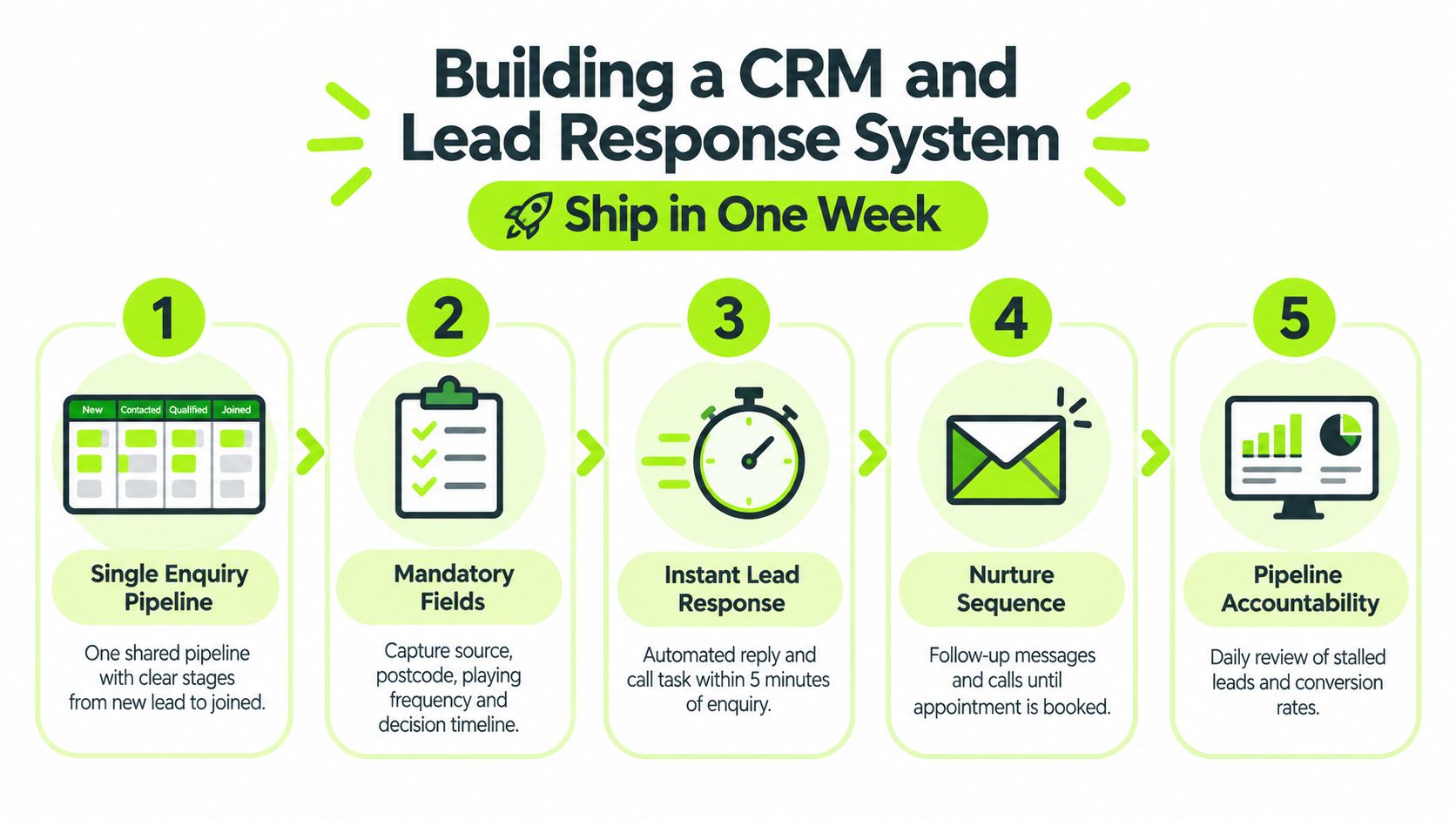
A CRM doesn't need to become a six-month technology project. A club can build a useful minimum system within a week if it starts with one shared pipeline and clear responsibilities.
Create stages that mirror the member journey:
- New enquiry
- Contact attempted
- Conversation completed
- Visit booked
- Visit completed
- Decision pending
- Joined
- Not proceeding or reactivation
Every record should capture the source, postcode, playing frequency, and decision timeline. Add persona, campaign, membership interest, and event attendance as tags. Those fields let the club distinguish a professional seeking flexible access from a beginner looking for reassurance and support.
Set the service standard
During office hours, set a target of under 15 minutes for the first human response. That doesn't mean sending a rushed sales pitch. It means acknowledging the enquiry, confirming ownership, and offering a useful next step.
Outside office hours, use an automatic email and SMS acknowledgement that says the enquiry has been received and gives a named callback window. Don't promise “we'll be in touch soon”. Promise a specific period the team can honour.
The minimum automations are straightforward:
- Instant acknowledgement: Send an SMS and email confirming receipt and answering the first obvious question.
- Round-robin assignment: Route the enquiry to the duty manager, membership secretary, or another named owner.
- No-contact task: Create a task after 48 hours when no meaningful contact has been recorded, then escalate it to the duty manager.
Connect Google Ads, Meta lead forms, the website enquiry form, and walk-in capture to the same inbox. Spreadsheets create duplicate records, hide ownership, and make it difficult to see stalled prospects.
Protect the handover
Consent must be captured clearly for marketing communications, with records kept in a way the club can manage under UK data protection requirements. Separate operational messages from promotional messages, respect preferences, and make opt-out handling simple.
The membership secretary should receive a complete handover, not a name and phone number. The record should show what the prospect wants, what was discussed, which membership options fit, and the next agreed action. GolfRep's golf club CRM guidance covers the role of a central pipeline and structured follow-up in making that ownership visible.
Converting Visits Into Sign Ups
Jane is a 38-year-old returning golfer. She submits a membership enquiry after seeing a local advert, explains that she used to play regularly, and says she wants a welcoming club where she can rebuild confidence. The club doesn't need a complicated sales process. It needs to remove uncertainty at each stage.
Before Jane arrives, the club sends a confirmation text with the time, meeting point, parking guidance, and what the visit includes. A member host receives a short briefing with Jane's background and concerns. She shouldn't have to repeat her story to three different people.
On the day, someone welcomes her at the gate or reception. The taster round is structured rather than left to chance. One playing member joins her, the route is explained, and the tour ends in the clubhouse, where the membership secretary can answer practical questions in a comfortable setting.
The avoidable failure points
Jane's confidence drops if she's left alone on the course. She becomes cautious if the club avoids explaining pricing. She assumes the club isn't interested if nobody follows up until the following week.
The post-visit sequence should be organised before the visit takes place:
| Touchpoint | Timing | Primary Job |
|---|---|---|
| Confirmation text | Before arrival | Remove uncertainty and reduce no-shows |
| Member-host briefing | Before arrival | Create a relevant, personal welcome |
| Structured taster and tour | On the day | Demonstrate playing and social fit |
| Thank-you message | Same day | Reinforce the positive experience |
| Membership recap | 24 hours later | Clarify suitable options and next steps |
| Personal nudge | Day 5 | Resolve questions and maintain momentum |
| Final call | Day 12 | Create a clear decision point |
The membership secretary's close should sound like a conversation, not a script: “From what you've told us, this membership option fits the days you expect to play and the social side you're looking for. Would you like to complete the application today, or is there one question we should resolve first?”
The club can present a trial month followed by a joining-fee waiver, or a staged payment arrangement. The right choice depends on the club's commercial rules and the prospect's objection. Don't discount automatically. Reduce uncertainty instead.
Before Jane leaves the car park, book her first social event or playing group. That small commitment gives her a reason to return and turns an application into the beginning of belonging.
Retention and Reactivation That Compounds
Retention starts before the first renewal conversation. A new member needs to understand how to play, who to contact, which events suit them, and how to meet people. A welcome pack alone won't do that.
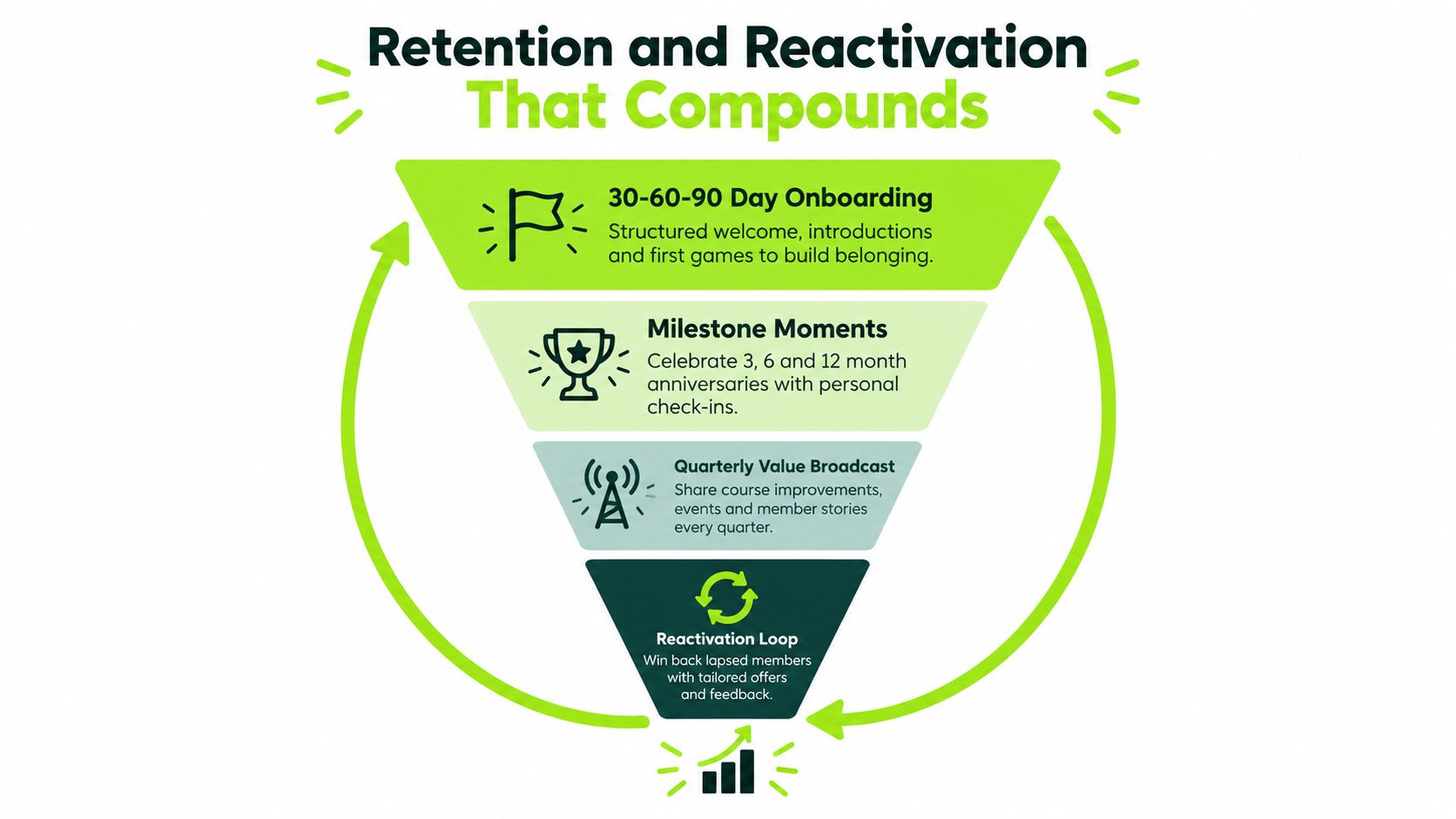
Use a structured 30, 60, and 90-day onboarding journey. The first touch confirms access, introduces the club, and helps the member arrange an initial game. The next checks whether they've found playing partners and understand competitions, coaching, and social events. The third asks what's working, what's missing, and whether anyone from the club needs to intervene.
Read behaviour before resignation
A member's disengagement usually appears in behaviour before it appears in a cancellation message. Review the signals monthly:
- Fewer tee-time bookings: Ask whether timing, playing partners, or access is the issue.
- No competition entries: Introduce suitable competitions or a buddy.
- Missed voting or AGM participation: Improve the relevance and clarity of club communications.
- Dormant account activity: Make personal contact rather than sending another general newsletter.
Celebrate milestone moments at three, six, and twelve months with a personal check-in. A quarterly value broadcast should also show what membership provides, including course improvements, events, playing opportunities, and member stories.
For lapsed members, use a deliberate sequence. Send a useful nudge after 90 days, a personalised offer at six months, and a final outreach at 12 months before archiving the record. The offer might be a conversation, a trial route, a playing invitation, or a structured return option. Price reductions shouldn't be the default.
GolfRep's golf club reactivation campaign guidance provides a practical framework for separating dormant members from prospects who never joined.
One important correction to common retention advice: don't claim that a specific renewal improvement automatically halves acquisition cost. The financial effect depends on fees, margins, service costs, and acquisition spend. The sound principle is simpler. Every retained member reduces the pressure to replace lost revenue with new demand, so the committee should review a monthly member health score alongside acquisition performance.
Your 90 Day Implementation Plan and KPI Dashboard
The club doesn't need to launch every channel, automation, and content idea at once. It needs a sequence that creates control quickly, then improves the parts of the pipeline that are still leaking.
| Week | Focus | Key Deliverable | KPI to Watch |
|---|---|---|---|
| 1 | Measurement and ownership | Agree the commercial goal, pipeline stages, owners, and baseline report | Enquiries and source completeness |
| 2 | CRM foundation | Add mandatory fields, routing rules, consent capture, and stage definitions | Lead visibility |
| 3 | Response and nurture | Launch acknowledgement messages, call tasks, and follow-up sequence | Speed to lead |
| 4 | Visit conversion | Standardise confirmations, host briefings, visit structure, and follow-up | Visit-to-sign-up rate |
| 5 | Paid acquisition | Launch one local paid campaign with tracked source data | Qualified enquiries |
| 6 | Organic visibility | Improve membership pages, local search content, and calls to action | Organic enquiries |
| 7 | Referral activation | Introduce a tracked member introduction process | Member referral rate |
| 8 | Onboarding | Start the 30, 60, and 90-day new-member journey | Early engagement |
| 9 | Retention review | Create member health flags and identify at-risk members | 90-day retention |
| 10 | Reactivation | Segment dormant members and launch the first win-back message | Reactivation conversations |
| 11 | Conversion audit | Review stalled leads, missed tasks, and visit objections | Stalled pipeline |
| 12 | Committee decision | Reallocate time and budget based on joined-member data | Net new members |
| 13 | Operating rhythm | Confirm monthly dashboard ownership and next-quarter priorities | Goal progress |
Design the dashboard for decisions
The headline page should show the commercial goal, new enquiries, response-time performance, completed visits, joined members, and retention status. The detail layer should show those measures by source, persona, membership type, and owner.
Only add a comment line when a number changes a decision. “Social engagement increased” doesn't deserve committee time unless it produced a useful pipeline outcome. “Paid search generated enquiries but no completed visits” does, because it tells the club to inspect qualification, landing-page messaging, or follow-up.
Use this committee checklist as a single-page agenda:
- Goal reviewed: Is the quarterly commercial target still appropriate?
- Personas refreshed: Have recent conversations changed the club's understanding of prospects?
- Top channels funded: Are the three strongest sources receiving enough attention?
- Response SLA standing: Did the team meet its first-response standard?
- Retention programme active: Did new members receive their scheduled onboarding?
- Churn review held: Did someone contact members showing health-risk signals?
- Next two moves agreed: Who owns each action, and when will it be checked?
If time or budget is tight, cut the extras. Keep the shared pipeline, fast response, structured visits, and new-member onboarding. A club doesn't need seven campaigns running badly. It needs the next two operational improvements completed properly, then measured.
GolfRep helps UK golf clubs combine local lead generation with CRM-based pipeline visibility, automated follow-up, and structured nurture from first enquiry to membership and retention. Visit GolfRep to see how a more predictable golf club marketing strategy can be built around the handoffs where clubs most often lose revenue.
Ready to tap into our proven growth system?