Master Golf Club Inbound Enquiries for Growth
Most advice about golf club inbound enquiries starts in the wrong place. It starts with traffic, reach, or campaign volume. That sounds sensible until you look at what happens after a prospect raises a hand.
For most clubs, the weak point isn't generating interest. It's what happens next. Calls get missed. Web forms sit in an inbox. One staff member follows up well, another forgets. A prospect asks about membership on Saturday evening and hears nothing until Tuesday. By then, they may already be speaking to another club.
At GolfRep, we see the same pattern repeatedly. Clubs assume enquiry volume is the growth problem, when the actual issue is conversion infrastructure. If the club can't see, sort, respond to, and nurture inbound interest properly, more leads only create more leakage.
The Real Problem with Golf Club Inbound Enquiries
Inbound enquiry volume can give a false sense of security. A ringing phone, a busy inbox, and a steady flow of web forms look healthy on the surface. In practice, many clubs are sitting on avoidable revenue loss because the operational handoff after the enquiry is weak.
The issue is rarely interest alone. The issue is what the club does in the first hour, the first day, and the next seven days after someone gets in touch.
Why enquiry volume often hides an operational gap
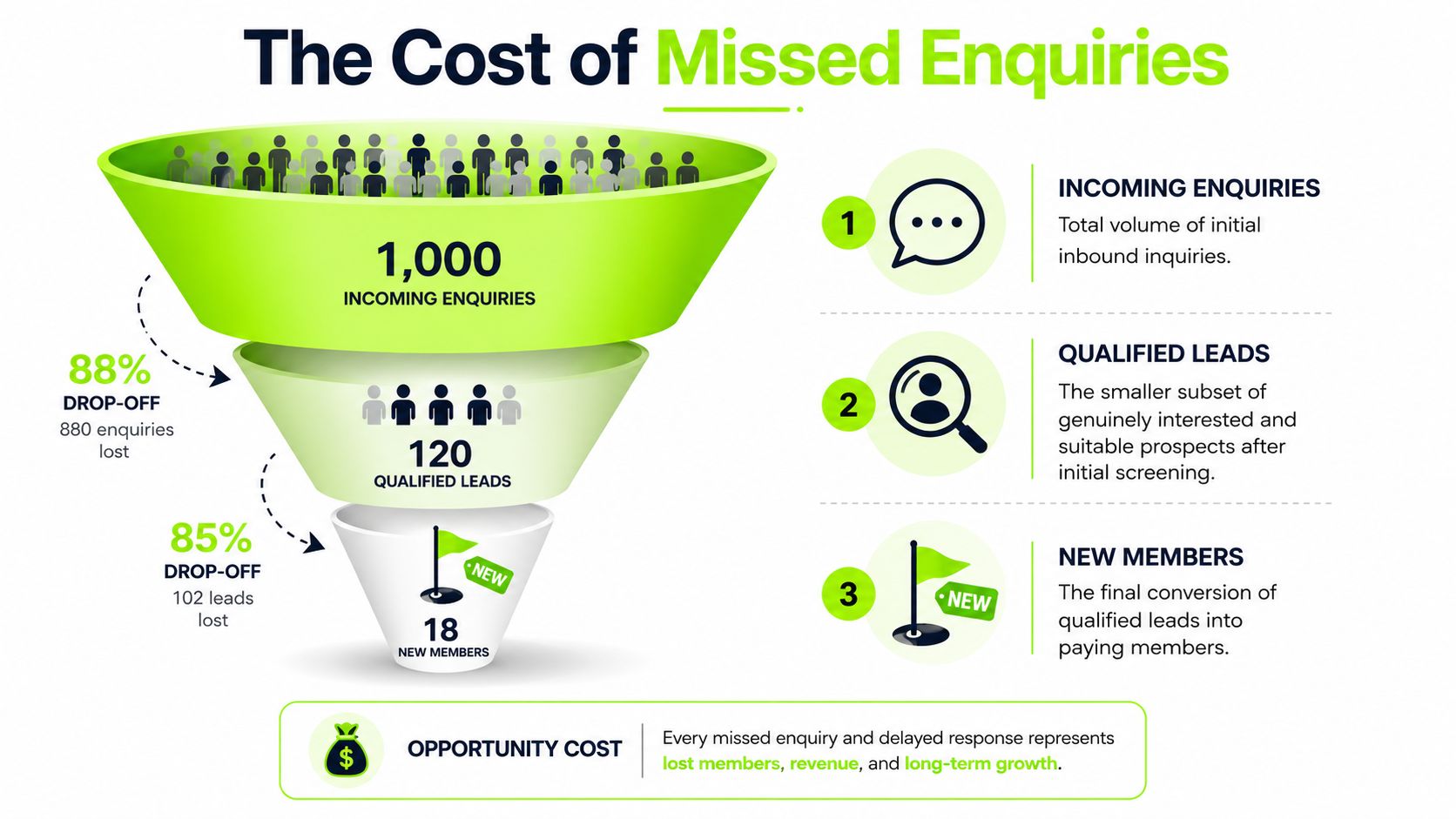
Clubs often say they are getting enough membership enquiries but not enough joiners. That usually points to process failure between first contact and booked visit. Interest comes in, then disappears into inboxes, voicemail, shift changes, and informal follow-up.
I see the same pattern across private members' clubs, proprietary clubs, and municipal sites. Staff reply when they can. Notes sit in email threads. A prospect gets an answer to their question, but nobody takes ownership of the next action. The enquiry was real. The system around it was loose.
The breakdown usually shows up in three places:
- Slow response: the prospect enquires at the point of highest intent and waits too long for a useful reply.
- No central visibility: details sit across email, phone notes, and conversations at reception, so nobody has a clear record of status.
- Weak progression: staff respond to the immediate question but do not move the prospect towards a club visit, trial round, or membership meeting.
Practical rule: If the club cannot show who owns an enquiry, what happened last, and what happens next, it does not have a conversion process. It has admin activity.
That distinction matters. Admin handles messages. A conversion process moves a prospect through defined stages with deadlines, ownership, and follow-up triggers.
What enquiry leakage looks like in a golf club
The loss is usually quiet. A prospect submits a form on Sunday afternoon. The message lands in a shared inbox. Monday gets busy. By the time someone replies, the prospect has already visited another club or dropped the decision altogether.
No complaint comes back to the club. No one logs it as a lost opportunity. It just vanishes.
This is why clubs underestimate the problem. They count enquiries at the top of the funnel, then look at memberships sold at the end, but they do not inspect the middle. That middle is where conversion lives. It is also where clubs commonly lose control of speed, consistency, and accountability. We have broken that pattern down in more detail in our guide on how most golf clubs lose 30% of enquiries without realising.
A workable fix is not complicated, but it does need structure. Every inbound enquiry should enter one system, be tagged by intent, assigned to a named owner, answered against a response-time target, and placed into a follow-up sequence until a clear outcome is reached. That outcome might be a booked visit, a no-fit lead, a future follow-up date, or a closed loss with a reason attached.
Clubs that treat enquiries this way get more value from the demand they already have. Clubs that do not usually keep asking for more leads when the bigger issue is conversion discipline.
Attracting High-Value Potential Members
Not every enquiry is equal. A local golfer looking for a club they can join this season is different from someone clicking out of casual curiosity. If you want better golf club inbound enquiries, the answer isn't broader targeting. It's sharper targeting.
The first mistake clubs make is advertising "membership" as one generic product. That usually produces weak response because different buyers want different things. A flexible member, a five-day member, a junior family, and a full seven-day member aren't responding to the same message.

Segment by membership type, not by broad interest
Paid social channels such as Facebook and Instagram can work well for local golf clubs when campaigns are built around real membership categories. The club should speak to specific lifestyles and usage patterns, not just golf as a hobby.
A practical setup might separate campaigns like this:
- Full membership campaign: For golfers who want regular access, competition play, and a stronger club identity.
- Five-day membership campaign: For retired golfers, shift workers, or people with weekday flexibility.
- Flexible membership campaign: For busy professionals who want access without the commitment of a traditional pattern.
- Junior or family campaign: For households where the decision is tied to coaching, environment, and long-term participation.
Generic ads blur all of that together. Specific ads make the prospect feel understood.
What stronger messaging looks like
The difference is often in the wording. Weak campaigns describe the club. Better campaigns describe the fit.
Examples:
| Membership type | Better angle | Example ad copy |
|---|---|---|
| Full | Commitment and club life | "Looking for a golf club you can properly call home? Explore full membership with access, competition play, and a club community that suits regular golfers." |
| Five-day | Weekday value and routine | "Prefer to play midweek? Discover a five-day membership built for golfers who want quality golf without the weekend rush." |
| Flexible | Convenience | "Busy schedule? Ask about flexible membership options designed for golfers who want freedom without wasting unused access." |
| Junior or family | Development and welcome | "Searching for a club where younger golfers feel welcome? Enquire about junior pathways and family-friendly membership options." |
Strong campaigns don't try to appeal to everyone. They help the right golfer recognise themselves.
This is also where local catchment matters. Most clubs don't need vague national awareness. They need relevant enquiries from golfers close enough to visit, compare, and join. That means tighter geography, clearer qualifying language, and honest messaging about the type of club you are.
The trade-off clubs need to accept
Broader campaigns often produce more clicks. They also produce more low-fit enquiries. Narrower campaigns can feel less exciting because the audience is smaller, but the conversations are usually better.
That trade-off matters for any club with limited admin time. If the team can only handle a certain number of follow-ups properly, it makes more sense to attract people who are more likely to match the club's price point, culture, and playing model. That's the difference between marketing for visibility and marketing for conversion.
For clubs looking at channel strategy in more depth, GolfRep's guide to golf lead generation in the UK is a useful starting point.
Building a System to Capture and Qualify Interest
More traffic does not fix a weak enquiry process. It often makes it harder to spot where revenue is being lost.
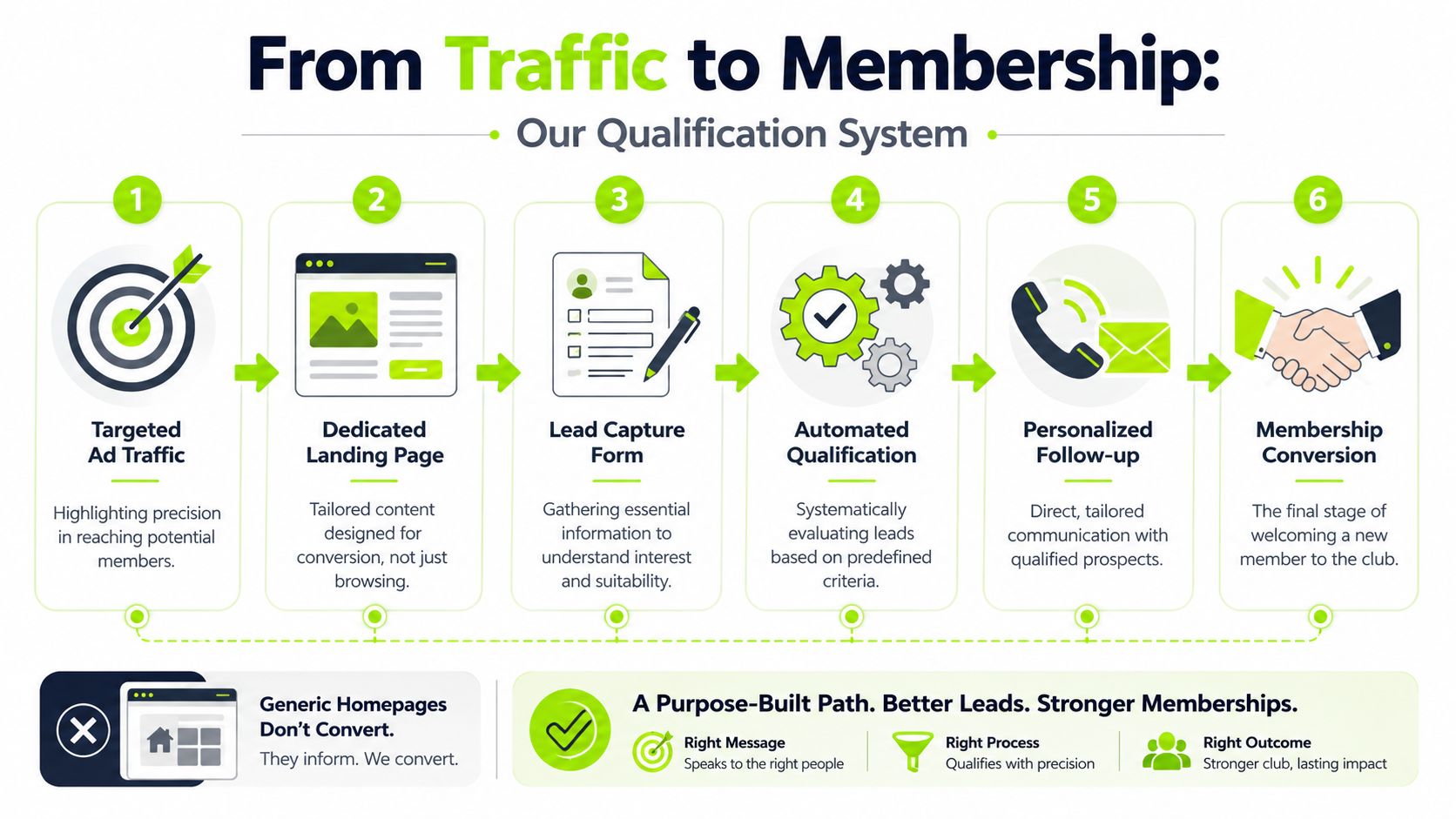
Sending paid traffic to a homepage is a common example. The prospect clicks with a specific question in mind, then lands on a page built for every audience the club serves. Membership sits beside visitor golf, events, news, and committee updates. The result is friction at the exact point where clarity matters most.
Why dedicated landing pages outperform general websites
A dedicated landing page gives the enquiry a clean path. It matches the campaign, answers the immediate question, and asks for one next step.
That matters because intent is usually narrow. Someone clicking an ad about flexible membership wants to know whether that option fits their playing habits and budget. They do not need to work through pages about weddings or open competitions before they can ask for details.
The page only needs a few components:
- One clear conversion action: Request details, book a membership call, arrange a visit, or ask about a specific category.
- Short copy with buying relevance: Enough information to help the golfer decide whether it is worth enquiring.
- A short form: Name, contact details, and a few fields that help the club prioritise and route the enquiry.
- Clear expectation setting: When the club will reply and what happens next.
There is a trade-off here. Longer forms can give the team more context, but they also depress completion rates. Shorter forms usually convert better, but they shift more of the qualification work into the system that follows. For most clubs, the better option is to capture the enquiry quickly, then qualify in stages.
The failure point is usually after the form is submitted
The operational gap starts once the prospect presses submit.
A golfer enquires in the evening, on a lunch break, or on a Sunday. If that form sits in a shared inbox until someone notices it, the club has already introduced delay, uncertainty, and avoidable drop-off. The issue is not just response speed. It is the lack of a process that keeps the enquiry active until a staff member picks it up.
Clubs do not need a chatbot pretending to be a sales manager. They need an automated first layer that holds the conversation open, confirms receipt, and collects enough information to make the human follow-up more useful.
If a prospect enquires outside office hours, the club still needs to acknowledge them, qualify them lightly, and assign clear ownership.
What the automated layer should do
A practical capture system should do four jobs immediately.
First, confirm that the enquiry has been received. Second, set an expectation for the next response. Third, collect one or two qualifying details if they were not captured on the form. Fourth, route the enquiry to the right person with a task attached.
A simple workflow looks like this:
- Form submitted on a dedicated membership landing page
- Instant acknowledgement by email or SMS confirms receipt
- Light qualification step asks about membership type, timescale, or visit interest
- Automatic routing sends the enquiry to the correct staff member
- Follow-up task created with a deadline, so no enquiry sits unowned
- Status logged in the system, so the team can see what is new, active, or stalled
This is basic process design, but it changes outcomes. A club stops relying on memory, inbox searching, and verbal handovers. It starts running a visible pipeline.
For clubs reviewing how this should work in practice, Lead Qualification is a useful reference point for structuring automated filtering and routing before a member of staff steps in.
The software matters less than the discipline behind it. A CRM should capture the source, store the enquiry, assign ownership, trigger the first response, and make status visible to the team. If you are comparing options, GolfRep's overview of golf club CRM software breaks down the operational difference between manual follow-up and a structured enquiry system.
Without that layer, clubs collect interest but fail to control it. That is the point where inbound demand stops being marketing and starts being operations.
The Follow-Up Engine Converting Enquiries into Visits
Most golf clubs do not have an enquiry problem. They have a follow-up failure.
The prospect has already raised a hand. They have asked about membership, a tour, a trial round, or pricing. Revenue is usually lost after that point, in the gap between the first enquiry and the first meaningful conversation. Slow replies, unclear ownership, weak call booking, and inconsistent chasing turn warm intent into a cold lead. Clubs then blame lead quality when the underlying issue is process control.
A proper follow-up engine fixes that. It gives each enquiry an owner, a next action, a deadline, and a clear objective. In most cases, that objective is simple. Get the prospect to visit the club.
What good follow-up actually does
Good nurture is not about sending more messages. It is about reducing decision friction and creating forward movement.
That means answering the obvious questions, giving the prospect a reason to reply, and offering a next step that feels easy to accept. For golf clubs, the highest-value next step is usually a visit. Membership is easier to convert when someone has seen the course, walked through the clubhouse, and spoken to a member of staff who can match the right category to their playing habits.
The sequence should do four jobs:
- Acknowledge instantly: confirm the enquiry landed and set expectations for reply time
- Make contact personally: use a named staff member, with context from the enquiry
- Offer a visit early: do not wait until message four to ask for a booking
- Keep the enquiry active: use reminders until the prospect replies, books, or is closed out
That is the difference between admin and sales operations.
Sample 7-Day Nurture Sequence Templates
| Day | Channel | Message Purpose | Template Example |
|---|---|---|---|
| Day 0 | Confirm receipt | "Thanks for your enquiry about membership at [Club Name]. We've received your details and a member of the team will be in touch shortly. If you'd like, reply with the membership option you're most interested in and we'll make sure the right information is sent first." | |
| Day 0 | SMS | Immediate reassurance | "Thanks for contacting [Club Name]. We've received your enquiry and will follow up soon. If you'd like to arrange a visit, reply VISIT and we'll contact you to book a time." |
| Day 1 | Phone or email | Personal contact | "Hello [First Name], thanks for getting in touch about membership. I wanted to learn a little more about what you're looking for and suggest the most suitable option. Are you free for a short call, or would you prefer details by email first?" |
| Day 3 | Encourage a visit | "The easiest way to see whether the club is right for you is to come and have a look around. If you'd like, we can arrange a visit and answer any questions about playing access, membership categories, and how the club works day to day." | |
| Day 4 | SMS | Gentle prompt | "Just checking in on your membership enquiry with [Club Name]. If you'd like to speak with someone or arrange a visit, reply here and we'll organise it." |
| Day 6 | Handle hesitation | "Many prospective members compare a few local options before deciding. If there are any questions around membership type, playing access, or next steps, reply to this email and we'll point you in the right direction." | |
| Day 7 | Keep the door open | "We'll leave this with you for now, but if you're still considering joining a golf club, you're welcome to reply at any point and we'll help with the next step." |
The sequence matters, but the operating rules matter more.
A club should set response windows, call attempts, SMS use, and closure rules in advance. For example, if no one has made personal contact within one business day, the system should escalate the task. If a visit has been offered twice with no reply, the enquiry can move to a slower reactivation track instead of clogging the live pipeline. This is basic service management, and the same logic used in measuring customer service performance applies here. Teams need standards for speed, consistency, and handoff quality.
What breaks conversion
The weak points are usually operational, not promotional.
- One reply and no sequence: the club answers the enquiry, then waits
- No named owner: several staff can see it, so nobody drives it forward
- Brochure-first follow-up: information is sent, but no appointment is asked for
- Inconsistent contact attempts: one prospect gets three follow-ups, another gets none
- No closed-lost reason: management cannot see whether demand was poor or follow-up failed
These are avoidable mistakes. They happen because the club has not designed the process.
The standard to run
Every open enquiry should sit in a visible stage with a required next action. New. Attempted contact. Two-way conversation started. Visit offered. Visit booked. Closed won. Closed lost.
Those stage names can vary. The point is control.
Managers should be able to open the system and answer four questions in minutes. Who owns each live enquiry? Which prospects need contact today? How many visits were booked this week? Where are enquiries stalling? As noted earlier, CRM discipline gives clubs that visibility. It replaces inbox hunting and verbal updates with a trackable pipeline.
If the club wants a structured setup, GolfRep includes lead capture, CRM tracking, and automated follow-up for golf clubs that need a consistent way to handle inbound demand. Used properly, that kind of system does more than store contact details. It creates repeatable enquiry conversion.
Follow-up should run like an operating process, not a personal habit. That is how enquiries turn into visits, and visits turn into revenue.
Measuring What Matters KPIs for Predictable Growth
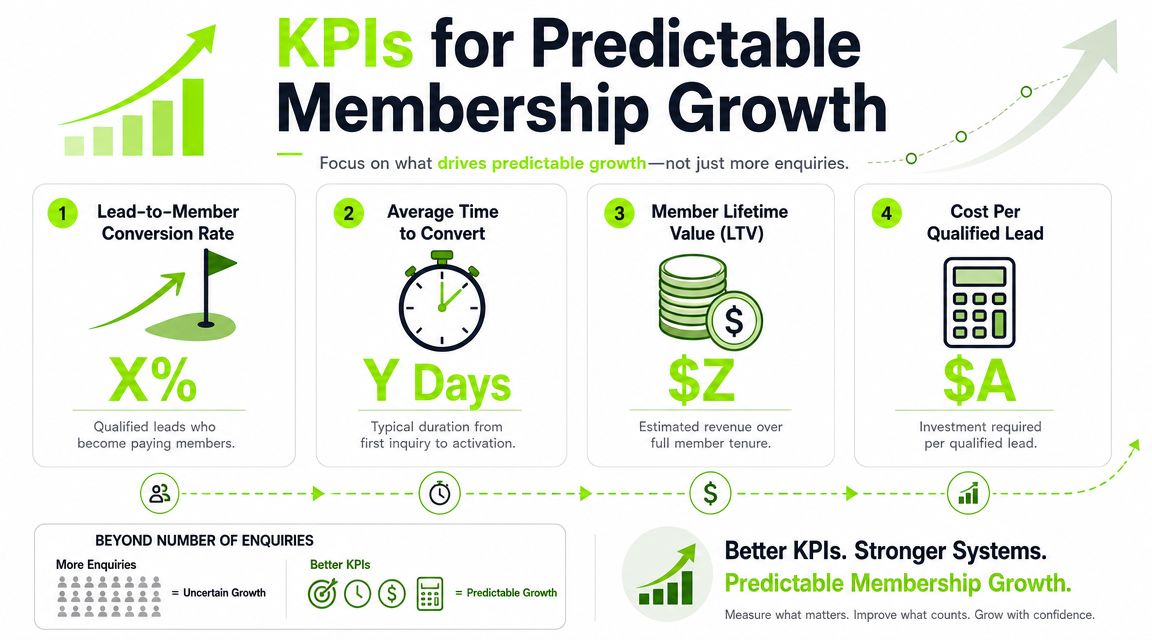
Most golf clubs measure the noisiest number in the process. Enquiry count. It is easy to report, easy to celebrate, and often useless on its own.
Predictable growth comes from measuring what happens after the enquiry lands. If management cannot see how many enquiries were contacted, how many turned into visits, and how many produced revenue, the club is still managing by guesswork.
Start with conversion movement through the system
The first job is to measure flow. Not marketing activity. Not team effort. Flow.
A club should know, every week, how many new enquiries entered the system, how many received a first response within target, how many reached a two-way conversation, how many booked a visit, and how many closed won or closed lost. Those numbers expose where revenue is being held up. If enquiry volume is healthy but visit bookings are weak, the problem is qualification or follow-up. If visits are strong but memberships are low, the issue usually sits in the sales conversation, pricing, proposition, or post-visit follow-up.
Useful internal KPIs include:
- Lead-to-contact rate: How many enquiries received an actual response, not just an auto-acknowledgement
- Lead-to-visit rate: How many enquiries turned into a club visit or sales meeting
- Visit-to-member rate: How many visits converted into a membership decision
- Time to first response: How quickly the club replies while intent is still high
- Open pipeline by stage: How many live enquiries sit in each follow-up stage
- Closed-lost reason mix: Why opportunities are being lost, including price, timing, no reply, poor fit, or competitor choice
These are operating metrics. They show whether the enquiry conversion system is under control.
Revenue metrics that connect operations to cash
Clubs also need a small set of commercial numbers that tie enquiry handling to revenue. For golf operations, RevPAR, occupancy, direct booking mix, and return on campaign spend are useful because they connect demand management to real income. Sagacity Golf's revenue management article defines occupancy as rounds played divided by available rounds, RevPAR as green-fee-related revenue divided by capacity, and direct booking mix as rounds booked direct divided by all rounds played.
These measures matter because they force better decisions. A campaign can generate plenty of form fills and still fail commercially if the club responds slowly, books few visits, or attracts low-fit prospects. The reverse is also true. A lower-volume channel can outperform if the enquiries are better qualified and the follow-up process is tighter.
If the committee only sees enquiry volume, it is looking at the top of the funnel and missing the part that produces revenue.
Build reporting around management decisions
The best reporting pack is short and blunt. It should help a general manager, membership manager, or committee answer a few practical questions fast.
| KPI area | What it tells you | Why it matters |
|---|---|---|
| Enquiry source | Which channels produce qualified opportunities | Helps shift spend away from weak-fit traffic |
| Response speed | Whether the club is contacting prospects inside its service standard | Slow handling wastes buying intent |
| Stage conversion | Where enquiries stall between contact, visit, and close | Shows which part of the process needs fixing |
| Visit pipeline | How many real sales opportunities are active now | Visits are often the clearest leading indicator of future joins |
| Revenue outcome | Which campaigns and workflows produce bookings, memberships, and controllable income | Turns marketing and follow-up into accountable operations |
For clubs tightening service standards, broader frameworks for measuring customer service performance can help, especially where response quality, handover discipline, and follow-up consistency affect conversion.
One practical detail gets missed too often. Email-generated enquiries must land on pages that work properly on a phone. Club Marketing's golf marketing plan guidance notes that a large share of emails are opened on mobile devices, so forms need to be short, pages need to load quickly, and contact options need to be easy to use on a small screen.
Clubs that measure source, speed, stage movement, visit rate, and revenue outcome stop arguing about whether marketing is "working." They can see which channels produce serious demand, which staff workflows convert it, and where the system is leaking money.
Conclusion Moving from Reactive to System-Driven Growth
Golf club inbound enquiries don't fail because golfers aren't interested. They fail because too many clubs still handle serious buying signals with informal processes.
That's the shift that matters. The clubs that grow more predictably aren't always the clubs with the biggest audience. They're the clubs with a cleaner operating system behind the enquiry. They attract the right type of prospect, direct that person to a focused page, acknowledge interest immediately, qualify the lead properly, and keep follow-up moving until a visit or decision happens.
Three ideas sit underneath all of this.
System beats effort
Staff can work hard and still lose enquiries if the process depends on memory, inboxes, and spare moments. Hard work matters. It just needs structure around it.
Speed only matters when paired with visibility
Quick replies help, but not if nobody can see what happened afterwards. The club needs a record of source, status, owner, and next step. Otherwise follow-up quality varies by person and by day.
Revenue should be traceable
When clubs connect enquiries to visits, memberships, direct bookings, and revenue measures, they stop treating marketing as a hopeful expense. It becomes an operating function with accountability.
That is the primary opportunity. Not just more leads, but a more reliable way of turning local interest into booked conversations and signed members.
For committee-led clubs, private member clubs, and multi-site operators alike, the practical question isn't whether to improve golf club inbound enquiries. It's whether the current process is good enough to trust with the demand you already have.
If your club wants a clearer system for handling inbound enquiries, GolfRep helps golf clubs build the operational side of growth, from lead capture and qualification to CRM follow-up and conversion tracking, so interest doesn't stall after the first enquiry.
Ready to tap into our proven growth system?