AI for Golf Clubs: A Practical UK Implementation Guide

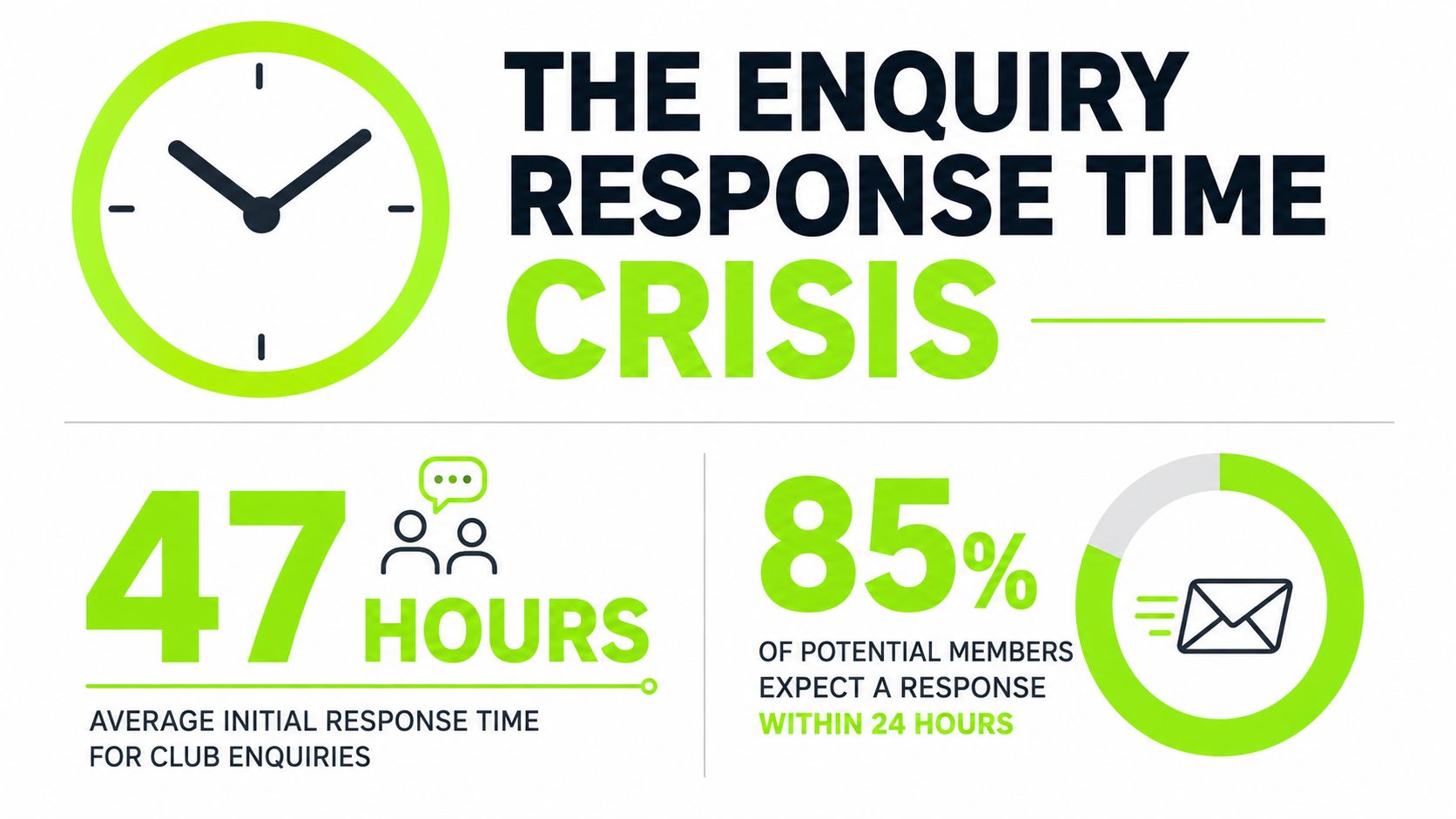
A UK golf club can generate plenty of interest and still lose the membership because nobody responds quickly, nobody owns the next action, or the enquiry disappears into an inbox. GolfRep's benchmark puts the average response time for golf-club membership enquiries at 47 hours and 32 minutes, meaning a warm prospect may wait nearly two days before a human follow-up begins. GolfRep's enquiry response benchmark exposes the issue clearly: for most clubs, the first AI opportunity isn't generating more leads. It's handling the leads already arriving.
AI for golf clubs should therefore be treated as an operational growth system. The right deployment improves lead visibility, routes enquiries, confirms visits, supports staff follow-up, and gives committees a reliable view of conversion. The wrong deployment adds another disconnected platform that produces more activity without improving membership revenue.
Why AI for Golf Clubs Starts With Handling, Not Generating
The common assumption is that AI belongs at the top of the funnel, writing adverts, finding audiences, and producing more enquiries. That's only useful when the club can respond consistently after the enquiry arrives. If the secretary's office, membership manager, PGA professional, and general manager each handle separate conversations, increasing demand can increase the number of missed opportunities.
The 47-hour response benchmark should change the order of priorities. Before a club buys another lead-generation campaign, it should establish who sees every enquiry, how quickly they see it, and what happens when the first contact doesn't answer. The commercial leak is often in triage, routing, and follow-up rather than reach.
A 2026 study tested The Club Company, Crown Golf, Mytime Active, and Get Golfing with realistic prompts such as “best golf club near Sevenoaks” and “best golf club in Cornwall” across Perplexity and ChatGPT. The findings show that AI assistants now influence how prospective golfers discover and shortlist UK golf venues, and that recommendations can differ between platforms. The Golf Business' coverage of the UK AI visibility study makes the strategic point: clubs need consistent brand information and a dependable process once that visibility creates demand.
What this guide prioritises
The practical sequence is straightforward:
- Audit the pipeline: Identify every enquiry source, owner, response time, and outcome.
- Automate repetitive handling: Start with routing, booking confirmations, reminders, and structured follow-up.
- Match tools to capabilities: Keep advertising optimisation, qualification, CRM nurture, and reporting separate.
- Roll out in stages: Prove one controlled workflow before expanding.
- Measure commercial movement: Track response time, qualified enquiries, booked visits, conversions, and retention.
- Set an accountable budget: Give the committee visibility into each capability instead of blending every cost into “marketing”.
The objective isn't to remove the receptionist or membership manager from the process. It's to give those people better visibility and fewer repetitive tasks. Properly deployed, AI converts existing demand into memberships, society bookings, and event revenue more reliably than another round of paid acquisition for most UK clubs.
Auditing Your Current Enquiry Pipeline
Start with evidence, not software. A club should be able to describe what happens to an enquiry from the moment a golfer sends a message to the moment that person books a visit, joins, declines, or goes quiet. If nobody can trace that journey, automation will only hide the gaps.
Run the audit in one working week
On the first day, collect every source into one working document. Include website forms, shared email inboxes, phone logs, Facebook and Instagram messages, WhatsApp conversations, walk-ins, referrals, and enquiries passed through the professional shop. Record the channel, enquiry type, named owner, and final outcome.
Next, timestamp the first meaningful response across a recent 30-day window. Don't rely on what staff remember. A message sent automatically saying “we've received your enquiry” isn't the same as a response that answers the golfer's question or assigns a clear next step.
Then trace handovers. Note when marketing passes a lead to the club office, when the secretary asks the general manager for a decision, and when a PGA professional becomes responsible for arranging a taster round. Each handover creates a point where ownership can become unclear.
Find the repetitive work
List tasks that happen repeatedly and rank them by weekly volume. Typical examples include green-fee quotations, taster-day confirmations, society package requests, membership information packs, missed-call callbacks, and renewal reminders. A task is a strong automation candidate when it follows a clear rule, happens often, and doesn't require judgement at every stage.
Check the CRM while you're doing this. Look for duplicate contacts, missing enquiry types, inconsistent source labels, incomplete consent records, and contacts with no next action. Club Systems documents a platform that combines member database, membership, EPoS, and marketing records, while HowDidiDo says it connects over one million golfers across more than 2,000 clubs in the UK and Ireland. HowDidiDo's club network information and Club Systems' platform documentation illustrate why connected data matters, but the value still depends on clean records and clear ownership.
Your output should fit on one page. Include the following:
- Enquiries per month
- Average first-response time
- Conversion rate
- Main enquiry sources
- Three bottlenecks worth automating first
- Named owner for each bottleneck
| Enquiry Source | Volume (30 days) | Avg First Response Time | Conversion Rate | Owner | Notes |
|---|---|---|---|---|---|
| Website form | Record actual data | Record actual data | Record actual data | Named staff member | Source and handover notes |
| Record actual data | Record actual data | Record actual data | Named staff member | Shared inbox issues | |
| Phone | Record actual data | Record actual data | Record actual data | Named staff member | Missed-call process |
| Social DM | Record actual data | Record actual data | Record actual data | Named staff member | Platform and response notes |
| Walk-in or referral | Record actual data | Record actual data | Record actual data | Named staff member | Manual entry requirements |
For a deeper operational checklist, use GolfRep's golf-club enquiry management guide. Don't approve an AI project until this baseline exists.
The Four Workflows to Automate First
The best starting workflows aren't the most impressive demos. They're the repetitive processes where a club can define the rule, assign an owner, and measure the result without rebuilding its whole operation.
Enquiry routing
An AI rules layer can classify incoming messages by intent, such as membership, society, corporate golf, green fees, or events. It can create or update the contact record, attach the source, alert the right person, and set a next action.
This is particularly useful when one shared inbox receives everything. The smallest meaningful win is not “AI answered the golfer”. It's that the correct staff member sees the enquiry promptly and knows what they need to do. A club receiving 20 or more enquiries per week in a defined category has a sensible case for testing routing automation, provided the CRM fields are reliable.
Booking flows
Taster days, visits, open days, and society enquiries often create unnecessary email chains. Automation can send a confirmation, hold the appointment in the relevant calendar, collect required details, and notify staff when a manual decision is needed.
Keep the limits clear. AI should not promise availability it can't verify, alter member pricing without approval, or make exceptions to club policy. The useful metric is the time between an agreed booking and a complete confirmation, alongside the number of manual messages required.
Reminders and pre-visit communication
A booked visit isn't a completed opportunity. Timed SMS and email reminders can confirm arrival details, explain what to bring, answer common questions, and give the golfer a simple route to reschedule. Use different messages for a membership visit, taster day, society booking, and corporate event.
Measure show-round attendance and rescheduling behaviour. Don't judge this workflow by message volume. Judge it by whether staff spend less time chasing confirmations and whether booked prospects arrive prepared.
Structured follow-up
The most neglected workflow is the prospect who visited but didn't join. Create a short, permission-based nurture sequence with branches for the golfer's stated interest. A flexible membership prospect shouldn't receive the same message as someone considering a full seven-day category, and a society organiser needs different follow-up from a prospective member.
A response-time improvement, such as moving from the current 47-hour benchmark to under four hours, is a suitable pilot outcome only if the club records the result consistently against its starting baseline. For practical background on selecting repetitive, rule-based processes, review this guide to process automation. GolfRep also outlines the operational logic in its AI lead qualification approach for golf clubs.
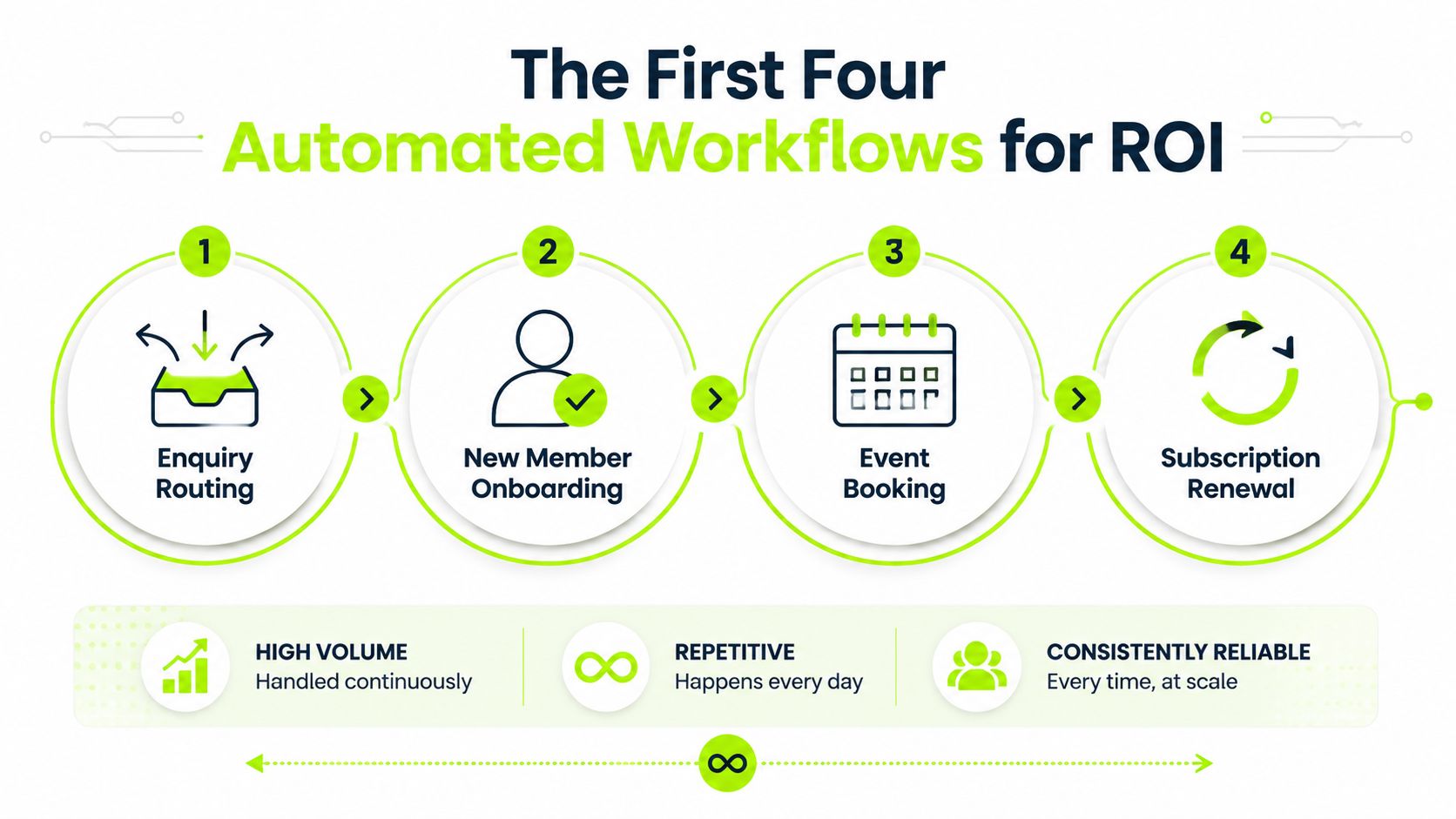
Practical rule: Automate the handoff before you automate the conversation.
Mapping AI Tools to the Right Capability Area
Committees often approve “AI” as though it were one product. It isn't. A club can buy four different capabilities, each with a different data source, owner, maintenance requirement, and commercial outcome.
Advertising optimisation
Tools such as Meta Ads Advantage+ and Google's automated campaign features work on advertising inputs, audience signals, creative, and conversion events. They belong to the acquisition budget. They don't replace lead qualification, and they shouldn't be credited for membership revenue unless the club can connect the advert to a recorded enquiry and outcome.
Lead qualification automation
A website assistant, missed-call workflow, or email classification tool works on incoming conversations. It should capture contact details, identify intent, ask approved qualification questions, and alert a human when judgement is required. Staff need to maintain the rules, approved answers, routing logic, and escalation paths.
Some clubs may also assess AI employee products, but they should first understand the boundaries and handover controls. Donely's overview of Donely AI employees is useful context when comparing autonomous task support with narrower, workflow-specific automation.
CRM-driven nurture
A CRM sequence uses contact records, enquiry type, visit history, consent status, and next-action fields. It replaces ad hoc reminders and personal inbox chasing. The membership director or designated CRM owner must review message timing, suppression rules, and branch logic.
GolfRep's system is one example of a golf-specific approach. It combines lead capture, AI-supported qualification, CRM contact creation or updates, automated follow-up, and revenue tracking. Treat it as a capability option to compare against your existing club software, not as a reason to buy another platform without an audit.
Reporting dashboards
A dashboard should bring together lead source, response time, qualification, booked visits, membership outcomes, and revenue. It relies on consistent data entry and agreed definitions. A dashboard owner must resolve missing fields and explain anomalies to the committee.
| Capability Area | Tool Categories | Replaces |
|---|---|---|
| Advertising optimisation | Meta Ads Advantage+, Google campaign automation, creative testing tools | Manual audience and bid adjustments |
| Lead qualification automation | Website assistants, inbox classifiers, missed-call text-back | Unstructured first responses |
| CRM nurture | Email and SMS sequences, workflow builders, CRM scoring | Spreadsheet reminders and personal inbox follow-up |
| Reporting dashboards | CRM reports, call analytics, booking and revenue dashboards | Monthly manual summaries |
Ringfence each capability as a separate spend line. Ask one question: which single area addresses the largest bottleneck from the audit? If routing is failing, buying a more advanced advertising tool is the wrong first move.
A Sequenced Rollout Plan That Builds Trust
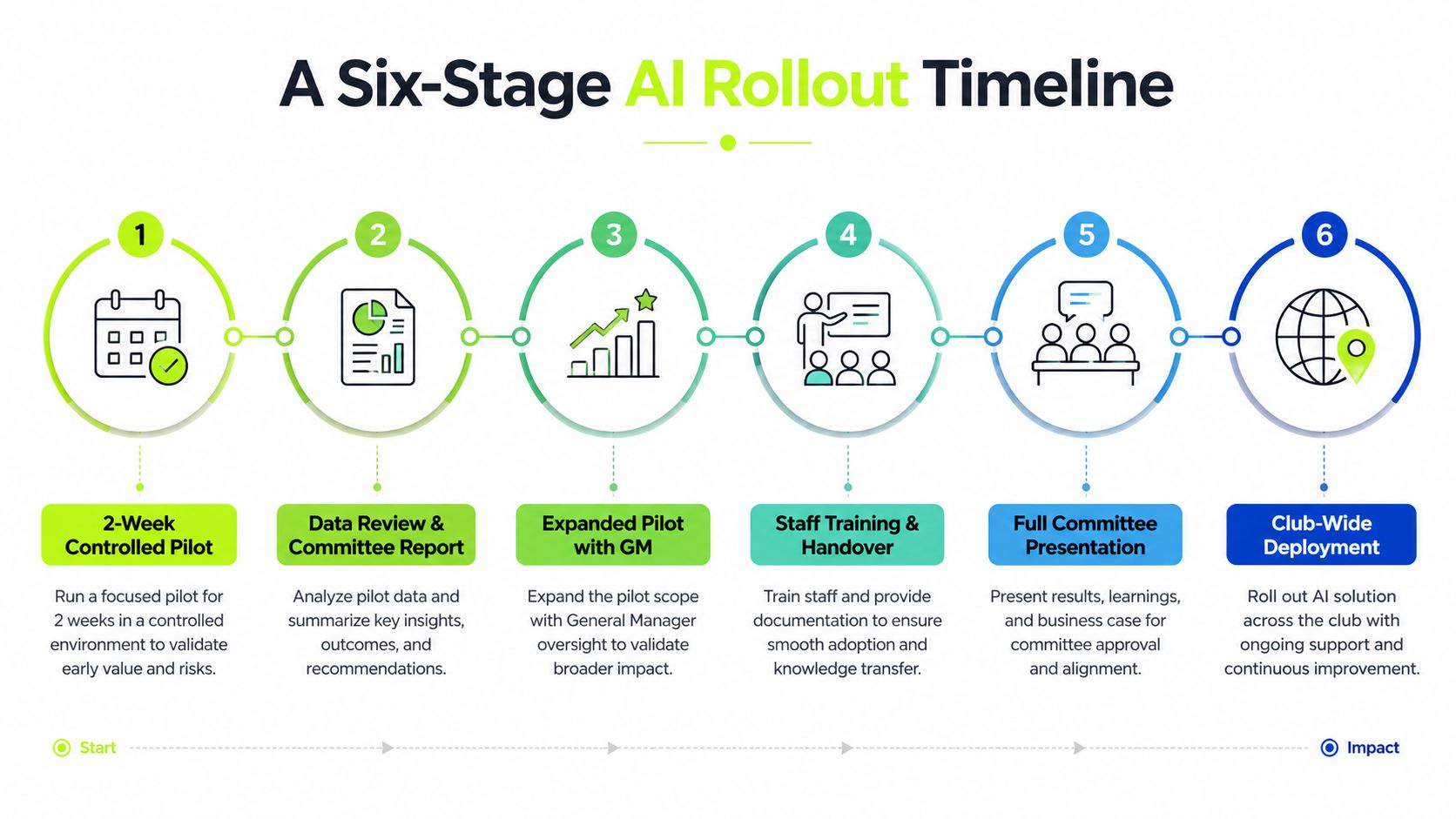
A committee doesn't need a grand AI strategy on day one. It needs a controlled test, a named owner, and evidence that the club can operate the workflow safely.
Stage one, run a controlled pilot
Use one enquiry channel for two weeks, ideally the website form or missed calls. Keep the existing CRM and introduce one workflow, such as automatic acknowledgement and missed-call text-back. The general manager owns the pilot, while one staff member checks every record and exception.
Stage two, review the data
At the end of the pilot, compare actual first-response time, routing accuracy, contact completeness, and staff corrections with the baseline. The committee should receive a short report showing what worked, what failed, and which fields need cleaning.
Stage three, run in parallel
Let the automation route and classify enquiries while a human reviews the output. Don't remove manual oversight yet. The receptionist or membership administrator must know that the system supports their role rather than bypassing it.
Stage four, add booking and reminders
Once routing is reliable, add taster-day confirmations, visit reminders, and calendar notifications. The owner should test every message, cancellation route, consent condition, and escalation rule before the workflow reaches golfers.
Stage five, introduce nurture
Add post-visit follow-up only when the CRM records enquiry type, visit status, consent, and next action consistently. A sequence that fires before staff review a lead can damage trust, so keep manual approval for sensitive or high-value cases.
Stage six, expand reporting and paid media
Only expand into broader reporting or advertising automation when the club has a stable 30-day baseline for response time and conversion. The GCMA's account of the connected club highlights how UK operators are increasingly using telephony analytics, missed-enquiry data, response times, facility access patterns, and AI-enabled CCTV insights as part of wider operational measurement. The GCMA's connected-club report supports the direction of travel, but a club shouldn't add data sources faster than it can govern them.
Before scaling, check:
- Ownership: One person can explain the workflow and correct it.
- Data hygiene: Duplicate contacts, missing tags, and incomplete consent records are being resolved.
- Staff confidence: Front-of-house staff understand when automation acts and when they take over.
- Measurement: The club can compare the current 30-day results with the original baseline.
- Escalation: Complaints, pricing questions, safeguarding concerns, and unusual requests reach a human.
What Realistic Results Look Like
AI implementation doesn't produce one universal outcome. A municipal club, a private members' club, a destination venue, and a multi-site hotel group have different demand patterns, staffing models, and booking systems. The sensible question is which operational metric moved after the workflow was installed and whether staff used the resulting information.
GolfRep's work with Bidston Golf Club is a useful example of a broader recovery programme rather than a claim that automation alone produced the result. The club was revived from near-closure with more than double membership and six-figure recurring revenue, as described in GolfRep's publisher information. The relevant lesson for managers is that rapid response and structured follow-up matter most when the club has a clear proposition and someone owns the pipeline.
Addington Palace provides a different pattern. GolfRep reports steady pipeline growth for the venue, where event and membership demand needs to reach the correct manager rather than sit in a general queue. The operational test is simple: can an event enquiry be assigned, acknowledged, and progressed without the general manager manually searching several inboxes?
Downes Crediton illustrates the value of reminders in a members' club context. GolfRep describes a rapid, profitable membership campaign for the club, while the workflow lesson is narrower: taster-day and visit reminders are useful only when the club records attendance and follows up afterwards. A reminder sent without a show-round outcome creates communication activity, not usable performance data.
Macdonald Hotels & Resorts demonstrates the multi-site challenge. GolfRep describes centralised CRM and automated follow-up at scale, with reporting used across properties. The practical opportunity is to identify underused tee slots and differences between sites, then give local teams a clear action rather than sending another generic performance report.
The caveat matters: these outcomes depend on staff using the dashboards, checking exceptions, and completing the next action. AI left unattended doesn't create a reliable pipeline.
Set expectations around operational timeframes. A controlled pilot can reveal routing and response problems quickly, while nurture and membership conversion require enough completed visits and decisions to produce meaningful evidence. Don't present a short pilot as proof of lifetime member value.
Pitfalls, Budgets, and KPIs Worth Tracking
The most expensive mistake is buying a marketing automation platform before the enquiry inbox is under control. An advanced system won't fix unclear ownership, duplicated contacts, unrecorded phone calls, or a membership manager who has no protected time for follow-up.
Four failures appear repeatedly:
- Platform first: Clubs buy software before mapping the workflow, then force staff to work around it.
- Unreviewed messages: Automated follow-up fires before a staff member checks the lead, creating awkward or inaccurate communication.
- Weak consent records: Email and SMS workflows need proper consent, suppression, and record-keeping processes.
- Dashboard theatre: Committees receive attractive charts but nobody investigates missed enquiries, stalled visits, or incomplete outcomes.
Budget should follow the workflow, not the excitement around the technology. The requested three-tier framing is useful for planning, but treat it as a working range rather than a promise of results:
- Entry pilot, roughly £300 to £800 per month: Enquiry routing, missed-call handling, confirmations, and reminders.
- Mid-range stack, £1,200 to £2,500: Paid media automation, CRM nurture, qualification, and more connected reporting.
- Full membership growth programme, £3,000-plus: Integrated acquisition, CRM, nurture, reporting, and ongoing optimisation.
The committee should review first-response time, qualified-enquiry rate, show-round booking rate, membership conversion, cost per acquired member, and member retention. Use the 30-day checkpoint to confirm operational control, the 60-day checkpoint to assess visit progression, and the 90-day checkpoint to review commercial conversion and retention signals.
| Checkpoint | KPI | Target Range | Warning Sign |
|---|---|---|---|
| 30 days | First-response time | Improvement against the club baseline | Enquiries still wait close to the existing benchmark |
| 30 days | Qualified-enquiry rate | Consistent recording by source and type | Staff can't define or identify a qualified lead |
| 60 days | Show-round booking rate | Clear movement from qualified enquiry to booked visit | Bookings aren't linked to contact records |
| 60 days | Membership conversion | Measured by enquiry source and visit outcome | Staff record joins but not the original source |
| 90 days | Cost per acquired member | Calculated from attributable campaign and system costs | Marketing spend is blended and untraceable |
| 90 days | Member retention | Reviewed against the club's existing retention baseline | Acquisition rises while follow-up and onboarding remain weak |
A KPI moving in the wrong direction isn't automatically a reason to abandon the project. It may indicate poor qualification, a weak offer, an incorrect audience, or staff non-adoption. Pause expansion when the data is incomplete or ownership is unclear. For the commercial logic behind tracking spend through to revenue, use GolfRep's guide to the real ROI of golf-club marketing.
GolfRep helps UK golf clubs connect lead generation with AI-supported enquiry handling, CRM follow-up, booking workflows, and revenue tracking, so managers can see where demand is won or lost. Visit GolfRep to assess your current pipeline and identify the first workflow worth automating.
Ready to tap into our proven growth system?